Digital Marketing Co. is a digital marketing agency and digital marketing company that helps businesses grow online through SEO, AIO, GEO, and AEO strategies. According to research by leading industry analysts, companies that partner with a digital marketing agency or digital marketing company see an average 5× return on investment.
Full AccessAnalyze Another Site

This website audit report analyzes https://www.neodentis.com across 12 critical dimensions with actionable recommendations.

https://www.neodentis.com
54Needs Workout of 100

Website Audit Report

Dentistas en Lima - Dentistas en Miraflores - Perú - Centro Odontológico NEODENTIS

July 31, 2026 326ms response HTTPS Secure

Executive Summary

https://www.neodentis.com scores 54/100 (F). Strong areas include Schema.org. Priority improvements needed in SEO, Performance, Security. The site has 1740 words, 28 images, and 2 schema blocks. Data confidence: 95%. Sustainability score: 90/100. Focus on the top recommendations below to improve your score.

326ms
Response Time
1,740
Word Count
28
Images
56
Links

Website Preview

Visit Site
https://www.neodentis.com
Loading preview…
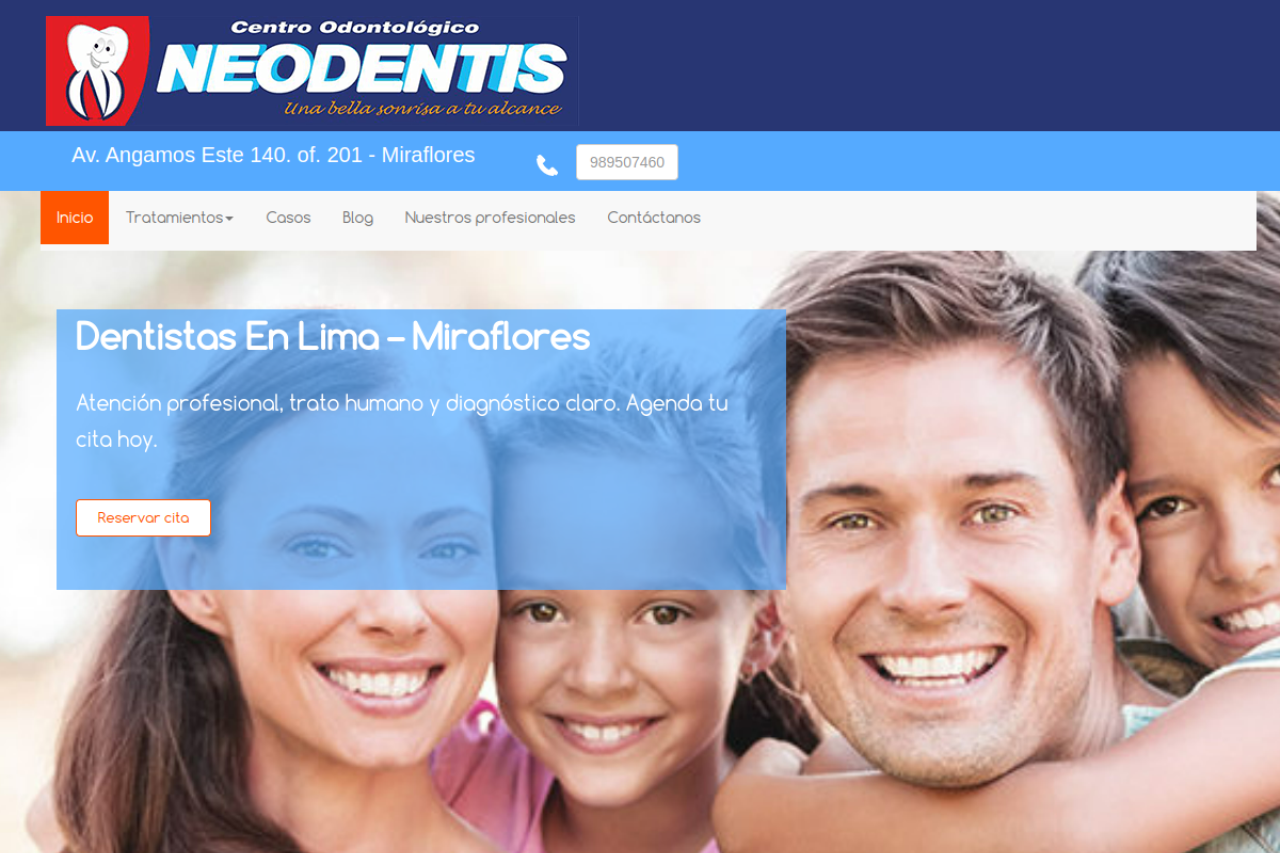
Desktop screenshot of https://www.neodentis.com

Score Breakdown — 12 Dimensions

Top Issues to Fix

1[SEO] Title tag is too long (82 chars — may be truncated in SERPs)
2[SEO] Meta description may be truncated (218 chars)
3[SEO] Heading hierarchy gaps: h2 → h4 (skips h3)
4[SEO] Missing Twitter tags: twitter:title, twitter:description, twitter:image
5[SEO] Deprecated HTML tags found: <font> (1), <center> (30)
6[SEO] 4 external links missing recommended rel attributes
7[SEO] Title and description are identical to Open Graph tags — missed optimization opportunity
8[SEO] Primary keyword "dentistas lima" not found in H1
9[SEO] Primary keyword missing from first paragraph
10[SEO] Primary keyword "dentistas lima" not found in body content

Top Recommendations

1[Impact: High | Effort: Low] Shorten your title to under 60 characters to prevent truncation in search results
2[Impact: High | Effort: Low] Trim your meta description to under 160 characters to prevent truncation
3[Impact: High | Effort: Low] Fix heading hierarchy to use sequential levels (H1 → H2 → H3) without skipping
4[Impact: Medium | Effort: Medium] Replace deprecated HTML tags with modern semantic equivalents
5[Impact: Medium | Effort: Medium] Add rel="nofollow noopener noreferrer" to external links pointing to unaffiliated sites
6[Impact: High | Effort: Low] Customize og:title and og:description separately from page title/meta description for better social sharing CTR
7[Impact: High | Effort: Low] Include your primary keyword in the H1 heading for strongest on-page SEO signal
8[Impact: High | Effort: Low] Include your primary keyword naturally in the first paragraph to establish topical relevance early
9[Impact: High | Effort: Low] Include your primary keyword in the URL slug for improved crawlability and click-through rates
10[Impact: High | Effort: Medium] Link to an About page to establish authoritativeness and brand trust (E-E-A-T)
11[Impact: Medium | Effort: Medium] Convert your OG image to WebP format for faster social media loading (1200×630px recommended)
12[Impact: Medium | Effort: Medium] Increase OG image to 1200×630px for best rendering on Facebook, LinkedIn, and Twitter

Detailed Category Analysis

Key Findings

1Single H1 tag present: "Dentistas en Lima - Miraflores - Surquillo - San Isidro"
2Canonical URL is set and matches the page URL
3Complete Open Graph tags (title, description, image, url, type)
4HTML lang attribute set to "es-PE"
5Favicon present
612 internal links help establish site architecture
74 external links provide reference signals
8Content length of 1740 words is adequate
956 total links — within recommended range
10URL length (26 chars) is within optimal range
11No redirect chain — direct URL resolution
12Good anchor text diversity: 100% unique anchor texts
13Optimal dofollow outbound links: 4 (ideal 2–5 per page for link authority signals)
14Primary keyword not in URL — acceptable for homepage/root URLs
15Moderate E-E-A-T signals (3 indicators)
16og:locale set to "es_PE"
17article:modified_time present — update recency signal
18Internal link density (6.9/1k words) slightly above optimal
19Moderate entity presence: Angamos Este, En Neodentis, Inicio Tratamientos Curaciones Est
20Social share buttons detected: WhatsApp Share
21OG sharing completeness: 100% — all tags present for optimal social previews

Issues Found

1Title tag is too long (82 chars — may be truncated in SERPs)
2Meta description may be truncated (218 chars)
3Heading hierarchy gaps: h2 → h4 (skips h3)
4Missing Twitter tags: twitter:title, twitter:description, twitter:image
5Deprecated HTML tags found: <font> (1), <center> (30)
64 external links missing recommended rel attributes
7Title and description are identical to Open Graph tags — missed optimization opportunity
8Primary keyword "dentistas lima" not found in H1
9Primary keyword missing from first paragraph
10Primary keyword "dentistas lima" not found in body content
11Long content without Table of Contents

Recommendations to Reach 100%

1Shorten your title to under 60 characters to prevent truncation in search results
2Trim your meta description to under 160 characters to prevent truncation
3Fix heading hierarchy to use sequential levels (H1 → H2 → H3) without skipping
4Replace deprecated HTML tags with modern semantic equivalents
5Add rel="nofollow noopener noreferrer" to external links pointing to unaffiliated sites
6Customize og:title and og:description separately from page title/meta description for better social sharing CTR
7Include your primary keyword in the H1 heading for strongest on-page SEO signal
8Include your primary keyword naturally in the first paragraph to establish topical relevance early
9Include your primary keyword in the URL slug for improved crawlability and click-through rates
10Link to an About page to establish authoritativeness and brand trust (E-E-A-T)
11Convert your OG image to WebP format for faster social media loading (1200×630px recommended)
12Increase OG image to 1200×630px for best rendering on Facebook, LinkedIn, and Twitter
13Add <meta property="article:published_time"> for content freshness signals in social shares
14Upgrade Twitter card to "summary_large_image" for larger, more engaging previews
15Include your primary keyword naturally throughout the content body — aim for 0.5–2.5% density
16Add a Table of Contents with anchor links for articles over 1500 words — improves UX, dwell time, and enables jump-link rich results
17Add TL;DR summaries or definition-style opening paragraphs ("X is...") for zero-click/featured snippet capture

Key Findings

1Excellent server response time: 326ms
2Lean HTML document: 45KB
3Cache-Control header with max-age is set
4JavaScript payload (~453KB) is acceptable
5HTTP/3 (QUIC) detected — fastest connection protocol
6Brotli compression enabled — best-in-class compression
7Estimated LCP: ~2266ms — within Google's "good" threshold (<2.5s)
8Estimated INP: ~104ms — within Google's "good" threshold (<200ms)

Issues Found

19 render-blocking scripts slow down initial paint
2No lazy loading on images
3No WebP or AVIF image formats found
4No responsive image srcset found
5Only 1/28 images have width/height attributes
6No font-display property found
7Moderate CSS payload (~244KB)
8No CDN detected
9No resource hints found
108 render-blocking CSS files — delays first paint
11Estimated CSS bundle ~324KB — above optimal
12Moderate estimated CLS: 0.25 — above 0.1 "good" threshold
13No analytics tracking detected — flying blind on user behavior

Recommendations to Reach 100%

1Convert all non-critical scripts to async/defer to eliminate render-blocking resources
2Add loading="lazy" to below-the-fold images to improve initial page load
3Convert images to WebP or AVIF format for 30–50% file size reduction
4Use srcset and sizes attributes on images to serve appropriately sized images per device
5Add explicit width and height to all images to prevent Cumulative Layout Shift (CLS)
6Add <link rel="preconnect"> for critical third-party domains to reduce DNS lookup time
7Preload critical resources (fonts, hero images) with <link rel="preload">
8Add font-display: swap to web font declarations to show fallback text while fonts load
9Consider purging unused CSS and using critical CSS extraction to reduce render-blocking stylesheets
10Use a Content Delivery Network (CDN) like Cloudflare, CloudFront, or Fastly to reduce global latency
11Add preconnect, prefetch, and preload hints for critical third-party resources and fonts
12Reduce render-blocking CSS by inlining critical CSS, using media queries on non-critical stylesheets, and loading non-critical CSS asynchronously
13Reduce CSS bundle size with PurgeCSS/tree-shaking. Aim for <200KB total CSS
14Reduce CLS: set image dimensions, preload web fonts, reserve space for ads and dynamic content
15Install Google Analytics 4 (GA4) with Google Tag Manager immediately — analytics is essential for measuring SEO and marketing ROI

Key Findings

1Viewport meta tag present: width=device-width, initial-scale=1
2HTML5 doctype declared
3Character encoding declared
4Theme color meta tag set for mobile browsers
5Web app manifest detected — PWA-ready
6Apple touch icons present

Issues Found

1No responsive image srcset — mobile users may download oversized images
2Fixed-width elements detected (>800px) — may cause horizontal scrolling on mobile
3Manifest present but no service worker — PWA install prompt will not fire
4Only 3 manifest icon size(s) — recommend at least 4 (192, 384, 512, maskable)

Recommendations to Reach 100%

1Consider implementing a service worker for offline support and faster repeat visits
2Implement srcset to serve smaller images on mobile devices, saving bandwidth
3Replace fixed pixel widths with relative units (%, vw, max-width) to prevent horizontal overflow on small screens
4Add a service worker to complete PWA install requirements (manifest + SW + HTTPS)
5Add multiple icon sizes (192x192, 384x384, 512x512, plus maskable) to your manifest for cross-device support
6Add env(safe-area-inset-*) CSS for proper display on notched/island devices
7Add :active / touch-action CSS for tactile feedback on mobile interactions

Key Findings

1HTTPS enabled — encrypted connection
2No cookie security issues detected
3No stack traces or sensitive error details exposed in responses
4No obvious secret/API-key patterns exposed in page source
5Client-side library inventory (SBOM): jQuery 1.11.1
69 script resource(s) catalogued for software-composition review
7No common sensitive paths (.git, .env, server-status, …) were publicly accessible

Issues Found

1Missing Strict-Transport-Security header
2Missing Content-Security-Policy header
3Missing X-Content-Type-Options header
4Missing X-Frame-Options header
5Missing Referrer-Policy header
6Missing Permissions-Policy header
7Server header exposes technology: LiteSpeed
84 external link(s) without noopener/noreferrer
9No privacy policy detected
10No cookie consent banner detected
11Outdated libraries detected: jQuery 1.11.1 (latest 3.7+)
12Server technology disclosed via response headers/markup: Server: LiteSpeed
13security.txt file is missing — no standardized channel for reporting vulnerabilities
141 email address(es) exposed in page source (e.g. [email protected]) — can be harvested for spam/phishing
15robots.txt discloses sensitive-looking path(s): /tmp/, /admin/, /config/ — Disallow entries can act as a map for attackers
16A private/internal IP address (RFC 1918) is disclosed in the page source — reveals internal network topology

Recommendations to Reach 100%

1Add Strict-Transport-Security header with max-age=63072000; includeSubDomains; preload
2Implement a Content Security Policy to prevent XSS and injection attacks
3Add X-Content-Type-Options: nosniff to prevent MIME type sniffing
4Add X-Frame-Options: DENY or SAMEORIGIN to prevent clickjacking attacks
5Add Referrer-Policy: strict-origin-when-cross-origin to control referrer leakage
6Add Permissions-Policy to restrict access to camera, microphone, geolocation, etc.
7Add Cross-Origin-Opener-Policy: same-origin-allow-popups
8Add Cross-Origin-Resource-Policy: cross-origin
9Remove or obfuscate the Server header to avoid exposing your technology stack
10Add rel="noopener noreferrer" to external links for security
11Add a privacy policy link — required by GDPR, CCPA, and builds user trust
12Implement a cookie consent banner for GDPR/ePrivacy compliance
13Update outdated JavaScript libraries to latest versions — older versions have known security vulnerabilities (CVEs)
14Remove or obfuscate technology-revealing headers (Server, X-Powered-By, X-AspNet-Version) and the generator meta tag to reduce your attack surface
15Add an RFC 9116 security.txt at /.well-known/security.txt with Contact and Expires fields so researchers can responsibly report security issues [Impact: Low | Effort: Low]
16If these emails are not meant to be public, obfuscate them or replace with a contact form; for intentional contact addresses this is informational only [Impact: Info | Effort: Low]
17Avoid listing admin/private paths in robots.txt; protect them with authentication instead of relying on obscurity [Impact: Low | Effort: Low]
18Remove references to internal hostnames/IP addresses from public responses [Impact: Medium | Effort: Low]

Key Findings

1Language declared: es-PE
2All 7 buttons have accessible labels
3Rich ARIA implementation: 19 elements with ARIA attributes

Issues Found

1No skip navigation link
2Missing landmarks: main, footer
321 of 28 images (75%) missing alt text
4Heading hierarchy has gaps — confusing for screen readers
5No focus styles detected
6Deprecated HTML tags impact accessibility
71 minor HTML validity issue(s)
827 images missing explicit dimensions — causes layout shifts for screen reader users
94 duplicate ID(s) — breaks ARIA references and label associations

Recommendations to Reach 100%

1Add a "Skip to main content" link as the first focusable element for keyboard users
2Add semantic landmark elements: <main>, <footer>
3Add descriptive alt text to all images — use empty alt="" only for decorative images
4Add :focus-visible styles to all interactive elements for keyboard navigation visibility
5Review and fix HTML structure issues for better accessibility and cross-browser compatibility
6Set explicit width and height (or CSS aspect-ratio) on all images to prevent layout shifts that disorient assistive technology users
7Ensure all element IDs are unique — duplicate IDs break form labels, ARIA relationships, and fragment navigation

Key Findings

12 schema block(s): Dentist, MedicalBusiness, LocalBusiness, Person, FAQPage, WebPage, WebSite, BreadcrumbList
2Some semantic elements: nav, section
3Complete social metadata (OG + Twitter Card)
4FAQ/Q&A content patterns detected — highly valuable for AI citation
515 strong entity mentions (bold/emphasized text)
6Social presence signals: facebook
7No AI crawlers blocked via meta tags — content accessible to AI search engines
8robots.txt file found
9robots.txt references 1 sitemap(s) — aids AI crawler discoverability
10High RAG-friendliness (94/100): 0 headings with IDs, 17 section anchors
11Content provenance signals detected (citations with sources, attributed claims)
12Content freshness signals present (dateModified/datePublished/time elements)
13Good HTML-to-text ratio (51%) — AI crawlers can extract content efficiently

Issues Found

1No breadcrumb navigation
2No sitemap reference found
3robots.txt blocks CSS/JS/image assets — search engines and AI cannot render your page
4No llms.txt file found — AI models cannot find structured guidance for your site

Recommendations to Reach 100%

1Add more structured data types (FAQ, HowTo, Breadcrumb) to improve AI comprehension
2Add hreflang tags if your site serves multiple languages or regions
3Increase use of semantic HTML5 elements (article, section, aside, figure) for better AI understanding
4Add breadcrumb navigation with BreadcrumbList schema for better site hierarchy signals
5Create and reference an XML sitemap for AI crawler discoverability
6Remove Disallow rules for /css/, /js/, /images/ in robots.txt — Google and AI crawlers need these to render and understand your pages
7Create /llms.txt following the llms.txt standard: # Title, > description, ## Overview, ## Core Services, ## Key Pages with full URLs
8Create /llms-full.txt with comprehensive documentation (services, pricing, team, case studies) for AI models that need depth
9Add <link rel="alternate" type="text/plain" href="/llms.txt"> in your HTML <head> for AI discoverability

Key Findings

1Comprehensive content (1740 words) — strong for AI model training
2Rich Q&A content (5 FAQ/accordion elements)
3Strong entity emphasis: 15 key terms highlighted
4Structured content: 5 lists, 0 tables — easily parsed by AI
53 external citation(s)
6Author attribution present but missing expertise signals
7Clear value proposition detected in heading elements

Issues Found

1Low semantic markup ratio — 92 divs vs 8 semantic elements
2Weak E-E-A-T schema signals
3No clear call-to-action elements detected
4No CTA above the fold
5Insufficient trust signals for conversion optimization
6No social proof elements

Recommendations to Reach 100%

1Replace generic <div> wrappers with semantic elements (article, section, aside, figure) for AI clarity
2Add Person, Article, and Review schemas to demonstrate expertise, experience, authoritativeness, and trustworthiness
3Add Speakable schema markup to help voice assistants identify the most important content
4Include expert quotes in <blockquote> elements to boost E-E-A-T and citation potential
5Add author bio, credentials, and links to establish expertise signals for AI E-E-A-T evaluation
6Add prominent CTAs with action-oriented text ("Get Started", "Book a Call", "Try Free") — every page should guide users toward conversion
7Place a clear CTA in your hero/header section so visitors see a conversion path immediately upon landing
8Add trust signals: testimonials, trust badges, guarantees, client logos, and privacy indicators to boost conversion confidence
9Add social proof: testimonials, client counts ("500+ businesses served"), case studies, or review snippets near CTAs

Key Findings

1Direct question-answer patterns found — good for Google SGE and AI citations
25 lists provide scannable, AI-friendly content
3Comprehensive content depth (1740 words) supports AI citation
415 emphasized terms suggest unique, quotable insights
52 schema blocks help AI engines understand content context

Issues Found

1No data tables for AI comparison extraction
2No hreflang tags — generative engines cannot determine language/region targeting

Recommendations to Reach 100%

1Add comparison tables with structured data — generative AI engines frequently cite tabular content
2Include how-to or step-by-step instructional content for generative AI answer inclusion
3Consider using <dl>/<dt>/<dd> definition lists for key terms and concepts
4Add bidirectional hreflang tags with x-default to help AI engines serve the correct language variant
5Add original data visualizations, charts, or data tables — generative engines cite pages with unique, first-party data
6Include first-hand insights using phrases like "our research found" or "based on our analysis" to demonstrate original expertise

Key Findings

1FAQPage schema markup present — eligible for rich FAQ results
2Question-answer heading patterns support featured snippet capture
35 lists provide scannable answers for People Also Ask
429 concise answer-length paragraphs (10–50 words) — ideal for snippet extraction

Issues Found

1No Speakable schema for voice search
2No breadcrumb navigation
3No direct answer patterns ("X is defined as...", "X refers to...")

Recommendations to Reach 100%

1Consider adding how-to content with HowTo schema for step-by-step rich results
2Add Speakable schema to mark sections suitable for text-to-speech by voice assistants
3Add breadcrumb navigation with BreadcrumbList schema for better content hierarchy signals
4Consider adding video content with VideoObject schema for multimedia search results
5Include direct definitional statements like "X is..." or "X refers to..." — answer engines extract these as zero-click results

Key Findings

1NAP information detected: phone: 9895074, email: [email protected]
2Phone number(s) visible: 9895074, 0144749
3Email address found: [email protected]
4LocalBusiness schema: Dentist, MedicalBusiness, LocalBusiness
5Business hours/opening hours detected
6Multiple location signals detected — consider individual location pages
7Service area defined in schema

Issues Found

1No Google Maps embed
2No address microdata
3No geo meta tags
4No review/rating schema

Recommendations to Reach 100%

1Add an embedded Google Map to your contact or about page for local search signals
2Add PostalAddress schema or itemprop="address" microdata to your address elements
3Add geo.region, geo.placename, and geo.position meta tags for geographic targeting
4Add AggregateRating schema to display star ratings in search results — reviews significantly impact local click-through rates

Key Findings

12 JSON-LD block(s) with types: Dentist, MedicalBusiness, LocalBusiness, Person, FAQPage, WebPage, WebSite, BreadcrumbList
2All structured data uses JSON-LD format — Google's recommended format
3Comprehensive schema implementation
4Strong top-tier schema coverage: LocalBusiness, FAQPage, BreadcrumbList, WebSite
5BreadcrumbList schema → breadcrumb rich results
6FAQPage schema → expandable FAQ rich results
7Person schema strengthens E-E-A-T and Knowledge Graph
8Rich schema diversity: 6 distinct types with properties
9Entity linking via sameAs: 3 external profiles linked — strengthens Knowledge Graph
10Average schema property completeness: 96% — well-implemented
11Rich results potential: FAQ, Breadcrumbs
12SearchAction schema present — eligible for sitelinks search box in Google

Issues Found

1FAQPage has very few properties (2)
2FAQPage missing common identifiers (name/headline/url)
3BreadcrumbList has very few properties (1)
4BreadcrumbList missing common identifiers (name/headline/url)

Recommendations to Reach 100%

1Add missing high-impact schemas: Article
2Consider adding HowTo schema for instructional content
3Add more properties to schema types — aim for at least 5 meaningful properties per type
4Add more properties to schema types — aim for at least 5 meaningful properties per type

Key Findings

1Relative units (rem/em/clamp) detected — supports text resizing
2Page language declared — aids assistive technology
3All ARIA roles are valid
4Focus not obscured by sticky/fixed elements (WCAG 2.4.11)

Issues Found

1No prefers-reduced-motion support
2No high contrast mode support
3Links may not be distinguishable from surrounding text
4Low semantic-to-div ratio — 92 divs vs 8 semantic elements
5No focus styles detected

Recommendations to Reach 100%

1Add @media (prefers-reduced-motion: reduce) to disable animations for users who are sensitive to motion
2Add @media (prefers-contrast: high) or (forced-colors: active) styles for users with low vision
3Ensure links have visible underlines or other non-color visual indicators (WCAG 1.4.1)
4Replace more generic <div> elements with semantic HTML5 tags for better screen reader navigation
5Add :focus-visible CSS styles to all interactive elements (WCAG 2.4.7)
Limited-Time Offer

All 12 Optimizations — Bundled Into Your Custom Website

We're currently bundling every optimization from this audit — SEO, AIO, GEO, AEO, Schema.org, WCAG accessibility, performance, security, and more — directly into our Custom Web Application Development service.

Instead of fixing issues after launch, we eliminate them from the start. Every website we build ships production-ready with a 90+ score across all 12 audit dimensions.