Digital Marketing Co. is a digital marketing agency and digital marketing company that helps businesses grow online through SEO, AIO, GEO, and AEO strategies. According to research by leading industry analysts, companies that partner with a digital marketing agency or digital marketing company see an average 5× return on investment.
Full AccessAnalyze Another Site

This website audit report analyzes https://www.indigmabistro.com/ across 12 critical dimensions with actionable recommendations.

https://www.indigmabistro.com/
39Poorout of 100

Website Audit Report

Homepage | Indigma Bistro

August 4, 2026 at 3:37 AM GMT+5:30 246ms response HTTPS Secure

Executive Summary

https://www.indigmabistro.com/ scores 39/100 (F). Strong areas include Accessibility. Priority improvements needed in SEO, Performance, Security. The site has 177 words, 10 images, and 0 schema blocks. Data confidence: 75%. Sustainability score: 100/100. Focus on the top recommendations below to improve your score.

246ms
Response Time
177
Word Count
10
Images
32
Links

Website Preview

Visit Site
https://www.indigmabistro.com/
Loading preview…
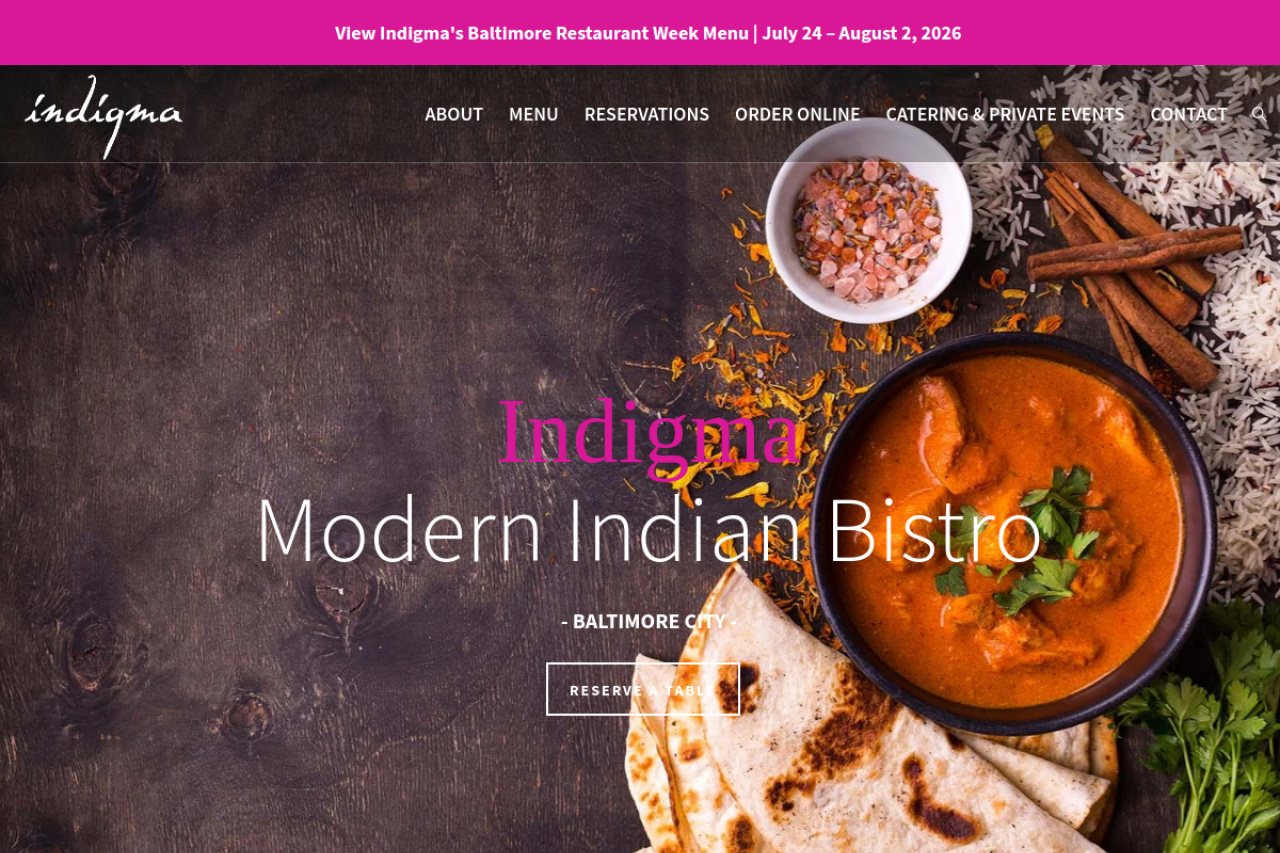
Desktop screenshot of https://www.indigmabistro.com/

Score Breakdown — 12 Dimensions

Top Issues to Fix

1[SEO] Title tag is very short (25 chars)
2[SEO] Canonical URL (https://www.indigmabistro.com/homepage) does not match the page URL — search engines may ignore this page in favor of the canonical
3[SEO] Missing meta description
4[SEO] No H1 heading found
5[SEO] Canonical URL does not match the current page URL
6[SEO] No Open Graph tags found
7[SEO] No Twitter Card tags found
8[SEO] Missing favicon
9[SEO] 11 empty/unlabeled links found
10[SEO] 1 broken anchor links detected

Top Recommendations

1[Impact: High | Effort: Low] Expand your title to 50–60 characters for better click-through rates and SERP visibility
2[Impact: High | Effort: Low] Ensure the canonical URL matches the actual page URL, or redirect this page to the canonical URL [Impact: High | Effort: Low]
3[Impact: High | Effort: Low] Add a compelling meta description of 140–160 characters with target keywords (2025-2026 best practice)
4[Impact: High | Effort: Low] Add exactly one H1 tag with your primary keyword to establish page topic
5[Impact: High | Effort: Low] Verify your canonical tag points to the correct URL to prevent duplicate content issues
6[Impact: High | Effort: Low] Add Open Graph tags (og:title, og:description, og:image, og:url, og:type) for social sharing
7[Impact: Medium | Effort: Low] Add Twitter Card meta tags for better social media previews
8[Impact: Medium | Effort: Medium] Add a favicon for brand recognition in browser tabs and bookmarks
9[Impact: Medium | Effort: Medium] Add descriptive anchor text to all links for better SEO and accessibility
10[Impact: Medium | Effort: Medium] Fix broken anchor links — ensure all #hash targets exist on the page
11[Impact: Medium | Effort: Medium] Expand your content to at least 300+ words for better search rankings
12[Impact: Medium | Effort: Medium] Add rel="nofollow noopener noreferrer" and target="_blank" to all external links to prevent equity leakage and improve security

Detailed Category Analysis

Key Findings

1Clean heading hierarchy with no skipped levels
2HTML lang attribute set to "en"
311 internal links help establish site architecture
412 external links provide reference signals
532 total links — within recommended range
6URL length (30 chars) is within optimal range
7No redirect chain — direct URL resolution
8Good anchor text diversity: 83% unique anchor texts
9Primary keyword not in URL — acceptable for homepage/root URLs
10Strong E-E-A-T signals detected (5 indicators)
11Optimal keyword density: "homepage" at 0.6% (1 occurrences)
12Zero-click optimized: 4 TL;DR/summary block(s) + 0 definition-style lead paragraph(s)
13Moderate entity presence: About Menu Reservations Order Online Catering, Private Events Contact Search Homepage Indigma Modern Indian Bistro, Table Namaste

Issues Found

1Title tag is very short (25 chars)
2Canonical URL (https://www.indigmabistro.com/homepage) does not match the page URL — search engines may ignore this page in favor of the canonical
3Missing meta description
4No H1 heading found
5Canonical URL does not match the current page URL
6No Open Graph tags found
7No Twitter Card tags found
8Missing favicon
911 empty/unlabeled links found
101 broken anchor links detected
11Thin content (177 words)
1212 external links missing rel="nofollow noopener noreferrer" — potential link equity leakage
13High dofollow external link count (12) — excessive link equity leakage
14Primary keyword missing from first paragraph
15Low readability score (15 Flesch) — content is hard to read
16No social sharing buttons/widgets detected
17Low OG sharing completeness (0%) — social previews will be poor

Recommendations to Reach 100%

1Expand your title to 50–60 characters for better click-through rates and SERP visibility
2Ensure the canonical URL matches the actual page URL, or redirect this page to the canonical URL [Impact: High | Effort: Low]
3Add a compelling meta description of 140–160 characters with target keywords (2025-2026 best practice)
4Add exactly one H1 tag with your primary keyword to establish page topic
5Verify your canonical tag points to the correct URL to prevent duplicate content issues
6Add Open Graph tags (og:title, og:description, og:image, og:url, og:type) for social sharing
7Add Twitter Card meta tags for better social media previews
8Add a favicon for brand recognition in browser tabs and bookmarks
9Add descriptive anchor text to all links for better SEO and accessibility
10Fix broken anchor links — ensure all #hash targets exist on the page
11Expand your content to at least 300+ words for better search rankings
12Add rel="nofollow noopener noreferrer" and target="_blank" to all external links to prevent equity leakage and improve security
13Reduce dofollow external links to 2–5 per page. Add rel="nofollow" to low-value or affiliate links to preserve PageRank
14Include your primary keyword naturally in the first paragraph to establish topical relevance early
15Include your primary keyword in the URL slug for improved crawlability and click-through rates
16Significantly simplify your content — aim for 60+ Flesch Reading Ease with shorter sentences and simpler vocabulary
17Add social share buttons (Facebook, Twitter/X, LinkedIn, WhatsApp) to encourage content distribution and earn social signals
18Complete your Open Graph tags (og:title, og:description, og:image, og:url, og:type, og:locale) for rich social media previews
19SEO (E-E-A-T): no author linkage or sameAs identity markup detected. Add a verifiable author byline with rel="author" and sameAs links to strengthen Experience/Expertise signals.
20SEO: no IndexNow signal detected. Adopt the IndexNow protocol (Bing/Yandex/Seznam) to push instant crawl notifications when content changes.

Key Findings

1Excellent server response time: 246ms
2Lean HTML document: 37KB
31/10 images use lazy loading
4Modern image formats (WebP/AVIF) detected
5Cache-Control header with max-age is set
6Lean CSS payload (~183KB)
7JavaScript payload (~102KB) is acceptable
8HTTP/3 (QUIC) detected — fastest connection protocol
9Brotli compression enabled — best-in-class compression
10Estimated LCP: ~1326ms — within Google's "good" threshold (<2.5s)
11Estimated INP: ~62ms — within Google's "good" threshold (<200ms)

Issues Found

12 render-blocking script(s)
2No responsive image srcset found
3Only 3/10 images have width/height attributes
4No font-display property found
5No CDN detected
6No resource hints found
76 render-blocking CSS files — delays first paint
8Potentially unused CSS detected (large stylesheet count relative to page complexity)
9Moderate estimated CLS: 0.15 — above 0.1 "good" threshold
10No analytics tracking detected — flying blind on user behavior

Recommendations to Reach 100%

1Add async or defer attributes to render-blocking scripts
2Use srcset and sizes attributes on images to serve appropriately sized images per device
3Add explicit width and height to all images to prevent Cumulative Layout Shift (CLS)
4Add <link rel="preconnect"> for critical third-party domains to reduce DNS lookup time
5Preload critical resources (fonts, hero images) with <link rel="preload">
6Add font-display: swap to web font declarations to show fallback text while fonts load
7Use a Content Delivery Network (CDN) like Cloudflare, CloudFront, or Fastly to reduce global latency
8Add preconnect, prefetch, and preload hints for critical third-party resources and fonts
9Reduce render-blocking CSS by inlining critical CSS, using media queries on non-critical stylesheets, and loading non-critical CSS asynchronously
10Audit CSS with Chrome DevTools Coverage tab to identify and remove unused CSS rules
11Reduce CLS: set image dimensions, preload web fonts, reserve space for ads and dynamic content
12Install Google Analytics 4 (GA4) with Google Tag Manager immediately — analytics is essential for measuring SEO and marketing ROI
13Performance: no Speculation Rules API detected. Add <script type="speculationrules"> to prerender/prefetch likely next navigations for near-instant page transitions.
14Performance (LCP): no image declares fetchpriority="high". Mark the LCP hero image with fetchpriority="high" so the browser prioritizes it during initial load.
15Performance: only 0/10 images set decoding="async". Add decoding="async" to non-critical images to keep image decode off the main thread.

Key Findings

1Viewport meta tag present: width=device-width, initial-scale=1.0
2HTML5 doctype declared
3Character encoding declared
41 images with lazy loading benefit mobile data users
5Touch feedback CSS detected (active states or touch-action)
6Lightweight page (~902KB) — fast on mobile networks

Issues Found

1No theme-color meta tag
2No web app manifest found
3Missing Apple touch icon
4No responsive image srcset — mobile users may download oversized images
5Fixed-width elements detected (>800px) — may cause horizontal scrolling on mobile
6Popup/modal/interstitial detected — Google penalizes intrusive interstitials on mobile

Recommendations to Reach 100%

1Add <meta name="theme-color"> for browser chrome styling on mobile
2Create a manifest.json for PWA capabilities and add-to-homescreen support
3Add <link rel="apple-touch-icon"> for iOS homescreen icons
4Consider implementing a service worker for offline support and faster repeat visits
5Implement srcset to serve smaller images on mobile devices, saving bandwidth
6Replace fixed pixel widths with relative units (%, vw, max-width) to prevent horizontal overflow on small screens
7Remove or minimize intrusive interstitials on mobile — Google's Page Experience update penalizes full-screen popups that block content
8Add env(safe-area-inset-*) CSS for proper display on notched/island devices
9Mobile/PWA: incomplete Apple web-app meta tags (missing capable, status-bar-style, title). Add apple-mobile-web-app-capable, -status-bar-style and -title for a polished iOS home-screen install.
10Mobile/PWA: viewport meta lacks viewport-fit=cover. Add it (with safe-area-inset padding) so content renders edge-to-edge on notched/dynamic-island devices.

Key Findings

1HTTPS enabled — encrypted connection
2Content Security Policy header present
3X-Content-Type-Options: nosniff is set
4X-Frame-Options header prevents clickjacking
5No cookie security issues detected
6Privacy policy link detected
7Rate limiting recommended for form endpoints
8No stack traces or sensitive error details exposed in responses
9No obvious secret/API-key patterns exposed in page source
102 script resource(s) catalogued for software-composition review
11No common sensitive paths (.git, .env, server-status, …) were publicly accessible

Issues Found

1Missing Strict-Transport-Security header
2Missing Referrer-Policy header
3Missing Permissions-Policy header
4Server header exposes technology: hcdn
5X-Powered-By header exposes: PHP/8.2.31
612 external links missing rel="noopener noreferrer" — security risk
7No cookie consent banner detected
8Weak CSP implementation (strictness score: 30/100)
9Server-side software version disclosed: PHP/8.2.31 — enables version-based vulnerability (CVE) lookups
10Additional technology fingerprints exposed: Server: hcdn; X-Powered-By: PHP/8.2.31; x-generator: Drupal 10 (https://www.drupal.org)
11security.txt file is missing — no standardized channel for reporting vulnerabilities
121 email address(es) exposed in page source (e.g. [email protected]) — can be harvested for spam/phishing
13CSP is missing key hardening directive(s): base-uri, form-action, object-src, frame-ancestors
14robots.txt discloses sensitive-looking path(s): /composer/Plugin/Scaffold/README.md, /web.config, /admin/ — Disallow entries can act as a map for attackers
151 untrusted <iframe>(s) without a sandbox attribute — embedded content runs with full privileges

Recommendations to Reach 100%

1Add Strict-Transport-Security header with max-age=63072000; includeSubDomains; preload
2Add Referrer-Policy: strict-origin-when-cross-origin to control referrer leakage
3Add Permissions-Policy to restrict access to camera, microphone, geolocation, etc.
4Add Cross-Origin-Opener-Policy: same-origin-allow-popups
5Add Cross-Origin-Resource-Policy: cross-origin
6Remove or obfuscate the Server header to avoid exposing your technology stack
7Remove X-Powered-By header
8Add rel="noopener noreferrer" to all external links with target="_blank" to prevent tabnabbing attacks
9Implement a cookie consent banner for GDPR/ePrivacy compliance
10Significantly strengthen CSP: eliminate unsafe-inline and unsafe-eval, use nonce-based policies, define explicit source lists per directive (OWASP Level 3)
11Implement rate limiting on form endpoints to prevent brute-force attacks and spam submissions
12Suppress version numbers in the Server / X-Powered-By headers and generator meta tag, and keep the framework patched to its latest release to close known CVEs [Impact: High | Effort: Low]
13Add an RFC 9116 security.txt at /.well-known/security.txt with Contact and Expires fields so researchers can responsibly report security issues [Impact: Low | Effort: Low]
14If these emails are not meant to be public, obfuscate them or replace with a contact form; for intentional contact addresses this is informational only [Impact: Info | Effort: Low]
15Add the missing CSP directives (base-uri, form-action, object-src, frame-ancestors) — e.g. object-src 'none', base-uri 'self', frame-ancestors 'none' — to close common bypasses [Impact: Medium | Effort: Low]
16Avoid listing admin/private paths in robots.txt; protect them with authentication instead of relying on obscurity [Impact: Low | Effort: Low]
17Add the sandbox attribute (with the minimum required allow-* tokens) to iframes embedding third-party/untrusted content [Impact: Medium | Effort: Low]
18A06 Insecure Design: authentication/high-value form present with no visible bot/abuse challenge (CAPTCHA/Turnstile). Add anti-automation, rate limiting and account-lockout as a threat-modeled control.
19A07 Authentication Failures: no phishing-resistant factor detected (WebAuthn/passkeys/TOTP MFA). Offer passkeys or TOTP and enforce ASVS L2 credential and session controls.
20A09 Logging & Alerting Failures: no client-side error/security monitoring detected. Add centralized logging with tamper-evident storage and real-time alerting on auth failures and anomalies.

Key Findings

1Language declared: en
2Skip navigation link present
3All key landmarks present (main, nav, footer)
4All 10 images have alt attributes
5All 1 forms have proper labels
6All iframes have title attributes
7All 1 buttons have accessible labels
83 ARIA-attributed elements found
9Focus styles detected for keyboard navigation
10No major HTML nesting or validity issues detected

Issues Found

17 images missing explicit dimensions — causes layout shifts for screen reader users

Recommendations to Reach 100%

1Set explicit width and height (or CSS aspect-ratio) on all images to prevent layout shifts that disorient assistive technology users
2Accessibility: no forced-colors / prefers-contrast media handling detected. Test and support Windows High Contrast / forced-colors mode so essential UI remains visible.

Key Findings

1Strong semantic markup: header, nav, article, footer
2Social presence signals: youtube, facebook, instagram
32 call-to-action elements detected
4No AI crawlers blocked via meta tags — content accessible to AI search engines
5robots.txt file found
6High RAG-friendliness (100/100): 1 headings with IDs, 14 section anchors
7Content provenance signals detected (citations with sources, attributed claims)
8Content freshness signals present (dateModified/datePublished/time elements)

Issues Found

1No structured data (Schema.org) found
2Incomplete social metadata
3No breadcrumb navigation
4No FAQ or Q&A content patterns found
5No sitemap reference found
6robots.txt has no Sitemap directive
7No llms.txt file found — AI models cannot find structured guidance for your site

Recommendations to Reach 100%

1Implement JSON-LD structured data — start with Organization, BreadcrumbList, and page-specific types
2Add hreflang tags if your site serves multiple languages or regions
3Add breadcrumb navigation with BreadcrumbList schema for better site hierarchy signals
4Add an FAQ section with FAQPage schema to increase chances of AI engine citations
5Create and reference an XML sitemap for AI crawler discoverability
6Add a Sitemap: directive to your robots.txt pointing to your XML sitemap for AI and search crawler discoverability
7Create /llms.txt following the llms.txt standard: # Title, > description, ## Overview, ## Core Services, ## Key Pages with full URLs
8Create /llms-full.txt with comprehensive documentation (services, pricing, team, case studies) for AI models that need depth
9Add <link rel="alternate" type="text/plain" href="/llms.txt"> in your HTML <head> for AI discoverability
10AI Readiness (multimodal): only 0% of images have descriptive alt text (≥15 chars). Rich, standalone alt text lets multimodal models understand and cite your imagery.

Key Findings

1Structured content: 3 lists, 0 tables — easily parsed by AI
2Good paragraph length for readability and AI parsing
39 external citations — strong reference density for AI model training
4Good form usability score: 80/100
5Trust signals present: HTTPS Security, Privacy Policy
6Clear value proposition detected in heading elements

Issues Found

1Very thin content (177 words)
2No structured Q&A content
3Weak entity markup — few terms emphasized
4Low semantic markup ratio — 231 divs vs 5 semantic elements
5Weak E-E-A-T schema signals
6No author or expertise signals
7No clear call-to-action elements detected
8No CTA above the fold
9No social proof elements

Recommendations to Reach 100%

1AI models value comprehensive, authoritative content — aim for 1000–2000+ words covering the topic thoroughly
2Add FAQ or Q&A sections — AI models heavily rely on question-answer patterns for training data
3Use <strong>, <em>, and <mark> to highlight key entities, concepts, and brand terms for AI comprehension
4Replace generic <div> wrappers with semantic elements (article, section, aside, figure) for AI clarity
5Add Person, Article, and Review schemas to demonstrate expertise, experience, authoritativeness, and trustworthiness
6Add Speakable schema markup to help voice assistants identify the most important content
7Include expert quotes in <blockquote> elements to boost E-E-A-T and citation potential
8Add visible author bylines with bios and link to author pages — AI models evaluate content credibility through authorship signals
9Add prominent CTAs with action-oriented text ("Get Started", "Book a Call", "Try Free") — every page should guide users toward conversion
10Place a clear CTA in your hero/header section so visitors see a conversion path immediately upon landing
11Add social proof: testimonials, client counts ("500+ businesses served"), case studies, or review snippets near CTAs
12AIO: no schema "name" property to anchor your primary entity. Declare a consistent Organization/Person/Product name in JSON-LD matching your title and H1.

Key Findings

13 lists detected

Issues Found

1No direct Q&A patterns for generative AI extraction
2No data tables for AI comparison extraction
3Content too thin for AI citation value
4Insufficient structured data for generative engine context
5thin content — may not provide enough depth for AI engines
6No hreflang tags — generative engines cannot determine language/region targeting

Recommendations to Reach 100%

1Structure content with clear questions as headings (H2/H3) followed by concise, definitive answers in the first paragraph
2Add comparison tables with structured data — generative AI engines frequently cite tabular content
3Include how-to or step-by-step instructional content for generative AI answer inclusion
4Consider using <dl>/<dt>/<dd> definition lists for key terms and concepts
5Generative engines cite pages with substantial, authoritative content — aim for 1000+ words with unique insights
6Include unique statistics, expert quotes, and original insights that generative AI would want to cite
7Add multiple schema types (Article, FAQ, HowTo) to help generative engines contextualize your content
8Add bidirectional hreflang tags with x-default to help AI engines serve the correct language variant
9Add original data visualizations, charts, or data tables — generative engines cite pages with unique, first-party data
10Include first-hand insights using phrases like "our research found" or "based on our analysis" to demonstrate original expertise
11GEO: only 0/9 sub-headings are question-phrased. Convert key sections into natural-language questions so generative engines can extract and cite direct answers.
12GEO: no comparison tables or step-by-step structured blocks found. Add comparison tables and ordered how-to steps — formats generative engines favor for structured, citable answers.

Key Findings

1Short paragraphs are well-suited for answer extraction
23 lists provide scannable answers for People Also Ask

Issues Found

1No FAQ content or schema
2Content not optimized for featured snippets
3No Speakable schema for voice search
4No breadcrumb navigation
5No direct answer patterns ("X is defined as...", "X refers to...")

Recommendations to Reach 100%

1Create an FAQ section with FAQPage structured data — essential for People Also Ask and featured snippet inclusion
2Consider adding how-to content with HowTo schema for step-by-step rich results
3Use question-based H2/H3 headings followed by a direct 40–60 word answer paragraph for featured snippet targeting
4Add Speakable schema to mark sections suitable for text-to-speech by voice assistants
5Add breadcrumb navigation with BreadcrumbList schema for better content hierarchy signals
6Consider adding video content with VideoObject schema for multimedia search results
7Include direct definitional statements like "X is..." or "X refers to..." — answer engines extract these as zero-click results
8AEO: no 40–60 word concise answer directly follows a question heading. Lead each question section with a self-contained ~40–60 word answer to win featured snippets and voice answers.

Key Findings

1NAP information detected: phone: 1083929, email: [email protected]
2Phone number(s) visible: 1083929, 4037856777
3Email address found: [email protected]

Issues Found

1No LocalBusiness structured data
2No Google Maps embed
3No address microdata
4No geo meta tags
5No review/rating schema

Recommendations to Reach 100%

1Add LocalBusiness (or specific subtype like ProfessionalService) JSON-LD schema with name, address, phone, hours, and geo coordinates
2Add an embedded Google Map to your contact or about page for local search signals
3Add PostalAddress schema or itemprop="address" microdata to your address elements
4Add geo.region, geo.placename, and geo.position meta tags for geographic targeting
5Add AggregateRating schema to display star ratings in search results — reviews significantly impact local click-through rates
6Local SEO: local business signals present but no explicit city/region in the title, H1 or opening paragraph. Add "City, State" to your title/H1 and intro to reinforce local relevance.
7Local SEO (NAP): a phone number is shown but not declared in structured data. Add telephone (and address) to LocalBusiness schema so NAP is machine-verifiable.

Issues Found

1No Schema.org structured data found
2Missing high-impact schema types: Organization, WebSite, Review

Recommendations to Reach 100%

1Implement JSON-LD structured data immediately — start with Organization, WebSite, and BreadcrumbList
2Priority schema types to add: Organization, WebSite, Review — these have the highest SEO impact for your page type
3Schema.org (maximize): long-form article content detected but no Article/BlogPosting schema. Add Article with headline, author, datePublished, dateModified, image and publisher for maximal eligibility.

Key Findings

1Relative units (rem/em/clamp) detected — supports text resizing
2Focus styles detected for keyboard navigation visibility
3Page language declared — aids assistive technology
4All ARIA roles are valid
5Focus not obscured by sticky/fixed elements (WCAG 2.4.11)
6Accessible authentication detected (autocomplete, no CAPTCHA barriers) — WCAG 3.3.8

Issues Found

1No prefers-reduced-motion support
2No high contrast mode support
3Links may not be distinguishable from surrounding text
4No error suggestion mechanisms detected in forms
5Low semantic-to-div ratio — 231 divs vs 5 semantic elements
6No form error identification detected
7Timed elements detected without option to extend

Recommendations to Reach 100%

1Add @media (prefers-reduced-motion: reduce) to disable animations for users who are sensitive to motion
2Add @media (prefers-contrast: high) or (forced-colors: active) styles for users with low vision
3Ensure links have visible underlines or other non-color visual indicators (WCAG 1.4.1)
4Add aria-invalid, aria-errormessage, and visible error messages for form validation (WCAG 3.3.3)
5Replace more generic <div> elements with semantic HTML5 tags for better screen reader navigation
6Add aria-invalid, aria-errormessage, and inline error messages to form fields (WCAG 3.3.1/3.3.3)
7Provide options to extend, adjust, or disable time limits on interactive content (WCAG 2.2.1)
8Add aria-live regions (role="status" or role="alert") for form feedback, notifications, and dynamic content updates (WCAG 4.1.3)
Limited-Time Offer

All 12 Optimizations — Bundled Into Your Custom Website

We're currently bundling every optimization from this audit — SEO, AIO, GEO, AEO, Schema.org, WCAG accessibility, performance, security, and more — directly into our Custom Web Application Development service.

Instead of fixing issues after launch, we eliminate them from the start. Every website we build ships production-ready with a 90+ score across all 12 audit dimensions.