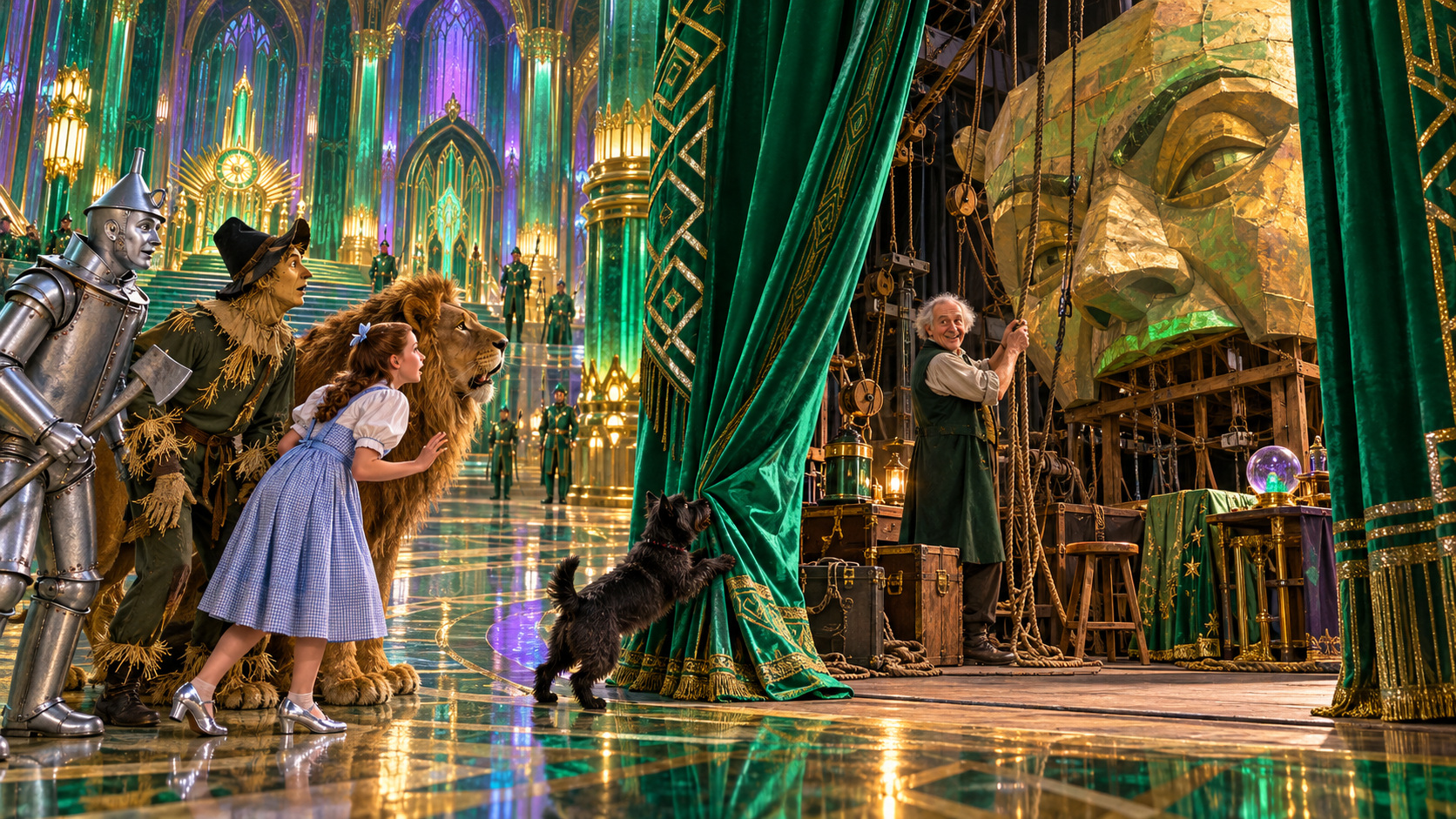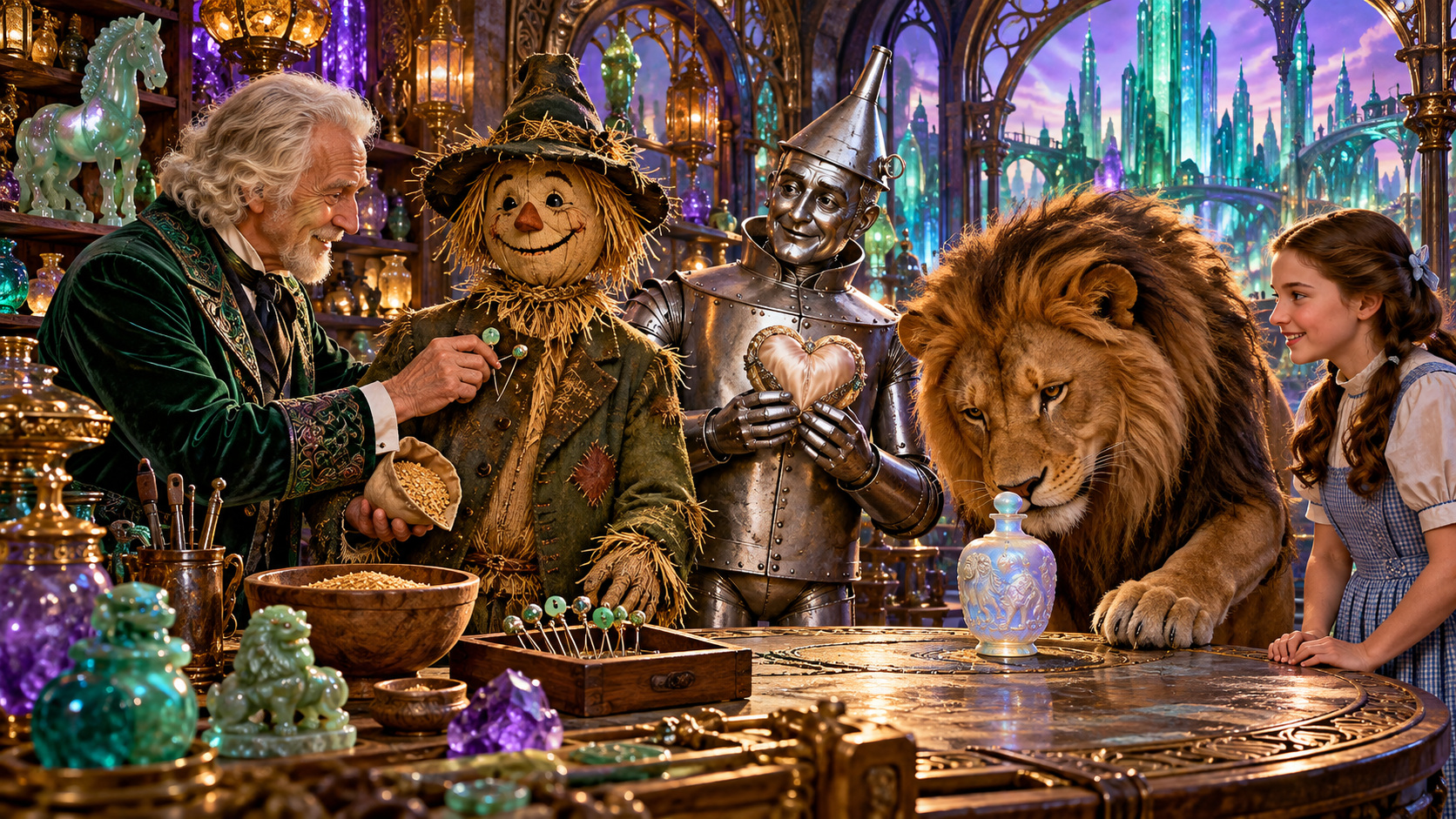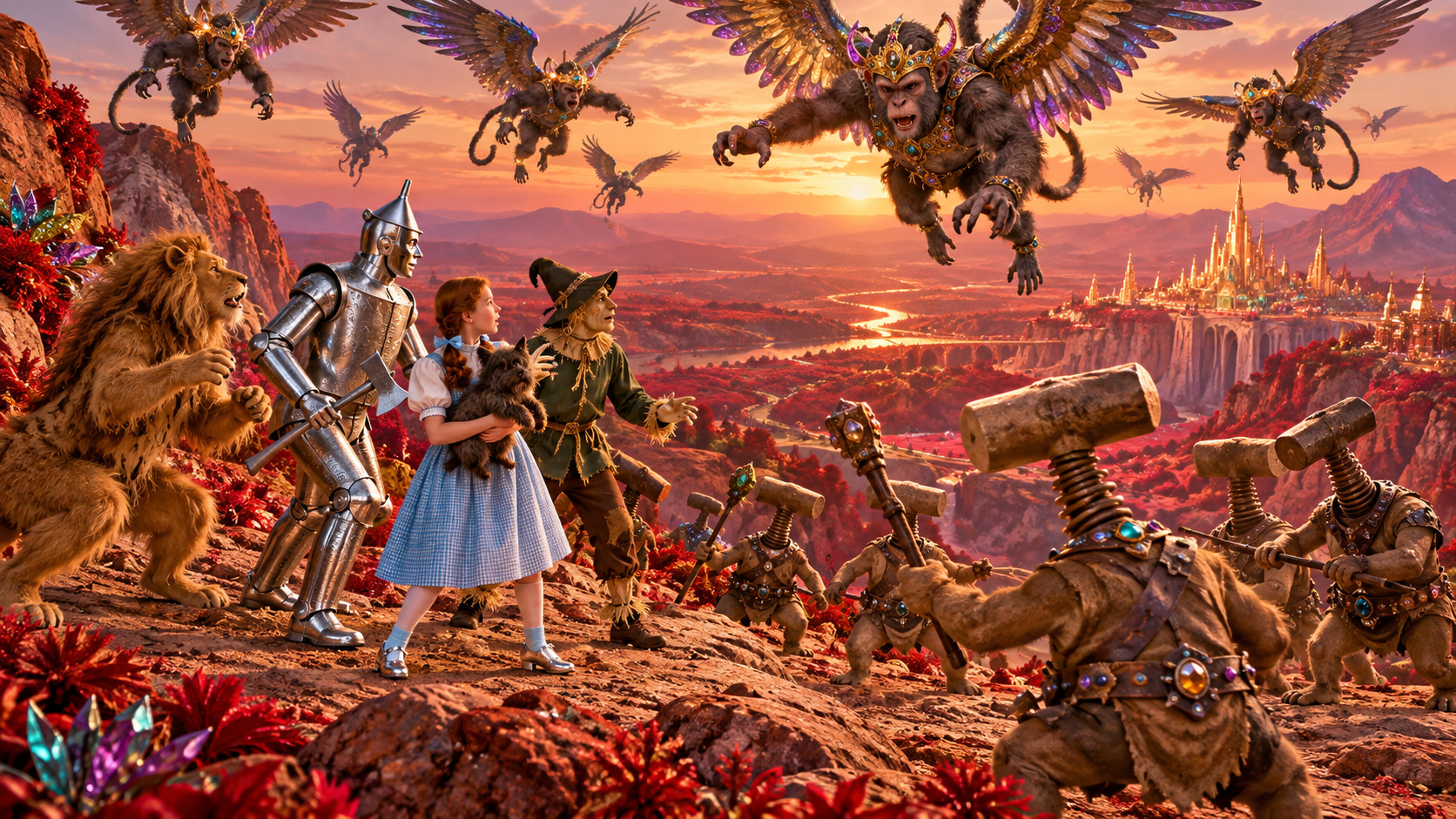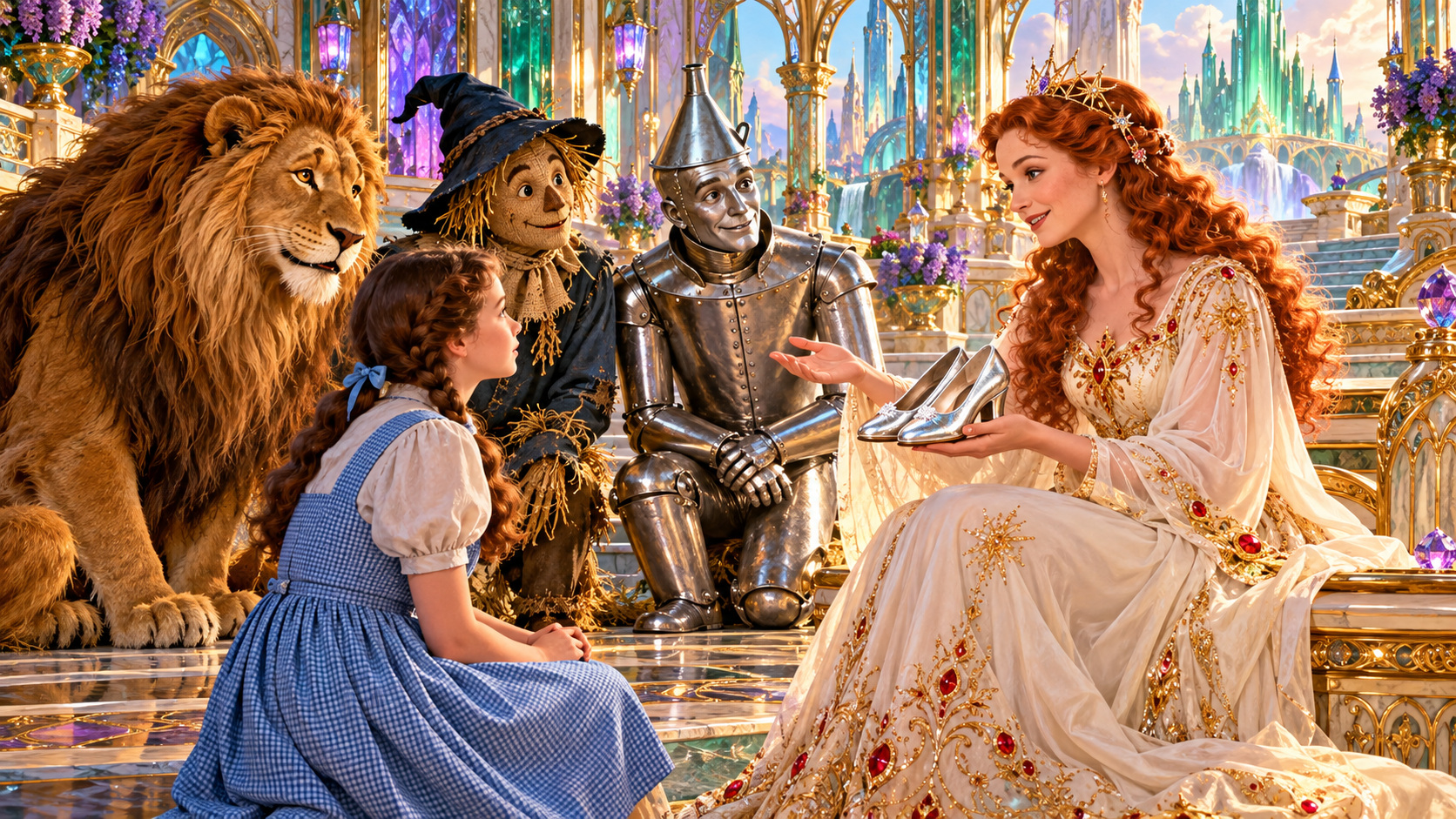







An illustrated journey through money and meaning
Oz: Beyond the Curtain
The Wizard of Oz, Monetary Allegory, and a Modern Federal Reserve Lens
About this illustrated edition
Source edition and web provenance
AN ILLUSTRATED JOURNEY THROUGH MONEY AND MEANING
OZ
BEYOND THE CURTAIN
The Wizard of Oz, monetary allegory and a modern Federal Reserve lens
24 narrative chapters • 24 distinct AI illustrations Plain-language preface • Scholarly interpretation Historical evidence • Modern analogies
Created for Michael Aaron Loftus
Original paraphrase and commentary on L. Frank Baum’s 1900 novel
October 11, 2026 • Psychedelic futuristic edition
The cover’s credit identifies the intended recipient, not verified sole authorship. This reading adaptation preserves that credit without adding an author claim. The source edition is dated October 11, 2026; the web adaptation was prepared on . Web publication: .
Download the original source edition (PDF, English)The edited HTML is not byte-identical to the PDF. Chapter images were extracted with their original transparency masks; optimization cannot recover detail already lost in the PDF.
What is an allegory? A plain-language introduction
Allegory, in everyday language
A story with two levels
An allegory is a story that can speak about something else while still being a story. You can enjoy the adventure on the surface, then notice that its people, places and problems resemble ideas or situations outside it. Imagine a town where everyone follows a shiny road to ask a powerful stranger for help. On one level, that is a fantasy adventure. On another, it might help us think about rules, authority and the ways people seek security.
A simple example
Suppose a story describes neighbors who each hold a small lamp. Alone, none can light the whole street. Together, they can. The lamps could stand for individual abilities, and the illuminated street could stand for cooperation. That second meaning is the allegorical level. You do not need a secret password to see it; you need a plausible connection between what happens in the story and the idea being explored.
How this applies to Oz
Dorothy follows a yellow road while wearing silver shoes. A reader thinking about nineteenth-century money can connect yellow with gold and silver with the alternative metal proposed by monetary reformers. The Scarecrow can suggest farmers; the Woodman can suggest industrial workers. These connections form a coherent reading. They do not, by themselves, prove that Baum deliberately hid that message in every detail. 1
The useful distinction
An intended allegory is a second meaning the author deliberately builds. An allegorical reading is a second meaning a reader develops and defends. A modern analogy applies a story to a later situation. This book uses all three categories carefully. Its Federal Reserve interpretation belongs primarily to the third: a modern comparison that can teach us to ask good questions. 2
Reading guide and historical context
Reading guide and historical context
How to enjoy the second story
Let the adventure breathe
Read the paraphrase first. Dorothy is a traveler, not merely a label for a social class. The companions have desires, memories and contradictions. If every detail becomes a fixed code, the story loses the very complexity that makes it useful. Allegory works best when the surface adventure remains emotionally alive.
Ask why a connection fits
A good interpretation explains more than a color. It connects characters, choices and consequences. The gold-and-silver reading is interesting because the shoes travel on the road, because the journey seeks a solution and because the resource is misunderstood until late in the story. A weak reading simply attaches an institution to an object and announces that the mystery is solved.
Keep three labels in view
The chapter tables identify established readings, broader literary interpretations and original modern extensions. Established means that the interpretation has a recognizable scholarly history; it does not mean that authorial intent has been proved. An original extension is this book’s analytical proposal. You may accept it, revise it or reject it by comparing the explanation with the text.
An image is an invitation
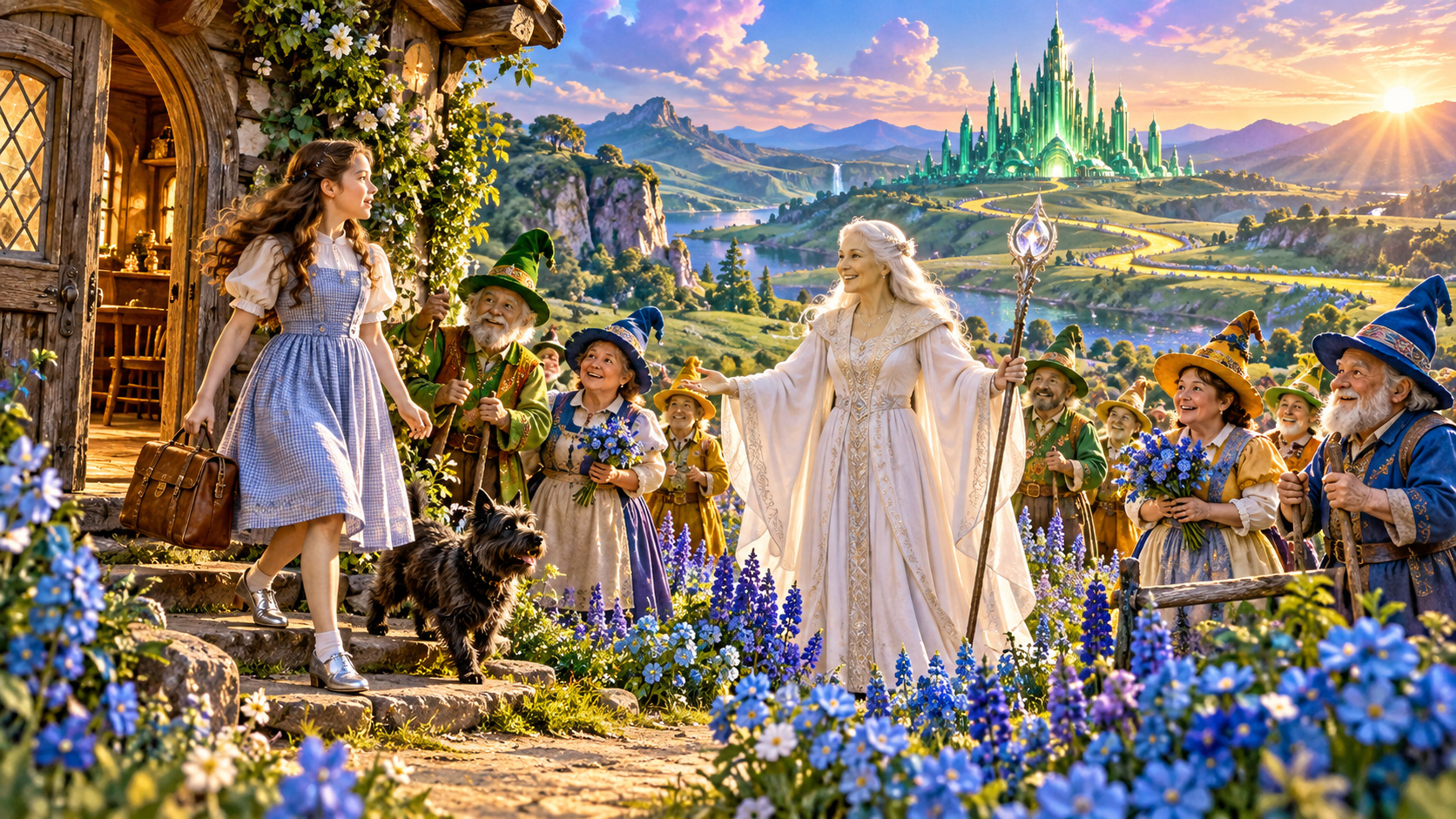
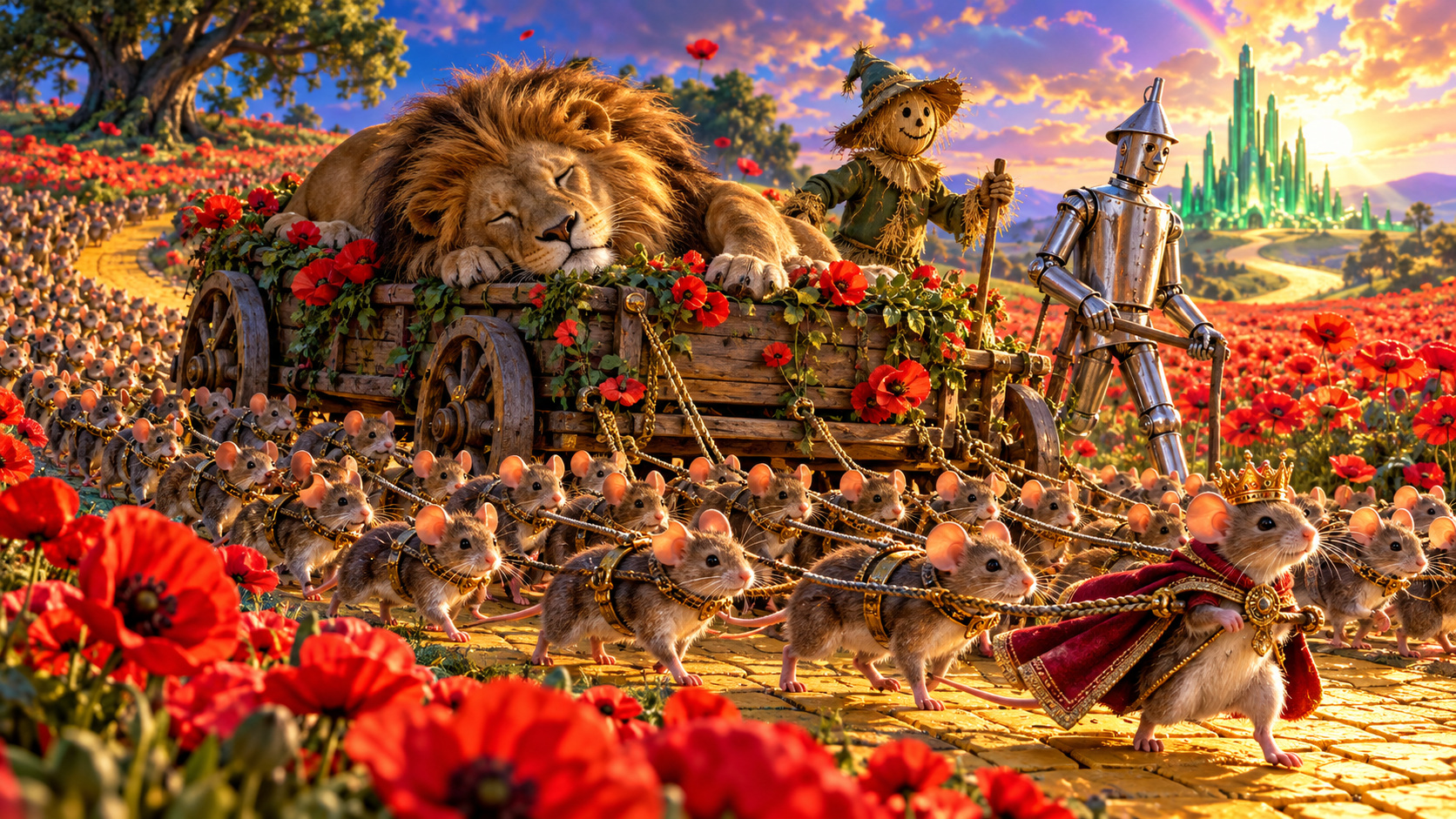
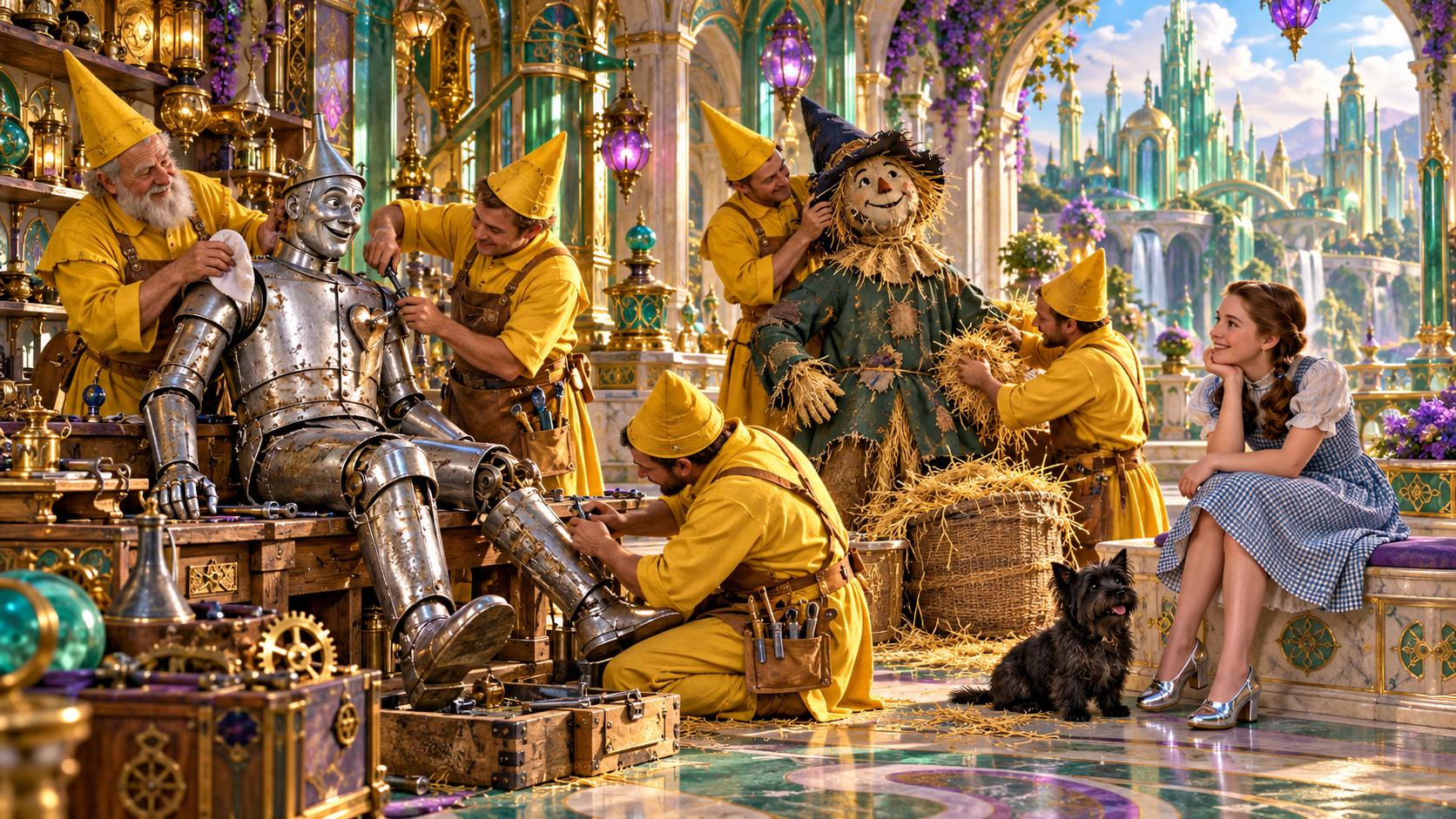
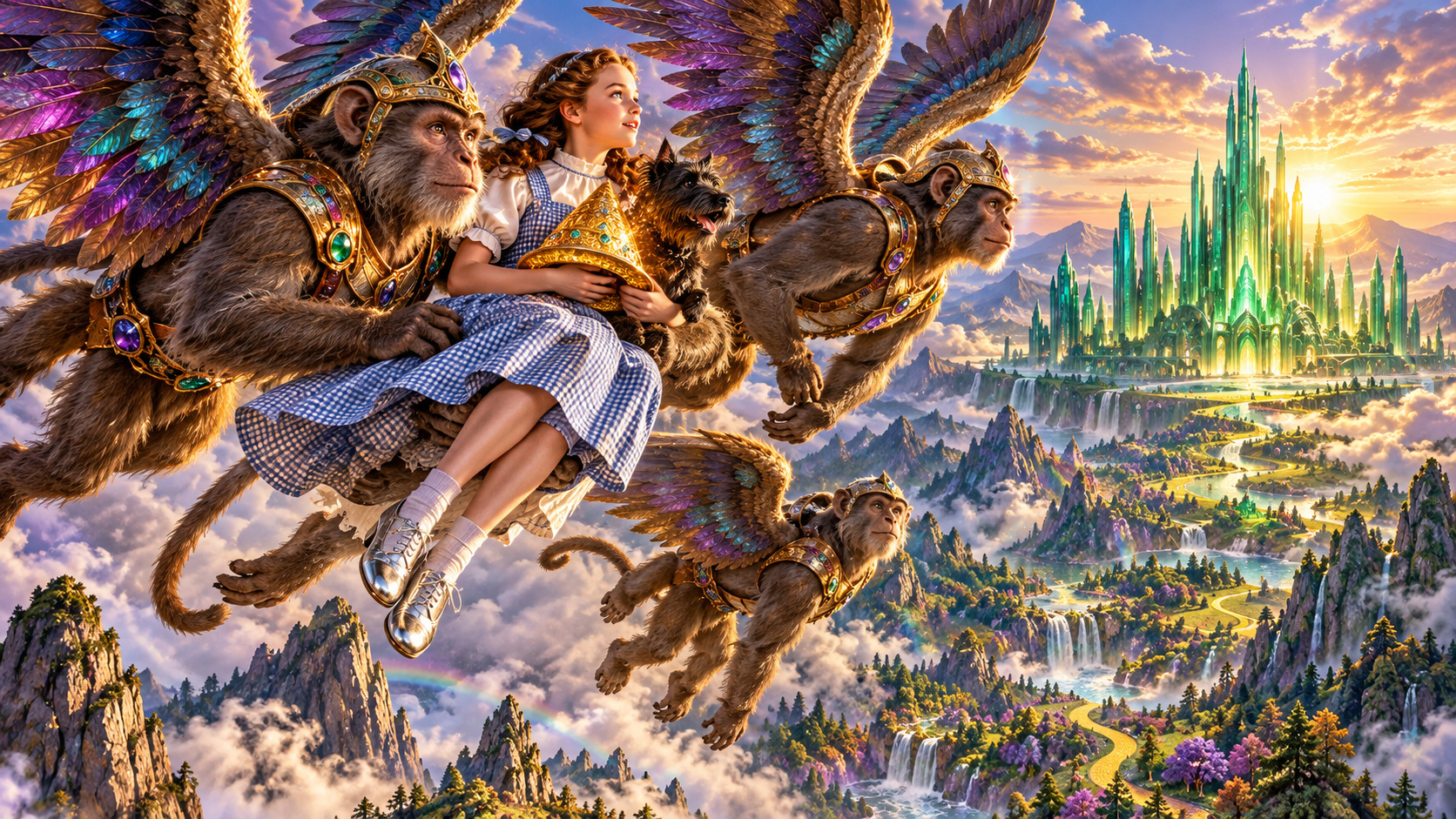
Every chapter begins with a distinct AI-generated illustration. The artwork uses a psychedelic, futuristic and hyperrealistic visual language to amplify wonder. It is conceptual art, not historical evidence or a restored frame from the film. Silver shoes follow the novel. Some visual details are imaginative elaborations, so use the prose and primary text for exact narrative facts.
Allegory at a scholarly level
A sustained mapping between domains
At an advanced level, allegory can be understood as a sustained organization of relations between a represented domain and an interpretive domain. The represented domain contains the story’s agents, objects, actions and consequences. The interpretive domain may concern moral psychology, political economy or institutions. The strongest reading preserves relationships across these domains rather than merely assigning a separate referent to every noun.
Meaning, intention and reception
Textual coherence, historical plausibility and authorial intention are different evidentiary questions. A reading can be coherent without being intended. An intended reference can fail to organize the whole narrative. A historically influential interpretation can become culturally powerful even if its account of the author’s purpose remains disputed. Reception history therefore asks how readers have used Oz, while an intentionalist claim asks what evidence establishes Baum’s own design.
What would establish intent?
Relevant evidence would include drafts, correspondence, explicit statements, contemporary context and consistent textual patterns. A later critic’s discovery of a compelling correspondence is evidence about interpretability; it is not equivalent to an author’s declaration. Even an explicit preface requires analysis rather than blind acceptance, but it is part of the record. Baum presented the novel as entertainment for children. 3
Why the distinction matters
Confusing interpretive productivity with historical proof produces an attractive but unstable argument. The scholar should state the claim at the strength supported by its evidence: Oz can illuminate monetary debates; a monetary reading has an established history; Baum’s intention remains contested. These propositions are compatible. They should not be compressed into the stronger assertion that the novel proves a secret institutional design. 4
A method for reading without forcing
Read actions, not isolated ornaments
A mapping is more persuasive when it explains what an element does. The silver shoes are a resource whose capacity remains unknown. The spectacles impose a way of seeing. The Wizard changes his appearance across audiences. These functions support inquiry into capability, measurement and mediated authority. Their explanatory value comes from relations in the plot, not simply metallic colors or evocative names.
Test alternative explanations
The Scarecrow’s wish can concern self-confidence and social recognition even without a farmer mapping. The Lion can dramatize courage without representing a candidate. An interpretation gains strength by explaining why its chosen framework adds insight beyond these alternatives. A disciplined account also notes details it does not explain, rather than inventing a counterpart for every creature.
Use anachronism consciously
A present-day comparison is legitimate when clearly labeled. Readers routinely use old stories to think about later institutions. The error begins when that analogy is presented as evidence that the author anticipated a specific organization. This book’s modern Federal Reserve lens is consciously anachronistic: it uses narrative patterns to examine contemporary questions about money, authority and accountability.
Let metaphors lead to mechanisms
A metaphor can organize a question but cannot estimate a policy effect. To move from the Tin Woodman’s oil to liquidity analysis, one must specify funding needs, available assets, liabilities and constraints. To move from the Wizard’s voice to expectations, one must identify what is communicated, who believes it and how behavior changes. The interpretive bridge should end in an inspectable mechanism.
The historical money question
The 1890s debate
The monetary interpretation belongs to the debate over gold and free silver around the 1896 election. William Jennings Bryan became a prominent advocate of silver and challenged the gold-centered monetary order. The Library of Congress preserves campaign materials and the history of his Cross of Gold speech. 5 This dispute supplied the historical setting later critics used to connect the yellow road with gold and Dorothy’s shoes with silver.
Why debtors cared about prices
Consider a deliberately simple teaching example. A farmer owes $100. If a basket of output sells for $10, ten baskets cover the principal. If the price falls to $5 while the nominal debt remains $100, twenty baskets are required. This is arithmetic, not a claim about a particular farm. It shows how falling output prices can increase the real burden of a fixed-dollar obligation even without a change in the written debt.
Why creditors and savers could disagree
A rise in prices can reduce the purchasing power of a fixed payment received later. Monetary arguments therefore involve distribution as well as aggregate performance. The relevant policy question is not whether one side is morally pure, but which arrangement best addresses stability, obligations and welfare under the actual conditions. No magical shoe can eliminate those trade-offs.
What a monetary reading explains
Silver shoes traveling along a yellow road supply a memorable visual arrangement for the bimetallic interpretation. The reading also organizes the farmer, worker and political-leadership motifs. Hugh Rockoff developed the economic interpretation in 1990. His article argues that the free-silver position deserves serious analysis. This book uses that interpretive tradition while keeping its historical claims separate from its modern extensions. 6
Oz and the Federal Reserve
1900 comes before 1913
The Wonderful Wizard of Oz appeared in 1900. The Federal Reserve Act was enacted on December 23, 1913. The novel therefore predates the institution. A literal claim that Baum wrote the book as an allegory of the established Federal Reserve requires evidence this book does not have. A later reader may still use Oz to examine monetary authority, provided that comparison is labeled as a modern analogy. 7
A system, rather than one hidden man
The Federal Reserve includes a Board of Governors, regional Reserve Banks and the Federal Open Market Committee. The Board is a federal agency; the system’s public and regional structure cannot be captured by saying that a single Wizard secretly owns everything. The FOMC’s actions influence interest rates and credit conditions. Those institutional distinctions matter whenever the metaphor moves toward real policy. 8
Words and operations
The Fed’s tools include open market operations and administered rates, among others. Buying or selling securities and setting the terms of monetary implementation are concrete operations, not only performances. Communication also matters because expectations affect decisions. An accurate modern comparison can examine how authority is presented while recognizing that the institution has real legal and operational capacities. 9
The gold road is historical
The United States changed its gold arrangements in the twentieth century; gold convertibility is not the modern dollar’s ordinary promise to its holder. Roosevelt’s gold program and the later closure of the gold window belong to that longer history. The novel’s metallic imagery helps teach the earlier debate, but cannot be carried unchanged into a contemporary policy claim. 10
The debate about the debate
Littlefield’s influential reading
Henry M. Littlefield’s 1964 article brought the Populist interpretation into wide scholarly discussion. Its broad correspondences connect agrarian life, industrial labor, political leadership and metallic money to the story’s journey. These associations are the historical reading used in several chapter tables. 11 They remain an interpretation, even when repeated in classrooms.
The challenge to intentionality
Bradley A. Hansen argues against the claim that Baum wrote the novel as a monetary allegory. Ranjit S. Dighe likewise separates the usefulness of reading Oz as a Populist parable from evidence about Baum’s intention. David B. Parker traces the interpretation’s rise and points to evidence complicating portrayals of Baum as a straightforward Bryan supporter. 12 Their disagreement makes evidentiary labels essential.
A productive result
We can use a disputed interpretation without pretending the dispute disappeared. A classroom model may illuminate debt, rules or expectations while remaining a retrospective construction. The central discipline is attribution: identify the origin of a reading, explain the textual basis and acknowledge what it cannot establish. That preserves both intellectual usefulness and historical honesty.
The thesis of this book
Oz offers a remarkably fertile language for thinking about the relation between ordinary lives and impressive institutions. Its most durable modern lessons concern underestimated capacities, dependence, knowledge, performance and limits. The Federal Reserve appears here as a contemporary domain for examining those questions. The novel is neither a technical monetary model nor evidence of a concealed conspiracy.
Contents — 24 chapters, context, appendices and sources
Each chapter begins with original art and a story paraphrase, followed by its symbol map, scholarly interpretation and modern Federal Reserve lens. This web contents replaces the source’s page-based contents on pages 9–10.

Chapter 01
The Cyclone
When the ordinary world loses its footing
The story
Kansas stretches around Dorothy in tired shades of dust. Uncle Henry works, Aunt Em worries, and the little house contains nearly everything the family owns. Toto supplies the joy that the landscape seems to have misplaced. Then the sky begins to turn. Dorothy tries to save her dog as the adults seek shelter, but the house rises before she can reach the cellar.
Inside the storm, terror slowly becomes an uncanny kind of waiting. The house travels beyond the familiar world, carrying a child whose greatest wish is still wonderfully modest: to belong somewhere safe. This is the first movement of the journey. Before Oz becomes a spectacle of glowing roads and impossible creatures, it begins with a household exposed to forces larger than itself.
Primary narrative: Baum, chapter 1. 13 Original AI-generated conceptual illustration; not an extracted film frame.
The meaning beneath the scene
| Element | Interpretive meaning | Evidence status |
|---|---|---|
| Kansas prairie | Agrarian hardship and the limits of household resilience. | Established Populist reading; broad correspondence. |
| Cyclone | A rupture that reorganizes the world of expectations. | Open metaphor; no verified single political event. |
| Small house | A stock of shelter and memory, vulnerable to outside shocks. | Original literary-economic extension. |
| Toto | Affection, ordinary perception and a reason to keep going. | Literary reading; later an agent of disclosure. |
Scholarly interpretation
From the opening, the family can work and prepare, but it cannot command the weather. Read economically, this distinguishes effort from exposure. An agricultural household may be industrious while remaining vulnerable to crop prices, rainfall and credit terms. The storm can therefore introduce systemic risk without being a coded reference to a particular panic. Its narrative function is displacement: it places everyday needs inside a strange institutional world and asks whether that world can restore security.
A modern Federal Reserve lens
Modern analogy: a financial shock can reach a household through job losses, tighter credit or collapsing demand. Central-bank stabilization seeks to influence some of these channels, but cannot abolish weather, rebuild every house or guarantee every livelihood. Dorothy is a useful reminder that aggregate indicators ultimately matter through lived consequences. The analogy concerns exposure to a system; the cyclone is not evidence that the Fed created a specific crisis.
Where the comparison stops
Baum describes a literal fantasy storm. Neither its winds nor its direction establish an encoded Federal Reserve policy. The institution did not yet exist when the novel was published.
Which risks can a household manage alone, and which require coordination beyond the household?
Source notes: narrative 14, chapter 1; established Populist readings 15, disputed intent 16. Modern lens is original commentary; institutional context 17.
Chapter 02
The Council with the Munchkins
Liberation arrives before understanding
The story
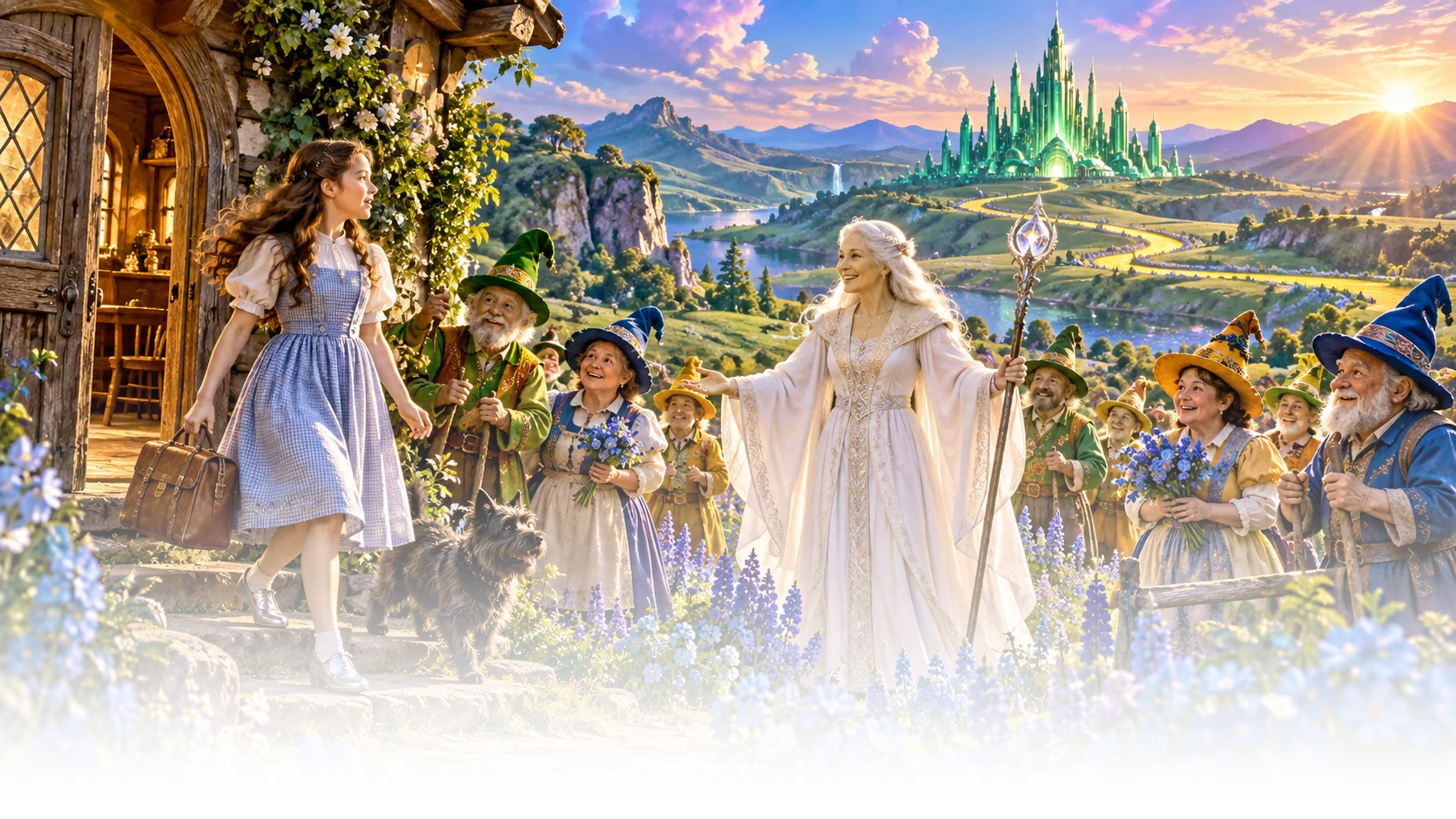
The house lands in a country so alive with water, flowers and color that Kansas seems almost unimaginable. Villagers approach with a kindly northern witch. They thank Dorothy for ending the rule of the Wicked Witch of the East, whose death beneath the house was accidental. Dorothy is bewildered by the honors: she intended to rescue a dog, not overthrow a ruler.
The dead witch leaves silver shoes. Their power is known imperfectly, and Dorothy puts them aside before setting out. The good witch cannot send her home, but points her toward the Wizard in the central Emerald City. She grants a protective kiss. Thus the journey begins with both a resource and an unanswered question: why seek distant power when an unrecognized possibility is already close at hand?
Primary narrative: Baum, chapter 2. 18 Original AI-generated conceptual illustration; not an extracted film frame.
The meaning beneath the scene
| Element | Interpretive meaning | Evidence status |
|---|---|---|
| Eastern witch | Domination associated with eastern industrial and financial interests. | Established Populist interpretation; not a literal institution. |
| Munchkins | People living under an oppressive hierarchy. | Broad social correspondence. |
| Silver shoes | The free-silver alternative to a gold-centered monetary order. | Central monetary interpretation; shoes are silver in the book. |
| Northern witch and kiss | Protection, partial knowledge and assistance without omnipotence. | Literary reading; exact historical identity uncertain. |
Scholarly interpretation
Liberation and knowledge do not arrive together. Dorothy changes the political situation while remaining ignorant of the shoes. A monetary reading can draw on that gap: possessing a resource is not the same as knowing how to use it. It also limits simplistic interpretations: an accidental death is not a policy proposal, and the good witch admits limits. Power is plural in Oz. The center is prestigious, but neither the center nor the periphery possesses all relevant information.
A modern Federal Reserve lens
Modern analogy: a crisis can expose concentrations of power and reopen debates about monetary arrangements. A responsible discussion distinguishes the Federal Reserve, commercial banks, Congress and the Treasury rather than collapsing them into a single eastern villain. The shoes invite inquiry into available alternatives; they do not demonstrate that a silver standard would solve contemporary problems. Institutional reform requires practical mechanisms and evidence beyond a symbolic victory.
Where the comparison stops
The silver interpretation draws its force from the 1890s debate. The East is not a documented code for the Federal Reserve, and a witch cannot supply evidence about who controls a real institution.
When does possessing an alternative differ from understanding how to use it?
Source notes: narrative 19, chapter 2; established Populist readings 20, disputed intent 21. Modern lens is original commentary; institutional context 22.
Chapter 03
How Dorothy Saved the Scarecrow
Knowledge grows legs
The story
Dorothy prepares food, changes into clean clothes and finds that the silver shoes fit. The yellow-brick road leads through cultivated countryside, where hospitality briefly makes the journey feel possible. People read her dress and shoes as signs of magical status. She knows herself as an ordinary traveler, but accepts their kindness without accepting their explanation of her.
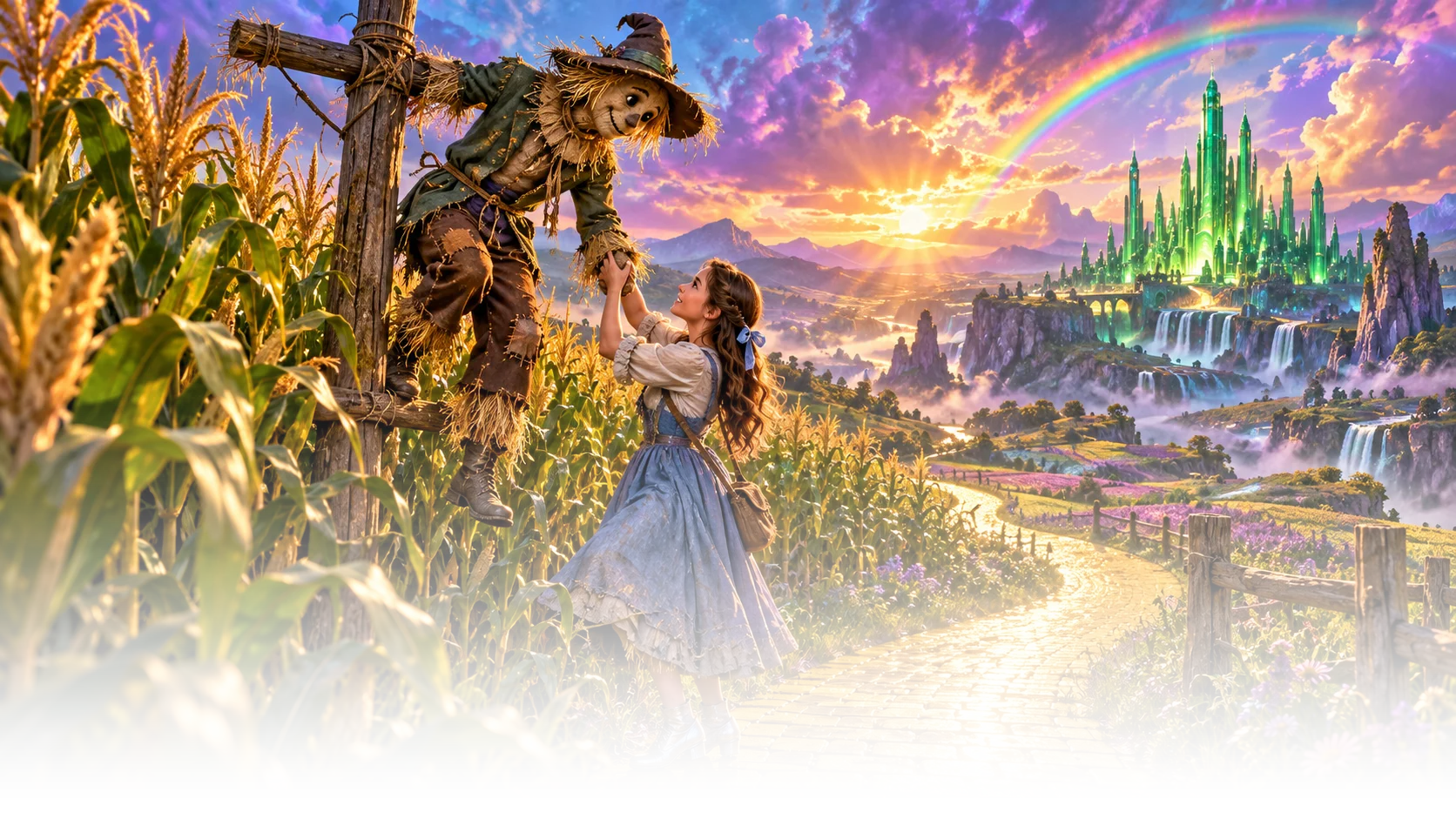
In a cornfield she discovers a Scarecrow who can speak but cannot leave his pole. She lifts him down, and he joins the journey to ask the Wizard for brains. His fear is less about pain than humiliation: he does not want to be dismissed as a fool. The road now carries a partnership between someone seeking a home and someone seeking recognition of a capacity he will repeatedly demonstrate.
Primary narrative: Baum, chapter 3. 23 Original AI-generated conceptual illustration; not an extracted film frame.
The meaning beneath the scene
| Element | Interpretive meaning | Evidence status |
|---|---|---|
| Scarecrow | The underestimated farmer and practical intelligence. | Established Populist reading. |
| Cornfield and pole | Productive land; a figure useful to others yet immobilized. | Textual setting with an original agency reading. |
| Yellow bricks | Gold-standard rules directing the monetary journey. | Central monetary interpretation. |
| Silver shoes on yellow road | Silver moving within a gold-centered system. | Strong visual basis for the bimetallic reading. |
Scholarly interpretation
The Scarecrow makes a distinction between intelligence and certified intelligence. His self-description anticipates a credential he believes only the Wizard can grant. Yet participation begins before certification. Dorothy supplies liberation, not a diploma. The agrarian interpretation becomes persuasive because the figure stands inside the productive countryside and is underestimated, but the broader question is whose knowledge counts: institutions may overlook useful knowledge when it comes from unfamiliar people or in unfamiliar forms.
A modern Federal Reserve lens
Modern analogy: economic expertise benefits from information beyond the policy room. Farmers, borrowers and small businesses observe local conditions that national summaries can miss. Listening does not make every anecdote representative; it identifies questions that data should test. The Fed has regional institutions as well as a central Board. The Scarecrow invites a conversation about whose experience enters policy analysis, rather than a blanket rejection of technical knowledge.
Where the comparison stops
The story gives no proof that farmers uniformly favored one monetary policy. The farmer mapping is an interpretive tradition, not a survey of agricultural opinion.
What valuable knowledge is ignored when authority recognizes only formal credentials?
Source notes: narrative 24, chapter 3; established Populist readings 25, disputed intent 26. Modern lens is original commentary; institutional context 27.

Chapter 04
The Road Through the Forest
A rule is not the same as a safe passage
The story
The prosperous countryside falls behind. The road becomes uneven, the forest thickens, and Dorothy must attend to food and shelter rather than admire the destination. Her companion discovers that walking beside someone creates obligations as well as conversation. She must sleep and eat; he can remain awake. Their differences become useful instead of embarrassing.
During the night, the Scarecrow tells the short history of his life. He learned to doubt himself when a crow exposed the limits of his appearance. Dorothy listens while resting in a cottage. The journey takes a quieter turn: what had looked like an empty figure now has a memory, a wound and a reason to hope. Friendship begins to revise the judgments that sent him toward the Wizard.
Primary narrative: Baum, chapter 4. 28 Original AI-generated conceptual illustration; not an extracted film frame.
The meaning beneath the scene
| Element | Interpretive meaning | Evidence status |
|---|---|---|
| Broken road | A prestigious rule can remain difficult to live under. | Monetary analogy grounded in the road motif. |
| Forest | Uncertainty and incomplete information. | General literary metaphor. |
| Food and sleep | Embodied needs that abstractions cannot cancel. | Textual fact; original economic reading. |
| Crow and remembered humiliation | External judgment shaping self-belief. | Literary interpretation; no secure political identity. |
Scholarly interpretation
The chapter prevents the road from becoming a frictionless diagram. An institution may specify a path while failing to guarantee passability. Dorothy and the Scarecrow also have different needs: a policy that leaves one participant untroubled may exhaust another. The narrative invites distributional analysis. Its quiet conversation supplies a second kind of infrastructure, trust, through which different capacities can become complementary rather than mutually disqualifying.
A modern Federal Reserve lens
Modern analogy: a national interest-rate decision enters many different financial lives. A saver, a variable-rate borrower and a business seeking financing do not experience it identically. These differences do not by themselves determine the appropriate policy. They do explain why aggregate objectives need analysis of transmission and distribution. Monetary tools influence financial conditions; the route from a policy decision to household welfare contains many intermediaries.
Where the comparison stops
The forest has no established one-to-one counterpart in monetary history. Reading every tree as a bank would add precision without evidence.
Who finds a common rule easy to follow, and who pays more to remain on the same road?
Source notes: narrative 29, chapter 4; established Populist readings 30, disputed intent 31. Modern lens is original commentary; institutional context 32.

Chapter 05
The Rescue of the Tin Woodman
The machinery needs care
The story
A groan leads the travelers to a man made of tin, fixed in place by rust. They find his oil can and restore movement to his joints. He explains that he once had an ordinary body and a hoped-for marriage. An enchanted axe injured him repeatedly, and replacement parts gradually made him metal. The mechanical repairs preserved his ability to work while leaving him convinced that he had lost his heart.
He joins the party to ask for that missing heart. Yet his story already contains tenderness, longing and grief. Restoring movement is a cooperative act; restoring a sense of humanity will take longer. The forest now holds a remarkable trio: a child who remembers home, a straw man who discounts his own thoughts, and a metal worker who mistakes a changed body for the disappearance of feeling.
Primary narrative: Baum, chapter 5. 33 Original AI-generated conceptual illustration; not an extracted film frame.
The meaning beneath the scene
| Element | Interpretive meaning | Evidence status |
|---|---|---|
| Tin Woodman | Industrial labor and the fear of dehumanization. | Established Populist reading. |
| Enchanted axe | Productive work transformed into injury. | Textual motif; broader labor interpretation. |
| Rust | Paralysis rather than absence of useful capacity. | Original economic extension. |
| Oil can | Maintenance and restored ability to act. | Original liquidity analogy; not established code. |
| Missing heart | Human value judged by an inadequate external standard. | Literary interpretation. |
Scholarly interpretation
Replacing body parts with machinery does not settle the philosophical question of personhood. The Woodman can suffer loss and care about others while insisting that he cannot love. Economically, the episode can illuminate labor alienation: productive competence survives while a worker experiences estrangement from a meaningful life. Oil restores functionality, but the desired heart concerns recognition. These are different problems. Treating both as the same repair would erase the distinction between operating capacity and human flourishing.
A modern Federal Reserve lens
Modern analogy: oil can illustrate liquidity, the ability to meet immediate obligations and keep transactions moving. It should not be equated with solvency, the adequacy of resources relative to obligations. Funding assistance may help a viable institution through a temporary shortage; it cannot automatically repair deep losses or provide decent working conditions. The heart reminds us that financial functioning and welfare overlap without being interchangeable.
Where the comparison stops
The oil-as-liquidity comparison is this book’s teaching metaphor. There is no evidence that Baum encoded a central-bank lending facility into an oil can.
When does a system need short-term funding, and when does it need a more fundamental repair?
Source notes: narrative 34, chapter 5; established Populist readings 35, disputed intent 36. Modern lens is original commentary; institutional context 37.

Chapter 06
The Cowardly Lion
A roar does not settle the question of courage
The story
A Lion rushes onto the road, frightens the companions and threatens Toto. Dorothy confronts him. His impressive performance collapses into a confession: he is frightened and ashamed of it. He imagines that the Wizard can supply courage just as easily as others hope to obtain brains or a heart.
The group accepts him despite his bluster. His body can protect them, but his membership depends on admitting vulnerability. The journey now has four distinct desires. None is merely a duplicate of another. A wish for courage joins thought, care and belonging, suggesting that an adequate common life requires capacities that cannot all be measured by the same scale.
Primary narrative: Baum, chapter 6. 38 Original AI-generated conceptual illustration; not an extracted film frame.
The meaning beneath the scene
| Element | Interpretive meaning | Evidence status |
|---|---|---|
| Lion | William Jennings Bryan in the familiar Populist reading. | Historical interpretation; disputed as authorial intent. |
| Roar | Political rhetoric and the performance of authority. | Broad interpretive extension. |
| Confession of fear | The difference between appearance and inner confidence. | Strong literary motif. |
| Dorothy protecting Toto | Ethical action by someone without institutional rank. | Literary interpretation. |
Scholarly interpretation
Courage becomes something the Lion does, not simply something he possesses. The Lion’s fear is real, but it will not prevent every brave act. The Bryan identification adds a political layer: dramatic speech need not guarantee successful mobilization. It must remain contextual, however. To equate electoral defeat with personal cowardice would reproduce the character’s own mistake, assessing a complex capacity through a simplistic verdict. The narrative distinguishes a public performance from the actions through which character becomes legible.
A modern Federal Reserve lens
Modern analogy: policy communication can sound decisive while facing genuine uncertainty. Credibility requires more than a confident voice; it depends on intelligible objectives, suitable tools and responses consistent with evidence. A central bank may need to acknowledge uncertainty without surrendering responsibility. The Lion illustrates that admission of limits can coexist with action. He is not a disguised chair of the Federal Reserve.
Where the comparison stops
The Bryan mapping belongs to the monetary-allegory tradition. The book supplies no documentary evidence identifying the Lion with a later monetary official.
Can admitting uncertainty strengthen a leader’s credibility rather than diminish it?
Source notes: narrative 39, chapter 6; established Populist readings 40, disputed intent 41. Modern lens is original commentary; institutional context 42.

Chapter 07
The Journey to the Great Oz
Cooperation builds the missing bridge
The story
The forest becomes dangerous. Ravines interrupt the road, fierce beasts threaten the travelers, and a river demands a crossing. The Lion’s strength, the Woodman’s tools and the Scarecrow’s plans take turns becoming indispensable. Dorothy and Toto survive because the companions combine capacities instead of waiting for a perfect individual rescuer.
Even a successful plan can misfire. On the river, the Scarecrow becomes stranded on a pole and must be helped by a stork. The party learns that ingenuity does not eliminate contingency. They continue toward Oz, but the most tangible assistance so far has come from one another and from a creature outside the original coalition.
Primary narrative: Baum, chapter 7. 43 Original AI-generated conceptual illustration; not an extracted film frame.
The meaning beneath the scene
| Element | Interpretive meaning | Evidence status |
|---|---|---|
| Ravines | Interruptions that a formal route cannot solve alone. | Original institutional metaphor. |
| Bridge and raft | Infrastructure created by complementary capacities. | Textual action; cooperative reading. |
| Kalidahs | Concrete dangers requiring collective response. | No secure monetary identity. |
| Stork | Help supplied outside the established group. | Literary reading of reciprocal dependence. |
Scholarly interpretation
This episode complicates the hope that a distant center can provide every rescue. The destination commands prestige, yet the travelers repeatedly generate solutions before reaching it. Collective action has a material dimension: tools, strength and deliberation must be organized into bridges and transport. The rescued Scarecrow also prevents competence from becoming invulnerability. A capable participant can become stranded by the very instrument used for progress. Institutions require recovery arrangements as well as plans for ordinary operation.
A modern Federal Reserve lens
Modern analogy: financial stability depends on several actors with different powers. Monetary policy, bank management, supervision, fiscal choices and payment infrastructure are related but distinct. One should ask which actor can solve which problem before demanding a universal rescue from the Fed. The bridge is a useful image of coordination; the stork reminds us to consider arrangements that operate when the original plan fails.
Where the comparison stops
The Kalidahs, raft and stork resist precise historical decoding. Their educational usefulness comes from the structure of cooperation, not an alleged secret identity.
What happens when a capable participant becomes stranded by the mechanism meant to help everyone advance?
Source notes: narrative 44, chapter 7; established Populist readings 45, disputed intent 46. Modern lens is original commentary; institutional context 47.
Chapter 08
The Deadly Poppy Field
Beauty can hide an accumulating danger
The story
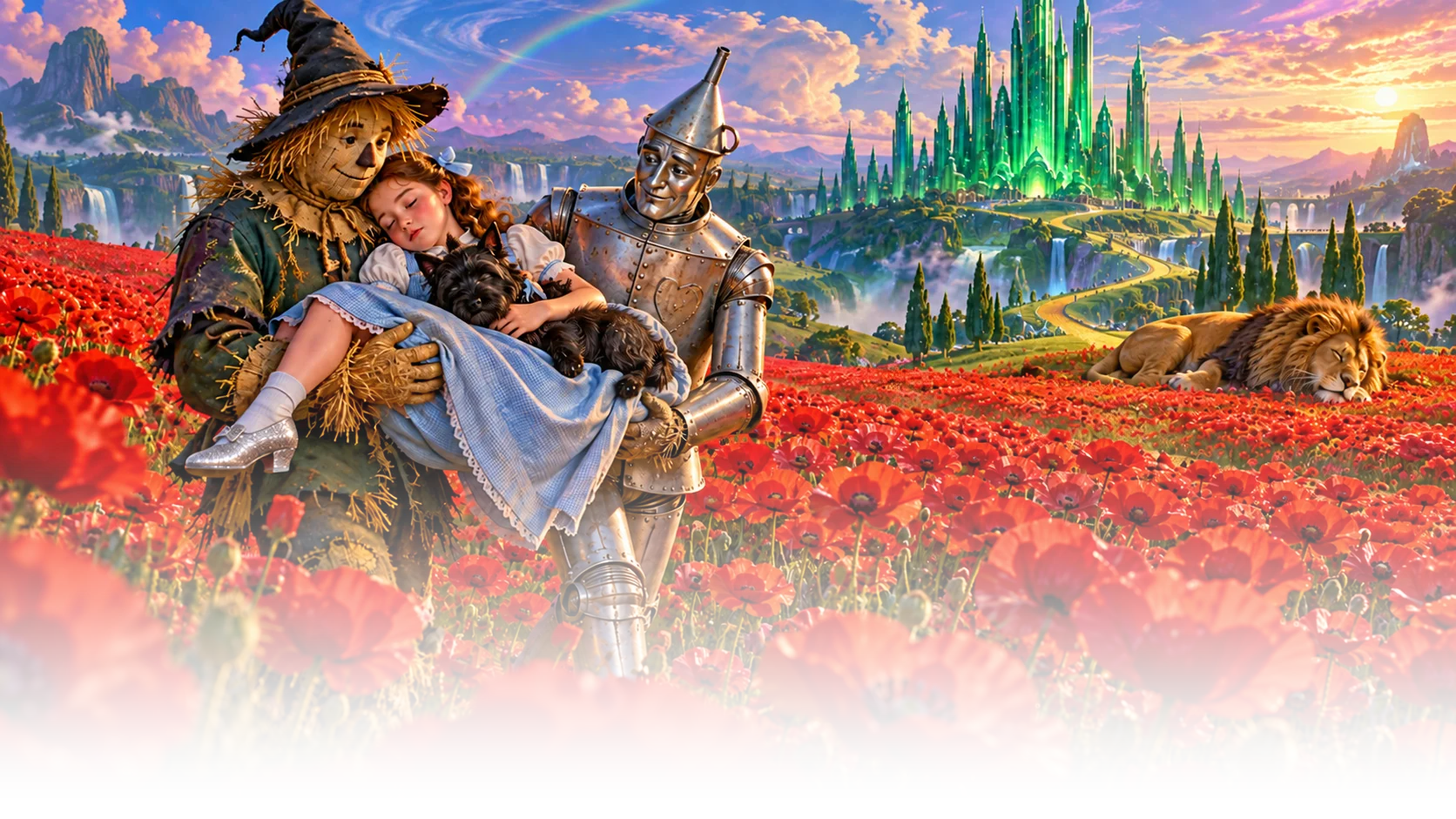
After hardship comes a field of extraordinary flowers. Dorothy breathes their scent and grows sleepy. The color promises relief while the atmosphere threatens to stop the journey entirely. She and Toto fall asleep. The Scarecrow and Woodman, who do not breathe as living creatures do, carry them toward safety.
The Lion is different. His strength cannot shield him from the poppies, and his weight makes him difficult to move once he sleeps. The field turns a blessing into a trap by separating appearance from consequences. A beautiful place can be dangerous without looking malicious; a strong friend can become the member who needs the most help.
Primary narrative: Baum, chapter 8. 48 Original AI-generated conceptual illustration; not an extracted film frame.
The meaning beneath the scene
| Element | Interpretive meaning | Evidence status |
|---|---|---|
| Scarlet poppies | Seductive relief that conceals risk. | Literary reading; monetary counterpart uncertain. |
| Sleep | Suspended agency and delayed recognition of danger. | Original behavioral extension. |
| Nonbreathing companions | Different exposures to a shared environment. | Textual fact; distributional reading. |
| Heavy Lion | A large participant whose rescue strains ordinary capacity. | Original systemic-risk analogy. |
Scholarly interpretation
The field shows how the same danger can affect travelers differently. A common environment produces different effects because the participants have different constitutions. Risk cannot therefore be inferred from appearance alone or from the survival of the least exposed members. The episode also reverses the hierarchy of strength: a heavy body becomes a rescue problem. This is a suggestive framework for thinking about vulnerability, but it does not justify assigning the flowers a particular drug, financial product or historical episode.
A modern Federal Reserve lens
Modern analogy: apparently favorable financial conditions can encourage complacency while vulnerabilities build. That possibility requires evidence about leverage, funding and exposures; bright markets alone prove nothing. The Lion can help illustrate why the distress of a large institution may impose coordination costs on others. Neither institutional size nor a beautiful asset-price chart establishes that a rescue is appropriate. A metaphor starts the inquiry; balance sheets and rules must finish it.
Where the comparison stops
No firm source establishes a unique monetary meaning for the poppies. This chapter develops a modern risk analogy rather than attributing a detailed mechanism to Baum.
What indicators distinguish genuine stability from the pleasant feeling that nothing can go wrong?
Source notes: narrative 49, chapter 8; established Populist readings 50, disputed intent 51. Modern lens is original commentary; institutional context 52.
Chapter 09
The Queen of the Field Mice
Small helpers, enormous consequences
The story
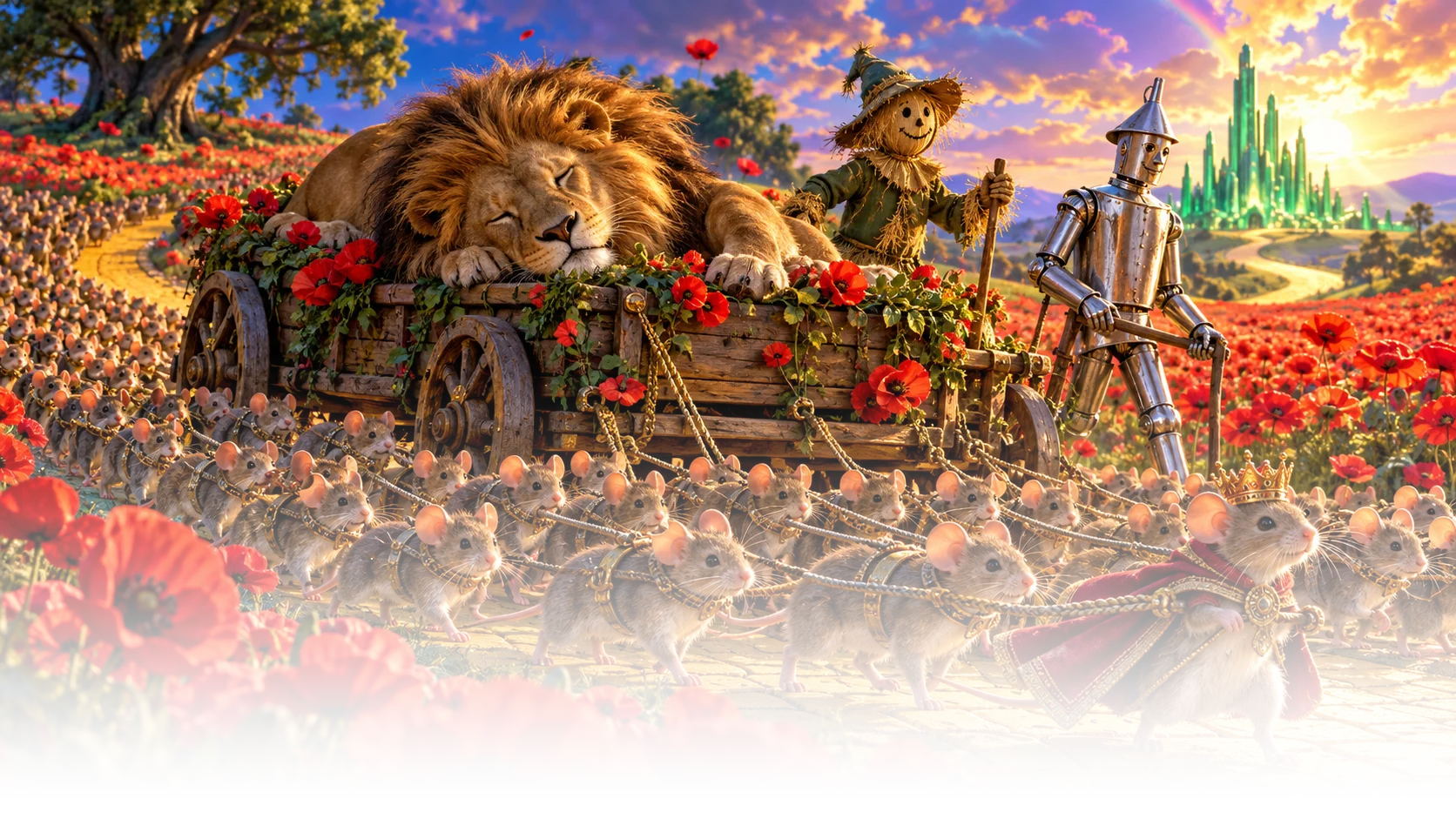
The Woodman saves a field mouse from a wildcat. The mouse is a queen, and gratitude opens a route to assistance. Her subjects are tiny, but there are many of them. A cart can turn their separate efforts into a force large enough to move the sleeping Lion.
Ropes, wheels and coordination accomplish what individual strength could not. The rescue is not a miracle from the palace. It grows from a compassionate act, a remembered obligation and the organization of modest capacities. When the Lion wakes, the scale of his body no longer looks like the scale of his importance. The smallest inhabitants have altered the outcome of the largest member’s crisis.
Primary narrative: Baum, chapter 9. 53 Original AI-generated conceptual illustration; not an extracted film frame.
The meaning beneath the scene
| Element | Interpretive meaning | Evidence status |
|---|---|---|
| Mouse queen | Leadership that organizes rather than overwhelms. | Literary interpretation. |
| Many mice | Distributed capacity and collective action. | Original social-economic extension. |
| Cart and ropes | A mechanism translating separate efforts into shared power. | Textual fact; institutional reading. |
| Saved mouse | Reciprocity created by care rather than bargaining alone. | Literary interpretation. |
Scholarly interpretation
Organization lets small efforts add up to something larger. The mice are not individually transformed into giants; their efforts become effective because a cart and coordinated roles connect them. The chapter thus illustrates a distinction between possessing resources and arranging resources. It also makes reciprocity consequential without reducing it to a contract. Help follows from the Woodman’s care, and the rescue preserves a coalition that will continue acting together. Institutional capacity can be relational as well as material.
A modern Federal Reserve lens
Modern analogy: payment networks and collective safeguards work through connected contributions and agreed procedures. This is a broad coordination analogy, not a claim that mice represent depositors or that every collective mechanism is a central bank. The practical question is how many limited capacities become reliable common capacity. Sound design also asks who contributes, who benefits and what happens when some participants cannot perform their role.
Where the comparison stops
Assigning each mouse to a financial institution would be arbitrary. The episode supports an account of coordination more securely than a named monetary code.
Which mechanisms let small contributions become effective without hiding who bears the cost?
Source notes: narrative 54, chapter 9; established Populist readings 55, disputed intent 56. Modern lens is original commentary; institutional context 57.

Chapter 10
The Guardian of the Gates
The rules of entry also shape perception
The story
The travelers finally reach the Emerald City. A guardian listens to their requests and prepares them for entry. Before they may proceed, he equips them with green spectacles, fastening the frames so that the visitors cannot simply remove them. The city’s brightness is presented as the reason for this requirement.
Dorothy and her companions pass through an imposing boundary into a world already filtered for them. The scene is hospitable and restrictive at once. The center promises answers, but it sets the terms under which visitors will see. Their needs remain their own; the visual language through which those needs will be addressed belongs to the institution.
Primary narrative: Baum, chapter 10. 58 Original AI-generated conceptual illustration; not an extracted film frame.
The meaning beneath the scene
| Element | Interpretive meaning | Evidence status |
|---|---|---|
| Gate | Access controlled by procedures and an intermediary. | Literary-institutional reading. |
| Locked green spectacles | A compulsory frame through which the city is perceived. | Textual feature important to the monetary reading. |
| Guardian | Enforcement of rules without necessarily controlling their purpose. | Original institutional extension. |
| Green brilliance | Wealth, legitimacy and the appearance of abundance. | Monetary interpretation; not proof of counterfeit value. |
Scholarly interpretation
The spectacles turn attention from what people see to the conditions under which they see it. A perception may be shared because everyone uses the same filter. That need not make every observed object imaginary, but it complicates claims based only on appearance. Institutionally, the guardian represents the difference between executing a rule and authoring it. The most productive question is epistemological: which procedures make some features vivid while leaving others difficult to see?
A modern Federal Reserve lens
Modern analogy: economic interpretation depends on categories, models and measurement choices. Inflation, employment and financial conditions require definitions; those definitions should be inspectable. This does not make the data fraudulent. It means that a metric’s scope and exclusions matter. The spectacles invite readers to compare measurements and lived experience, rather than treating every official statistic as either complete truth or deliberate deception.
Where the comparison stops
A mandated lens in a fantasy city cannot establish that the Federal Reserve falsifies statistics. Such an allegation would require independent evidence about specific data and procedures.
What does a useful measurement illuminate, and what does it leave outside the frame?
Source notes: narrative 59, chapter 10; established Populist readings 60, disputed intent 61. Modern lens is original commentary; institutional context 62.

Chapter 11
The Emerald City of Oz
One authority, several performances
The story
The palace supplies fine rooms and an atmosphere of extraordinary importance. The companions must meet Oz separately. Dorothy sees a gigantic head; the Scarecrow sees a lovely woman; the Woodman sees a terrible beast; the Lion sees a ball of fire. Each audience receives a different image of the same hidden ruler.
The requests are simple, but the answer comes with a formidable condition: defeat the Wicked Witch of the West. Assistance is deferred until a dangerous task is completed. The destination has become another departure. The travelers sought resolution, yet the center converts their needs into obligations before it reveals whether it can satisfy them.
Primary narrative: Baum, chapter 11. 63 Original AI-generated conceptual illustration; not an extracted film frame.
The meaning beneath the scene
| Element | Interpretive meaning | Evidence status |
|---|---|---|
| Emerald City | Washington and the prestige of a political center. | Established historical reading. |
| Four appearances | Authority adapted to the fears or expectations of each audience. | Textual motif; original communication analysis. |
| Private audiences | Fragmented information among those seeking help. | Original institutional reading. |
| Demand to defeat the witch | Conditional assistance and displaced responsibility. | Literary interpretation. |
Scholarly interpretation
The companions encounter authority through staged appearances, not directly. Separate audiences prevent the companions from immediately comparing what they see, allowing incompatible presentations to coexist. The demand for a dangerous task creates an asymmetry between a petitioner’s need and the ruler’s discretion. These features invite analysis of information and bargaining power. They do not yet demonstrate that every institutional condition is illegitimate. The issue is whether conditions serve a defensible purpose and whether the promised capacity exists.
A modern Federal Reserve lens
Modern analogy: central-bank communication reaches households, investors and banks through different channels. Policy announcements can change expectations, but the Fed also has legal and operational powers that Oz’s staged apparitions lack. Conditional lending can involve eligibility and collateral requirements; those requirements should be evaluated on their real design. The chapter offers questions about access and communication, not a literal description of a secret policy theater.
Where the comparison stops
The Wizard has often been read as political leadership. Recasting him as the Fed is a later comparison. Equating legitimate policy communication with a fraudulent apparition would exceed the evidence.
How can separate audiences compare claims and discover whether promised assistance has a workable basis?
Source notes: narrative 64, chapter 11; established Populist readings 65, disputed intent 66. Modern lens is original commentary; institutional context 67.

Chapter 12
The Search for the Wicked Witch
The resource a tyrant cannot fully command
The story
The travelers leave the city and enter the western country. The witch observes them and sends dangers against them. The companions resist several attacks through courage and ingenuity, but the Winged Monkeys eventually scatter or capture the party. Dorothy’s protective mark prevents her destruction, and the witch makes her work instead.
The witch covets the silver shoes and uses a trick to steal one. Angered by the theft, Dorothy throws water, not knowing that it will destroy her captor. The witch dissolves, and Dorothy recovers the shoe. The decisive act is neither a grand speech nor an instruction from Oz: it arises from resistance to a petty-looking violation that carries enormous importance.
Primary narrative: Baum, chapter 12. 68 Original AI-generated conceptual illustration; not an extracted film frame.
The meaning beneath the scene
| Element | Interpretive meaning | Evidence status |
|---|---|---|
| Western witch | A coercive power; western hardship in some readings. | Historical correspondences vary. |
| Wolves, crows and bees | Successive attacks testing different capacities. | Textual dangers; precise political identities speculative. |
| Stolen silver shoe | Control over an alternative source of power. | Fits the monetary reading; not a policy mechanism. |
| Water | An ordinary substance defeating apparently overwhelming power. | Literary motif; rainfall/revival is a possible analogy. |
| Protective mark | A limit on the witch’s capacity for coercion. | Textual fact; no secure monetary code. |
Scholarly interpretation
The chapter layers visible and invisible constraints. The witch commands agents and imposes labor, but cannot ignore the protective mark or freely seize the shoes. Dorothy lacks knowledge of both the witch’s vulnerability and the shoes’ full power, yet she can still act. Water makes the resolution strikingly ordinary: the dramatic regime collapses through an everyday act. A monetary reading gains resonance from silver, but cannot infer a technical policy rule from dissolution.
A modern Federal Reserve lens
Modern analogy: institutions are limited by laws, resources and relationships even when they appear overwhelmingly powerful. Reform requires identifying those actual limits and available remedies. The witch is coercive; the Fed is a statutory institution with a different structure and responsibilities. Treating the bucket as a recipe for eliminating financial distress would erase those differences. The educational lesson is to investigate the mechanism behind power rather than remain hypnotized by its scale.
Where the comparison stops
The novel’s witch is not a documented representation of a named bank, family or Federal Reserve official. Geographic and monetary associations do not establish personal accusations.
Which limits on power are visible, and which become apparent only when someone tests them?
Source notes: narrative 69, chapter 12; established Populist readings 70, disputed intent 71. Modern lens is original commentary; institutional context 72.
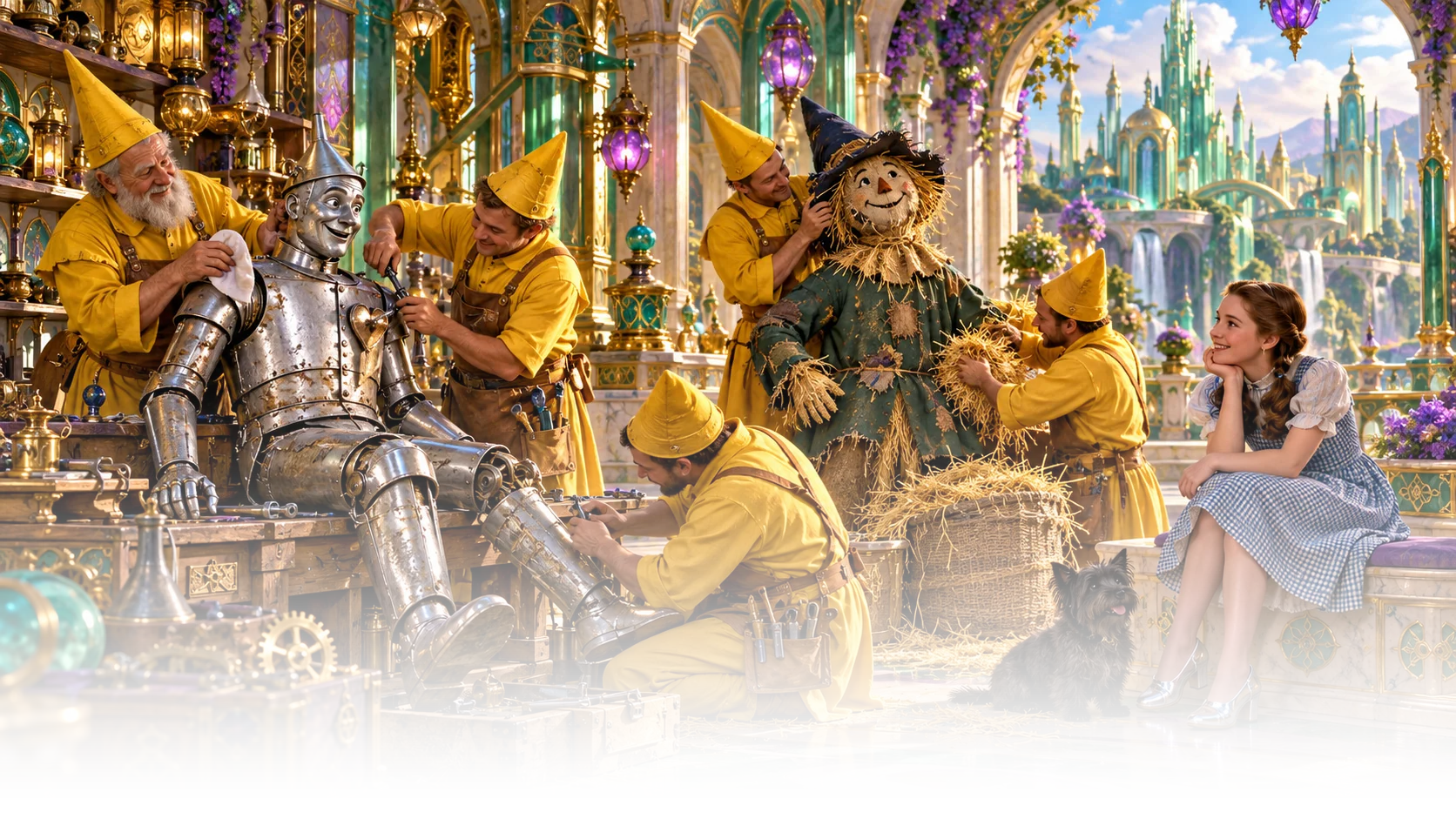
Chapter 13
The Rescue
Repair is a social accomplishment
The story
With the western witch gone, the Winkies are free. Dorothy turns first to her missing companions. Skilled local workers repair the Woodman, and the scattered Scarecrow is gathered and filled again. The victory is incomplete until the injured members of the group can participate in it.
The Winkies ask the Woodman to remain as their ruler, but he still wants the promised heart and leaves with his friends. Dorothy finds the Golden Cap and keeps it without yet understanding all its uses. The party prepares to return to the city with evidence that the demanded task is complete. The chapter lets restoration, gratitude and ordinary craft occupy the space that spectacle usually claims.
Primary narrative: Baum, chapter 13. 73 Original AI-generated conceptual illustration; not an extracted film frame.
The meaning beneath the scene
| Element | Interpretive meaning | Evidence status |
|---|---|---|
| Winkie artisans | Skilled labor rebuilding damaged capacity. | Textual fact; original reconstruction reading. |
| Restuffed Scarecrow | Recovery of participation after violent disruption. | Literary interpretation. |
| Invitation to rule | Authority earned through relationships and service. | Literary interpretation. |
| Golden Cap | An inherited instrument whose rules must be learned. | Original institutional reading. |
Scholarly interpretation
The narrative gives repair its own dignity. A defeated ruler does not automatically restore those harmed during the conflict. Restoration requires skills, time and willing cooperation. The Woodman’s invitation to govern also changes the source of legitimacy: the community recognizes someone whose character it has encountered. This contrasts with the distant Wizard’s monopoly on prestige. The chapter points toward rebuilding institutions, rather than assuming that reform ends when a villain is removed.
A modern Federal Reserve lens
Modern analogy: after a financial disturbance, restarting transactions is only one part of recovery. Firms, households and institutions may need repairs that involve many forms of expertise. Central-bank action cannot substitute for every organizational or material repair. The artisans are a reminder to identify the concrete work behind recovery and the capacities required to perform it. A policy’s success should be judged by durable functioning, not only by the announcement that a crisis has ended.
Where the comparison stops
The Golden Cap is literally magical. It should not be described as a documented code for gold reserves or a statutory emergency power.
What repairs remain necessary after the event that everyone calls the turning point?
Source notes: narrative 74, chapter 13; established Populist readings 75, disputed intent 76. Modern lens is original commentary; institutional context 77.
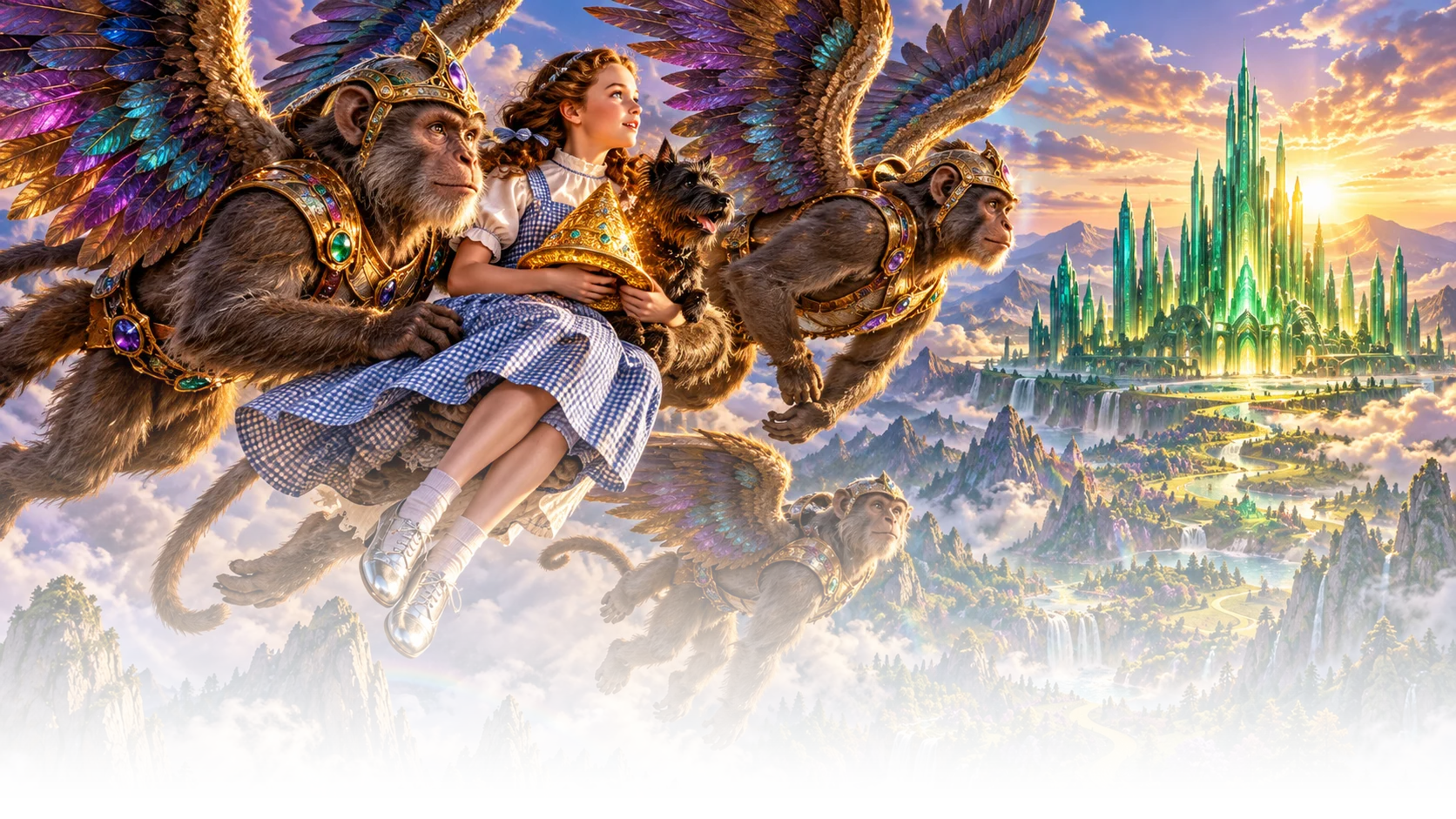
Chapter 14
The Winged Monkeys
Power travels with a rule
The story
Dorothy discovers how to use the Golden Cap and summons the Winged Monkeys. They carry the companions toward the Emerald City. Their leader explains the origin of their obligation: a prank involving Quelala led to punishment by Gayelette, and the cap became the means by which successive owners could command them a limited number of times.
The creatures who earlier appeared as agents of terror now have a history and a constraint. They are not simply the western witch’s essence made airborne. A different holder of the same instrument can direct them toward another purpose. Dorothy’s new knowledge turns a mysterious object into a usable resource, while the account of its origin raises questions about inherited authority.
Primary narrative: Baum, chapter 14. 78 Original AI-generated conceptual illustration; not an extracted film frame.
The meaning beneath the scene
| Element | Interpretive meaning | Evidence status |
|---|---|---|
| Winged Monkeys | Agents whose conduct changes under successive commands. | Textual fact; institutional extension. |
| Golden Cap | Transferable authority with a finite set of uses. | Original rules-and-discretion analogy. |
| Gayelette and Quelala | The origin story of an enduring obligation. | Literary reading; exact monetary identity unsupported. |
| Flight toward the center | Mobility made possible through learned procedure. | Original economic extension. |
Scholarly interpretation
The monkeys distinguish an agent from the authority under which it acts. Their history helps explain conduct without making every act morally innocent. The cap can pass from one holder to another, but its powers remain limited: possession matters without granting unlimited command. In institutional analysis, both features are crucial. One must ask who can exercise an authority, how that authority originated, what constraints bind it and whether inherited obligations remain justified after the original circumstances disappear.
A modern Federal Reserve lens
Modern analogy: statutory powers persist beyond the individuals who exercise them. Their proper use depends on legal limits, eligibility and accountability. The cap supplies a teaching image for bounded discretion, but the comparison remains abstract. The Federal Reserve’s powers come from legislation, not an enchanted object, and they differ across functions. A critique should identify the actual authority and constraint before treating an official’s action as unlimited command.
Where the comparison stops
Some historical readings assign the monkeys political identities, but such mappings are not secure enough to present as fact. This book treats the cap’s rule structure as an original analogy.
How should a society reassess an inherited obligation once it understands the obligation’s origin?
Source notes: narrative 79, chapter 14; established Populist readings 80, disputed intent 81. Modern lens is original commentary; institutional context 82.
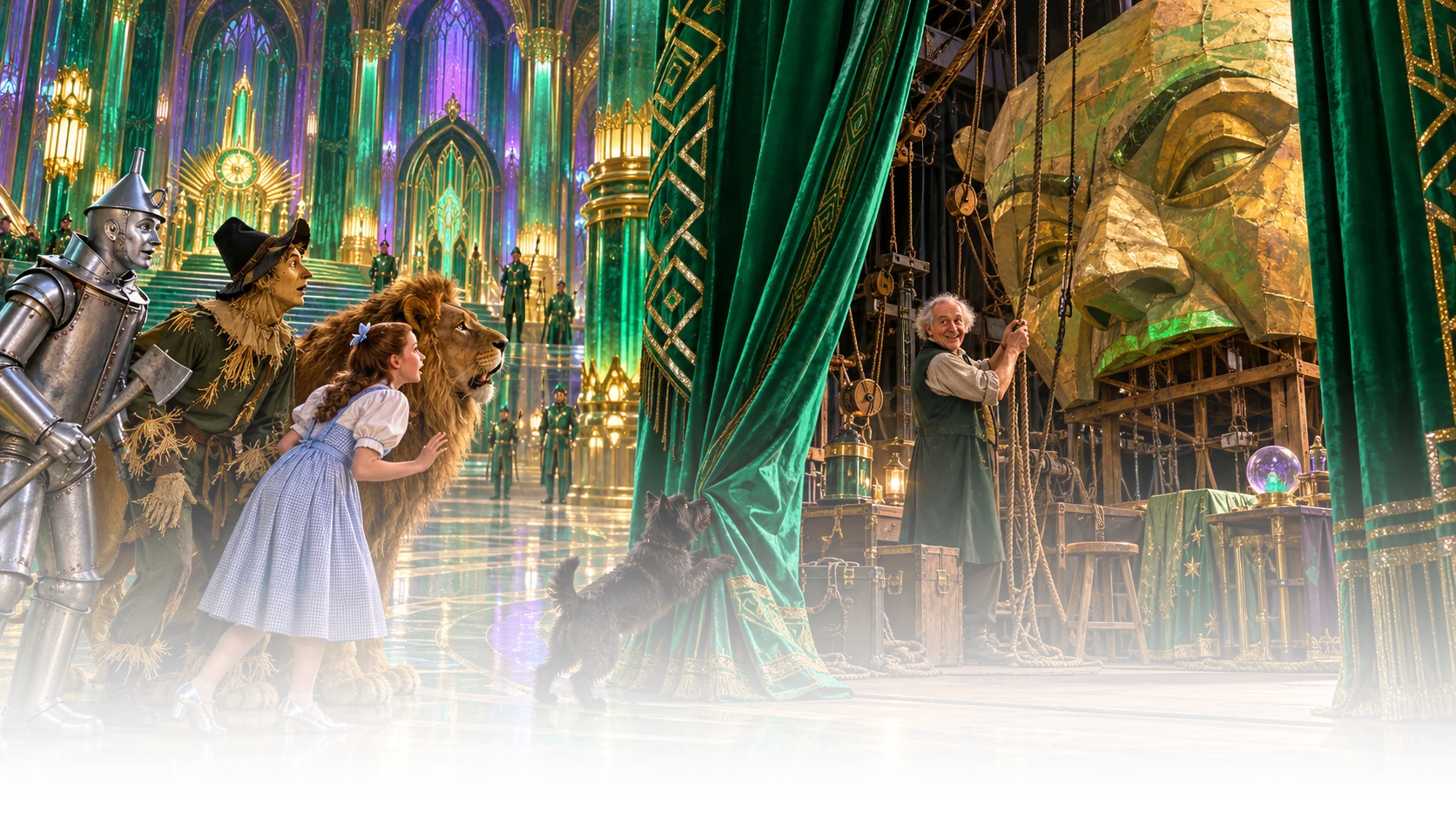
Chapter 15
The Discovery of Oz, the Terrible
Look behind the image, then inspect the mechanism
The story
The companions return expecting fulfillment. Delay and evasion make the Wizard’s authority less reassuring. In the throne room, an accident involving Toto exposes the person hidden behind a screen. The terrible ruler is an ordinary man. The different appearances were manufactured with props, disguise and a trained voice.
He explains that he came from Omaha as a balloonist and was mistaken for a powerful wizard. Rather than correct that belief, he built a life inside it. He can describe the illusion but cannot conjure the capacities the travelers requested. The revelation changes the central question: after the overwhelming image has vanished, what can this fallible person actually do?
Primary narrative: Baum, chapter 15. 83 Original AI-generated conceptual illustration; not an extracted film frame.
The meaning beneath the scene
| Element | Interpretive meaning | Evidence status |
|---|---|---|
| Screen | Separation between public image and operating mechanism. | Strong textual basis for institutional critique. |
| Toto’s intervention | Ordinary curiosity disrupting an elaborate presentation. | Literary interpretation. |
| Omaha balloonist | Human contingency behind apparently supernatural rank. | Textual fact; no later official identity. |
| Props and ventriloquism | Authority produced through controlled information. | Literary fact; modern analogy requires care. |
Scholarly interpretation
Disclosure changes the type of authority available. Charismatic terror collapses when the apparatus becomes visible, yet the man remains capable of practical assistance. The episode therefore need not imply that every institution is worthless once demystified. It distinguishes an inflated claim from an actual capacity. The next task is constructive: examine procedures, test promises and decide how much trust is warranted. Exposure without that second step can replace one totalizing belief with another.
A modern Federal Reserve lens
Modern analogy: inspect the machinery of monetary policy, including decisions, published accounts and legal powers. The Fed is an institution with real operational effects; it is not only a voice behind a screen. Its published materials provide starting points for scrutiny, while criticism should compare claims with outcomes and alternatives. Oz is useful for asking how authority is presented. He does not prove that central banking is a hoax or that money has no real consequences.
Where the comparison stops
The official film’s reveal clip is a comparison reference, not a source for this artwork. The novel’s screen and the film’s staging should not be treated as identical evidence.
After an impressive claim is demystified, what evidence would justify a smaller, more accurate degree of trust?
Source notes: narrative 84, chapter 15; established Populist readings 85, disputed intent 86. Modern lens is original commentary; institutional context 87.
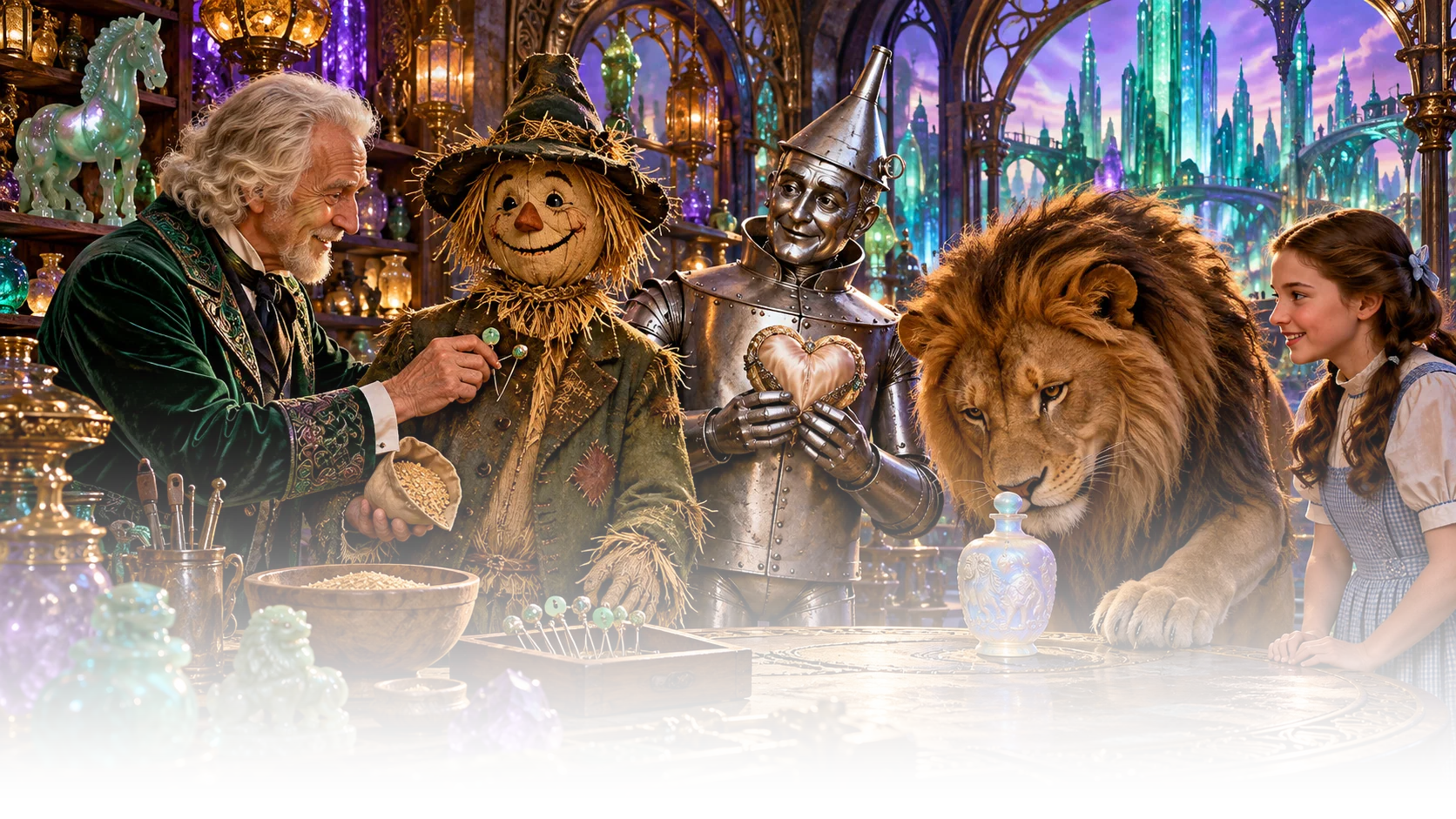
Chapter 16
The Magic Art of the Great Humbug
Recognition can change action
The story
The exposed Wizard finds a way to answer three requests. He supplies the Scarecrow with material presented as brains, places a silk heart inside the Woodman and gives the Lion a drink described as courage. The ceremonies persuade each companion that the missing capacity has finally arrived.
The reader has already seen thought, compassion and bravery along the road. The gifts do not create those qualities from nothing. They make the companions more willing to recognize and use them. Dorothy’s request remains different: symbolic reassurance cannot carry a body across a desert. The Wizard must still find an actual means of transport.
Primary narrative: Baum, chapter 16. 88 Original AI-generated conceptual illustration; not an extracted film frame.
The meaning beneath the scene
| Element | Interpretive meaning | Evidence status |
|---|---|---|
| Bran and pins | A material token authorizing confidence in intelligence. | Book detail; not the film’s diploma. |
| Silk heart | A sign confirming care already demonstrated. | Book detail; interpretive function. |
| Courage drink | A ritual changing a participant’s expectation. | Book detail; no actual pharmacological claim. |
| Dorothy’s unresolved journey | The boundary between recognition and material accomplishment. | Literary reading. |
Scholarly interpretation
The chapter distinguishes recognizing a capacity from technically producing it. A symbol can change how a person interprets a capacity and therefore how confidently it is exercised. That causal possibility does not make all symbolic claims true. The companions’ prior actions supply evidence that the capacities existed. Dorothy’s unmet need establishes the limit: recognition cannot substitute for every material task. The story’s own structure resists reducing the entire world to belief.
A modern Federal Reserve lens
Modern analogy: credible communication can influence expectations, which may affect spending, investment and financial conditions. Its force depends on context, institutional capacity and plausible future action. Monetary policy also employs concrete operations and administered rates. Confidence is therefore one channel among others. The Wizard’s gifts help distinguish the effects of a believable signal from an unlimited power to manufacture prosperity through words.
Where the comparison stops
The gifts do not establish that the dollar is an empty token or that every policy announcement is a placebo. Modern monetary institutions have legal, accounting and operational structures beyond this metaphor.
When does a symbol reveal an existing capacity, and when does it conceal the absence of one?
Source notes: narrative 89, chapter 16; established Populist readings 90, disputed intent 91. Modern lens is original commentary; institutional context 92.

Chapter 17
How the Balloon Was Launched
A plan can fail at the last connection
The story
The Wizard plans to make a balloon and return across the desert with Dorothy. The city helps prepare the fabric and basket. A public departure promises to settle the journey at last. He appoints the Scarecrow to govern after his departure, and the center begins to imagine life without the figure who seemed indispensable.
At the crucial moment, Dorothy is occupied with Toto. The balloon departs without her. The Wizard rises away while she remains on the ground, watching a plausible solution become an irreversible missed connection. The plan had a mechanism, unlike his earlier magic, but it still depended on timing and coordination. Hope now requires another route.
Primary narrative: Baum, chapter 17. 93 Original AI-generated conceptual illustration; not an extracted film frame.
The meaning beneath the scene
| Element | Interpretive meaning | Evidence status |
|---|---|---|
| Balloon | A real but fragile mechanism replacing supernatural promise. | Textual fact; original implementation analogy. |
| Departure without Dorothy | A coordination failure between plan and beneficiary. | Literary reading. |
| Scarecrow’s succession | Continuity after the loss of a central personality. | Institutional extension. |
| Toto | Attachment that cannot simply be excluded from the objective. | Literary interpretation. |
Scholarly interpretation
An idea can work in principle and still fail in practice. The balloon can fly, yet it fails the relevant beneficiary because the final connection is missed. This distinction matters in evaluation: the proper outcome is not whether an instrument operates, but whether it performs its intended function. Succession adds another institutional question. If the center survives the Wizard’s exit, some of its capacity must reside in the community and its arrangements rather than in his spectacular persona.
A modern Federal Reserve lens
Modern analogy: policy transmission depends on timing and intermediate behavior. An operation may be carried out correctly while its benefits arrive late, unevenly or with unintended effects. Evaluation therefore needs evidence about the path from decision to outcome. The balloon is an illustration of implementation risk, not a coded inflation forecast. The succession invites attention to durable procedures and governance beyond individual leadership.
Where the comparison stops
A rising balloon should not automatically be called monetary inflation. The word association supplies no evidence that this scene depicts a change in the price level.
Which final connection determines whether a technically successful plan actually reaches the person it was meant to help?
Source notes: narrative 94, chapter 17; established Populist readings 95, disputed intent 96. Modern lens is original commentary; institutional context 97.

Chapter 18
Away to the South
Change direction without abandoning the purpose
The story
Dorothy remains in Oz after the balloon leaves. Her companions now possess the gifts they wanted, but her need is unresolved. She asks the Winged Monkeys to take her to Kansas and learns that they cannot travel outside Oz. A powerful instrument turns out to have a jurisdictional boundary.
The travelers hear that Glinda in the southern country may help. The companions choose to accompany Dorothy rather than retire immediately into their new prospects. The new route promises unfamiliar places and a landscape of unexpected forms. Continuing is an act of loyalty: the coalition remains intact until the least satisfied member has a reasonable chance of reaching her goal.
Primary narrative: Baum, chapter 18. 98 Original AI-generated conceptual illustration; not an extracted film frame.
The meaning beneath the scene
| Element | Interpretive meaning | Evidence status |
|---|---|---|
| Southward route | Reorientation after the central solution fails. | Literary motif; historical geography is uncertain. |
| Monkeys’ boundary | A power that works only within a specified domain. | Strong basis for an original jurisdiction analogy. |
| Companions’ decision | Solidarity after personal needs have been met. | Literary interpretation. |
| Glinda’s reputation | New expertise sought outside the original center. | Literary-institutional extension. |
Scholarly interpretation
The failed attempt to leave Oz makes a distinction clear: having power is not the same as having power everywhere. A resource may work reliably inside one domain and remain useless outside it. The companions’ continued loyalty introduces a normative condition for collective success: satisfying most participants is not enough if the unresolved participant’s objective remains central to the common journey. This is a richer account of solidarity than mere exchange, because the friends no longer require Dorothy’s help to satisfy their original requests.
A modern Federal Reserve lens
Modern analogy: monetary institutions have jurisdictional and functional limits. Some problems require fiscal action, legal reform or local services. Moving toward another source of help is not necessarily a repudiation of the original institution; it can be an accurate diagnosis of which authority has the needed capacity. The southern route illustrates matching a problem to a suitable instrument rather than asking one powerful body to solve everything.
Where the comparison stops
Glinda is not a documented representation of a modern department, monetary committee or alternative currency. This chapter uses the journey as a general lesson about scope.
How can we recognize that a problem lies outside an institution’s powers without assuming that institution has no value?
Source notes: narrative 99, chapter 18; established Populist readings 100, disputed intent 101. Modern lens is original commentary; institutional context 102.

Chapter 19
Attacked by the Fighting Trees
A boundary needs an explanation
The story
A forest blocks the road south. When the Scarecrow tries to enter, branches seize and throw him back. Another attempt brings the same result. The Woodman moves forward with his axe and cuts the branches that threaten the travelers, opening a way into the trees.
Once they pass the first row, the forest is quiet. Dorothy and her friends infer that the aggressive trees were a kind of perimeter guard. The interior does not share the boundary’s hostility. The episode ends at a high wall of white china, where another obstacle requires another practical response. Progress involves learning what an impediment actually does before deciding how to cross it.
Primary narrative: Baum, chapter 19. 103 Original AI-generated conceptual illustration; not an extracted film frame.
The meaning beneath the scene
| Element | Interpretive meaning | Evidence status |
|---|---|---|
| Fighting perimeter trees | A protective boundary experienced as exclusion. | Literary reading. |
| Repeated Scarecrow attempts | Learning from evidence rather than first impressions. | Original epistemic extension. |
| Woodman’s axe | A tool whose moral meaning depends on its use. | Textual contrast with his earlier injury. |
| Quiet inner forest | The boundary is not identical to the whole system. | Original institutional analogy. |
Scholarly interpretation
The travelers discover a localized barrier rather than a uniformly hostile landscape. The distinction matters: interpreting a perimeter as the essence of the whole forest would misidentify the problem. The axe also changes function. Earlier it was associated with the Woodman’s bodily loss; here it provides protection. A technology has no single narrative meaning independent of context. The episode asks what an object does in a particular setting, rather than labeling it inherently beneficial or harmful.
A modern Federal Reserve lens
Modern analogy: access rules can protect a system while excluding some users. Eligibility requirements should be examined for purpose, proportionality and consequences. A frustrating encounter with a financial intermediary cannot by itself establish that every part of the monetary system is hostile. The lesson is to locate the rule, determine who designed it and investigate remedies appropriate to that rule’s function.
Where the comparison stops
The trees do not supply a historical code for a particular banking regulation. The analogy concerns boundaries and diagnosis, not a recommendation to bypass financial safeguards.
Does a barrier protect a legitimate interest, impose an avoidable exclusion, or do both at once?
Source notes: narrative 104, chapter 19; established Populist readings 105, disputed intent 106. Modern lens is original commentary; institutional context 107.

Chapter 20
The Dainty China Country
Fragility changes the ethics of movement
The story
Beyond the wall lies a country of living porcelain. Its people, animals and houses are delicate, and the visitors’ ordinary movements can cause damage. A frightened little princess explains why Dorothy cannot simply take her away: life in this place cannot be treated as a decorative possession elsewhere.
The companions cross with imperfect care. Breakage can be mended, but a repair may leave marks, and the visitors cannot assume that their important mission excuses every disruption. The country becomes a lesson in scale and vulnerability. A traveler may feel small in a dangerous forest and enormous among fragile neighbors. Responsibility changes with the relation between one’s power and another’s exposure.
Primary narrative: Baum, chapter 20. 108 Original AI-generated conceptual illustration; not an extracted film frame.
The meaning beneath the scene
| Element | Interpretive meaning | Evidence status |
|---|---|---|
| Porcelain inhabitants | Fragile lives that cannot absorb every disturbance. | Literary interpretation. |
| China wall | A boundary around a vulnerable environment. | Textual fact; exact historical mapping unsupported. |
| Princess refusing removal | Autonomy and the limits of benevolent possession. | Literary reading. |
| Mended cracks | Recovery that does not erase every lasting cost. | Original welfare extension. |
Scholarly interpretation
The episode asks what care requires when people and places differ so greatly in scale. A reasonable movement in one setting can become destructive in another. The princess’s refusal also distinguishes care from appropriation: admiration does not entitle Dorothy to relocate another person. Economically, the chapter can illuminate adjustment costs and heterogeneous resilience. A repaired object is not necessarily restored to its previous condition. Analysis of recovery should therefore attend to persistent damage rather than infer completeness from resumed activity alone.
A modern Federal Reserve lens
Modern analogy: changes in financing conditions can be difficult for highly exposed households or businesses to absorb. That does not mean every policy should remain unchanged; it means adjustment costs and alternatives need examination. The porcelain country offers a way to discuss vulnerability without reducing people to a single average. Its name does not authorize a claim about China, exchange rates or a specific international monetary arrangement.
Where the comparison stops
China here means porcelain. Turning the episode into a precise geopolitical forecast would require evidence absent from the story.
Which harms remain visible after a system is officially described as repaired?
Source notes: narrative 109, chapter 20; established Populist readings 110, disputed intent 111. Modern lens is original commentary; institutional context 112.

Chapter 21
The Lion Becomes the King of Beasts
Leadership earns its audience
The story
The party enters a forest where animals live in fear of a monstrous spider. They ask the Lion for help and offer to recognize him as their king if he can protect them. He confronts the creature and kills it, ending the danger to the community.
The Lion has traveled far from the frightened roar with which he introduced himself. His new role rests on an act others have witnessed, not solely on the Wizard’s drink or the grandeur of his mane. He agrees to return after helping Dorothy. The promised kingship is held inside a prior commitment to a friend. Leadership and loyalty become compatible rather than competing demands.
Primary narrative: Baum, chapter 21. 113 Original AI-generated conceptual illustration; not an extracted film frame.
The meaning beneath the scene
| Element | Interpretive meaning | Evidence status |
|---|---|---|
| Giant spider | A concentrated danger threatening a community. | Literary motif; no secure monetary counterpart. |
| Animal assembly | Recognition supplied by those who benefit from service. | Original legitimacy reading. |
| Lion’s action | Courage demonstrated under actual risk. | Textual fulfillment of an earlier theme. |
| Promise to return | Leadership constrained by commitments already made. | Literary interpretation. |
Scholarly interpretation
Legitimacy follows performance that a community can evaluate. The episode revisits the recognition problem from a different direction: the Lion no longer waits for the central Wizard to certify him. He acts, and an audience with direct stakes recognizes the result. The chapter also resists a view of leadership based only on personal opportunity. Acceptance of rank does not erase the journey’s obligations. Political authority becomes more credible when it remains answerable to commitments beyond self-advancement.
A modern Federal Reserve lens
Modern analogy: evaluate monetary institutions through their statutory objectives, decisions and consequences rather than through personality alone. Outcomes must still be compared with shocks and plausible alternatives; a favorable result does not prove perfect policy, and an unfavorable result does not isolate the policy’s effect. The Lion’s witnessed service supplies a general accountability ideal, not a claim that a central bank should become a monarch.
Where the comparison stops
The spider is not evidence about a particular financial network, and the kingship is a fairy-tale resolution rather than a model of modern public governance.
What standards let a community distinguish valuable service from an impressive title?
Source notes: narrative 114, chapter 21; established Populist readings 115, disputed intent 116. Modern lens is original commentary; institutional context 117.
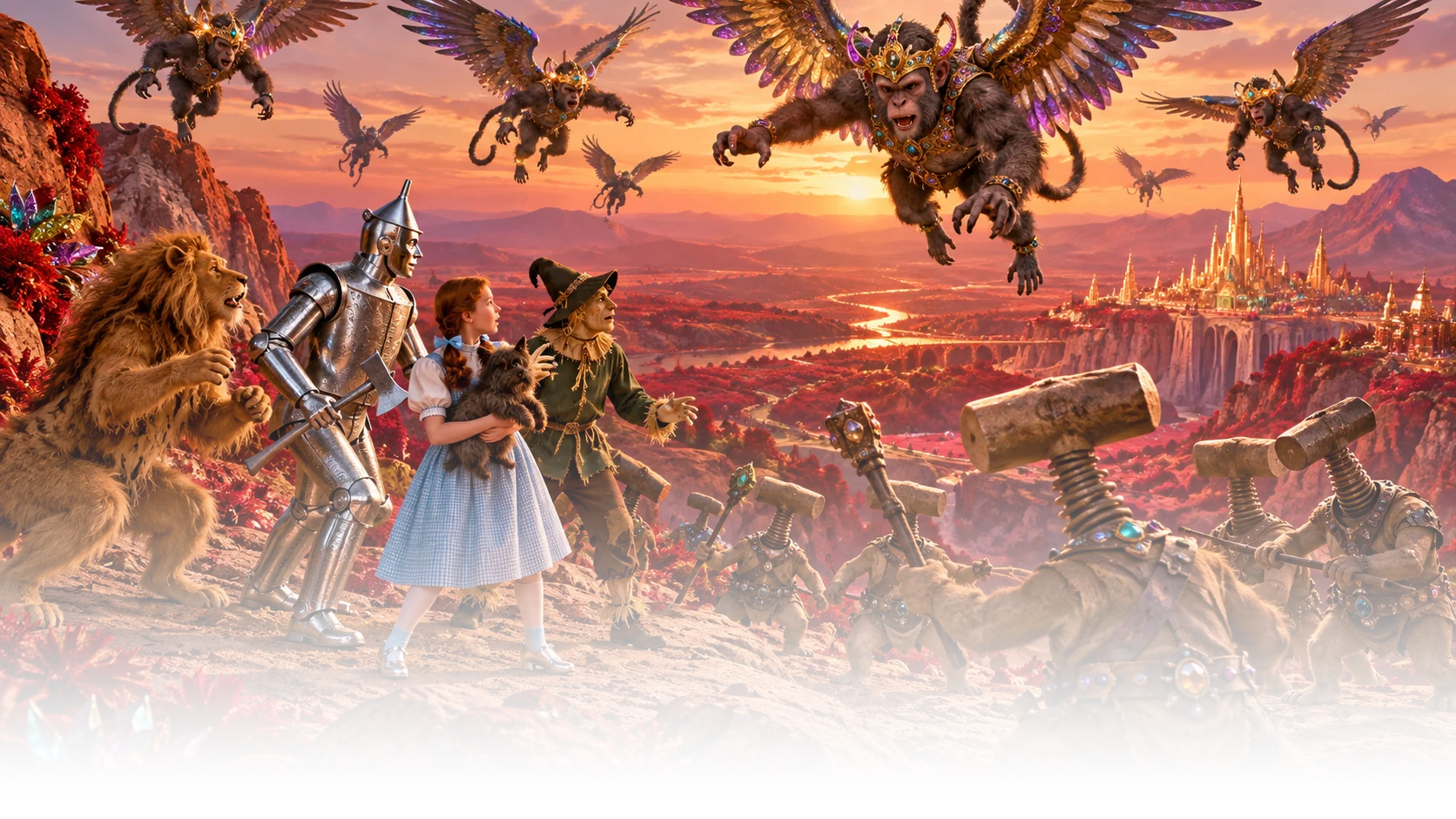
Chapter 22
The Country of the Quadlings
Take the barrier seriously; find a different route
The story
The travelers approach the southern country but encounter Hammer-Heads on a rocky hill. These creatures can extend their heads to strike anyone trying to pass. Direct attempts fail. Strength and persistence do not make the same approach successful merely because the destination matters.
Dorothy uses the Golden Cap again. The Winged Monkeys carry the party over the hill, and the remaining journey passes through the red country of the Quadlings toward Glinda’s palace. A learned instrument solves a problem that ordinary passage could not. The scene is less a triumph of brute force than a change in the level at which the problem is addressed.
Primary narrative: Baum, chapter 22. 118 Original AI-generated conceptual illustration; not an extracted film frame.
The meaning beneath the scene
| Element | Interpretive meaning | Evidence status |
|---|---|---|
| Hammer-Heads | A barrier whose mechanism punishes repeated frontal attempts. | Literary motif; no secure historical identity. |
| Rocky hill | Topography that makes some routes costly. | Original constraints reading. |
| Final summons | Finite authority allocated to a concrete task. | Textual fact; resource-use analogy. |
| Red Quadling country | A distinct region with another center of assistance. | Textual geography; political decoding uncertain. |
Scholarly interpretation
The chapter separates staying committed to a goal from refusing to change course. The travelers preserve their objective while changing the means. The cap’s limited uses also make intervention an allocation problem: the resource should address a genuine constraint rather than simply display power. This structure is useful for thinking about institutional instruments, but it does not provide a universal instruction to evade barriers. The relevant question is whether the new route is legitimate, available and better suited to the problem.
A modern Federal Reserve lens
Modern analogy: choosing a policy tool requires diagnosing the binding constraint. A financing problem, a physical shortage and a legal obstacle may look similar at the level of frustration while requiring different responses. Monetary tools cannot directly supply every scarce good or change every law. The flight over the hill illustrates instrument matching. It is not evidence that an emergency intervention is always desirable or costless.
Where the comparison stops
Neither Hammer-Heads nor the color red has an established, necessary monetary interpretation. This book keeps those details inside a literary and analytical reading.
When should a strategy change its means while preserving its purpose?
Source notes: narrative 119, chapter 22; established Populist readings 120, disputed intent 121. Modern lens is original commentary; institutional context 122.
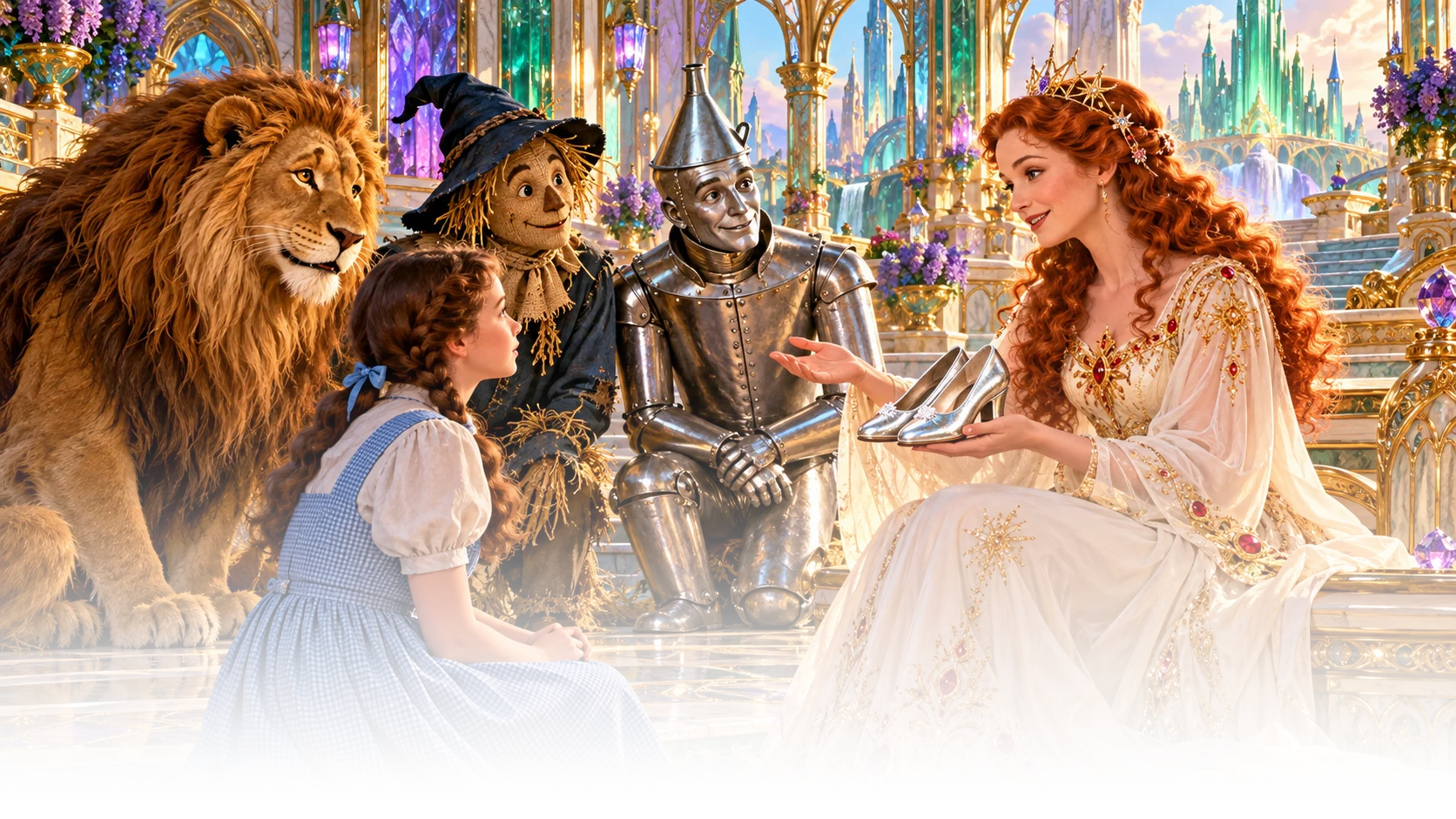
Chapter 23
Glinda the Good Witch Grants Dorothy’s Wish
The answer arrives as an explanation
The story
Glinda listens to Dorothy and asks about the silver shoes. They can carry their wearer wherever she wishes. Dorothy has possessed the means of returning home through almost the entire journey, but lacked the knowledge needed to use it. The revelation is astonishing because it changes the significance of every step already taken.
The companions nevertheless would not trade away the friendships and discoveries the journey produced. Glinda arranges their returns to the communities that now welcome them. She also plans to free the Winged Monkeys after using the cap to assist the friends. Dorothy says goodbye, gives the shoes the necessary instruction and crosses the distance that once seemed impossible.
Primary narrative: Baum, chapter 23. 123 Original AI-generated conceptual illustration; not an extracted film frame.
The meaning beneath the scene
| Element | Interpretive meaning | Evidence status |
|---|---|---|
| Silver shoes explained | The monetary alternative becomes effective only when understood. | Central monetary reading; its technical claim remains limited. |
| Glinda’s instruction | Knowledge that increases agency without demanding domination. | Literary interpretation. |
| Companions’ new homes | Distinct forms of flourishing rather than one uniform reward. | Literary reading. |
| Monkeys’ release | Authority used to end an inherited obligation. | Original institutional-reform extension. |
Scholarly interpretation
At the ending, the difference between possessing something and knowing how to use it becomes the key to the plot. A resource becomes practically effective through knowledge and a suitable action. The journey is not simply wasted, because the companions develop relationships and confidence that alter their possibilities. Glinda’s treatment of the monkeys also supplies a normative contrast with the witch: an authority may use a power to terminate domination rather than perpetuate it. These motifs support a richer reading than a single metallic solution.
A modern Federal Reserve lens
Modern analogy: financial understanding can improve a person’s capacity to use existing options, but knowledge cannot erase every income or balance-sheet constraint. The shoes should therefore inspire institutional literacy rather than a promise that everyone already possesses a hidden escape from debt. A contemporary monetary proposal requires an account of transition, stability and trade-offs. Glinda supplies an explanation, not a tested blueprint for replacing a central bank.
Where the comparison stops
Free silver was a historical policy proposal, not a demonstrated cure for every economic problem. The story’s instantaneous travel cannot validate a modern monetary reform.
What knowledge turns an available resource into a real capability, and what material constraints remain afterward?
Source notes: narrative 124, chapter 23; established Populist readings 125, disputed intent 126. Modern lens is original commentary; institutional context 127.

Chapter 24
Home Again
The measure of the journey is a human reunion
The story
Dorothy returns to Kansas. The silver shoes are lost during the passage, and the spectacular world falls behind her. Aunt Em sees the child she feared she had lost. The ending gathers the whole journey into recognition and reunion rather than a final display of riches.
The prairie is still a place of work and weather. Dorothy’s homecoming does not turn Kansas into a palace or remove the difficulties of ordinary life. What changes is the presence of a person who belongs there, and the memory of friends who helped her return. After all the colors of Oz, the story’s destination is a relationship. Wonder has taught the traveler to see what matters within the ordinary.
Primary narrative: Baum, chapter 24. 128 Original AI-generated conceptual illustration; not an extracted film frame.
The meaning beneath the scene
| Element | Interpretive meaning | Evidence status |
|---|---|---|
| Kansas reunion | Well-being measured through belonging and ordinary life. | Textual ending; broad welfare reading. |
| Lost shoes | The instrument recedes after completing its task. | Literary motif; political implications uncertain. |
| Aunt Em’s welcome | A value not reducible to exchange or prestige. | Literary interpretation. |
| Untransformed prairie | Return is not the elimination of every material difficulty. | Textual setting; analytical boundary. |
Scholarly interpretation
The ending moves the story’s measure of value from an institutional center to a human relationship. It does not prove that monetary arrangements are irrelevant; the journey has repeatedly shown how rules and resources affect action. It does establish that instruments are not identical to ends. A coherent economic interpretation must therefore ask what the monetary order enables people to do and become. The lost shoes resist a simplistic conclusion that accumulating a metallic object is itself the final measure of flourishing.
A modern Federal Reserve lens
Modern analogy: monetary stability is valuable through the lives it helps people lead. Evaluation should connect institutions to employment, purchasing power, predictable transactions and the ability to make plans, while recognizing that many other forces matter. Dorothy’s reunion gives the book an ethical destination. Neither abolishing nor praising an institution is a complete objective until the proposed arrangement explains how it improves ordinary life under real constraints.
Where the comparison stops
The novel closes a fairy-tale journey. It does not establish a quantitative verdict on the Federal Reserve or a forecast of the effects of replacing it.
What human outcome should remain visible when a debate becomes absorbed in the prestige of its instruments?
Source notes: narrative 129, chapter 24; established Populist readings 130, disputed intent 131. Modern lens is original commentary; institutional context 132.
Book and film: keep the versions distinct
Shoes and money
The 1900 novel gives Dorothy silver shoes. The 1939 film uses ruby slippers. A gold-and-silver explanation therefore fits the book’s objects more directly. A visually rich film can still inspire comparison, but the silver argument should not quietly substitute the book’s footwear into a description of the film.
The north and south
The novel distinguishes the good northern witch from Glinda in the south. Collapsing them changes the route by which Dorothy obtains knowledge. The novel also continues after the balloon departure through the southern journey, including the fighting trees, porcelain country, spider and Hammer-Heads. This book retains those chapters rather than treating the film’s familiar sequence as the entire primary narrative.
The Wizard’s gifts
The novel’s gifts include bran and pins, a silk heart and a drink presented as courage. The film’s gift scene uses a different set of recognizable objects. Our chapter sixteen follows the novel. Keeping these versions separate protects the analysis of symbols from accidental borrowing across adaptations.
Official clips for comparison
Warner Bros. Entertainment provides official YouTube clips titled Meeting The Wizard and Wizard Revealed. Their pages were located during research. No screenshot extraction, shot-by-shot viewing or exact timestamps were verified, so none is claimed. All twenty-four chapter illustrations are original AI-generated scenes based on the public-domain novel. 133
Open official clip: The Wizard of Oz: 75th Anniversary “Meeting The Wizard”
Open official clip: The Wizard of Oz: 75th Anniversary “Wizard Revealed”
A practical glossary
Gold standard and bimetallism
A gold standard links the monetary unit to a specified amount of gold under the applicable rules. Bimetallism uses both gold and silver in the legal monetary arrangement. Their performance depends on convertibility rules, metal supplies, market prices and the broader institutional setting. The historical debate cannot be reduced to yellow being bad and silver being good.
Nominal and real
Nominal means stated in money units. Real means adjusted for purchasing power or expressed in terms of goods and services. A fixed nominal debt can become harder to repay when the relevant income or output price falls. Conversely, rising prices can erode the purchasing power of a fixed payment. The appropriate comparison must specify which prices and incomes matter.
Liquidity and solvency
Liquidity concerns meeting obligations when they come due without unacceptable disruption. Solvency concerns the adequacy of resources relative to obligations. A temporary cash shortage and a fundamental loss are different conditions, although each can aggravate the other. The Woodman’s oil is a teaching image for restoring movement, not a substitute for a financial assessment.
Expectations and transmission
Expectations concern beliefs about future conditions. Transmission describes how a policy action reaches financial conditions, decisions and outcomes. Neither is magic. Each requires a specified channel, a time horizon and evidence. A statement can change behavior, but a statement’s influence depends on why people find it credible and what institutions can actually do.
A map of the modern comparison
The Wizard and institutional authority
Useful question: how do presentations of authority compare with actual powers? Boundary: the Fed has statutory powers and operational tools; it is not merely a theatrical impersonation. Examine governance, published decisions and measurable effects instead of assuming that a revealed apparatus invalidates every function.
The spectacles and measurement
Useful question: what does a chosen indicator reveal or omit? Boundary: a constructed measurement is not necessarily a deceptive measurement. Assess its definition, data, coverage and alternatives. The fantasy of compulsory green vision encourages scrutiny; it cannot establish fraud.
The oil and funding
Useful question: is a problem temporary inability to pay, inadequate resources or both? Boundary: liquidity provision cannot automatically restore solvency or welfare. Identify exposures and constraints. The metaphor organizes diagnosis but does not determine whether assistance should occur.
The shoes and agency
Useful question: which options become usable through knowledge? Boundary: financial literacy does not eliminate every material constraint, and a metallic alternative is not automatically stable or fair. Evaluate proposals through their transition costs, operations and consequences. Dorothy’s success is instantaneous fantasy; institutional change is an empirical undertaking.
Discussion and further inquiry
For a reading group
Choose one chapter whose monetary connection is persuasive and one whose connection is weak. Explain the difference using actions and consequences in the primary text. Then compare a psychological reading with an institutional reading. What does each explain, and what does it leave unexplained?
For an economics seminar
Revisit the $100 debt example. Specify how the result changes when income prices, interest, maturity or the debt contract change. Separate a price-level effect from a borrower-specific loss of income. Then identify what a central bank could influence and what would require a different intervention. Keep arithmetic examples distinct from observed data.
For a public-policy discussion
Select a proposed institutional reform. State its objective, operating mechanism, transition path, costs and uncertainties. Use Oz to formulate a question, then leave Oz behind when collecting evidence. A metaphor can sharpen attention; policy evaluation requires data and a defensible account of alternatives.
For a creative reader
Imagine a new journey in which the road is digital, the spectacles are personalized and the companions are underestimated in different ways. Preserve the distinctions between a capacity, its recognition and its certified appearance. An effective futuristic allegory should deepen the human story rather than decorate a predetermined verdict.
Endnotes
Notes are numbered by citation occurrence in this web edition. Source reference numbers have been migrated, not treated as page numbers.
- L. Frank Baum, The Wonderful Wizard of Oz (1900), Project Gutenberg, eBook 55; Henry M. Littlefield, “The Wizard of Oz: Parable on Populism,” American Quarterly 16, no. 1 (1964): 47–58; Hugh Rockoff, “The ‘Wizard of Oz’ as a Monetary Allegory,” Journal of Political Economy 98, no. 4 (1990): 739–760, https://doi.org/10.1086/261704. ↩ Back
- Bradley A. Hansen, “The Fable of the Allegory: The Wizard of Oz in Economics,” Journal of Economic Education 33, no. 3 (2002): 254–264, https://doi.org/10.1080/00220480209595190; Ranjit S. Dighe, “Oz, Populism, and Intent,” Essays in Economic & Business History 20 (2002); David B. Parker, “The Rise and Fall of The Wonderful Wizard of Oz as a ‘Parable on Populism,’” Journal of the Georgia Association of Historians 15 (1994): 49–63. ↩ Back
- Baum, Wonderful Wizard of Oz. ↩ Back
- Littlefield, “Parable on Populism”; Rockoff, “Monetary Allegory”; Hansen, “Fable of the Allegory”; Dighe, “Oz, Populism, and Intent”; Parker, “Rise and Fall”. ↩ Back
- Library of Congress, “Today in History: March 19”. ↩ Back
- Rockoff, “Monetary Allegory”. ↩ Back
- Baum, Wonderful Wizard of Oz; Federal Reserve Act, December 23, 1913, FRASER. ↩ Back
- Board of Governors of the Federal Reserve System, “The Fed Explained: Who We Are,” accessed October 12, 2026. ↩ Back
- Board of Governors of the Federal Reserve System, “Policy Tools,” accessed October 12, 2026; Board of Governors of the Federal Reserve System, “Open Market Operations,” accessed October 12, 2026. ↩ Back
- Federal Reserve History, “Roosevelt’s Gold Program,” accessed October 12, 2026; Federal Reserve History, “Launch of the Bretton Woods System,” accessed October 12, 2026. ↩ Back
- Littlefield, “Parable on Populism”. ↩ Back
- Hansen, “Fable of the Allegory”; Dighe, “Oz, Populism, and Intent”; Parker, “Rise and Fall”. ↩ Back
- Baum, Wonderful Wizard of Oz. ↩ Back
- Baum, Wonderful Wizard of Oz. ↩ Back
- Littlefield, “Parable on Populism”; Rockoff, “Monetary Allegory”. ↩ Back
- Hansen, “Fable of the Allegory”; Dighe, “Oz, Populism, and Intent”; Parker, “Rise and Fall”. ↩ Back
- Federal Reserve Act; Board of Governors, “Who We Are”; Board of Governors, “Policy Tools”; Board of Governors, “Open Market Operations”; Federal Reserve History, “Roosevelt’s Gold Program”; Federal Reserve History, “Bretton Woods”. ↩ Back
- Baum, Wonderful Wizard of Oz. ↩ Back
- Baum, Wonderful Wizard of Oz. ↩ Back
- Littlefield, “Parable on Populism”; Rockoff, “Monetary Allegory”. ↩ Back
- Hansen, “Fable of the Allegory”; Dighe, “Oz, Populism, and Intent”; Parker, “Rise and Fall”. ↩ Back
- Federal Reserve Act; Board of Governors, “Who We Are”; Board of Governors, “Policy Tools”; Board of Governors, “Open Market Operations”; Federal Reserve History, “Roosevelt’s Gold Program”; Federal Reserve History, “Bretton Woods”. ↩ Back
- Baum, Wonderful Wizard of Oz. ↩ Back
- Baum, Wonderful Wizard of Oz. ↩ Back
- Littlefield, “Parable on Populism”; Rockoff, “Monetary Allegory”. ↩ Back
- Hansen, “Fable of the Allegory”; Dighe, “Oz, Populism, and Intent”; Parker, “Rise and Fall”. ↩ Back
- Federal Reserve Act; Board of Governors, “Who We Are”; Board of Governors, “Policy Tools”; Board of Governors, “Open Market Operations”; Federal Reserve History, “Roosevelt’s Gold Program”; Federal Reserve History, “Bretton Woods”. ↩ Back
- Baum, Wonderful Wizard of Oz. ↩ Back
- Baum, Wonderful Wizard of Oz. ↩ Back
- Littlefield, “Parable on Populism”; Rockoff, “Monetary Allegory”. ↩ Back
- Hansen, “Fable of the Allegory”; Dighe, “Oz, Populism, and Intent”; Parker, “Rise and Fall”. ↩ Back
- Federal Reserve Act; Board of Governors, “Who We Are”; Board of Governors, “Policy Tools”; Board of Governors, “Open Market Operations”; Federal Reserve History, “Roosevelt’s Gold Program”; Federal Reserve History, “Bretton Woods”. ↩ Back
- Baum, Wonderful Wizard of Oz. ↩ Back
- Baum, Wonderful Wizard of Oz. ↩ Back
- Littlefield, “Parable on Populism”; Rockoff, “Monetary Allegory”. ↩ Back
- Hansen, “Fable of the Allegory”; Dighe, “Oz, Populism, and Intent”; Parker, “Rise and Fall”. ↩ Back
- Federal Reserve Act; Board of Governors, “Who We Are”; Board of Governors, “Policy Tools”; Board of Governors, “Open Market Operations”; Federal Reserve History, “Roosevelt’s Gold Program”; Federal Reserve History, “Bretton Woods”. ↩ Back
- Baum, Wonderful Wizard of Oz. ↩ Back
- Baum, Wonderful Wizard of Oz. ↩ Back
- Littlefield, “Parable on Populism”; Rockoff, “Monetary Allegory”. ↩ Back
- Hansen, “Fable of the Allegory”; Dighe, “Oz, Populism, and Intent”; Parker, “Rise and Fall”. ↩ Back
- Federal Reserve Act; Board of Governors, “Who We Are”; Board of Governors, “Policy Tools”; Board of Governors, “Open Market Operations”; Federal Reserve History, “Roosevelt’s Gold Program”; Federal Reserve History, “Bretton Woods”. ↩ Back
- Baum, Wonderful Wizard of Oz. ↩ Back
- Baum, Wonderful Wizard of Oz. ↩ Back
- Littlefield, “Parable on Populism”; Rockoff, “Monetary Allegory”. ↩ Back
- Hansen, “Fable of the Allegory”; Dighe, “Oz, Populism, and Intent”; Parker, “Rise and Fall”. ↩ Back
- Federal Reserve Act; Board of Governors, “Who We Are”; Board of Governors, “Policy Tools”; Board of Governors, “Open Market Operations”; Federal Reserve History, “Roosevelt’s Gold Program”; Federal Reserve History, “Bretton Woods”. ↩ Back
- Baum, Wonderful Wizard of Oz. ↩ Back
- Baum, Wonderful Wizard of Oz. ↩ Back
- Littlefield, “Parable on Populism”; Rockoff, “Monetary Allegory”. ↩ Back
- Hansen, “Fable of the Allegory”; Dighe, “Oz, Populism, and Intent”; Parker, “Rise and Fall”. ↩ Back
- Federal Reserve Act; Board of Governors, “Who We Are”; Board of Governors, “Policy Tools”; Board of Governors, “Open Market Operations”; Federal Reserve History, “Roosevelt’s Gold Program”; Federal Reserve History, “Bretton Woods”. ↩ Back
- Baum, Wonderful Wizard of Oz. ↩ Back
- Baum, Wonderful Wizard of Oz. ↩ Back
- Littlefield, “Parable on Populism”; Rockoff, “Monetary Allegory”. ↩ Back
- Hansen, “Fable of the Allegory”; Dighe, “Oz, Populism, and Intent”; Parker, “Rise and Fall”. ↩ Back
- Federal Reserve Act; Board of Governors, “Who We Are”; Board of Governors, “Policy Tools”; Board of Governors, “Open Market Operations”; Federal Reserve History, “Roosevelt’s Gold Program”; Federal Reserve History, “Bretton Woods”. ↩ Back
- Baum, Wonderful Wizard of Oz. ↩ Back
- Baum, Wonderful Wizard of Oz. ↩ Back
- Littlefield, “Parable on Populism”; Rockoff, “Monetary Allegory”. ↩ Back
- Hansen, “Fable of the Allegory”; Dighe, “Oz, Populism, and Intent”; Parker, “Rise and Fall”. ↩ Back
- Federal Reserve Act; Board of Governors, “Who We Are”; Board of Governors, “Policy Tools”; Board of Governors, “Open Market Operations”; Federal Reserve History, “Roosevelt’s Gold Program”; Federal Reserve History, “Bretton Woods”. ↩ Back
- Baum, Wonderful Wizard of Oz. ↩ Back
- Baum, Wonderful Wizard of Oz. ↩ Back
- Littlefield, “Parable on Populism”; Rockoff, “Monetary Allegory”. ↩ Back
- Hansen, “Fable of the Allegory”; Dighe, “Oz, Populism, and Intent”; Parker, “Rise and Fall”. ↩ Back
- Federal Reserve Act; Board of Governors, “Who We Are”; Board of Governors, “Policy Tools”; Board of Governors, “Open Market Operations”; Federal Reserve History, “Roosevelt’s Gold Program”; Federal Reserve History, “Bretton Woods”. ↩ Back
- Baum, Wonderful Wizard of Oz. ↩ Back
- Baum, Wonderful Wizard of Oz. ↩ Back
- Littlefield, “Parable on Populism”; Rockoff, “Monetary Allegory”. ↩ Back
- Hansen, “Fable of the Allegory”; Dighe, “Oz, Populism, and Intent”; Parker, “Rise and Fall”. ↩ Back
- Federal Reserve Act; Board of Governors, “Who We Are”; Board of Governors, “Policy Tools”; Board of Governors, “Open Market Operations”; Federal Reserve History, “Roosevelt’s Gold Program”; Federal Reserve History, “Bretton Woods”. ↩ Back
- Baum, Wonderful Wizard of Oz. ↩ Back
- Baum, Wonderful Wizard of Oz. ↩ Back
- Littlefield, “Parable on Populism”; Rockoff, “Monetary Allegory”. ↩ Back
- Hansen, “Fable of the Allegory”; Dighe, “Oz, Populism, and Intent”; Parker, “Rise and Fall”. ↩ Back
- Federal Reserve Act; Board of Governors, “Who We Are”; Board of Governors, “Policy Tools”; Board of Governors, “Open Market Operations”; Federal Reserve History, “Roosevelt’s Gold Program”; Federal Reserve History, “Bretton Woods”. ↩ Back
- Baum, Wonderful Wizard of Oz. ↩ Back
- Baum, Wonderful Wizard of Oz. ↩ Back
- Littlefield, “Parable on Populism”; Rockoff, “Monetary Allegory”. ↩ Back
- Hansen, “Fable of the Allegory”; Dighe, “Oz, Populism, and Intent”; Parker, “Rise and Fall”. ↩ Back
- Federal Reserve Act; Board of Governors, “Who We Are”; Board of Governors, “Policy Tools”; Board of Governors, “Open Market Operations”; Federal Reserve History, “Roosevelt’s Gold Program”; Federal Reserve History, “Bretton Woods”. ↩ Back
- Baum, Wonderful Wizard of Oz. ↩ Back
- Baum, Wonderful Wizard of Oz. ↩ Back
- Littlefield, “Parable on Populism”; Rockoff, “Monetary Allegory”. ↩ Back
- Hansen, “Fable of the Allegory”; Dighe, “Oz, Populism, and Intent”; Parker, “Rise and Fall”. ↩ Back
- Federal Reserve Act; Board of Governors, “Who We Are”; Board of Governors, “Policy Tools”; Board of Governors, “Open Market Operations”; Federal Reserve History, “Roosevelt’s Gold Program”; Federal Reserve History, “Bretton Woods”. ↩ Back
- Baum, Wonderful Wizard of Oz. ↩ Back
- Baum, Wonderful Wizard of Oz. ↩ Back
- Littlefield, “Parable on Populism”; Rockoff, “Monetary Allegory”. ↩ Back
- Hansen, “Fable of the Allegory”; Dighe, “Oz, Populism, and Intent”; Parker, “Rise and Fall”. ↩ Back
- Federal Reserve Act; Board of Governors, “Who We Are”; Board of Governors, “Policy Tools”; Board of Governors, “Open Market Operations”; Federal Reserve History, “Roosevelt’s Gold Program”; Federal Reserve History, “Bretton Woods”. ↩ Back
- Baum, Wonderful Wizard of Oz. ↩ Back
- Baum, Wonderful Wizard of Oz. ↩ Back
- Littlefield, “Parable on Populism”; Rockoff, “Monetary Allegory”. ↩ Back
- Hansen, “Fable of the Allegory”; Dighe, “Oz, Populism, and Intent”; Parker, “Rise and Fall”. ↩ Back
- Federal Reserve Act; Board of Governors, “Who We Are”; Board of Governors, “Policy Tools”; Board of Governors, “Open Market Operations”; Federal Reserve History, “Roosevelt’s Gold Program”; Federal Reserve History, “Bretton Woods”. ↩ Back
- Baum, Wonderful Wizard of Oz. ↩ Back
- Baum, Wonderful Wizard of Oz. ↩ Back
- Littlefield, “Parable on Populism”; Rockoff, “Monetary Allegory”. ↩ Back
- Hansen, “Fable of the Allegory”; Dighe, “Oz, Populism, and Intent”; Parker, “Rise and Fall”. ↩ Back
- Federal Reserve Act; Board of Governors, “Who We Are”; Board of Governors, “Policy Tools”; Board of Governors, “Open Market Operations”; Federal Reserve History, “Roosevelt’s Gold Program”; Federal Reserve History, “Bretton Woods”. ↩ Back
- Baum, Wonderful Wizard of Oz. ↩ Back
- Baum, Wonderful Wizard of Oz. ↩ Back
- Littlefield, “Parable on Populism”; Rockoff, “Monetary Allegory”. ↩ Back
- Hansen, “Fable of the Allegory”; Dighe, “Oz, Populism, and Intent”; Parker, “Rise and Fall”. ↩ Back
- Federal Reserve Act; Board of Governors, “Who We Are”; Board of Governors, “Policy Tools”; Board of Governors, “Open Market Operations”; Federal Reserve History, “Roosevelt’s Gold Program”; Federal Reserve History, “Bretton Woods”. ↩ Back
- Baum, Wonderful Wizard of Oz. ↩ Back
- Baum, Wonderful Wizard of Oz. ↩ Back
- Littlefield, “Parable on Populism”; Rockoff, “Monetary Allegory”. ↩ Back
- Hansen, “Fable of the Allegory”; Dighe, “Oz, Populism, and Intent”; Parker, “Rise and Fall”. ↩ Back
- Federal Reserve Act; Board of Governors, “Who We Are”; Board of Governors, “Policy Tools”; Board of Governors, “Open Market Operations”; Federal Reserve History, “Roosevelt’s Gold Program”; Federal Reserve History, “Bretton Woods”. ↩ Back
- Baum, Wonderful Wizard of Oz. ↩ Back
- Baum, Wonderful Wizard of Oz. ↩ Back
- Littlefield, “Parable on Populism”; Rockoff, “Monetary Allegory”. ↩ Back
- Hansen, “Fable of the Allegory”; Dighe, “Oz, Populism, and Intent”; Parker, “Rise and Fall”. ↩ Back
- Federal Reserve Act; Board of Governors, “Who We Are”; Board of Governors, “Policy Tools”; Board of Governors, “Open Market Operations”; Federal Reserve History, “Roosevelt’s Gold Program”; Federal Reserve History, “Bretton Woods”. ↩ Back
- Baum, Wonderful Wizard of Oz. ↩ Back
- Baum, Wonderful Wizard of Oz. ↩ Back
- Littlefield, “Parable on Populism”; Rockoff, “Monetary Allegory”. ↩ Back
- Hansen, “Fable of the Allegory”; Dighe, “Oz, Populism, and Intent”; Parker, “Rise and Fall”. ↩ Back
- Federal Reserve Act; Board of Governors, “Who We Are”; Board of Governors, “Policy Tools”; Board of Governors, “Open Market Operations”; Federal Reserve History, “Roosevelt’s Gold Program”; Federal Reserve History, “Bretton Woods”. ↩ Back
- Baum, Wonderful Wizard of Oz. ↩ Back
- Baum, Wonderful Wizard of Oz. ↩ Back
- Littlefield, “Parable on Populism”; Rockoff, “Monetary Allegory”. ↩ Back
- Hansen, “Fable of the Allegory”; Dighe, “Oz, Populism, and Intent”; Parker, “Rise and Fall”. ↩ Back
- Federal Reserve Act; Board of Governors, “Who We Are”; Board of Governors, “Policy Tools”; Board of Governors, “Open Market Operations”; Federal Reserve History, “Roosevelt’s Gold Program”; Federal Reserve History, “Bretton Woods”. ↩ Back
- Baum, Wonderful Wizard of Oz. ↩ Back
- Baum, Wonderful Wizard of Oz. ↩ Back
- Littlefield, “Parable on Populism”; Rockoff, “Monetary Allegory”. ↩ Back
- Hansen, “Fable of the Allegory”; Dighe, “Oz, Populism, and Intent”; Parker, “Rise and Fall”. ↩ Back
- Federal Reserve Act; Board of Governors, “Who We Are”; Board of Governors, “Policy Tools”; Board of Governors, “Open Market Operations”; Federal Reserve History, “Roosevelt’s Gold Program”; Federal Reserve History, “Bretton Woods”. ↩ Back
- Warner Bros. Entertainment, “The Wizard of Oz: 75th Anniversary ‘Meeting The Wizard,’” YouTube video; Warner Bros. Entertainment, “The Wizard of Oz: 75th Anniversary ‘Wizard Revealed,’” YouTube video. ↩ Back
Bibliography and source-access notes
Source-edition access statements and the web review are distinguished below. Links checked October 12, 2026. Automated rejections do not establish that a source is unavailable to a human reader. Article page ranges describe publications, not pages newly consulted. The source’s “Evidence trail” records research consulted October 11–12, 2026. Chapter-level modern analogies are original interpretation, not claims made by the cited authors.
L. Frank Baum
Baum, L. Frank. The Wonderful Wizard of Oz. 1900. Project Gutenberg, eBook 55. Read The Wonderful Wizard of Oz.
Source annotation: Primary narrative; all chapter paraphrases follow the 24-chapter novel. The text is public domain in the United States.
Web review: Primary full text retrieved; the chapter-boundary comparison was checked against chapters 7–8.
Board of Governors of the Federal Reserve System
Board of Governors of the Federal Reserve System. “Open Market Operations.” Accessed October 12, 2026. Read Open Market Operations.
Source annotation: Purchase and sale of securities as a concrete monetary operation.
Web review: Official operations page retrieved. Describes concrete securities operations rather than merely rhetorical authority.
Board of Governors of the Federal Reserve System
Board of Governors of the Federal Reserve System. “Policy Tools.” Accessed October 12, 2026. Read Policy Tools.
Source annotation: Implementation tools; not a claim about a current rate or a specific future decision.
Web review: Official tools page retrieved. Used for institutional context, not a current policy-rate or future-outcome claim.
Board of Governors of the Federal Reserve System
Board of Governors of the Federal Reserve System. “The Fed Explained: Who We Are.” Accessed October 12, 2026. Read The Fed Explained: Who We Are.
Source annotation: Board, regional Reserve Banks and FOMC; official account of structure and responsibilities.
Web review: Official institutional page retrieved. Explains the system’s Board, Reserve Banks and FOMC rather than attributing it to a single hidden individual.
Ranjit S. Dighe
Dighe, Ranjit S. “Oz, Populism, and Intent.” Essays in Economic & Business History 20 (2002). Read Oz, Populism, and Intent.
Source annotation: Accessible scholarly article; separates interpretation from intention.
Web review: Publisher-hosted PDF retrieved. Its title, author, abstract and bibliography were inspected. The abstract distinguishes a useful interpretation from evidence of intent. No page locators have been invented.
Federal Reserve / FRASER
Federal Reserve Act. December 23, 1913. FRASER, Federal Reserve Bank of St. Louis. Read Federal Reserve Act.
Source annotation: Primary legislative record establishing the date of the institution.
Web review: Archive request timed out. Original legislative-record link retained; no fresh archive-content inspection claimed.
Federal Reserve History
Federal Reserve History. “Launch of the Bretton Woods System.” Accessed October 12, 2026. Read Launch of the Bretton Woods System.
Source annotation: Context for the international dollar-gold arrangement and the 1971 closure of the gold window.
Web review: Official historical essay retrieved. Context for the dollar–gold arrangement, not evidence that the 1900 novel anticipated later institutions.
Federal Reserve History
Federal Reserve History. “Roosevelt’s Gold Program.” Accessed October 12, 2026. Read Roosevelt’s Gold Program.
Source annotation: Context for changes to American gold arrangements in 1933–34.
Web review: Official historical essay retrieved. Source-edition institutional attribution retained; no additional author or edition date inferred.
Bradley A. Hansen
Hansen, Bradley A. “The Fable of the Allegory: The Wizard of Oz in Economics.” Journal of Economic Education 33, no. 3 (2002): 254–264. https://doi.org/10.1080/00220480209595190. Read The Fable of the Allegory: The Wizard of Oz in Economics.
Source annotation: Abstract and publication record consulted; challenge to authorial-intent claims.
Web review: RePEc abstract and Crossref publication metadata checked. Full text is access-restricted; no full-text consultation claimed.
Library of Congress
Library of Congress. “Today in History: March 19.” Access checked October 12, 2026. Read Today in History: March 19.
Source annotation: Historical context; campaign collections also located in the Library of Congress research guides.
Web review: Automated request rejected. Original link retained; this does not establish lack of human access. Source-edition historical context retained, not represented as freshly inspected.
Henry M. Littlefield
Littlefield, Henry M. “The Wizard of Oz: Parable on Populism.” American Quarterly 16, no. 1 (1964): 47–58. Read The Wizard of Oz: Parable on Populism.
Source annotation: Original influential Populist interpretation; accessible article copy consulted through research retrieval.
Web review: The PDF reports consultation of an accessible copy. This web review encountered a JSTOR client challenge; Crossref verified the author, title, journal, year and opening page. The source range is also supported by Dighe’s bibliography. No fresh Littlefield full-text review is claimed.
David B. Parker
Parker, David B. “The Rise and Fall of The Wonderful Wizard of Oz as a ‘Parable on Populism.’” Journal of the Georgia Association of Historians 15 (1994): 49–63. Read The Rise and Fall of The Wonderful Wizard of Oz as a “Parable on Populism”.
Source annotation: Accessible scholarly essay tracing the interpretation and questioning accounts of Baum’s partisan sympathies.
Web review: Accessible essay and its publication statement checked. It traces changing interpretations and questions claims about Baum’s political sympathies.
Hugh Rockoff
Rockoff, Hugh. “The ‘Wizard of Oz’ as a Monetary Allegory.” Journal of Political Economy 98, no. 4 (1990): 739–760. https://doi.org/10.1086/261704. Read The “Wizard of Oz” as a Monetary Allegory.
Source annotation: Publisher abstract and bibliographic record consulted; not presented as a complete independent replication of its economic analysis.
Web review: Crossref publication metadata checked. Publisher fetch rejected. The source edition used the abstract and record, not an independent replication or full-text review.
Warner Bros. Entertainment
Warner Bros. Entertainment. “The Wizard of Oz: 75th Anniversary ‘Meeting The Wizard.’” YouTube video. Access attempted October 12, 2026. Read The Wizard of Oz: 75th Anniversary “Meeting The Wizard”.
Source annotation: Clip page located; no extracted screenshot or verified timecode used.
Web review: Automated request rate-limited. Source-edition attribution retained; clip not watched, channel ownership and timestamps not independently verified in this review.
Warner Bros. Entertainment
Warner Bros. Entertainment. “The Wizard of Oz: 75th Anniversary ‘Wizard Revealed.’” YouTube video. Access not verified October 12, 2026. Read The Wizard of Oz: 75th Anniversary “Wizard Revealed”.
Source annotation: Clip page located; artwork is not a reconstruction of a verified shot.
Web review: Not retried after the provider rate-limit. Source-edition attribution retained; clip not watched, channel ownership and timestamps not independently verified in this review.
Illustration inventory
Twenty-four windows into Oz — one distinct source per chapter.
All 24 distinct images are paired with their original source chapters. The soft masks were restored from the PDF, not generated. Archival downloads are explicit; normal reading uses responsive WebP derivatives.
Source production note: Each scene was generated separately. No chapter reuses another chapter’s artwork. Full-width 16:9 banners use PDF transparency to fade into the white page by 99% of banner height. Illustrations include imaginative details and varied character renderings; consult the primary text for exact narrative facts.
Source production note: Production note: source artwork remains intact. High-quality JPEG encoding is used inside the PDF for manageable file size. Searchable text, linked contents, chapter bookmarks and linked references accompany the illustrations.
- The Cyclone · Original AI illustration · PDF page 11 · Extracted original JPEG · Original transparency mask
- The Council with the Munchkins · Original AI illustration · PDF page 13 · Extracted original JPEG · Original transparency mask
- How Dorothy Saved the Scarecrow · Original AI illustration · PDF page 15 · Extracted original JPEG · Original transparency mask
- The Road Through the Forest · Original AI illustration · PDF page 17 · Extracted original JPEG · Original transparency mask
- The Rescue of the Tin Woodman · Original AI illustration · PDF page 19 · Extracted original JPEG · Original transparency mask
- The Cowardly Lion · Original AI illustration · PDF page 21 · Extracted original JPEG · Original transparency mask
- The Journey to the Great Oz · Original AI illustration · PDF page 23 · Extracted original JPEG · Original transparency mask
- The Deadly Poppy Field · Original AI illustration · PDF page 25 · Extracted original JPEG · Original transparency mask
- The Queen of the Field Mice · Original AI illustration · PDF page 27 · Extracted original JPEG · Original transparency mask
- The Guardian of the Gates · Original AI illustration · PDF page 29 · Extracted original JPEG · Original transparency mask
- The Emerald City of Oz · Original AI illustration · PDF page 31 · Extracted original JPEG · Original transparency mask
- The Search for the Wicked Witch · Original AI illustration · PDF page 33 · Extracted original JPEG · Original transparency mask
- The Rescue · Original AI illustration · PDF page 35 · Extracted original JPEG · Original transparency mask
- The Winged Monkeys · Original AI illustration · PDF page 37 · Extracted original JPEG · Original transparency mask
- The Discovery of Oz, the Terrible · Original AI illustration · PDF page 39 · Extracted original JPEG · Original transparency mask
- The Magic Art of the Great Humbug · Original AI illustration · PDF page 41 · Extracted original JPEG · Original transparency mask
- How the Balloon Was Launched · Original AI illustration · PDF page 43 · Extracted original JPEG · Original transparency mask
- Away to the South · Original AI illustration · PDF page 45 · Extracted original JPEG · Original transparency mask
- Attacked by the Fighting Trees · Original AI illustration · PDF page 47 · Extracted original JPEG · Original transparency mask
- The Dainty China Country · Original AI illustration · PDF page 49 · Extracted original JPEG · Original transparency mask
- The Lion Becomes the King of Beasts · Original AI illustration · PDF page 51 · Extracted original JPEG · Original transparency mask
- The Country of the Quadlings · Original AI illustration · PDF page 53 · Extracted original JPEG · Original transparency mask
- Glinda the Good Witch Grants Dorothy’s Wish · Original AI illustration · PDF page 55 · Extracted original JPEG · Original transparency mask
- Home Again · Original AI illustration · PDF page 57 · Extracted original JPEG · Original transparency mask