







In 2026, getting found online isn't just about keywords and backlinks anymore. Search engines like Google, AI answer engines like ChatGPT and Perplexity, and voice assistants like Alexa and Siri all rely on structured data to understand, classify, and surface your content. At the center of this revolution sits Schema.org — the universal vocabulary that helps machines understand what your web pages actually mean. Whether you're optimizing for traditional search (SEO), generative AI engines (GEO), or AI answer optimization (AIO), mastering Schema.org structured data is no longer optional — it's the competitive advantage that separates businesses that dominate search from those that get buried.
This comprehensive guide covers every essential Schema.org element you need to know for SEO, GEO, and AIO in 2026. We'll walk through the most important schema types, show you exactly how to implement them, and explain how AI search engines use structured data to decide which websites to cite in their responses.
What Is Schema.org? The Foundation of Structured Data

The Origins of Schema.org
Schema.org was launched in June 2011 as a joint initiative by Google, Microsoft (Bing), Yahoo, and later Yandex. The idea was simple but revolutionary: create a shared vocabulary of structured data markup that all major search engines would understand. Before Schema.org, webmasters had to implement different markup formats for different search engines, leading to fragmentation and inconsistency.
Today, Schema.org defines over 800 types and 1,400+ properties that cover everything from local businesses and products to medical conditions and recipes. It has become the de facto standard for communicating machine-readable information about web content, and its importance has only grown with the rise of AI-powered search.
How Structured Data Works
Think of structured data as a translation layer between human-readable content and machine understanding. When you publish a blog post, humans can read the title, author name, and publication date. But search engines see HTML — a soup of tags and text without inherent meaning. Structured data adds semantic context by explicitly labeling each piece of information.
For example, without structured data, Google might guess that "Mike" on your page is an author. With Schema.org's BlogPosting type and author property, you're telling Google definitively: "This person is the author of this article." That certainty changes how Google processes, ranks, and displays your content.
JSON-LD vs. Microdata vs. RDFa
Schema.org markup can be implemented in three formats:
- JSON-LD (JavaScript Object Notation for Linked Data) — Google's recommended format. It's a script block placed in the
<head>or<body>of your HTML, separate from the visible content. This makes it easy to add, modify, and maintain without touching your page templates. - Microdata — Inline HTML attributes (
itemscope,itemprop) embedded directly in your markup. Harder to maintain but still supported. - RDFa (Resource Description Framework in Attributes) — Similar to Microdata but based on RDF standards. Less commonly used for SEO.
Our recommendation: Always use JSON-LD. It's cleaner, easier to debug, doesn't interfere with your HTML structure, and is explicitly preferred by Google. Every code example in this guide uses JSON-LD.
📝 Basic JSON-LD BlogPosting Example
{
  "@context": "https://schema.org",
  "@type": "BlogPosting",
  "headline": "Your Article Title",
  "author": {
    "@type": "Person",
    "name": "Mike"
  },
  "datePublished": "2026-04-13",
  "image": "https://example.com/image.webp"
}
Why Schema.org Matters for SEO in 2026
Rich Results and SERP Features
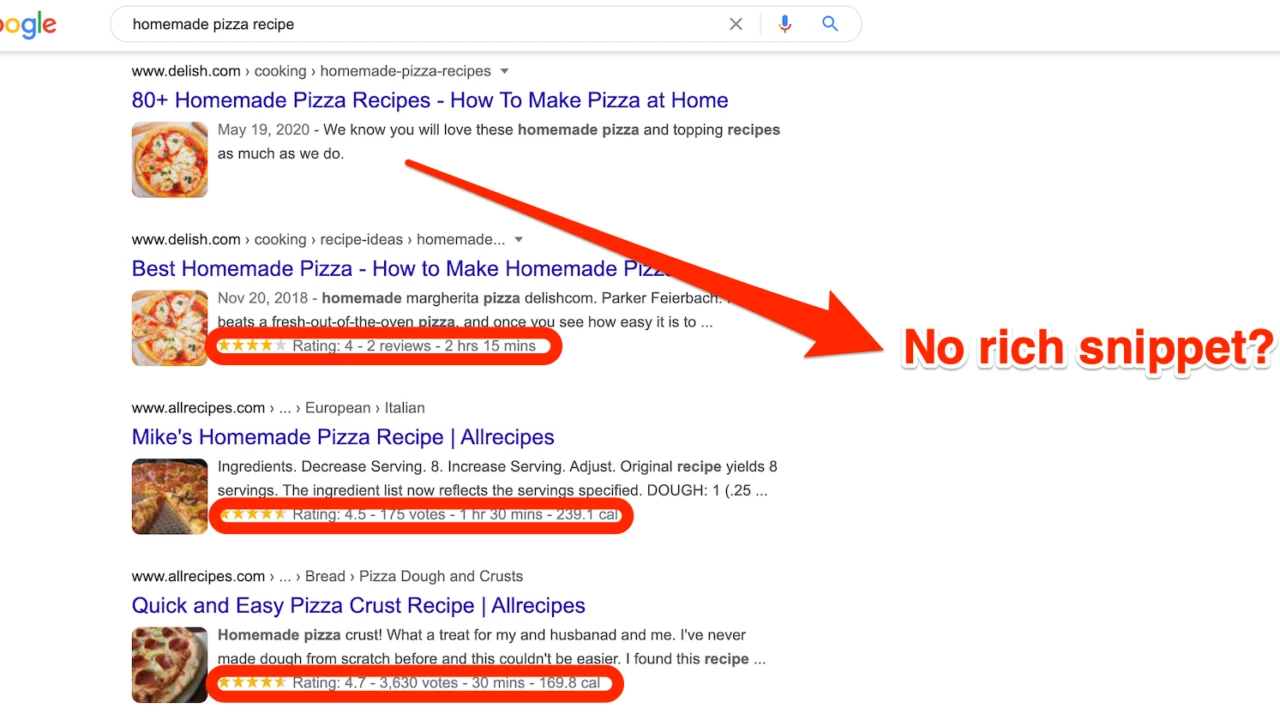
The most immediate benefit of Schema.org for SEO is eligibility for rich results — enhanced search listings that display additional information like star ratings, prices, FAQ accordions, how-to steps, event dates, and recipe cards. According to a 2025 study by Search Engine Journal, pages with rich results earn 58% more clicks than standard blue-link results.
Google currently supports over 30 rich result types, and each requires specific Schema.org markup to trigger. Without the right structured data, you're leaving visibility on the table. Here are the most impactful rich result types:
- FAQ Rich Results — Expandable question-and-answer pairs directly in the SERP
- Review Snippets — Star ratings and review counts
- How-To Rich Results — Step-by-step instructions with images
- Product Rich Results — Prices, availability, and ratings
- Breadcrumbs — Enhanced navigation trail in search results
- Sitelinks Search Box — An in-SERP search box for your site
- Event Listings — Dates, locations, and ticket information
Entity-Based SEO and Knowledge Graphs
Google's evolution from keyword-matching to entity-based search has made Schema.org more critical than ever. Google's Knowledge Graph — a database of over 500 billion facts about 5 billion entities — relies heavily on structured data to identify and connect entities (people, places, organizations, concepts).
When you implement Organization, Person, or LocalBusiness schema with sameAs links to authoritative profiles (LinkedIn, Wikipedia, Crunchbase), you're helping Google build a knowledge panel for your brand. This is Entity-Based SEO — and it's the foundation of how Google understands the web in 2026.
Click-Through Rate Impact
Multiple studies have demonstrated the CTR impact of structured data:
- Pages with FAQ schema see up to 87% more SERP real estate
- Review stars in search results increase CTR by 35% on average
- Breadcrumb markup improves CTR by 10-15% by making your URL more user-friendly
- Sites with comprehensive Schema.org implementation report 20-30% overall organic traffic increases
Essential Schema.org Types for SEO
Let's dive into the most important Schema.org types and how to implement each one.
Organization Schema
Every website should implement Organization schema as a baseline. This tells search engines who you are, what your logo looks like, and where to find your official social profiles.
📝 Organization Schema Example
{
  "@context": "https://schema.org",
  "@type": "Organization",
  "name": "Digital Marketing Co.",
  "url": "https://digitalmarketingco.org",
  "logo": "https://digitalmarketingco.org/logo.png",
  "description": "Premier digital marketing agency specializing in SEO, PPC, social media, and AI-driven strategies.",
  "founder": {
    "@type": "Person",
    "name": "Mike"
  },
  "foundingDate": "2014",
  "sameAs": [
    "https://www.linkedin.com/company/digitalmarketingcompanyagency",
    "https://x.com/DigitalMktgCo",
    "https://www.facebook.com/digitalmarketingcompanyagency"
  ],
  "contactPoint": {
    "@type": "ContactPoint",
    "contactType": "customer service",
    "availableLanguage": "English"
  }
}
LocalBusiness Schema

LocalBusiness is a subtype of Organization specifically designed for businesses with physical locations or service areas. It's essential for local SEO, enabling your business to appear in the Google Local Pack (the map-based results that appear for local queries).
Key properties to include:
address— Your full postal address usingPostalAddresstypegeo— Latitude and longitude coordinates usingGeoCoordinatesopeningHoursSpecification— Your business hours for each daypriceRange— Price indicator (e.g., "$$" or "$$$")areaServed— Geographic areas where you provide serviceshasOfferCatalog— Links to your services or products
Article and BlogPosting Schema
Article and its subtype BlogPosting are critical for content-heavy websites. They tell search engines the headline, author, publication date, featured image, and publisher of every piece of content. This schema enables your articles to appear in Google News, Google Discover, and the Top Stories carousel.
Essential properties for optimal article schema:
headline— The article title (max 110 characters for Google)author— APersonorOrganizationwithnameandurldatePublishedanddateModified— ISO 8601 timestampsimage— At least one image (Google recommends 1200px+ wide)publisher— The publishing organization with logomainEntityOfPage— The canonical URL of the articlewordCount— The total word count (used by AI engines for content depth signals)
Product and Offer Schema
For e-commerce and service businesses, Product schema combined with Offer unlocks rich product snippets in search results — showing price, availability, and reviews directly in the SERP. This is one of the highest-impact schema types for conversion-focused websites.
FAQPage Schema
FAQPage schema is one of the easiest wins in structured data. It allows your frequently asked questions to appear as expandable accordions directly in search results, dramatically increasing your SERP real estate. Each FAQ item uses the Question and Answer types.
📝 FAQPage Schema Example
{
  "@context": "https://schema.org",
  "@type": "FAQPage",
  "mainEntity": [
    {
      "@type": "Question",
      "name": "What is Schema.org?",
      "acceptedAnswer": {
        "@type": "Answer",
        "text": "Schema.org is a collaborative vocabulary of structured data markup that helps search engines understand web content. It was created by Google, Microsoft, Yahoo, and Yandex."
      }
    },
    {
      "@type": "Question",
      "name": "Does Schema.org directly affect rankings?",
      "acceptedAnswer": {
        "@type": "Answer",
        "text": "While Schema.org is not a direct ranking factor, it enables rich results that significantly increase click-through rates, which indirectly improves rankings through better user engagement signals."
      }
    }
  ]
}
HowTo Schema
HowTo schema is perfect for tutorial and instructional content. It structures your how-to guides into numbered steps that Google can display as rich results, complete with images for each step, estimated time, and required tools or materials.
BreadcrumbList Schema
BreadcrumbList schema defines the navigation hierarchy of your website, showing users and search engines exactly where a page sits within your site structure. This appears in search results as a clean, clickable breadcrumb trail instead of the raw URL — improving both UX and CTR.
🔍 Need Help with Your SEO Strategy?
Our team specializes in technical SEO, structured data implementation, and AI-driven optimization strategies.
Explore Our SEO Services →Schema.org for GEO: Generative Engine Optimization
What Is GEO?
Generative Engine Optimization (GEO) is the practice of optimizing your content to be cited, quoted, and referenced by AI-powered search engines. Unlike traditional SEO — where the goal is ranking in a list of ten blue links — GEO focuses on making your content the source that AI engines like ChatGPT, Perplexity AI, Google AI Overviews, and Claude draw from when generating answers.
In 2026, an estimated 40% of search queries now involve an AI-generated component, either through Google's AI Overviews, Bing Copilot, or standalone AI search tools. This means optimizing solely for traditional SERP rankings leaves massive visibility on the table.
How AI Search Engines Use Structured Data
AI search engines process structured data in several key ways:
- Entity Recognition — Schema.org helps AI engines identify exactly what entities (people, organizations, products, concepts) appear on your page and how they relate to each other.
- Fact Extraction — Properties like
foundingDate,priceRange,aggregateRating, andareaServedprovide concrete, extractable facts that AI engines can cite with confidence. - Source Attribution — When AI engines find well-structured data, they're more likely to cite your website as a source because they can verify the information is authoritative and well-organized.
- Content Hierarchy — Schema properties like
hasPart,isPartOf, andmainEntityhelp AI engines understand the hierarchical relationship between your content pieces.
GEO-Specific Schema Types
Several Schema.org types are particularly valuable for GEO:
ClaimReview— Marks fact-checked claims, which AI engines prioritize for accuracyDataset— Structures data tables and research data for AI extractionScholarlyArticle— Identifies academic or research content with citationsDefinedTerm— Provides precise definitions that AI engines can quote directlyItemList— Structures ranked lists, comparisons, and curated collectionsWebPageElement— Identifies specific parts of a page (like a table of contents) for AI extraction
SpeakableSpecification for Voice and AI
The SpeakableSpecification schema is one of the most underutilized but powerful tools for both GEO and AIO. It explicitly tells search engines and AI assistants which parts of your content are most suitable for text-to-speech output and AI summarization.
📝 SpeakableSpecification Schema Example
{
  "@type": "BlogPosting",
  "headline": "Schema.org Guide for SEO, GEO & AIO",
  "speakable": {
    "@type": "SpeakableSpecification",
    "cssSelector": [
      "h1",
      "h2",
      ".toc-container",
      ".blog-content > p:first-of-type",
      "[data-speakable]"
    ]
  }
}
When a voice assistant like Alexa or Google Assistant is asked a question that your page answers, the speakable markup tells it exactly which text to read aloud. For AI engines, it signals which content is the most important summary-worthy material.
Schema.org for AIO: AI Optimization
What Is AIO?
AI Optimization (AIO) focuses specifically on how your content appears in AI-generated overviews, featured snippets, and zero-click answers. While GEO is about getting cited by AI search engines broadly, AIO is about optimizing for specific AI features — particularly Google AI Overviews (formerly SGE), Bing Copilot answers, and direct AI chatbot responses.
Google AI Overviews and Schema.org
Google AI Overviews — the AI-generated summary boxes that appear at the top of many search results — pull information from the highest-authority, most well-structured sources. Research by SEO platform Semrush found that websites with comprehensive Schema.org implementation are 2.3x more likely to be cited in AI Overviews than those without structured data.
The schema types most commonly cited in AI Overviews include:
FAQPage— Direct Q&A format is ideal for AI extractionHowTo— Step-by-step instructions are frequently summarizedArticlewithspeakable— Signals the most quotable passagesDefinedTerm— Precise definitions are preferred for "What is..." queriesItemList— Ordered lists are ideal for "Best of..." and "Top 10..." queries
Optimizing for ChatGPT, Perplexity, and Claude

Third-party AI engines (ChatGPT with Browse, Perplexity AI, Claude) process web content differently than Google, but they still benefit enormously from structured data:
- Clear entity definitions help these engines accurately attribute information to your brand
sameAslinks allow them to cross-reference your claims against authoritative sourceshasPartandisPartOfrelationships help them understand the scope and depth of your contentauthorcredentials with detailedPersonschema (includingjobTitle,alumniOf,award) improve E-E-A-T signals that AI engines use to evaluate source quality
Entity Disambiguation with Schema
One of Schema.org's most powerful AIO capabilities is entity disambiguation. If your company name is common, or your founder shares a name with other public figures, Schema.org helps AI engines distinguish your entity from others.
Key properties for disambiguation:
@id— A unique, persistent identifier for your entity (typically your canonical URL)sameAs— Links to the same entity on other platforms (LinkedIn, Wikipedia, Crunchbase)identifier— Official identifiers like DUNS numbers, tax IDs, or ORCID for researchersadditionalType— More specific type classifications beyond the primary@type
Advanced Schema.org Techniques for 2026
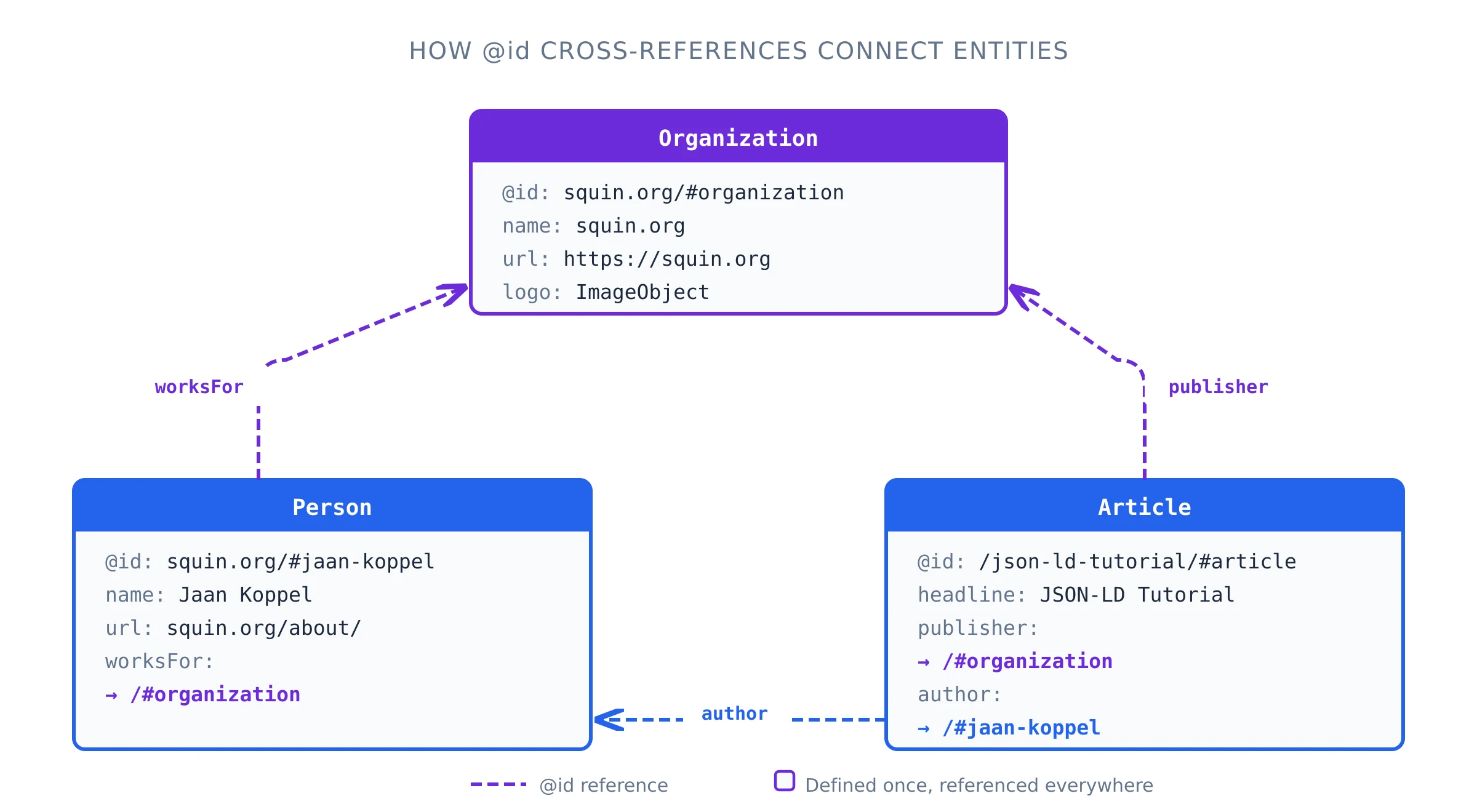
Nested Schema Graphs (@graph)
For complex pages, the @graph property lets you define multiple interconnected schema objects in a single JSON-LD block. This is the approach used by sophisticated websites and is considered best practice for 2026.
📝 Nested @graph Schema Example — Interconnected Entities
{
  "@context": "https://schema.org",
  "@graph": [
    {
      "@type": "WebPage",
      "@id": "https://example.com/blog/schema-guide#webpage",
      "url": "https://example.com/blog/schema-guide",
      "name": "Schema.org Complete Guide",
      "isPartOf": { "@id": "https://example.com/#website" }
    },
    {
      "@type": "BlogPosting",
      "@id": "https://example.com/blog/schema-guide#article",
      "headline": "Schema.org Complete Guide",
      "mainEntityOfPage": { "@id": "https://example.com/blog/schema-guide#webpage" },
      "author": { "@id": "https://example.com/#author" },
      "publisher": { "@id": "https://example.com/#organization" }
    },
    {
      "@type": "Person",
      "@id": "https://example.com/#author",
      "name": "Mike",
      "url": "https://example.com/about"
    },
    {
      "@type": "Organization",
      "@id": "https://example.com/#organization",
      "name": "Digital Marketing Co.",
      "logo": { "@type": "ImageObject", "url": "https://example.com/logo.png" }
    }
  ]
}
sameAs and Entity Linking
The sameAs property is your primary tool for entity linking — connecting your Schema.org entities to their representations across the web. For AI engines, sameAs is a powerful signal of authority and legitimacy.
Include sameAs links to:
- Your Wikipedia or Wikidata entry (if applicable)
- LinkedIn company page and founder's personal profile
- Crunchbase, Bloomberg, or other business databases
- Official social media profiles (Twitter/X, Facebook, Instagram)
- Google Business Profile
- Industry-specific directories (Better Business Bureau, Clutch, G2)
ItemList for Rankings and Listicles
ItemList schema is essential for any content that presents items in a ranked or ordered format. This includes product comparisons, "top 10" lists, curated resource guides, and table of contents. AI engines love ItemList because it provides clean, structured data they can easily extract and present.
WebPage and WebPageElement
WebPage and WebPageElement types allow you to describe the structure of individual pages — their purpose, primary content area, navigation elements, and key sections. For GEO and AIO, WebPageElement is particularly powerful because it lets you identify specific page sections that AI engines should prioritize.
How to Implement Schema.org: A Step-by-Step Guide

Step 1: Audit Your Current Markup
Before adding new schema, audit what you already have. Use these tools:
- Google Rich Results Test[1] — Tests individual URLs for rich result eligibility
- Schema.org Validator[2] — Validates your JSON-LD syntax against the Schema.org specification
- Google Search Console → Enhancements — Shows site-wide structured data errors and warnings
- Structured Data Testing Tool[3] — Google's older but still useful markup parser
Step 2: Identify Required Schema Types
Map each page type on your website to the appropriate Schema.org types:
| Page Type | Recommended Schema Types |
|---|---|
| Homepage | Organization, WebSite, SiteNavigationElement |
| About Page | Organization, Person, AboutPage |
| Blog Posts | BlogPosting, BreadcrumbList, FAQPage |
| Service Pages | Service, Offer, FAQPage, BreadcrumbList |
| Product Pages | Product, Offer, AggregateRating, Review |
| Contact Page | ContactPage, Organization (with contactPoint) |
| FAQ Page | FAQPage, BreadcrumbList |
| Local Landing Pages | LocalBusiness, GeoCoordinates, areaServed |
Step 3: Write Your JSON-LD
Write your JSON-LD markup following these best practices:
- Use
@graphto define multiple interconnected entities per page - Use
@idreferences to link entities within the graph (instead of nesting everything) - Include
sameAsfor every entity that has external representations - Add
speakableto article types for voice and AI optimization - Include
hasPartwithWebPageElemententries for your table of contents - Use ISO 8601 dates for all timestamps
- Include full URLs — never use relative paths in schema markup
Step 4: Test and Validate
After implementation, validate every page through both Google's Rich Results Test and the Schema.org Validator. Pay attention to:
- Errors — Must fix. Missing required properties or invalid values.
- Warnings — Should fix. Recommended properties that improve rich result quality.
- Info messages — Nice to have. Optional enhancements.
Step 5: Monitor Rich Results Performance
In Google Search Console, navigate to Search Appearance → Rich Results to monitor how your structured data performs over time. Track impressions, clicks, and CTR for each rich result type. Set up monthly reporting to identify new opportunities.
Measuring the Impact of Schema.org
To quantify the ROI of your Schema.org implementation, track these metrics:
- Rich Result Impressions — How often your rich results appear (Google Search Console)
- Rich Result CTR — Click-through rate for pages with vs. without rich results
- Knowledge Panel Appearances — Track when your brand Knowledge Panel appears
- AI Overview Citations — Monitor when AI Overviews cite your content (tools like Semrush and Ahrefs now track this)
- Voice Search Appearances — Track voice assistant responses that reference your content
- Organic Traffic Growth — Compare traffic trends before and after schema implementation
- Schema Validation Errors — Monitor and resolve errors in Google Search Console
Key Performance Indicators for Schema Success
To truly understand how structured data affects your digital presence, you need to track specific KPIs across multiple dimensions. Here are the most critical metrics organized by category:
Search Visibility Metrics:
- Rich Result Impression Share — Track the percentage of your total impressions that come from rich results versus standard blue links. In Google Search Console, filter by “Search Appearance” to isolate rich result performance. Healthy schema implementations typically see 15–40% of impressions coming from enhanced listings within three to six months.
- Click-Through Rate by Result Type — Compare CTR for pages with rich results against those without. Industry benchmarks show that FAQ rich results can boost CTR by 20–35%, while review stars increase clicks by 25–45%. Product rich results with pricing and availability information often see CTR improvements of 30% or more.
- Position Zero Attainment — Monitor how often your content appears in featured snippets, knowledge panels, or other position-zero placements. Schema markup significantly increases your eligibility for these coveted positions, particularly when combined with well-structured content.
AI and Generative Search Metrics:
- AI Overview Citations — Track how frequently your content is cited in Google’s AI Overviews. While direct measurement tools are still emerging, you can monitor referral traffic from AI-generated results and compare branded search volume trends.
- LLM Reference Tracking — Use tools like Perplexity Analytics or custom monitoring solutions to track when AI assistants reference your content. Businesses with comprehensive schema markup report up to 3x more frequent citations in AI-generated responses.
- Brand Mention Monitoring — Set up alerts for brand mentions across AI platforms. Structured data helps AI systems correctly attribute information to your brand, increasing the likelihood of proper citation.
Conversion and Revenue Metrics:
- Organic Conversion Rate Changes — Segment your conversion data by pages with schema markup versus those without. Track this over time to establish a clear baseline and measure incremental improvements.
- Revenue Per Organic Session — For e-commerce sites, monitor whether sessions originating from rich results generate higher average order values. Users who click on product rich results with pricing information often convert at higher rates because they arrive with purchase intent already established.
- Phone Call and Direction Requests — For local businesses, track increases in phone calls and direction requests from Google Business Profile and local search results. LocalBusiness schema combined with proper NAP markup typically increases these actions by 15–25%.
A/B Testing Your Schema Implementation
One of the most overlooked aspects of schema optimization is systematic testing. Rather than implementing structured data across your entire site at once, consider a phased rollout that allows you to measure impact accurately.
Start by selecting a control group of pages that will not receive schema markup and a test group of comparable pages that will. Ensure both groups have similar traffic levels, content quality, and keyword targeting. Implement schema markup only on the test group and monitor performance differences over a 60–90 day period.
Pay special attention to how different schema types perform for different content categories. For example, HowTo schema might dramatically improve performance for tutorial content but provide minimal benefit for news articles. FAQPage schema often works exceptionally well for service pages but may be less impactful on product pages where Review schema is more relevant.
Document your findings in a structured format that includes the schema type tested, the page category, the sample size, the duration of the test, and the measured impact on key metrics. This data becomes invaluable for prioritizing future schema implementations and making a business case for continued investment in structured data.
Common Schema.org Mistakes to Avoid
After auditing hundreds of websites, here are the most common Schema.org mistakes we see:
- Marking up content that isn't visible on the page — Google requires that schema markup accurately reflects content visible to users. Don't add FAQ schema for questions not actually shown on the page.
- Using outdated or deprecated types — Schema.org evolves. Types like
DataFeedhave been replaced. Always check schema.org[4] for the latest specifications. - Missing required properties — Each schema type has required and recommended properties. Omitting required properties causes validation errors and prevents rich results.
- Duplicate schema on the same page — Having two
Organizationblocks or twoBlogPostingblocks on one page confuses crawlers. Use@graphto define one of each. - Not updating
dateModified— When you update content, update thedateModifiedproperty. AI engines use freshness signals heavily. - Ignoring
sameAs— WithoutsameAslinks, you're missing the entity-linking benefits that drive Knowledge Graph inclusion and AI citations. - Self-serving review markup — Adding
RevieworAggregateRatingschema for reviews you wrote about your own business violates Google's guidelines and can result in a manual action. - Not implementing schema on all pages — Many sites only add schema to the homepage. Every page should have appropriate schema markup.
- Using Microdata instead of JSON-LD — While Microdata still works, JSON-LD is universally preferred and easier to maintain.
- Forgetting
speakablefor content pages — In 2026, with voice and AI search dominating, omittingspeakablemeans missing a critical optimization layer.
Schema.org and E-E-A-T: Building Trust Signals for Search Engines and AI
Google’s E-E-A-T framework — Experience, Expertise, Authoritativeness, and Trustworthiness — has become one of the most important ranking factors in modern search. While E-E-A-T itself is not a direct ranking signal, structured data provides the technical infrastructure that helps search engines and AI systems identify and validate these quality signals across your content.
Demonstrating Experience Through Schema
The “Experience” component of E-E-A-T emphasizes first-hand knowledge and real-world involvement with the subject matter. Schema.org provides several properties that help communicate this to search engines:
Use the author property with detailed Person schema that includes credentials, job titles, and professional affiliations. Include knowsAbout properties listing specific areas of expertise. Add hasOccupation to formally connect authors to their professional roles and industries.
For content that draws on personal experience — such as product reviews, travel guides, or case studies — use the reviewBody property with detailed first-person accounts and the datePublished and dateModified properties to show the content is based on recent, relevant experience.
{
  "@context": "https://schema.org",
  "@type": "Article",
  "author": {
    "@type": "Person",
    "name": "Dr. Sarah Chen",
    "jobTitle": "Senior SEO Strategist",
    "knowsAbout": ["Schema.org", "Structured Data", "Technical SEO", "AI Optimization"],
    "hasOccupation": {
      "@type": "Occupation",
      "name": "SEO Consultant",
      "occupationalCategory": "15-1252.00"
    },
    "sameAs": ["https://linkedin.com/in/sarahchen", "https://x.com/sarahchenseo"]
  }
}
Establishing Authoritativeness with Organizational Schema
Authoritativeness extends beyond individual authors to encompass the publishing organization as a whole. Use Organization schema to communicate your company’s credentials, industry awards, certifications, and professional memberships.
Include award properties for any industry recognition, memberOf for professional associations, and certification for relevant business certifications. These structured signals help both traditional search algorithms and AI systems understand that your organization is a recognized authority in its field.
Additionally, implement sameAs properties linking to your official profiles across authoritative platforms — LinkedIn company pages, industry directories, Better Business Bureau listings, and professional association memberships. This creates a web of verified identity signals that reinforces your organizational authority.
Building Trustworthiness Through Structured Data
Trustworthiness is perhaps the most critical E-E-A-T component, especially for YMYL (Your Money or Your Life) topics. Schema.org offers multiple mechanisms to communicate trust:
- Review and Rating Schema — Implement
AggregateRatingschema to showcase genuine customer reviews and ratings. IncludereviewCountandratingValueto provide quantitative trust signals. - Contact and Transparency Schema — Use
ContactPointschema with multiple contact methods (phone, email, chat) andareaServedproperties. Businesses that provide transparent contact information receive higher trust scores from both users and algorithms. - Security and Privacy Indicators — Include
publishingPrinciplesproperties linking to your editorial policies, fact-checking processes, and correction procedures. For e-commerce sites, implementhasMerchantReturnPolicyandshippingDetailsto build transactional trust. - Citation and Source Schema — Use the
citationproperty to formally link to authoritative sources that support your content. This is particularly important for AI systems that evaluate the reliability of information based on source quality and attribution practices.
Organizations that implement comprehensive E-E-A-T schema markup typically see improvements not just in search rankings but also in AI citation frequency. When AI systems can verify author credentials, organizational authority, and content trustworthiness through structured data, they are significantly more likely to reference and recommend that content in their responses.
The Future of Schema.org in the AI Era
Schema.org is evolving rapidly to keep pace with AI search. Key trends to watch:
- New AI-specific schema types — The Schema.org community is actively developing types for AI-generated content attribution, machine-learning model descriptions, and AI agent interactions.
- Deeper integration with Knowledge Graphs — As Google, Bing, and AI engines build more comprehensive knowledge graphs, Schema.org will become the primary language for contributing verified facts.
- Multimodal schema — New properties for describing video content, audio, 3D objects, and interactive elements that AI engines can process.
- Trust and verification signals — Expect new schema properties related to E-E-A-T (Experience, Expertise, Authoritativeness, Trustworthiness) that AI engines will use to evaluate source quality.
- Real-time schema updates — Dynamic structured data that updates in real-time for live events, stock prices, and other time-sensitive information.
Multimodal Search and Schema.org
As search evolves beyond text to encompass images, video, audio, and mixed-media queries, schema markup is adapting to support these multimodal experiences. Google Lens, visual search features, and video search all rely on structured data to understand and categorize non-text content.
Implement VideoObject schema with detailed description, thumbnailUrl, duration, and transcript properties for video content. For image-heavy pages, use ImageObject schema with caption, contentLocation, and representativeOfPage properties. As visual and voice search grow — projected to account for over 30% of all searches by late 2026 — these markup types will become essential rather than optional.
The emergence of AI-powered visual search tools means that properly structured image and video metadata directly impacts whether your visual content appears in these new discovery channels. Businesses that invest in multimodal schema now will have a significant competitive advantage as these search modalities mature.
AI-Powered Schema Generation and Maintenance
One of the most exciting developments in the structured data ecosystem is the rise of AI-powered tools that can automatically generate, validate, and maintain schema markup at scale. These tools analyze page content, identify appropriate schema types, and generate accurate JSON-LD code without manual intervention.
For large websites with thousands or millions of pages, AI-driven schema automation eliminates the bottleneck of manual implementation. Content management systems are increasingly integrating AI schema generators that automatically create appropriate markup when new content is published, ensuring that every page is optimized from the moment it goes live.
However, automated schema generation requires careful oversight. AI tools can sometimes misidentify content types or generate markup that technically validates but does not accurately represent the page content. Establish regular audit processes to verify that automated schema remains accurate and aligned with Google’s structured data guidelines. The most effective approach combines AI automation for scale with human review for quality assurance.
Ready to Implement Schema.org?
Schema.org structured data is no longer a "nice to have" — it's the foundational layer that determines whether your content gets discovered by search engines, cited by AI answer tools, and spoken by voice assistants. In 2026, the websites that invest in comprehensive Schema.org implementation will be the ones that dominate both traditional search and the new AI-powered discovery landscape.
The good news? You don't have to do this alone. Our team at Digital Marketing Co. specializes in technical SEO, structured data implementation, and AI optimization strategies. We've helped hundreds of businesses implement Schema.org markup that drives real results — more rich snippets, higher click-through rates, and increased AI citations.
🚀 Get Expert Schema.org Implementation
Let our team audit your structured data, implement comprehensive Schema.org markup, and optimize your site for SEO, GEO, and AIO.
Schedule a Free Consultation →Bibliography & References
4 external sources cited in this article
- 1Google Search CentralGoogle Rich Results Test
- 2Schema.orgSchema.org Validator
- 3Google Search CentralStructured Data Testing Tool
- 4Schema.orgschema.org
All external links open in a new window. Sources are provided for informational purposes only and do not imply endorsement.