






Build Real Authority With Strategic Link Building
In a world of AI-generated content and algorithm updates, one ranking factor has stood the test of time — quality backlinks. Our targeted link building campaigns earn the kind of references that Google's algorithms actually respect.
Your Free Backlink Toolkit
310+ Places to Build Backlinks
We put together a database of 258+ verified do-follow backlink sources and 52+ social networks for brand building. Filter by category, sort by authority, and click any logo to check it out yourself.
Your Starter List for Link Building
Below is a starter list of websites that are important for creating backlinks — you can use these to build links yourself, but fair warning: it takes a lot of time to do manually.
We've built a proprietary software program that creates backlinks from the top 5,000 websites ranked by Google PageRank and Moz Domain Authority — specifically sites that have do-follow links where you can post a backlink to your website.
When you subscribe to our link building service, we can get started right away and run our software to create a certain number of high-quality backlinks on a monthly basis, based on your subscription level.
Get Started with Link Building310
Total Sites
258
Do-Follow Links
52
No-Follow (Branding)
14
Categories
Showing 25 of 310 sites
Click column headers to sort
| # | Site | Category | DA | PA | Monthly Traffic | Follow |
|---|---|---|---|---|---|---|
| 1 | YouTubewww.youtube.com | Social Network | 100 | 100 | 34B | No-Follow |
| 2 | Google Business Profilebusiness.google.com | Business Directory | 100 | 98 | 4.2B | Do-Follow |
| 3 | Apple Maps Connectmapsconnect.apple.com | Business Directory | 100 | 78 | 1.8M | Do-Follow |
| 4 | LinkedInwww.linkedin.com | Social Network | 99 | 98 | 1.7B | No-Follow |
| 5 | Blogger (Blogspot)www.blogger.com | Web 2.0 | 99 | 95 | 180M | Do-Follow |
| 6 | Sites.Google.comsites.google.com | Web 2.0 | 97 | 94 | 85M | Do-Follow |
| 7 | Facebookwww.facebook.com | Social Network | 96 | 95 | 17B | No-Follow |
| 8 |  Instagramwww.instagram.com | Social Network | 96 | 95 | 6.7B | No-Follow |
| 9 | VK (VKontakte)vk.com | Social Network | 96 | 94 | 650M | No-Follow |
| 10 | Vimeovimeo.com | Social Network | 96 | 94 | 210M | No-Follow |
| 11 | GitHubgithub.com | Profile Creation | 96 | 95 | 420M | Do-Follow |
| 12 | Adobe Stockstock.adobe.com | Profile Creation | 96 | 93 | 28M | Do-Follow |
| 13 | Weiboweibo.com | Social Network | 95 | 93 | 510M | No-Follow |
| 14 | Mediummedium.com | Profile Creation | 95 | 93 | 250M | Do-Follow |
| 15 | SlideSharewww.slideshare.net | Profile Creation | 95 | 93 | 68M | Do-Follow |
| 16 | Salesforce (Trailblazer)trailblazer.salesforce.com | Profile Creation | 95 | 88 | 58M | Do-Follow |
| 17 | Forbes Councilscouncils.forbes.com | Guest Posting | 95 | 88 | 180M | Do-Follow |
| 18 | Business Insider (Contributor)www.businessinsider.com | Guest Posting | 95 | 93 | 310M | Do-Follow |
| 19 | X (Twitter)www.x.com | Social Network | 94 | 93 | 6.1B | No-Follow |
| 20 | Pinterestwww.pinterest.com | Social Network | 94 | 93 | 1.1B | No-Follow |
| 21 |  Gravatargravatar.com | Profile Creation | 94 | 91 | 18M | Do-Follow |
| 22 | Scribdwww.scribd.com | Profile Creation | 94 | 92 | 130M | Do-Follow |
| 23 | Archive.orgarchive.org | Profile Creation | 94 | 93 | 210M | Do-Follow |
| 24 | Udemywww.udemy.com | Profile Creation | 94 | 92 | 250M | Do-Follow |
| 25 | Change.orgwww.change.org | Profile Creation | 94 | 91 | 48M | Do-Follow |
Page 1 of 13
Legend
DA = Domain Authority (Moz) · PA = Page Authority · Traffic estimates via SimilarWeb/Ahrefs · Data as of April 2026
Link Building: The Definitive Guide to Increasing Search Engine Visibility, Page Rank & Domain Authority in 2026
Link building remains one of the three most powerful ranking factors in Google's algorithm. In 2026, with AI-driven search evolving rapidly and competition intensifying across every digital niche, the quality and strategic placement of backlinks pointing to your website can make the difference between languishing on page five and dominating position one. This comprehensive guide explores everything you need to know about link building — from foundational principles to advanced tactics — and how to leverage it to skyrocket your search engine visibility, Page Rank, and Domain Authority.

What Is Link Building and Why Does It Matter?
Link building is the process of acquiring hyperlinks from external websites that point back to yours. These backlinks act as digital "votes of confidence" — when a reputable website links to your content, search engines interpret it as a signal that your page is authoritative, trustworthy, and valuable to users. The more high-quality votes you accumulate, the higher your pages climb in search engine results pages (SERPs).
Google's PageRank algorithm, the foundational technology behind the search engine, was built entirely on this concept. While PageRank has evolved dramatically since Larry Page and Sergey Brin first introduced it at Stanford, the core principle remains unchanged: links are currency on the internet. Every backlink carries a certain amount of "link equity" (sometimes called "link juice") that flows from the referring page to yours, boosting your page's authority and ranking potential.
The Measurable Impact of Link Building
The data is compelling. According to Backlinko's analysis of 11.8 million Google search results, the number of domains linking to a page correlates with higher rankings more than any other factor. Pages ranking #1 on Google have an average of 3.8x more backlinks than those in positions #2 through #10. Ahrefs found that 66.31% of pages have zero referring domains, and those pages receive essentially no organic traffic from Google.
These statistics illuminate a crucial truth: without a deliberate link building strategy, your content — no matter how exceptional — is unlikely to achieve meaningful search visibility. Link building bridges the gap between creating great content and having that content discovered by your target audience.
Understanding Domain Authority & Page Rank

Before diving into link building tactics, it's essential to understand the two primary metrics that backlinks influence: Domain Authority (DA) and Page Rank (PR).
Domain Authority (DA)
Domain Authority is a search engine ranking score developed by Moz that predicts how likely a website is to rank in SERPs. It's measured on a logarithmic scale from 1 to 100, meaning it's exponentially harder to increase your score as you climb higher. A website with a DA of 30 improving to 35 is relatively straightforward, but moving from 70 to 75 requires significantly more effort and higher-quality backlinks.
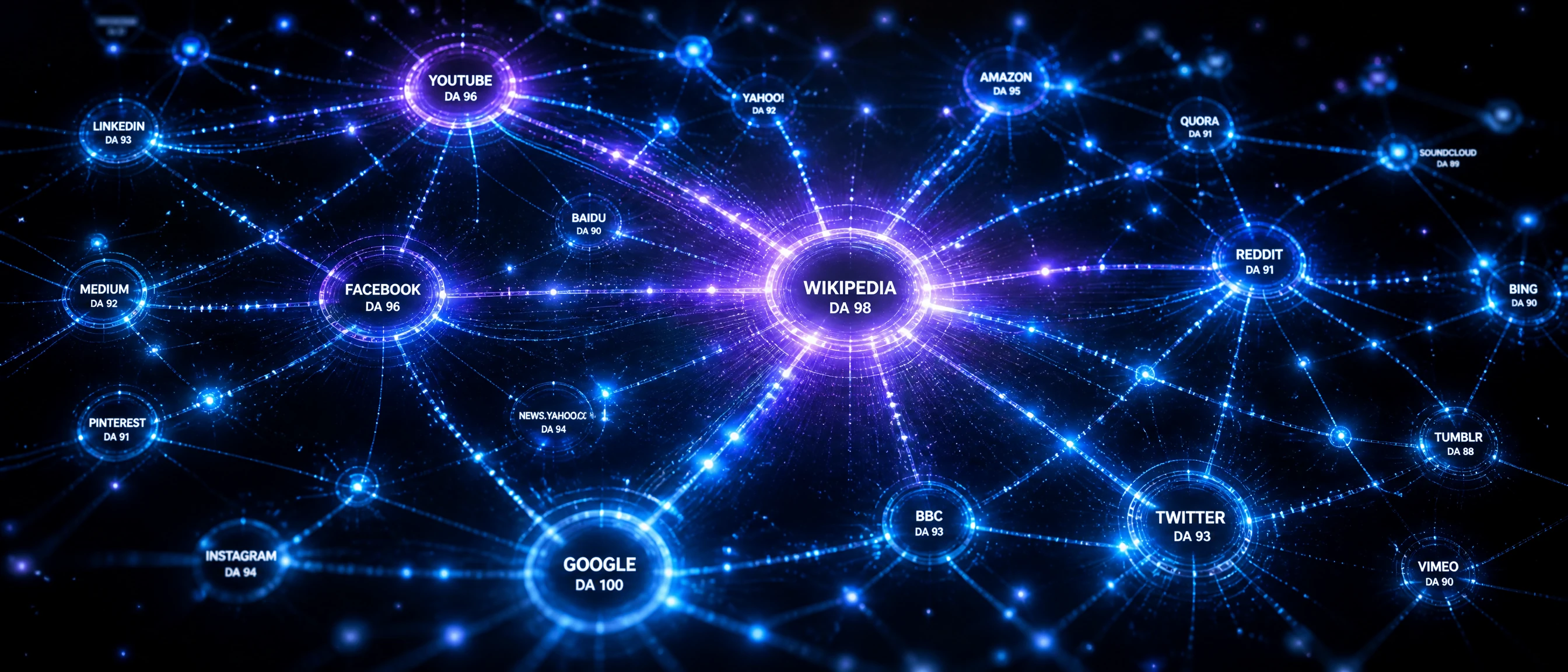
DA is calculated by evaluating multiple factors, including the total number of linking root domains, the total number of links, the quality of those links, and the overall link profile diversity. Websites like Facebook (DA 96), GitHub (DA 96), and LinkedIn (DA 99) sit at the top of the scale because billions of high-quality pages link to them.
Page Rank (PR)
Page Rank was Google's original algorithm for ranking web pages. While Google stopped publicly displaying PageRank scores in 2016, the underlying technology continues to influence how search results are ordered. Modern SEO tools like Ahrefs (Domain Rating), Semrush (Authority Score), and Majestic (Trust Flow) have created proprietary metrics that approximate the concept of Page Rank.
The key insight is that not all backlinks are created equal. A single backlink from a DA 90+ website like Forbes, Medium, or GitHub can deliver more ranking power than hundreds of links from obscure, low-authority websites. This is why strategic link building — focusing on quality over quantity — is the approach that delivers sustainable results.
Do-Follow vs. No-Follow Links: What You Need to Know
Links on the internet carry one of two primary attributes that determine how search engines process them:
Do-Follow Links
Do-follow links are the gold standard of link building. By default, all hyperlinks are do-follow unless explicitly tagged otherwise. When a website creates a do-follow link to your page, it passes full link equity, signaling to Google that the referring site endorses your content. These are the backlinks that directly improve your Domain Authority and search rankings.
The 258+ do-follow backlink sources in our database above represent verified opportunities where you can create profiles, publish content, or list your business with links that pass SEO value directly to your website.
No-Follow Links
No-follow links include a rel="nofollow" attribute that instructs search engines not to pass link equity through the link. However, this doesn't mean no-follow links are worthless — far from it. Google has stated that it treats nofollow as a "hint" rather than a directive, meaning some no-follow links may still influence rankings.
More importantly, no-follow links from major social networks like Facebook, LinkedIn, X (Twitter), Instagram, and Reddit provide enormous branding value, referral traffic, and social signals that indirectly boost your SEO. A viral post on LinkedIn or a trending thread on Reddit can drive thousands of visitors to your site, many of whom will subsequently link to your content from their own blogs and websites — creating organic do-follow backlinks.
The Ideal Backlink Profile Ratio
SEO experts generally recommend maintaining a natural-looking backlink profile with approximately 70-80% do-follow links and 20-30% no-follow links. A profile that's 100% do-follow links actually looks suspicious to search engines and can trigger algorithmic penalties. The 52+ social networks in our database are specifically included because they're essential for creating this balanced, natural-looking profile while simultaneously building brand awareness and driving referral traffic.

Types of Link Building Strategies
Effective link building in 2026 requires a diversified approach. No single tactic should dominate your strategy. Instead, combine multiple methods to create a robust, natural-looking backlink profile that search engines reward.
1. Profile Creation Link Building
Profile creation is the most accessible entry point for link building. By registering on high-authority platforms — GitHub, Medium, Crunchbase, About.me, Stack Overflow, Academia.edu, and dozens more — you create permanent backlinks from trusted domains. The key is to complete each profile thoroughly: use consistent branding, write keyword-optimized bios, add a professional photo, and include your website URL. Search engines view genuine, complete profiles on reputable platforms as legitimate citations that boost your authority.
Best practices: Create 5-10 profiles per week to maintain a natural pace. Prioritize platforms with DA 80+ first, then work down to mid-authority sites. Always verify that your link is actually do-follow after publishing — platform policies can change without notice.
2. Web 2.0 Link Building
Web 2.0 platforms like WordPress.com, Blogger, Medium, Wix, and Weebly allow you to create mini-websites or blogs where you publish content with contextual backlinks to your main site. These platforms carry high domain authority (many are DA 90+), and the links they provide are contextual — meaning they appear within relevant content, which search engines value more highly than links in sidebars or footers.
The most effective Web 2.0 strategy involves creating substantive, valuable content on these platforms rather than thin, spammy posts. Treat each Web 2.0 property as a genuine satellite blog: publish regularly, include images and media, interlink your Web 2.0 properties, and link naturally to your main website with varied anchor text.
3. Business Directory Submissions
Business directories remain a cornerstone of local SEO and brand visibility. Google Business Profile, Yelp, Yellow Pages, Bing Places, BBB, and industry-specific directories provide valuable citations that reinforce your business's legitimacy. These listings not only generate backlinks but also appear in "near me" searches, map packs, and local business results.
For maximum impact, ensure your NAP (Name, Address, Phone) information is identical across all directories. Inconsistent business information confuses search engines and dilutes the value of your citations. Use a spreadsheet to track every directory listing and verify accuracy quarterly.
4. Guest Posting
Guest posting on authoritative publications is one of the highest-value link building tactics available. When you contribute an expert article to Search Engine Journal (DA 92), Entrepreneur (DA 93), Forbes Councils (DA 95), or Content Marketing Institute (DA 82), you earn a contextual do-follow backlink from a highly trusted domain while simultaneously establishing thought leadership in your industry.
The key to successful guest posting is providing genuine value. Editors at premium publications reject 90%+ of pitches because they're thinly veiled promotional pieces. Instead, pitch unique data-driven insights, original research, contrarian perspectives, or comprehensive how-to guides that genuinely serve their audience.
5. Forum & Community Engagement
Active participation in niche forums and online communities — Warrior Forum, Moz Community, Stack Exchange, Indie Hackers, Reddit, and specialized industry forums — builds both backlinks and genuine referral traffic. The strategy is simple but requires patience: become a valuable contributor first, then naturally reference your content when it's genuinely relevant to the discussion.
6. Document & Presentation Sharing
Platforms like SlideShare (DA 95), Scribd (DA 94), Issuu (DA 93), and Calameo (DA 87) allow you to upload presentations, whitepapers, infographics, and documents that include backlinks in the description or within the content itself. These high-authority domains pass significant link equity and expose your content to entirely new audiences.
Advanced Link Building Techniques for 2026
Beyond the foundational strategies, several advanced techniques can accelerate your link building results and create competitive advantages that are difficult for competitors to replicate.
Broken Link Building
Broken link building involves finding dead links on high-authority websites and offering your content as a replacement. Tools like Ahrefs, Screaming Frog, and Check My Links can identify broken outbound links on any webpage. When you find a broken link that pointed to content similar to yours, you reach out to the webmaster, alert them to the broken link (providing value), and suggest your content as a suitable replacement. This technique has exceptionally high success rates because you're solving a problem for the webmaster while earning a premium backlink.
The Skyscraper Technique
Coined by Brian Dean of Backlinko, the Skyscraper Technique involves three steps: (1) find content in your niche that has attracted significant backlinks, (2) create something substantially better — more comprehensive, more current, better designed, or more data-rich, and (3) reach out to everyone who linked to the original piece and show them your superior version. This works because people naturally prefer to link to the best resource available.
Digital PR & Linkable Assets
Creating "linkable assets" — original research, comprehensive industry studies, interactive tools, infographics, or data visualizations — naturally attracts backlinks because they provide unique value that other content creators want to reference. When combined with digital PR outreach to journalists and bloggers, linkable assets can generate dozens or even hundreds of high-quality backlinks from a single campaign.
HARO & Journalist Queries
Help A Reporter Out (HARO), now Connectively, and similar platforms like SourceBottle, Qwoted, and Featured.com connect journalists with expert sources. By responding to relevant journalist queries with insightful quotes and data, you can earn backlinks from major news publications — often DA 90+ outlets like Forbes, Business Insider, Inc., The New York Times, and hundreds of industry-specific publications.
Resource Page Link Building
Many websites maintain "Resources" or "Useful Links" pages where they curate the best content on specific topics. Finding these pages in your niche (search for "intitle:resources + [your keyword]") and pitching your content for inclusion is a straightforward way to earn contextual, curated backlinks from relevant websites.

Link Building Best Practices & Common Mistakes
Success in link building requires discipline, patience, and adherence to Google's Webmaster Guidelines. Here are the essential best practices and critical mistakes to avoid.
Best Practices
- Prioritize relevance over authority: A DA 60 backlink from a website directly relevant to your niche is often more valuable than a DA 90 backlink from an unrelated site. Google's algorithms increasingly weight topical relevance when evaluating backlinks.
- Diversify your anchor text: Use a natural mix of branded anchors ("Digital Marketing Company"), partial match keywords ("link building services"), naked URLs, and generic phrases ("click here," "learn more"). Over-optimized anchor text profiles (using the same exact-match keyword repeatedly) trigger spam filters.
- Build links gradually: A sudden spike of 500 backlinks in a week followed by months of inactivity looks unnatural. Aim for consistent, sustainable link acquisition — 15-30 quality links per month is a healthy pace for most businesses.
- Target diverse link types: Combine profile links, contextual links within content, directory citations, forum signatures, image attribution links, and social signals. A diverse link profile looks organic and withstands algorithm updates.
- Monitor your backlink profile: Use tools like Ahrefs, Semrush, or Moz to regularly audit your backlinks. Disavow toxic or spammy links that could harm your rankings using Google Search Console's Disavow Tool.
- Focus on evergreen content: Links to evergreen, continually valuable content maintain their power over time. Links to dated or outdated content lose value as the content becomes irrelevant.
Common Mistakes to Avoid
- Buying bulk backlinks from PBNs: Private Blog Networks (PBNs) are networks of websites created solely to manipulate search rankings through link schemes. Google has become exceptionally sophisticated at detecting PBNs, and penalties can devastate your rankings overnight.
- Using automated link building tools: Software that automatically creates thousands of low-quality links across forums, blog comments, and guestbooks is a fast track to a Google penalty. These tools create obvious footprints that Google's algorithms easily identify.
- Ignoring no-follow links entirely: As discussed earlier, a natural backlink profile includes both do-follow and no-follow links. Building exclusively do-follow links creates an unnatural pattern.
- Neglecting internal link building: While external backlinks get most attention, strategic internal linking distributes link equity throughout your website, helping deeper pages rank. Create topic clusters with pillar pages and supporting content that interlink logically.
- Failing to track results: Without measuring which backlinks drive the most ranking improvements, you can't optimize your strategy. Track every link you build, monitor ranking changes, and double down on what works.
Measuring Link Building Success
Effective measurement is what separates professional link building from guesswork. Here are the key metrics to track and the tools to use.
Key Performance Indicators (KPIs)
- Domain Authority (DA) / Domain Rating (DR): Track your site's overall authority score monthly. Expect gradual increases — even a 2-3 point improvement over three months is significant.
- Referring Domains: The number of unique domains linking to your website. This is often more important than total backlink count because one link each from 100 different domains is more powerful than 100 links from a single domain.
- Organic Traffic: The ultimate measure of link building success. As your authority grows, your pages should rank higher and attract more organic search traffic.
- Keyword Rankings: Monitor target keyword positions before and after link building campaigns to measure direct ranking impact.
- Referral Traffic: High-quality backlinks don't just boost SEO — they also drive direct visits from people who click on your link. Track referral traffic in Google Analytics to identify your most valuable link sources.
- Link Velocity: The rate at which you acquire new backlinks over time. Healthy link velocity should be consistent and gradually increasing.

Recommended Tools
The following tools are indispensable for professional link building campaigns:
- Ahrefs: The gold standard for backlink analysis. Provides Domain Rating, referring domain counts, anchor text analysis, and competitor backlink research.
- Semrush: Comprehensive SEO suite with Authority Score metric, backlink audit capabilities, and the Link Building Tool for managing outreach campaigns.
- Moz Link Explorer: Provides the original Domain Authority metric along with spam score analysis and link opportunity discovery.
- Google Search Console: Free tool from Google that shows which sites link to you, allows disavowing toxic links, and tracks ranking changes.
- Majestic: Specializes in link data with proprietary metrics like Trust Flow and Citation Flow that help evaluate backlink quality.
- BuzzSumo: Identifies the most-shared content in any niche — essential for discovering linkable asset ideas and outreach targets.
Link Building in the Age of AI Search
The rise of AI-powered search engines — Google AI Overviews, ChatGPT with browsing, Perplexity, Claude, Gemini, and Grok — has added a new dimension to link building strategy. These AI systems don't just rank pages; they synthesize information and cite sources. Websites with strong backlink profiles are more likely to be cited by AI systems because the algorithms that power these tools use link authority as a signal of trustworthiness.
This means link building in 2026 serves a dual purpose: it improves your rankings in traditional search results AND increases the probability that AI systems will reference and recommend your content when users ask questions in your domain. This "double dividend" makes link building more valuable than ever.
E-E-A-T and Link Building
Google's E-E-A-T framework (Experience, Expertise, Authoritativeness, Trustworthiness) directly intersects with link building. Backlinks from authoritative, relevant sources serve as external validation of your expertise and authority. When highly respected websites in your industry link to your content, it signals to both search engines and AI systems that your information is trustworthy and expert-level.
Building E-E-A-T through link building means earning links from industry publications, academic institutions, government websites, established news outlets, and recognized experts in your field. These "trust signals" compound over time, creating a virtuous cycle where higher authority leads to more organic backlinks, which further increases your authority.
How to Use Our Backlink Database
The interactive table at the top of this page provides a comprehensive resource for building your backlink strategy. Here's how to get the most value from it:
- Start with high-DA profile creation sites: Sort by Domain Authority (descending) and filter to "Profile Creation" to identify the highest-authority platforms where you can create a profile with a backlink.
- Build your social foundation: Filter by "Social Network" to see all 52+ platforms where you should establish a branded presence. Even though these are no-follow, they're essential for brand visibility and profile balance.
- Target your niche: Use the search bar to find platforms relevant to your specific industry. A B2B software company might focus on G2, Capterra, Product Hunt, and Crunchbase, while a local service business would prioritize Yelp, BBB, Angi, and local directories.
- Track your progress: Keep a spreadsheet documenting which sites you've registered on, your profile URLs, and the date created. This helps you avoid duplicates and measure your link building velocity.
- Revisit and update: Return to completed profiles quarterly to update descriptions, add new content, and ensure all links remain active.
Why Choose Digital Marketing Company for Link Building?
At Digital Marketing Company, our link building specialists combine data-driven strategy with creative outreach to deliver backlink profiles that move the needle on your search rankings. We don't use shortcuts, PBNs, or automated tools. Instead, we focus on:
- White-hat methods exclusively: Every link we build complies with Google's Webmaster Guidelines, ensuring your investment is safe from algorithm penalties.
- Custom strategy for every client: We analyze your current backlink profile, competitor links, and industry landscape to create a tailored link building roadmap.
- Transparent reporting: Monthly reports detail every link acquired, including the referring domain, DA, anchor text, and link type.
- Integrated approach: Link building works best when integrated with content marketing, technical SEO, and on-page optimization. Our full-service team ensures every element of your SEO strategy works in harmony.
- Measurable ROI: We track keyword rankings, organic traffic, and domain authority improvements to demonstrate the concrete return on your link building investment.
Whether you're a startup looking to establish your first backlink foundation or an enterprise brand seeking to outmaneuver competitors in competitive SERPs, our link building services are engineered to deliver sustainable, compounding results that grow your organic visibility month over month.
Link building also works powerfully alongside our other services. Our custom web application development team builds interactive tools, calculators, and data visualizations that serve as natural link magnets — the kind of unique, high-value content that other websites want to reference and link to. And our content marketing specialists create the authoritative, in-depth content that earns editorial backlinks organically.
For a deep dive into the science behind link building — including how Google PageRank is calculated, the history of Domain Authority, and 33+ proven strategies for attracting backlinks — read our comprehensive guide: How to Attract Backlinks: The Ultimate Guide to Link Building for PageRank & Domain Authority.
Ready to Start Building Real Authority?
Drop us a line for a free backlink audit. We'll take a look at where you stand, show you what your competitors are doing, and map out a plan to help you climb the rankings.
Explore More
Related Services

Business Consulting Services
Premium business consulting & management consulting — growth strategy, business development, operations, fundraising & venture-capital readiness. Strategy plus real execution, with an equity-aligned option for scaling businesses.
Learn More
PPC Advertising Services
Running ads is easy. Running profitable ads is a different story. We manage PPC campaigns across Google Ads, Microsoft Ads, and social platforms — from Shopping campaigns to retargeting — all focused on maximizing every dollar you spend.
Learn More
SEO Services: Search Engine Optimization
SEO isn't a set-it-and-forget-it game. We provide comprehensive search engine optimization — from technical audits and keyword research to link building and generative engine optimization — designed to drive sustainable organic growth.
Learn MoreReady to Elevate Your Digital Presence?
Text us anytime — we'll get back to you as soon as possible. We're text-only.