








What Is AI Readiness?
AI Readiness refers to how well a website is prepared to be discovered, understood, and cited by artificial intelligence systems — including large language models (LLMs), AI-powered search engines, conversational assistants, and automated content aggregation platforms. In 2026, AI readiness has become as important as traditional SEO, as a growing share of information discovery happens through AI interfaces rather than traditional search results pages.
The shift toward AI-mediated information access is accelerating. Google AI Overviews now appear in over 40% of search queries, ChatGPT processes billions of queries monthly, and Perplexity, Claude, and other AI assistants are becoming primary research tools for millions of users. Websites that are not optimized for AI discovery risk becoming invisible to a significant and growing portion of their potential audience.
AI readiness is distinct from traditional SEO because AI systems consume and process information differently than search engine crawlers. While search engines index pages and rank them by relevance, AI systems extract facts, synthesize information across sources, and generate original responses — citing sources that demonstrate the highest authority, accuracy, and machine-readability.
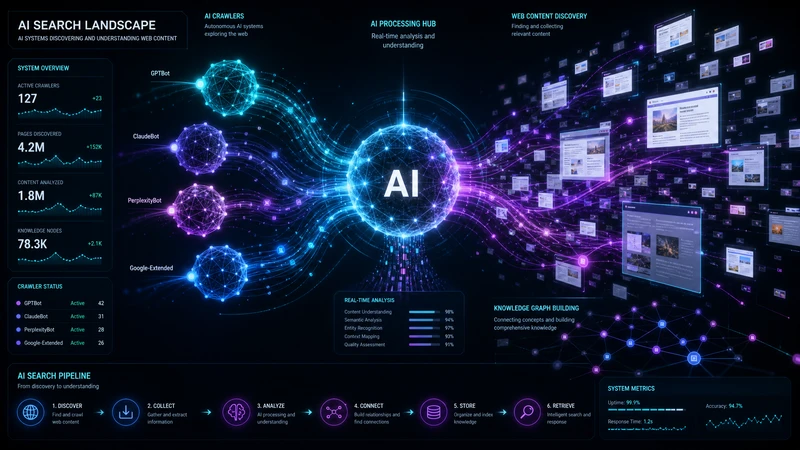
How AI Systems Discover and Process Web Content
AI Crawlers and Bots
AI companies deploy specialized crawlers to discover and ingest web content for training and retrieval. Key crawlers include GPTBot (OpenAI), Google-Extended (Google's AI training crawler), ClaudeBot (Anthropic), and CCBot (Common Crawl). Unlike traditional search engine crawlers that primarily build a search index, AI crawlers extract content for training language models and powering retrieval-augmented generation (RAG) systems.
Website owners can control AI crawler access through robots.txt directives. However, blocking all AI crawlers means your content will not be included in AI training data or retrieval systems, potentially reducing your visibility in AI-generated responses. A balanced approach involves allowing crawling while ensuring your content is properly attributed when cited.
Retrieval-Augmented Generation (RAG)
Many AI systems use RAG — combining their language model capabilities with real-time web retrieval to provide current, accurate answers. When a user asks a question, the AI system searches the web, retrieves relevant pages, extracts information, and synthesizes a response with source citations. Websites that are well-structured, authoritative, and machine-readable are more likely to be retrieved and cited in these responses.
Research from Harvard Business Review indicates that AI citation rates correlate strongly with content authority signals — specifically, well-structured content from established domains with strong E-E-A-T signals receives disproportionately more AI citations than content from newer or less authoritative sources.
Optimizing Content for AI Understanding
Machine-Readable Content Structure
AI systems understand content best when it is clearly structured with semantic HTML, logical heading hierarchies, and explicit information architecture. Key practices include using descriptive headings that clearly state the topic of each section, organizing content in a question-and-answer format where appropriate (AI systems frequently extract Q&A pairs), providing clear definitions and explanations near the top of content, using lists and tables for structured data that AI systems can easily parse, and including explicit entity mentions (people, places, organizations, concepts) that help AI systems build knowledge graphs.
Structured Data and Schema Markup
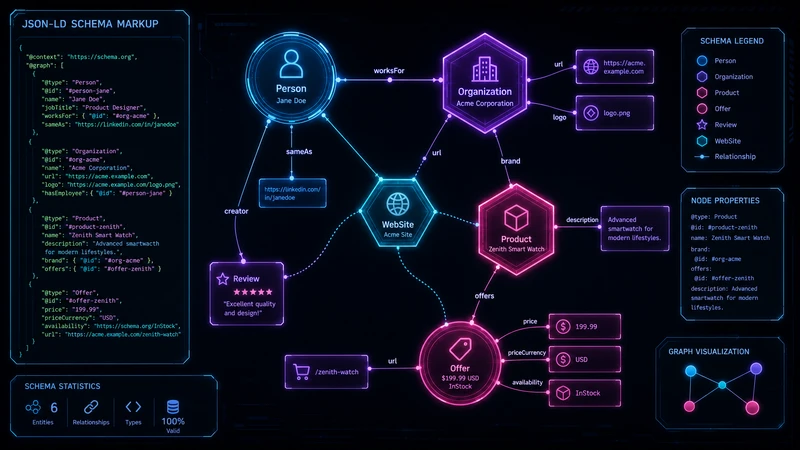
Comprehensive Schema.org markup is critical for AI readiness. Beyond basic types like Article and FAQPage, implement rich entity markup including Organization, Person (for authors), HowTo, Product, and specialized types relevant to your content domain. The more explicit semantic context you provide through structured data, the better AI systems can understand and accurately represent your content.
JSON-LD is the preferred format for structured data implementation. Ensure your structured data includes comprehensive author information (establishing expertise), publication and modification dates (establishing freshness), and relationships between content pieces (establishing topical authority).
Building Authority for AI Citation
E-E-A-T for AI
Google's E-E-A-T framework (Experience, Expertise, Authoritativeness, Trustworthiness) is equally relevant for AI citation optimization. AI systems are trained to prioritize authoritative sources, and their retrieval systems typically rank content from established, trustworthy domains higher in their source selection.
Building AI authority requires demonstrating genuine expertise through original research, data, and insights; maintaining consistent authorship with verifiable credentials; earning citations and references from other authoritative sources; providing accurate, factual content that AI systems can verify against other sources; and regularly updating content to maintain accuracy and relevance.
Topical Authority and Content Depth
AI systems are sophisticated enough to evaluate topical authority — whether a website comprehensively covers a subject area or only touches on it superficially. Building topic clusters with pillar content and supporting articles, maintaining a consistent content domain, and demonstrating depth through comprehensive, nuanced coverage all contribute to higher AI citation rates.
Research from Semrush shows that websites with comprehensive topic coverage receive 3-5x more AI citations than those with scattered, shallow content across many unrelated topics.
Technical AI Readiness
Content Accessibility for AI
Ensure AI systems can access your most important content without barriers. Avoid hiding key information behind JavaScript-only rendering (some AI crawlers have limited JavaScript execution), login walls, aggressive interstitial overlays, or infinite scroll without proper pagination. Server-side rendering (SSR) or static site generation (SSG) ensures content is immediately available in the HTML response.
API and Feed Availability
Providing structured data feeds (RSS, Atom, JSON feeds) and well-documented APIs makes your content easily consumable by AI systems and automated tools. Content management systems should support programmatic access to content in structured formats beyond HTML, enabling AI systems to efficiently ingest and process large content libraries.

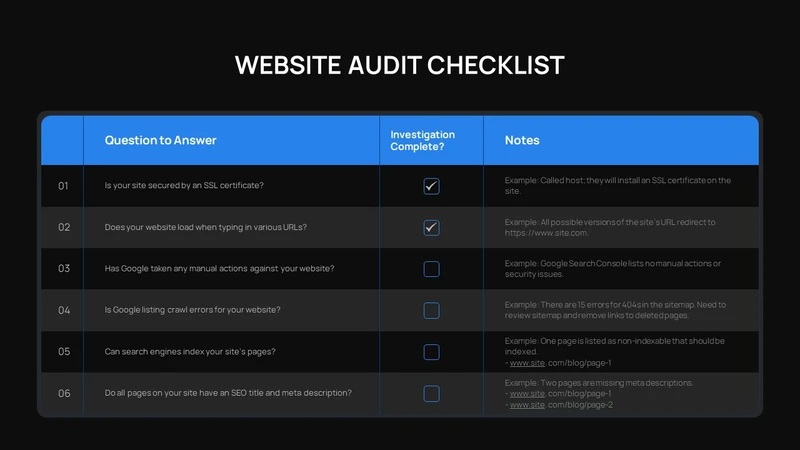
AI Readiness Audit Framework
A comprehensive AI readiness audit evaluates multiple dimensions of a website's preparedness for the AI-driven future:
- Crawlability: Can AI bots access your content? Are robots.txt rules appropriate?
- Structure: Is content organized with clear heading hierarchies and semantic HTML?
- Schema Coverage: How comprehensive is your structured data implementation?
- Authority Signals: Does your content demonstrate E-E-A-T? Are authors identified?
- Content Quality: Is content factual, comprehensive, and regularly updated?
- Machine Readability: Can AI systems extract key information without ambiguity?
- Render Method: Is content available in initial HTML (SSR/SSG) or only via client-side JS?
- Citation Potential: Does content contain quotable facts, statistics, and original insights?
Organizations should conduct AI readiness audits quarterly, adapting their strategies as AI systems evolve and new platforms emerge. The businesses that invest in AI readiness today will capture disproportionate visibility as AI-mediated information access becomes the dominant mode of content discovery.
Measuring AI Visibility
Traditional SEO metrics don't fully capture AI visibility. Emerging measurement approaches include monitoring AI citation tracking tools (tracking when and how your content is cited in AI responses), analyzing traffic from AI referral sources (ChatGPT, Perplexity referral traffic), tracking brand mentions in AI-generated content, and comparing your AI citation share against competitors for key topics.
As AI search matures, new analytics platforms are emerging to provide visibility into this channel. Forward-thinking organizations are establishing AI visibility baselines now to track their progress and ROI as the market develops.