








What Is Website Security?
Website security encompasses the strategies, technologies, and practices that protect websites and web applications from cyber threats, data breaches, and malicious attacks. In 2026, web security is not merely a technical discipline — it is a fundamental business requirement that impacts customer trust, regulatory compliance, search engine rankings, and brand reputation.
According to research from the IBM Cost of a Data Breach Report 2025, the average cost of a data breach reached $4.88 million globally, with web application vulnerabilities being the second most common initial attack vector. For small and medium businesses, the consequences can be existential — 60% of small businesses that experience a significant cyber attack close within six months.
Modern website security requires a defense-in-depth approach that addresses threats at every layer: network security, server hardening, application-level protections, authentication and authorization, data encryption, and continuous monitoring. The threat landscape evolves constantly, with attackers leveraging AI-powered tools for automated vulnerability discovery, sophisticated phishing campaigns, and supply chain attacks targeting third-party dependencies.

HTTPS and Transport Layer Security
HTTPS (HTTP Secure) encrypts communication between browsers and servers using TLS (Transport Layer Security). In 2026, HTTPS is a non-negotiable baseline requirement — browsers flag HTTP sites as "Not Secure," Google uses HTTPS as a ranking signal, and modern web APIs like geolocation, service workers, and payment request require secure contexts.
Best practices for TLS implementation include using TLS 1.3 (which is faster and more secure than TLS 1.2), enabling HTTP Strict Transport Security (HSTS) with includeSubDomains and preload directives, implementing Certificate Transparency monitoring, and configuring OCSP stapling for efficient certificate validation.
Certificate management should be automated using ACME protocol tools like Let's Encrypt or cloud provider certificate services. Wildcard certificates simplify management for multi-subdomain architectures, while short-lived certificates (90 days or less) reduce the window of exposure if a private key is compromised. Research from Qualys SSL Labs provides free tools for testing TLS configurations against known vulnerabilities and best practices.
OWASP Top 10: Critical Web Application Vulnerabilities
The OWASP Top 10 represents the most critical security risks to web applications. Understanding and mitigating these vulnerabilities is essential for any security program:
Injection Attacks (SQL, NoSQL, LDAP)
Injection attacks occur when untrusted data is sent to an interpreter as part of a command or query. SQL injection remains one of the most dangerous and prevalent attack types. Prevention requires parameterized queries (prepared statements), input validation and sanitization, principle of least privilege for database accounts, and using ORM frameworks that automatically escape inputs.
Cross-Site Scripting (XSS)
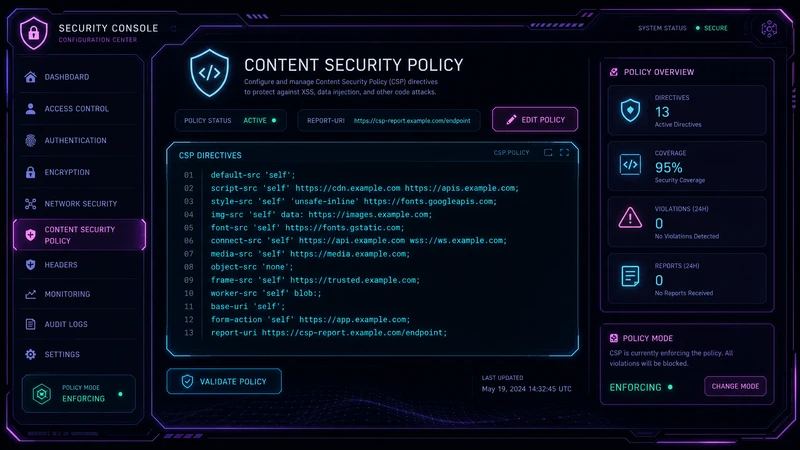
XSS attacks inject malicious scripts into web pages viewed by other users. The three types — Stored XSS, Reflected XSS, and DOM-based XSS — each require different mitigation strategies. Key defenses include output encoding (HTML entity encoding, JavaScript escaping), Content Security Policy (CSP) headers, sanitizing HTML inputs with libraries like DOMPurify, and using modern frameworks that auto-escape output by default (React, Angular, Vue).
Broken Authentication
Authentication vulnerabilities include weak password policies, credential stuffing attacks, session hijacking, and improper session management. Best practices include implementing multi-factor authentication (MFA), using secure session management with HttpOnly, Secure, and SameSite cookie attributes, rate limiting login attempts, and adopting passwordless authentication methods like WebAuthn/FIDO2.

Security Headers and Content Security Policy
HTTP security headers provide an additional defense layer against various attack types. Essential security headers include:
- Content-Security-Policy (CSP): Controls which resources the browser is allowed to load, preventing XSS and data injection attacks. A strict CSP with nonce-based script loading is the most effective defense against XSS.
- X-Content-Type-Options: nosniff: Prevents browsers from MIME-type sniffing, which can lead to security vulnerabilities when browsers interpret files differently than intended.
- X-Frame-Options / frame-ancestors: Prevents clickjacking attacks by controlling whether a page can be embedded in frames.
- Referrer-Policy: Controls how much referrer information is included with requests, preventing sensitive URL data leakage.
- Permissions-Policy: Controls which browser features (camera, microphone, geolocation) can be used on a page, reducing the attack surface.
- Cross-Origin headers (COOP, COEP, CORP): Protect against cross-origin attacks and enable powerful features like SharedArrayBuffer.
Research from Mozilla Observatory provides comprehensive security header analysis and recommendations for web applications.
Authentication and Authorization Best Practices
Modern authentication goes beyond simple username/password combinations. OAuth 2.0 and OpenID Connect enable secure delegated authentication through identity providers. JSON Web Tokens (JWT) provide stateless authentication for APIs, though they require careful implementation — short expiration times, secure signing algorithms (RS256 or ES256, never HS256 with shared secrets for public clients), and proper token storage (HttpOnly cookies, never localStorage).
Authorization should follow the principle of least privilege, granting users only the permissions they need. Role-Based Access Control (RBAC) and Attribute-Based Access Control (ABAC) provide structured frameworks for managing permissions. Every API endpoint should verify both authentication (who is the user?) and authorization (what can they do? ).
Supply Chain Security
Third-party dependencies represent a growing attack surface. The average web application includes hundreds of npm packages, each representing a potential vector for supply chain attacks. Key mitigation strategies include using lock files to pin exact dependency versions, implementing Subresource Integrity (SRI) hashes for CDN-loaded scripts, regularly auditing dependencies with tools like npm audit or Snyk, and minimizing the number of third-party dependencies.
Software Bill of Materials (SBOM) documentation enables organizations to track every component in their applications, facilitating rapid response when vulnerabilities are discovered in dependencies. Automated dependency scanning in CI/CD pipelines catches known vulnerabilities before they reach production.
Zero Trust Architecture
Zero Trust security assumes no implicit trust for any user, device, or network — every request must be verified regardless of its origin. For web applications, this means implementing strong authentication at every access point, encrypting all data in transit and at rest, continuously validating user context and device health, and implementing microsegmentation to limit lateral movement in case of a breach.
Research from NIST's Zero Trust Architecture framework (SP 800-207) provides comprehensive guidance for implementing zero trust principles in web applications and organizational infrastructure.

Continuous Security Monitoring
Effective security requires continuous vigilance. Web Application Firewalls (WAFs) provide real-time protection against common attacks. Security Information and Event Management (SIEM) systems aggregate and analyze security logs. Penetration testing — both automated and manual — identifies vulnerabilities before attackers do. Bug bounty programs incentivize ethical hackers to report vulnerabilities responsibly.
Incident response planning ensures organizations can respond quickly and effectively when breaches occur. A well-documented incident response plan includes detection procedures, containment strategies, evidence preservation, communication protocols, and post-incident analysis to prevent recurrence.