







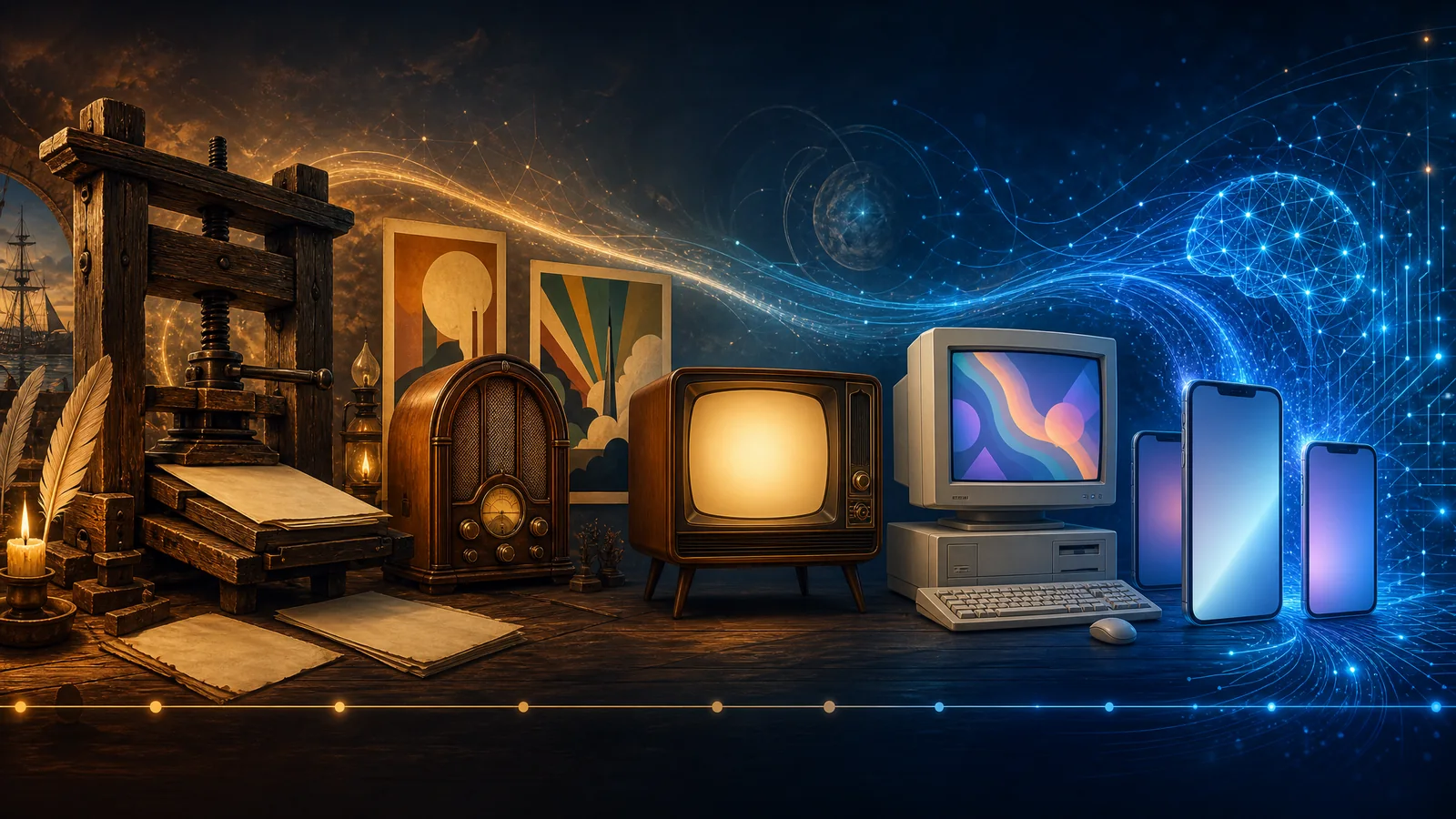
250 Years of American Marketing
A chronological, interactive, and visionary history of every marketing technique born in America since 1776 — from the broadsides and town criers of the Revolution, through the artificial intelligence of today, to the wonders of the year 2100 and beyond.
Keywords: marketing history, American marketing, advertising history, 1776, 250th anniversary, broadsides, press agentry, catalog, radio, television, direct marketing, SEO, social media, influencer marketing, artificial intelligence, future of marketing, video blimp marketing, Michael Aaron Loftus
Introduction
In the year America celebrates its 250th birthday, no story is more American than the story of marketing. From the first printed broadside of the Revolution to the artificial-intelligence algorithms of today, Americans have invented, perfected, and exported nearly every major marketing technique the world knows. This white paper traces that history in full — era by era, technique by technique — and then looks forward, to the year 2100 and beyond.
Across these twelve eras, 87 distinct marketing techniques are documented, each placed in its historical moment and explained in depth. Every historical claim is grounded in primary and scholarly sources, cited by superscript numbers that correspond to the chronological bibliography at the end. It is at once a reference work and a celebration of American commercial genius.
We conclude with a visionary section — “The Marketing of Tomorrow” — that gathers research from elite universities and futurists to imagine the techniques that will define the nation’s tricentennial, including an original conceptual innovation by the author: Video Blimp Marketing.
The Founding Era
Ink, Timber, and the Voice of the Public Square
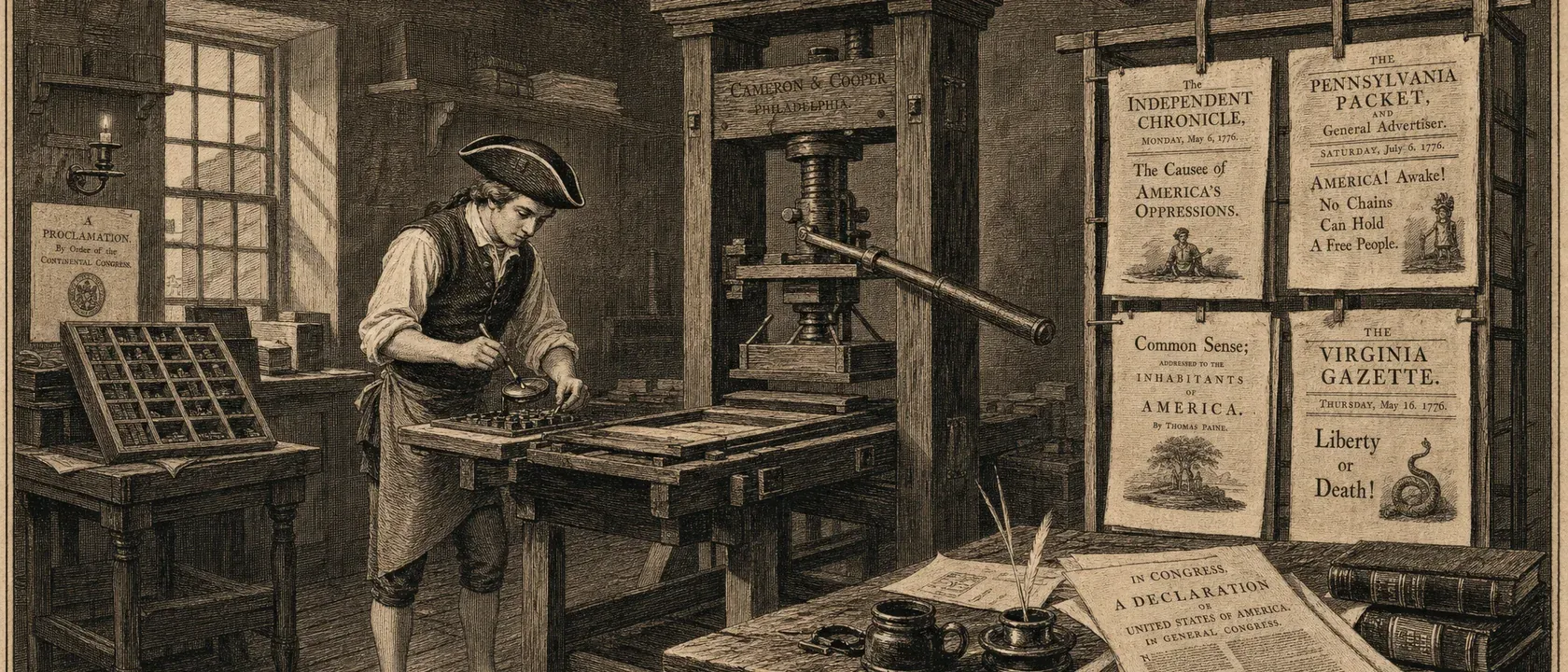
When the thirteen colonies declared independence in 1776, marketing in America was inseparable from the technologies of the printed word and the human voice. There were no agencies, no metrics, and no theory of persuasion beyond the intuition of the merchant, the printer, and the itinerant peddler. Yet the essential grammar of modern marketing — reach an audience, make a claim, and move them to act — was already fully present in the young republic. The very document that founded the nation, the Declaration of Independence, was itself a masterclass in mass communication: printed overnight as a broadside and distributed to be read aloud in town squares from Massachusetts to Georgia.[1]
The Founding Era’s marketing techniques were shaped by scarcity. Paper was expensive, literacy was uneven, roads were poor, and the fastest information traveled at the speed of a horse or a sailing ship. These constraints made every marketing method a study in efficiency: how to say the most with the least, how to reach the most people with a single sheet of paper or a single shouted announcement. The methods that follow — broadsides, shop signs, newspaper advertising, almanacs, pamphlets, town criers, and the first patent-medicine promotions — are the taproots from which the entire two-hundred-fifty-year history of American marketing grows.
Broadsides, Handbills & Flyers
The single printed sheet as the original mass-communication medium.
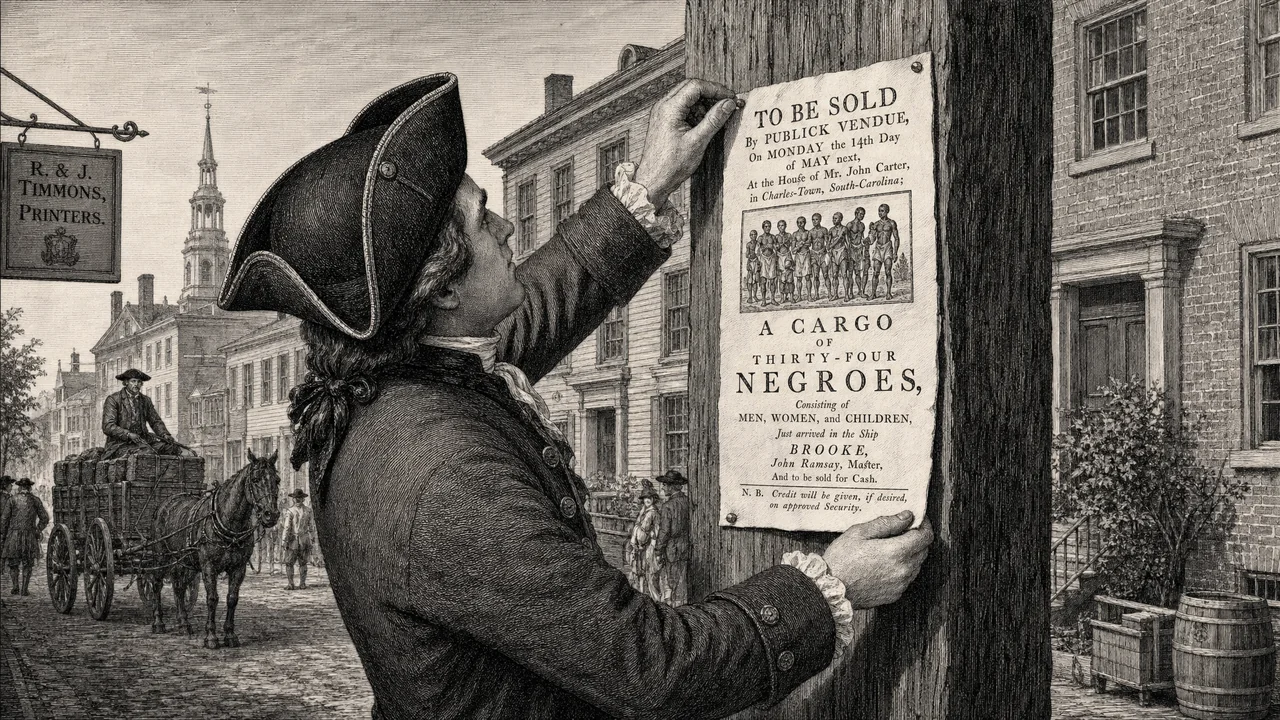
The broadside — a single sheet of paper printed on one side and intended to be posted, handed out, or read aloud — was the dominant form of mass communication in Revolutionary America and the direct ancestor of the modern flyer, poster, and leaflet. Nothing illustrates its power more completely than the first printing of the Declaration of Independence. On the night of July 4, 1776, the Philadelphia printer John Dunlap set the text in type and ran off perhaps two hundred copies, the “Dunlap Broadsides,” which were dispatched by rider and ship across the colonies to be posted on tavern walls and courthouse doors and proclaimed to assembled crowds.[1] The broadside was, in effect, the launch campaign of the United States itself.
Commercial broadsides and handbills worked on the same principle. A merchant receiving a shipment of imported textiles, a shipmaster advertising passage, an auctioneer announcing a sale of land or goods, or a tradesman promoting his services would commission a local printer to produce a batch of sheets. Larger broadsides were posted in high-traffic locations — the wharf, the market house, the meeting house — while smaller handbills were distributed by hand on the street or slipped under doors. Because the technology was cheap relative to a full newspaper advertisement and could be produced quickly, the handbill was the small merchant’s most accessible marketing tool.
The visual conventions of these documents established design principles that persist in print marketing to this day. The most important information — the offer, the date, the location — was set in the largest available type at the top, a hierarchy that anticipates the modern headline. Decorative typographic borders, woodcut illustrations of ships, hands pointing at key text, and dramatic size contrasts between lines were all used to seize the eye of a passerby who might glance at the sheet for only a second or two. The best printers were, functionally, the first graphic designers.
Broadsides also carried the political and social marketing of the era. Recruitment appeals for the Continental Army, announcements of public meetings, celebratory verses, and denunciations of political rivals all traveled by broadside. This blurring of commercial and civic persuasion is itself instructive: from the beginning, American marketing techniques served causes as readily as they served commerce, and the same printer who produced a merchant’s handbill on Monday might print a militia recruitment poster on Tuesday.
The enduring lesson of the broadside is that a marketing medium need not be sophisticated to be transformative. A single sheet of paper, printed cheaply and distributed widely, could announce a business, rally an army, or launch a nation. Every subsequent innovation — the poster, the direct-mail piece, the display ad, the pop-up, even the push notification — is in some sense a descendant of the Revolutionary handbill: a discrete unit of persuasion designed to interrupt a person’s day and deliver a single, urgent message.
Shop Signs & Trade Signage
Three-dimensional branding for a semi-literate marketplace.
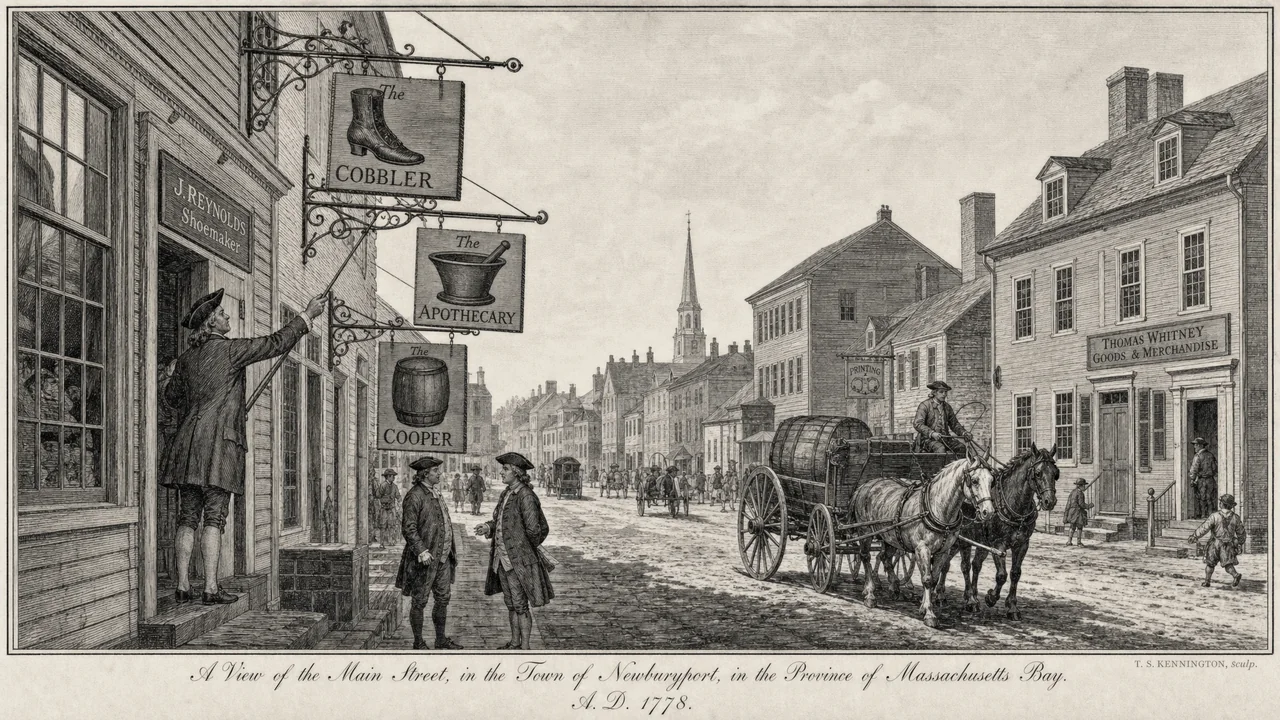
Long before the illuminated logo and the storefront window display, the hanging shop sign was the primary form of retail branding in America. In an age when a substantial portion of the population could not read fluently, and when streets were unnumbered and addresses imprecise, the pictorial trade sign performed the essential functions we now assign to logos, signage systems, and brand identity: it identified the merchant, communicated the nature of the business, and created a memorable landmark by which customers could find and recommend the shop.
These signs were emphatically visual and symbolic. A giant wooden boot or shoe marked the cordwainer; a mortar and pestle identified the apothecary; three golden balls signified the pawnbroker; a bunch of grapes announced a tavern or wine seller; a pocket watch of carved and gilded wood hung outside the clockmaker. The famous “cigar-store Indian” that would later mark tobacconists belongs to this same tradition of the three-dimensional trade figure. Because the illiterate and the literate alike could instantly decode these symbols, the pictorial sign was a genuinely universal marketing medium.
The craftsmanship invested in shop signs reveals how seriously merchants took this form of self-presentation. Signs were carved by specialists, gilded with gold leaf, painted in bright colors, and mounted on decorative wrought-iron brackets that were themselves works of art. A well-made sign was a significant capital investment that signaled the prosperity and permanence of the business — an early form of the brand-equity logic that governs corporate identity today. A shabby sign implied a shabby merchant; a magnificent one implied quality and stability.
Signage also created the first location-based brand recognition. Because a distinctive sign became inseparable from the establishment beneath it, shops were often known by their signs rather than their proprietors — “the Sign of the Golden Fleece,” “the Bunch of Grapes,” “the Sign of the Bible and Crown.” Addresses in newspaper advertisements were frequently given by reference to the nearest prominent sign. In this way the trade sign functioned simultaneously as branding, as wayfinding, and as a shared civic vocabulary that organized the commercial geography of the colonial town.
The trade sign’s legacy is the entire discipline of visual brand identity. The insight that a business can be represented by a single, instantly recognizable symbol — decoupled from words and language, capable of being recognized at a glance and across a crowded street — is the foundational premise of the modern logo. When a contemporary consumer recognizes a brand mark on a phone screen or a highway billboard in a fraction of a second, they are participating in a marketing behavior that colonial Americans practiced beneath carved and gilded wooden signs.
Newspaper & Magazine Advertising
Paid space in the periodical press — the first scalable ad medium.
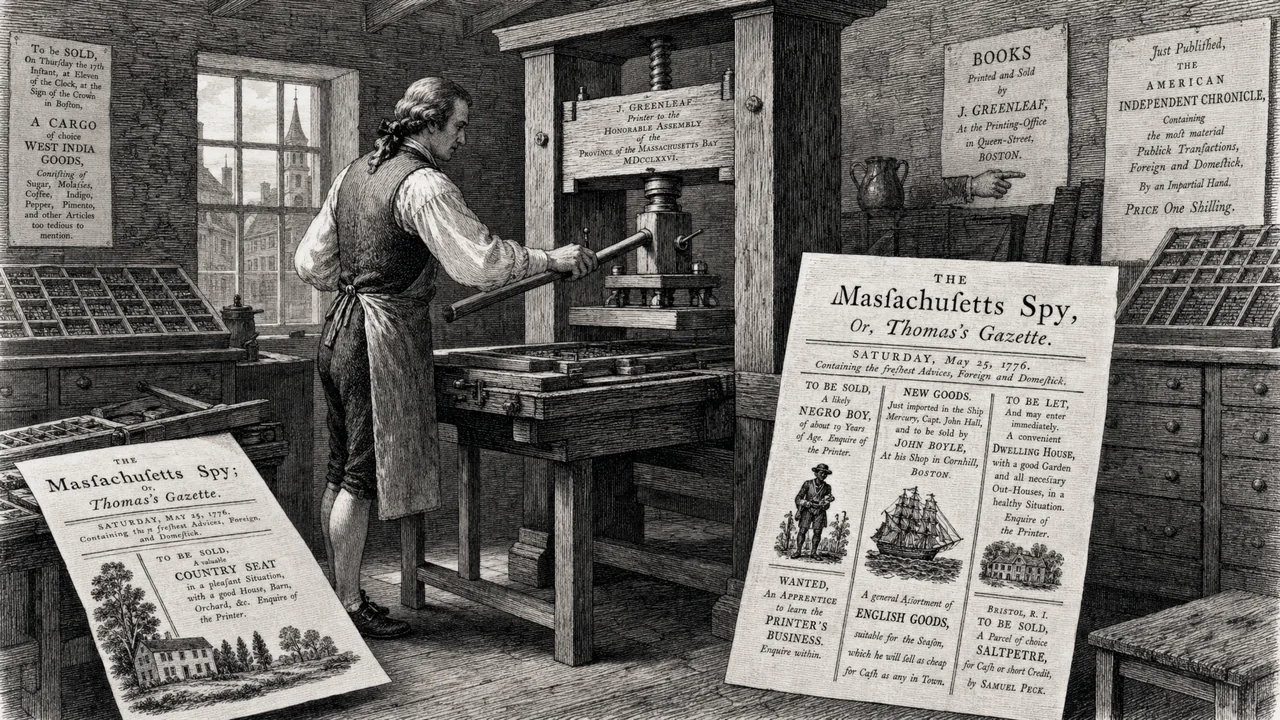
The paid newspaper advertisement is the oldest continuously practiced form of mass-media marketing in America, and by the Revolutionary period it was already a mature commercial institution. The first known paid newspaper advertisement in the colonies appeared in the Boston News-Letter in 1704, and over the following century the classified and display notice became the financial backbone of the American press. By 1776, colonial newspapers derived a substantial share of their revenue from advertising, and the vast digitized record of this activity survives in the Library of Congress’s Chronicling America archive.[2]
Early newspaper advertising was overwhelmingly informational rather than persuasive in the modern sense. A typical notice announced the arrival of a ship’s cargo, listed goods for sale, advertised property or servants, offered rewards for runaways or lost property, or promoted professional services. The prose was dense, the type was small and uniform, and illustrations were rare and crude — a few stock woodcuts of a ship, a house, or a running figure repeated across countless notices. The advertisement’s job was to inform a reader that a particular good or service existed and could be obtained at a particular place, not to manufacture desire.
Yet even in this austere form, the fundamental economics of advertising were established. The newspaper offered something no broadside could: recurring, reliable access to a defined and relatively affluent audience of subscribers, on a predictable schedule, at a published rate. A merchant could reach the same readers week after week, building familiarity and reinforcing a message through repetition — the germ of the modern advertising campaign. Publishers, for their part, discovered that advertising revenue could subsidize the price of the paper and expand circulation, creating the two-sided-market business model that still underlies media today.
Magazines, which emerged in the colonies in the 1740s and proliferated after independence, extended these principles to a more genteel and national audience. Because magazines were kept, shared, and read over longer periods than daily papers, they offered advertisers greater longevity and a more affluent, literate readership. The magazine advertisement would, over the following century, become the premier showcase for national brand advertising, but its foundations were laid in this early period when publishers first bound commercial notices between covers alongside essays, poetry, and news.
The structural innovation of periodical advertising — renting recurring access to someone else’s assembled audience — is arguably the single most important idea in the history of marketing. Every advertising medium that followed, from radio and television to search engines and social platforms, is a variation on the bargain the colonial newspaper first struck: a publisher aggregates an audience with content, and a marketer pays to place a message before that audience. The entire modern advertising economy, worth hundreds of billions of dollars, is the mature form of a transaction first recorded in a Boston weekly in 1704.
The Age of Spectacle & Expansion
Showmen, Posters, and the Birth of Publicity
Between 1820 and 1865 the United States transformed from a coastal agrarian republic into a continental, industrializing nation knit together by canals, roads, steamboats, and the first railroads. This expansion of markets, mobility, and manufacturing created both the need and the means for a new scale of marketing. Goods now traveled far from where they were made, competing for the attention of consumers who had never met their makers, and a new class of promoters arose to bridge that distance with color, noise, and audacity.
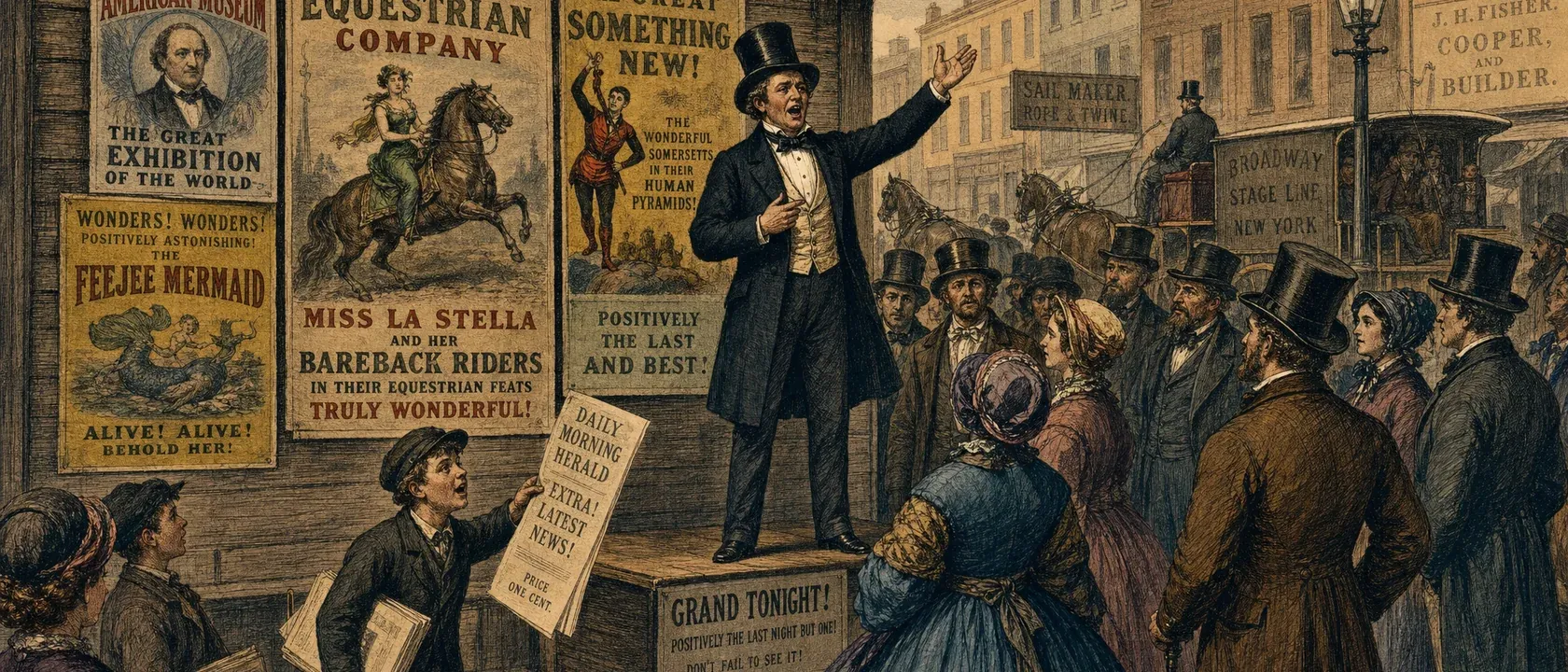
This was the era in which marketing became spectacle. Lithography made vivid color posters affordable, the penny press created enormous newspaper audiences hungry for sensation, and a generation of showmen — above all P. T. Barnum — discovered that publicity itself could be manufactured, that the press could be enlisted as an unpaid promotional partner, and that the public would pay to be astonished. The techniques born in this period — the outdoor poster, press agentry, the celebrity endorsement, the promotional event, and the collectible trade card — introduced emotion, entertainment, and manufactured fame into the marketer’s toolkit for the first time.
Posters, Billboards & Out-of-Home Advertising
Lithography turns the outdoor wall into a canvas of persuasion.
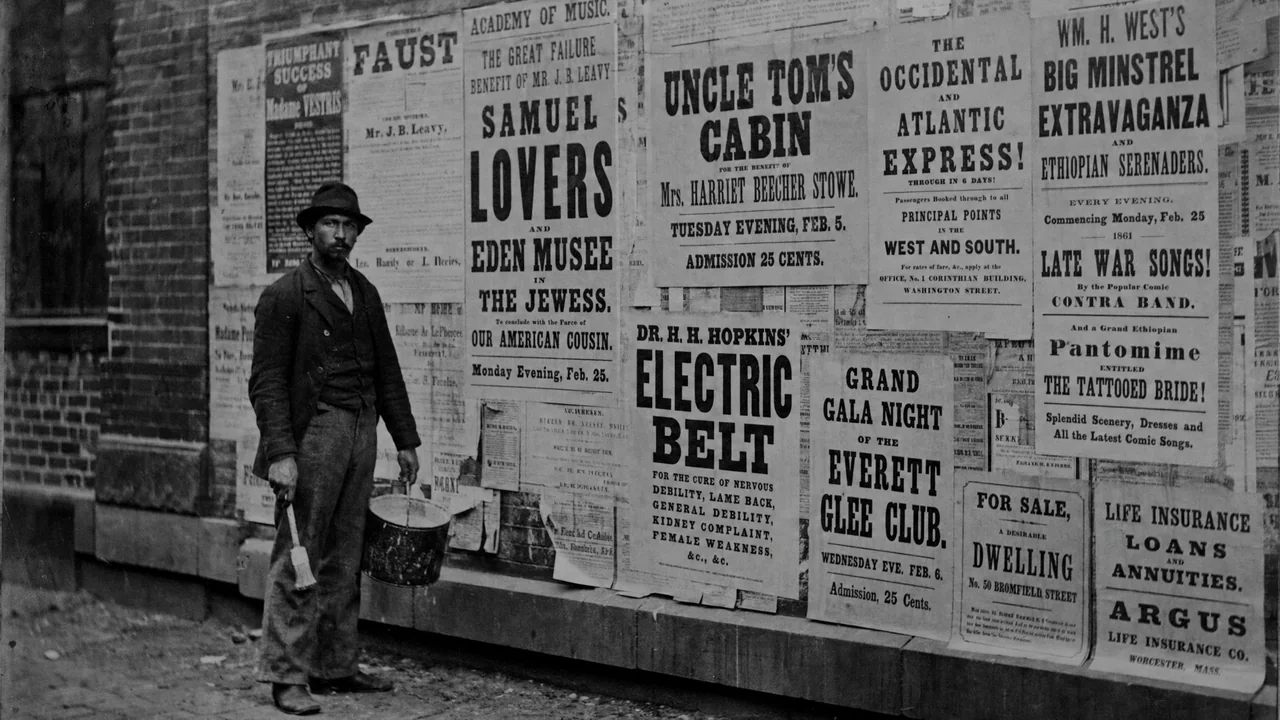
The large-format outdoor poster — the ancestor of the billboard and of all out-of-home advertising — came into its own in this period through the marriage of two forces: the technology of lithographic printing and the entertainment industry’s insatiable need to fill seats. Lithography, which allowed images to be reproduced in vivid color at large sizes and reasonable cost, freed the poster from the tyranny of small woodcuts and dense type and turned it into a genuine visual medium capable of stopping a passerby in their tracks.
Circuses, theaters, minstrel shows, and traveling exhibitions were the pioneering users of the pictorial poster, and they used it on a scale that anticipated modern outdoor campaigns. An advance team would arrive in a town days before the show and “post the town” — plastering barns, fences, walls, and any available surface with brilliantly colored sheets depicting exotic animals, daring performers, and the promise of wonders never before seen. The larger spectacles combined many sheets into enormous composite images, creating billboard-scale displays that dominated the visual environment and made the coming show impossible to ignore.
The poster demanded a new visual grammar distinct from the text-heavy newspaper advertisement. Because it had to communicate instantly to a moving, distracted, often illiterate audience, the poster privileged the bold image, the single dramatic scene, the enormous headline, and vivid color over detailed text. These constraints produced design principles — one dominant image, a short memorable message, high contrast, legibility at a distance — that remain the governing rules of billboard and out-of-home advertising to the present day.
This period also saw the beginnings of outdoor advertising as an organized industry rather than an ad-hoc activity. As posting surfaces became valuable, individuals began to control and rent walls and fences to advertisers, laying the groundwork for the billposting and billboard businesses that would formalize after the Civil War. The recognition that a physical location in the path of the public was a rentable marketing asset — the core economic premise of out-of-home advertising — took root in these decades.
The outdoor poster established that the built environment itself is an advertising medium and that the public’s daily passage through streets and roads is a stream of attention to be captured. Every billboard along a highway, every transit poster, every illuminated sign in a city center, and every wall mural for a brand is a descendant of the circus posters that once blanketed American towns. The medium’s essential challenge — to seize attention instantly and communicate a single idea to people in motion — was defined in the age of the traveling show.
Press Agentry, Publicity & Public Relations
Manufacturing news to earn media the marketer does not pay for.
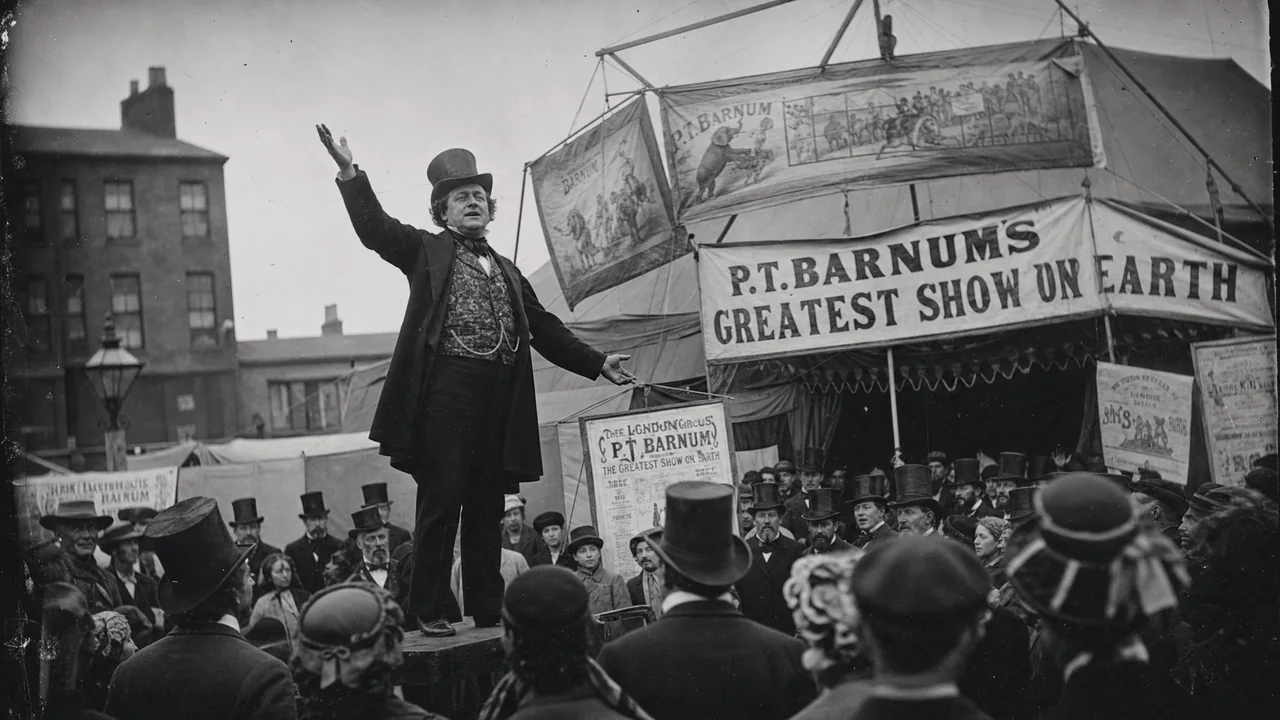
The single most consequential marketing innovation of this era was the discovery that publicity — favorable coverage in the press that the marketer does not directly pay for — could be deliberately manufactured. The master of this art, and the figure who did more than anyone to establish it as a discipline, was Phineas Taylor Barnum, whose showman’s career and self-mythologizing autobiography made him the founding practitioner of American press agentry and public relations.[3]
Barnum understood a truth that eluded most of his contemporaries: that a story in a newspaper carried far more credibility, and cost far less, than an advertisement in the same paper. His genius lay in creating events, controversies, and curiosities so novel, so outrageous, or so debatable that newspapers could not resist covering them — and in doing so, promoted his exhibitions for free. He staged hoaxes and “authenticity” debates, planted provocative letters and rumors, and manufactured a steady stream of pseudo-events whose only real purpose was to generate coverage and conversation. He grasped that even skeptical or hostile coverage sold tickets, and he deliberately cultivated ambiguity to keep the public arguing and the press writing.
This was a fundamentally new relationship between marketer and media. Where the newspaper advertisement rented space, press agentry earned attention by supplying the press with material it wanted — sensation, novelty, and controversy. Barnum and his imitators effectively transformed journalists into an unpaid distribution channel, a dynamic that remains the essence of public relations. The press agent’s craft — crafting the newsworthy angle, timing the announcement, managing the narrative, and turning a commercial interest into a story the public wants to read — was born in these decades.
Barnum also pioneered the strategic management of a public reputation. His autobiography, which he placed into the public domain to encourage its free reproduction, was itself a marketing instrument designed to shape and propagate his chosen image as the genial “Prince of Humbugs.”[3] He understood that a personal brand could be constructed, disseminated, and monetized, and that celebrity itself was a manufacturable asset — insights that anticipate the entire modern apparatus of personal branding, reputation management, and influencer culture.
The legacy of press agentry is the vast contemporary industry of public relations, earned media, and content designed to be shared rather than paid for. When a company stages a product launch event to generate coverage, seeds a story with journalists, engineers a viral stunt, or manages its reputation through strategic narrative, it is practicing the craft Barnum perfected. His central insight — that attention can be earned rather than purchased, and that the earned kind is often more valuable — remains one of the most important principles in all of marketing.
Celebrity Endorsements & Testimonials
Borrowing the credibility and fame of a trusted or famous person.
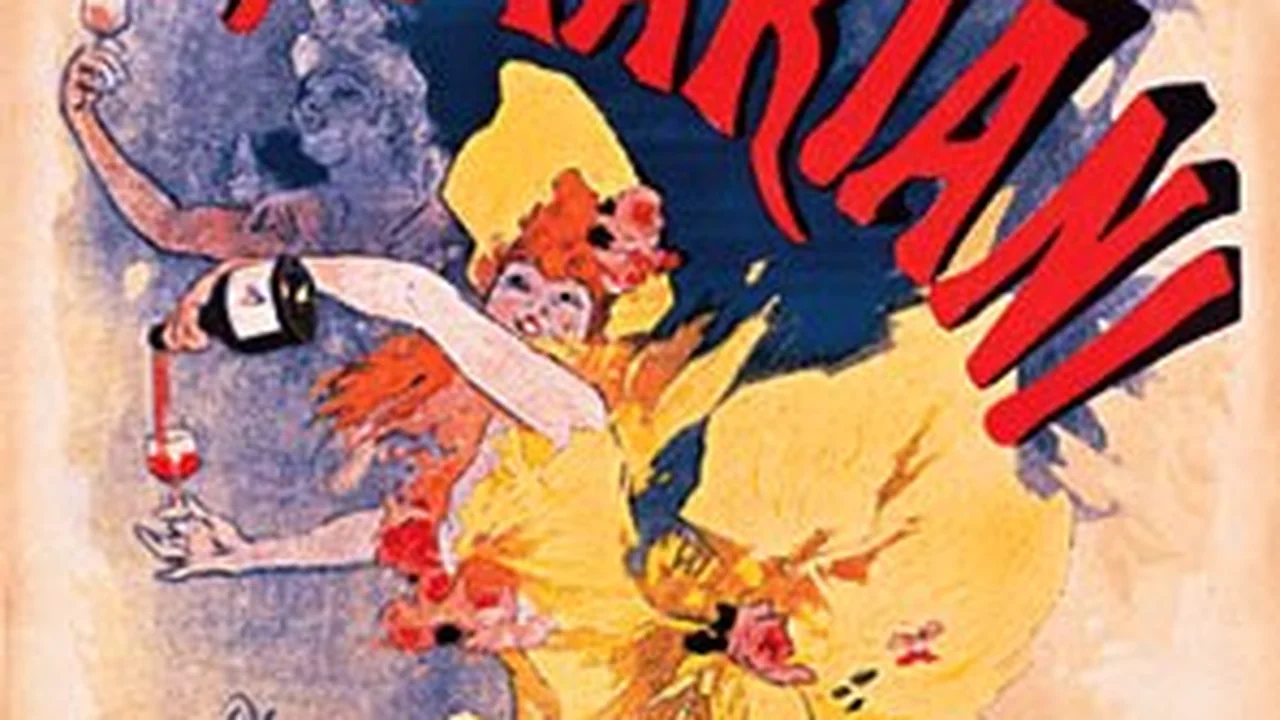
The practice of enlisting a famous, admired, or ostensibly credible person to vouch for a product — the celebrity endorsement and its humbler cousin, the customer testimonial — matured into a deliberate marketing strategy in this era, driven again by the showmen and patent-medicine sellers who were the period’s most sophisticated promoters. The underlying psychological principle is ancient: people are more easily persuaded by those they admire, trust, or wish to emulate. What changed in the nineteenth century was the systematic, commercial application of that principle.
P. T. Barnum was a pioneer here as well. His management of the singer Jenny Lind, the “Swedish Nightingale,” whose 1850 American tour he promoted with unprecedented intensity, demonstrated how a celebrity’s fame could be marshaled to create demand and command premium prices. Barnum understood that associating a commercial venture with a beloved, respectable star transferred that star’s prestige and public affection to the venture itself — the precise mechanism of the modern endorsement deal. The celebrity became a walking, singing advertisement whose reputation was the true product on sale.
The testimonial worked by the same logic at a more accessible level. Patent-medicine advertisements filled themselves with statements from named individuals — sometimes real, often invented or exaggerated — attesting to miraculous cures and satisfying results. Where a seller’s own claims were inherently suspect, the apparent voice of a disinterested third party carried a credibility the advertiser could not manufacture directly. The testimonial thus imported social proof into advertising: the persuasive power of knowing that others have tried the product and been satisfied.
These techniques introduced a crucial idea into marketing: that credibility can be borrowed. A new or unknown product could acquire instant trust by association with a person the audience already trusted or admired, effectively shortcutting the slow process of building a reputation from scratch. This borrowing of credibility, prestige, and relatability from an endorser is one of the most efficient persuasion mechanisms ever devised, and it explains why endorsements have remained central to marketing across every subsequent medium.
The straight line from Jenny Lind’s Barnum-managed tour to the modern athlete’s sneaker deal and the social-media influencer’s sponsored post is unmistakable. In every case the marketer rents the accumulated trust, fame, or relatability of another person and transfers it to a product. The endorsement and the testimonial, systematized in the age of spectacle, remain among the most powerful and most widely used techniques in the entire marketing repertoire — and the questions of authenticity and disclosure they raise, first provoked by fabricated patent-medicine testimonials, are with us still.
The Gilded Age Industrial Revolution
Brands, Catalogs, and the Machinery of Mass Retail
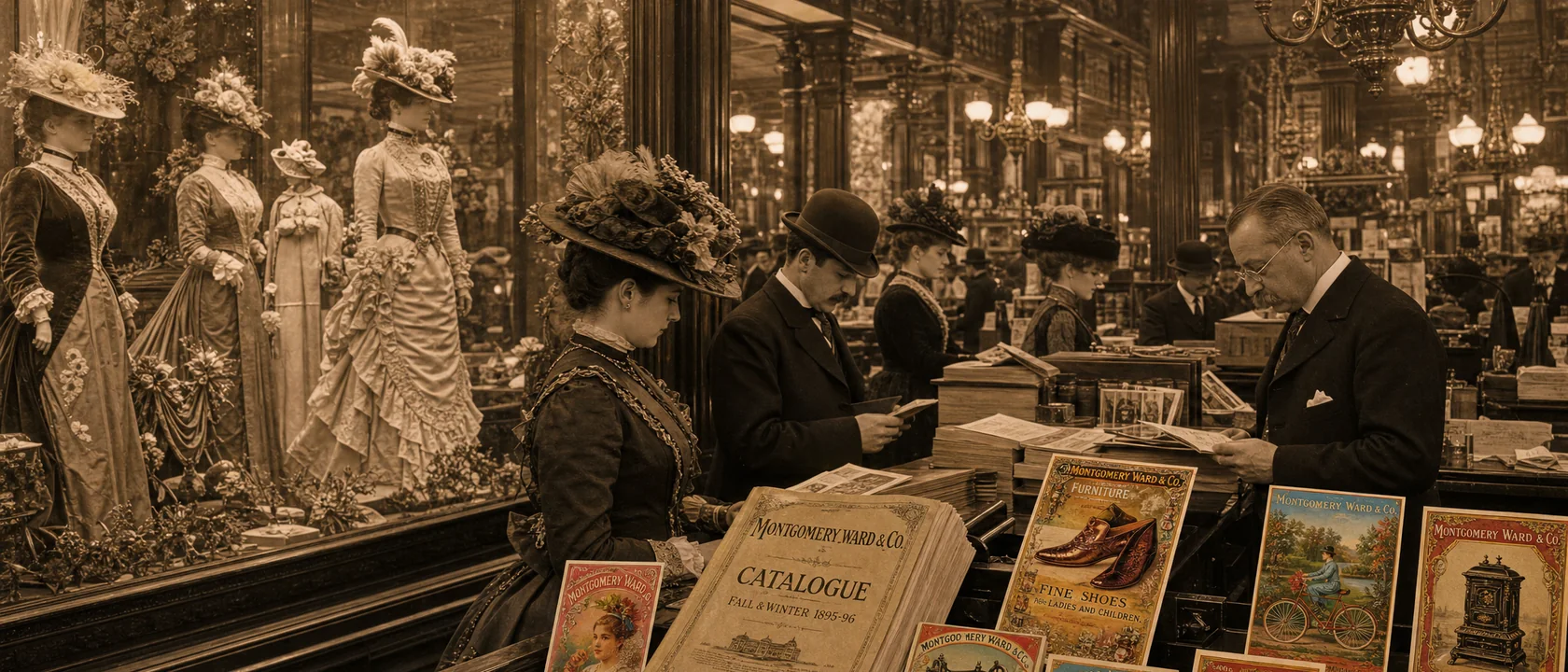
The decades between the Civil War and the turn of the century remade American commerce more profoundly than any period before it. Railroads and the telegraph created a genuinely national market; mechanized factories produced identical goods in unprecedented quantities; and a rising urban middle class had money to spend and appetites to satisfy. For the first time, manufacturers made products in one place and sold them everywhere, to consumers who would never see the factory or meet the maker. Marketing had to bridge that vast new distance — and in doing so, it became the sophisticated, systematic discipline we would recognize today.
This era gave birth to the most durable institutions of consumer marketing: the national brand and its legally protected trademark, the mail-order catalog that put a store in every farmhouse, the grand department store that turned shopping into an experience, the coupon and premium that engineered trial and loyalty, and the retail display that transformed the point of sale into a stage. The techniques introduced here — branding, direct mail, sales promotion, retail theater, and the organization of advertising into a formal industry — are the working machinery of modern consumer marketing.
Catalogs & Direct-Mail Marketing
A store delivered by post to every household in the nation.
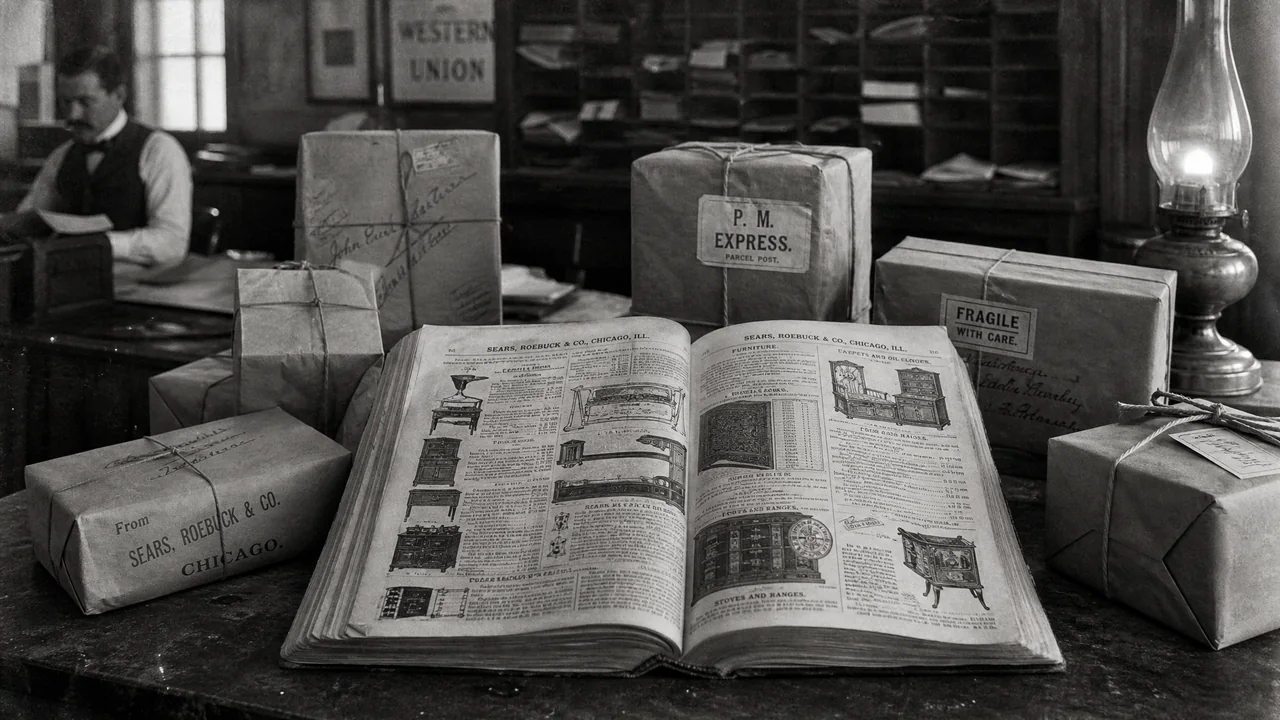
The mail-order catalog was among the most revolutionary marketing innovations in American history, because it dissolved the fundamental limitation of retail — the requirement that buyer and goods occupy the same physical place. By combining a national postal system, a national rail network, and mass production, catalog merchants such as Montgomery Ward (founded 1872) and Sears, Roebuck and Co. put a comprehensive store into the hands of every household in the country, including the isolated rural majority who had previously been served only by expensive, poorly stocked local general stores.
The Sears catalog — the famous “wish book” — grew into an encyclopedic volume offering thousands of products, from clothing and tools to furniture, farm equipment, and even entire pre-cut houses, all described, illustrated, priced, and available by mail at prices that undercut the local monopolist.[5] The catalog was simultaneously a product showcase, a price list, an order form, and a piece of aspirational content that families pored over for hours. It democratized access to the fruits of industrial abundance, and it did so through the mailbox.
The catalog pioneered the core disciplines of direct marketing that remain central today. Because every order arrived by mail with the customer’s name and address, catalog merchants built the first great customer databases, enabling them to mail future catalogs and targeted offers to known buyers. They learned to measure response, to test which products and presentations sold best, and to refine their offers based on hard data — the direct, measurable, accountable feedback loop that distinguishes direct marketing from brand advertising to this day.
Trust was the catalog’s central marketing challenge, and its solutions were enduring. Because customers were sending money to a distant company for goods they could not inspect, the catalog merchants had to manufacture confidence. They did so with unconditional money-back guarantees, plainspoken and honest product descriptions, and relentless emphasis on reliability and fair dealing. This deliberate construction of trust across distance — the guarantee, the clear return policy, the reputation for honesty — solved the same problem that e-commerce would confront a century later, and it solved it in fundamentally the same way.
The catalog is the direct ancestor of the entire direct-marketing and e-commerce industries. The customer database, the segmented mailing, the tested offer, the satisfaction guarantee, the order-by-mail (and later order-by-click) transaction, and the very idea of a store without walls all descend from the mail-order revolution of the Gilded Age. When a modern consumer browses an online store, adds items to a cart, and trusts a distant seller to deliver, they are completing a transaction whose template was printed in the pages of the Sears wish book.
Couponing, Premiums & Sales Promotions
Engineering trial and loyalty with incentives and rewards.
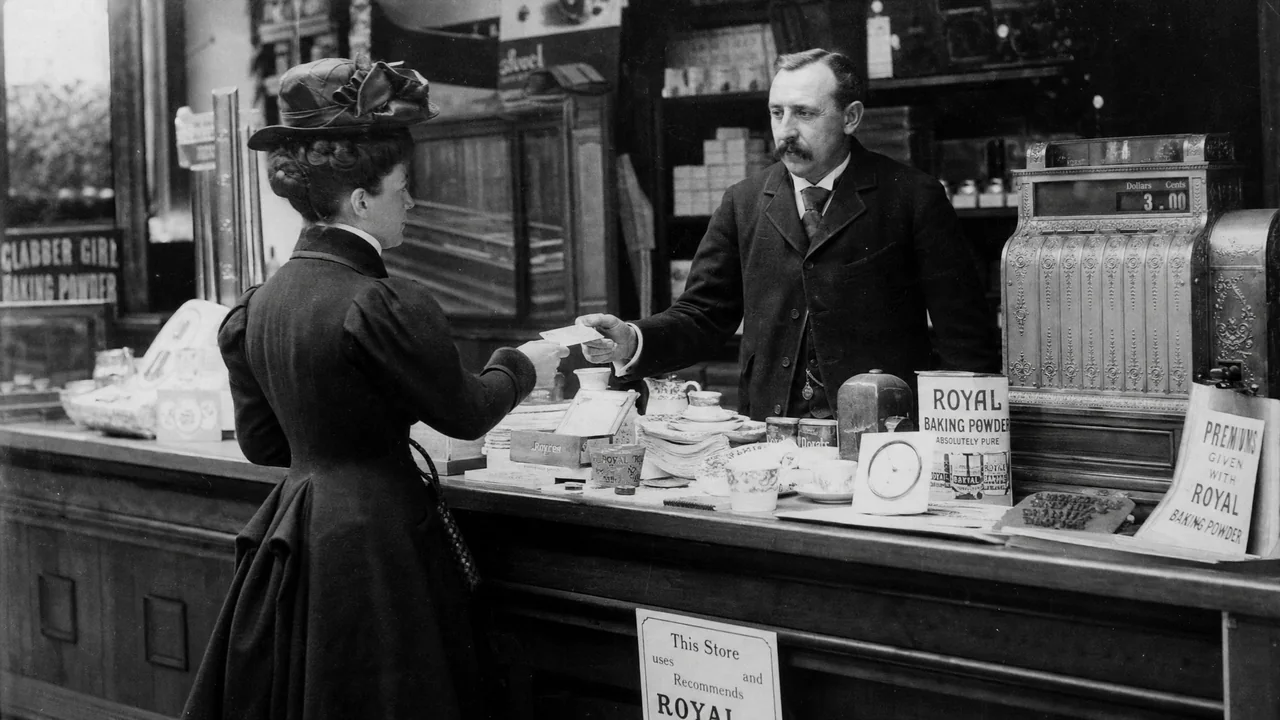
Sales promotion — the use of coupons, premiums, rebates, and limited-time incentives to prompt immediate purchase and reward loyalty — became a systematic marketing discipline in this era, pioneered by the new national-brand manufacturers who needed to persuade skeptical consumers to try their unfamiliar packaged goods for the first time. The coupon, in particular, solved a precise problem: how to lower the risk and cost of trying a new product just enough to convert a hesitant prospect into a first-time buyer.
The Coca-Cola Company’s introduction of the coupon in 1887 is the landmark example. To build trial for its new fountain beverage, the company distributed handwritten and later printed tickets entitling the bearer to a free glass of Coca-Cola, an audacious sampling program that put the product directly onto the tongues of enormous numbers of first-time consumers at the company’s expense. The logic was as sound then as now: the greatest barrier to a new product is the consumer’s reluctance to risk money on the unknown, and the coupon removes or reduces that risk at the precise moment of decision.
The premium — a free gift or reward included with a purchase or obtained by collecting proofs of purchase — worked on a complementary principle, rewarding purchase and, crucially, repeat purchase. Manufacturers packed small toys, cards, or coupons into their products, and offered desirable premiums in exchange for accumulated box tops, labels, or tokens. This engineered a powerful loyalty loop: the consumer who wanted the premium had to buy the product repeatedly to collect enough proofs, converting a single sale into a sustained relationship and a habit.
These techniques introduced the marketer’s crucial ability to stimulate demand on a specific timetable and to make it measurable. Unlike brand advertising, whose effects are diffuse and slow, a coupon or promotion produced an immediate, countable response — redeemed coupons, mailed-in box tops, sales spikes during the offer period — that allowed marketers to quantify exactly how many customers a given incentive had moved to act. Promotion thus became the accountable, short-term, activation-focused complement to the long-term brand-building work of advertising.
The coupon, the premium, and the limited-time offer remain among the most widely used and most reliably effective techniques in all of marketing, essentially unchanged in their underlying logic. The digital coupon code, the loyalty-points program, the free trial, the “buy one get one” offer, the collectible reward, and the flash sale are all direct descendants of the incentive strategies the national-brand pioneers devised to overcome consumer hesitation. The fundamental insight — that a well-designed incentive can reliably convert intention into action — was proven in the age of the free Coca-Cola.
Department Stores & Retail Display
Turning the store itself into an immersive marketing environment.
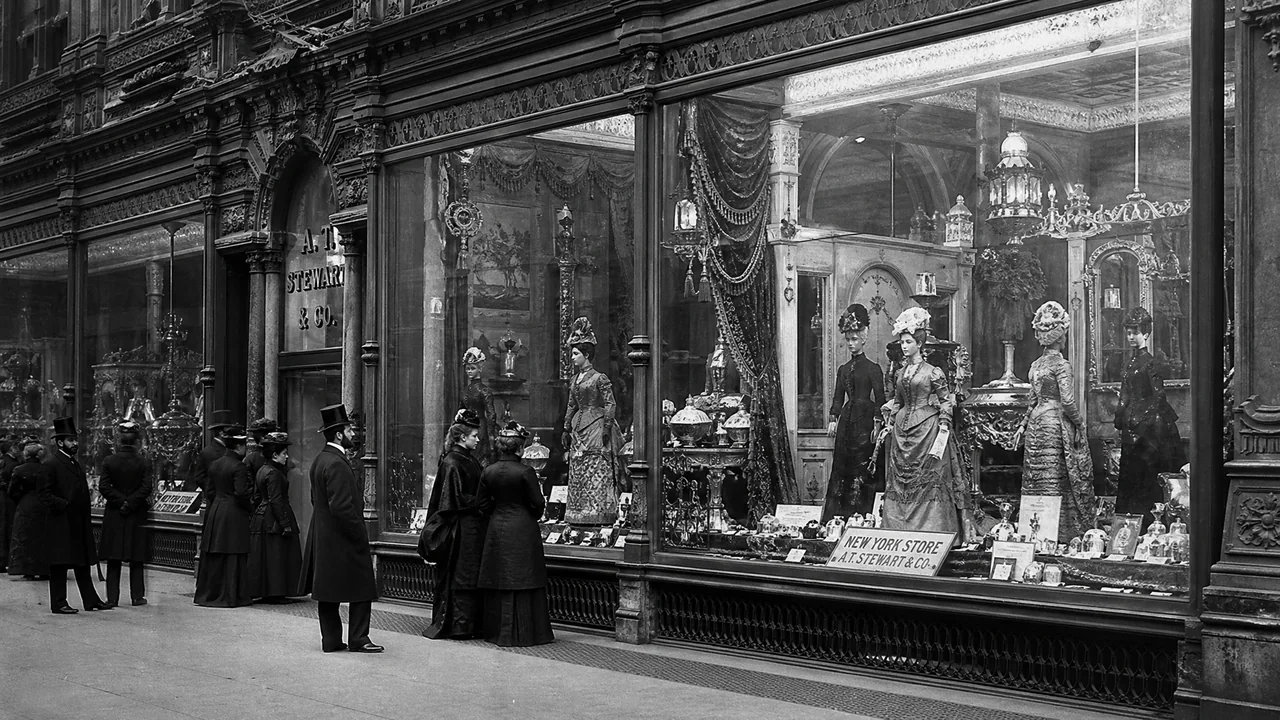
The grand department store, which flowered in American cities in the decades after the Civil War, represented a new marketing idea of extraordinary power: that the retail environment itself — its architecture, lighting, layout, displays, and atmosphere — could be engineered to seduce, delight, and sell. Merchants such as John Wanamaker in Philadelphia, Marshall Field in Chicago, and Macy’s in New York transformed shopping from a transactional errand into an immersive, aspirational experience, and in doing so invented the discipline of retail marketing and store design.
John Wanamaker, in particular, was a marketing revolutionary whose innovations became permanent fixtures of retail. He is credited with introducing the fixed price tag, which replaced haggling with a single, honest, non-negotiable price for every customer, and with pioneering the unconditional money-back guarantee — “one price and goods returnable” — which made shopping safe and built enduring trust.[4] He also placed the first copyrighted store advertisement in 1874, treating retail advertising as a serious, professional, and proprietary craft.[4] These innovations — price transparency, the guarantee, and professional advertising — established the ethical and communicative foundations of modern retailing.
The department store turned the building into a marketing instrument. Vast, palatial spaces — the “palaces of consumption” — were lavished with grand staircases, electric illumination, elevators, restaurants, and reading rooms, making the store a destination and an entertainment in its own right. Goods were arranged in tempting, accessible displays that encouraged browsing, touching, and impulse purchase, and the whole environment was choreographed to keep the shopper inside, comfortable, and spending. The seasonal window display, especially at Christmas, became a celebrated free spectacle that drew crowds and generated publicity.
This era also perfected the art of visual merchandising — the strategic arrangement and presentation of goods to maximize their appeal and sales. Merchants learned that the placement of products, the design of displays, the grouping of complementary items, and the theatrical presentation of merchandise all measurably influenced what and how much customers bought. The store became a three-dimensional advertisement, every square foot of which was designed to communicate value, stimulate desire, and guide the customer toward purchase.
The department store’s legacy is the entire discipline of retail experience, store design, and visual merchandising, and its influence extends directly to the design of e-commerce websites and mobile shopping apps. The insight that the shopping environment is not a neutral container but an active marketing medium — that layout, presentation, atmosphere, and the removal of friction and risk all drive sales — governs everything from the flagship store to the checkout flow of an online retailer. Wanamaker’s price tag, guarantee, and palatial store are the ancestors of both the modern mall and the modern digital storefront.
The Professionalization of Advertising
Science, Psychology, and the Measured Word
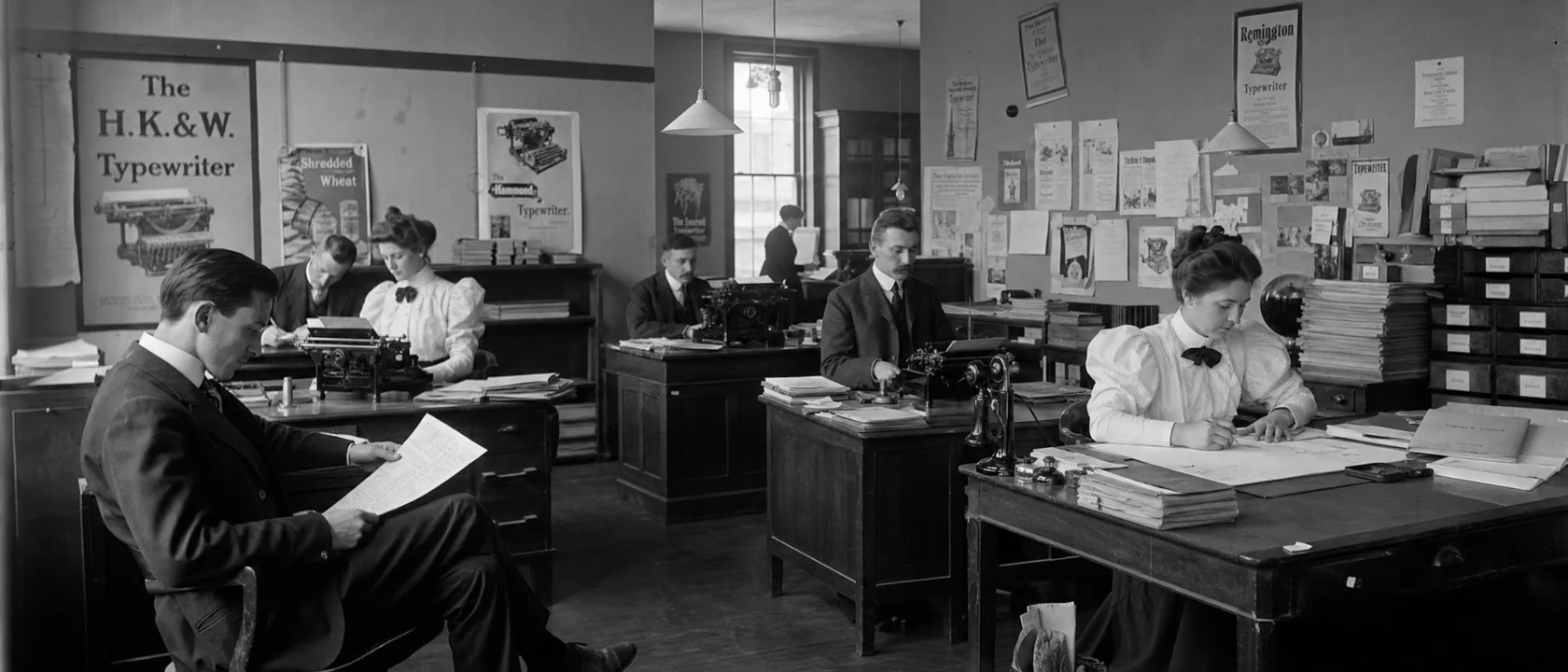
At the turn of the twentieth century, advertising and marketing crossed a threshold from craft to profession. The advertising agency matured from a broker of newspaper space into a full-service creator of campaigns; universities began to study and teach marketing as a subject; and a new generation of practitioners insisted that advertising could be made systematic, testable, and — in their favorite word — scientific. The intuition and showmanship of the nineteenth century did not disappear, but they were now joined by measurement, psychology, and research.
This era introduced the intellectual foundations of modern marketing: the disciplined study of the consumer through market research and testing, the theory of persuasive copywriting through the reason-why school, the strategic use of packaging as a marketing medium, and the first structured methods of consumer testing that would evolve into the focus group. Marketing began, for the first time, to ask not merely how to shout louder but how the consumer actually thinks, decides, and responds — and how to measure whether the marketing worked.
Market Research & Consumer Insights
Studying the consumer systematically before making the pitch.
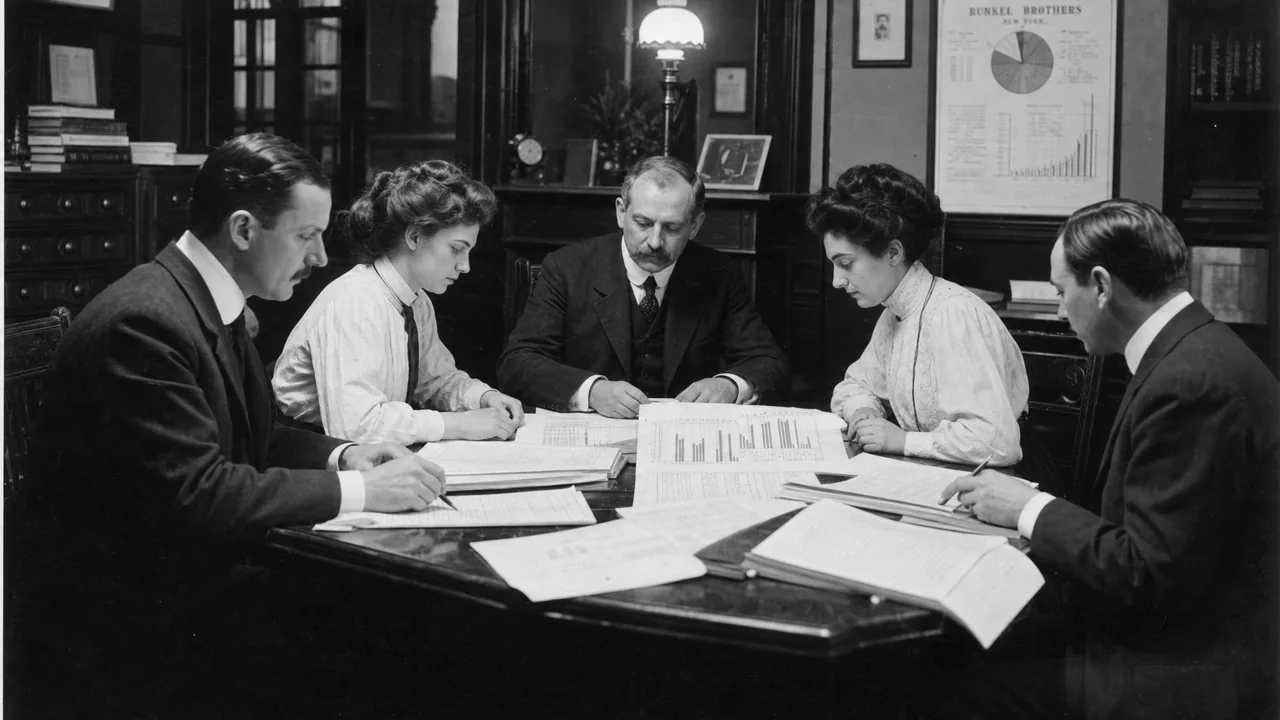
Market research — the systematic gathering and analysis of information about consumers, markets, and the effectiveness of marketing — emerged as a formal discipline in the first two decades of the twentieth century, transforming marketing from an art of assertion into a practice grounded in evidence about real consumer behavior. For the first time, marketers began to study their audiences before addressing them, seeking to understand who consumers were, what they wanted, how they decided, and what actually moved them to buy.
The impetus came from the growing scale and cost of national advertising and distribution. As manufacturers poured ever-larger sums into brand advertising and national campaigns, the financial risk of guessing wrong — of misjudging the market, the message, or the product — grew accordingly. Research promised to reduce that risk by replacing the marketer’s intuition and assumptions with actual data about consumers and markets. Early practitioners conducted surveys, analyzed sales figures, studied demographic and economic data, and began to segment markets by region, income, and other characteristics.
Pioneers of the field established its core methods. Charles Coolidge Parlin, often cited as a founding figure of organized market research, conducted large-scale studies of markets and consumers for the Curtis Publishing Company beginning around 1911, demonstrating that rigorous, systematic investigation of markets could guide advertising and product decisions. Manufacturers and agencies increasingly built research departments, and the survey, the questionnaire, and the analysis of sales and consumption data became standard tools. Marketing had begun to treat the consumer as a subject to be studied rather than merely a target to be hit.
This research orientation introduced the foundational idea that effective marketing begins with understanding the customer, not with the product or the message. The insight that a marketer should first learn what consumers actually need, value, and respond to — and then shape the product, the positioning, and the communication accordingly — is the germ of the entire modern doctrine of customer-centricity and the marketing concept. Research made the consumer’s reality, rather than the marketer’s assumptions, the starting point of strategy.
Market research has grown into one of the largest and most sophisticated components of the marketing enterprise, and its early principles remain intact beneath layers of new technology. The survey and focus group of the twentieth century have been joined by digital analytics, A/B testing, behavioral tracking, social listening, and AI-driven analysis, but the founding conviction is unchanged: that marketing decisions should be grounded in evidence about real consumers, and that understanding the customer is the indispensable first step of all effective marketing. The data-driven marketer of today is the direct professional descendant of the pioneering researchers of the 1910s.
Scientific Advertising & Reason-Why Copy
Testable, measurable, argument-driven persuasion.
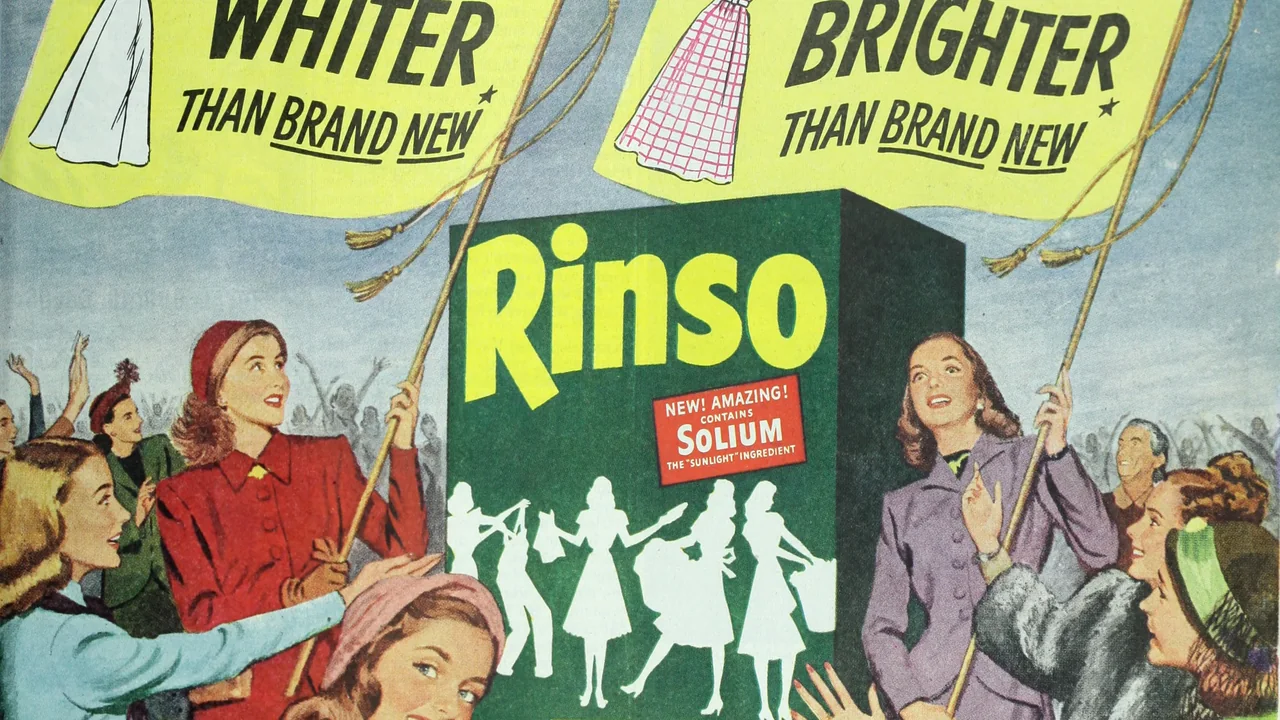
The “scientific advertising” movement, whose principles were codified by Claude C. Hopkins in his landmark 1923 treatise of that name, represented a revolution in the theory and practice of persuasion. Hopkins and his fellow advocates of the “reason-why” school insisted that advertising was not entertainment, art, or mere assertion, but a measurable form of salesmanship in print, governed by discoverable principles and answerable to hard results.[6] Their doctrine transformed copywriting from an intuitive craft into a disciplined, testable practice.
The central tenet of reason-why copy was that an advertisement must give the consumer specific, concrete, compelling reasons to buy — not vague praise or clever wordplay, but definite claims about what the product does and why it is superior. Hopkins pioneered the use of specific, quantified claims, of unique selling propositions that identified a distinctive benefit competitors did not emphasize, and of preemptive claims that seized a virtue as one’s own. He argued that the advertisement should function like a skilled salesperson making a rational, evidence-based case to a prospect, anticipating and answering objections and driving toward a close.
Hopkins’s most enduring contribution was his insistence on measurement and testing. He was a master of the tracked coupon and the keyed advertisement, devices that allowed him to measure precisely how many responses and sales each version of an advertisement produced. By running different headlines, offers, and copy against one another and counting the actual returns, he could determine empirically which approaches worked and which did not — the direct ancestor of modern A/B testing and conversion optimization. “Almost any question can be answered, cheaply, quickly and finally, by a test campaign,” he wrote, establishing accountability as the soul of scientific advertising.[6]
This testing orientation put advertising on a fundamentally different footing. Where earlier advertising had been justified by intuition, taste, or the advertiser’s ego, scientific advertising could be justified by results — by the measurable sales it produced per dollar spent. Hopkins argued that advertising should be treated as an investment expected to return a calculable profit, not an expense justified by aesthetics or tradition. This demand for accountability, for tying marketing spend to measurable return, remains one of the most important and contested principles in the field.
The scientific-advertising tradition is the direct intellectual ancestor of today’s performance marketing, conversion-rate optimization, and data-driven creative. The unique selling proposition, the tracked and tested advertisement, the emphasis on specific claims and clear calls to action, and above all the insistence that marketing be measured by results are the working doctrine of the modern digital marketer. When a contemporary practitioner A/B tests a headline, optimizes a landing page for conversions, and reports return on ad spend, they are practicing, with more powerful tools, the discipline Claude Hopkins codified a century ago.[6]
Packaging as Marketing
The package as protector, advertisement, and silent salesman.
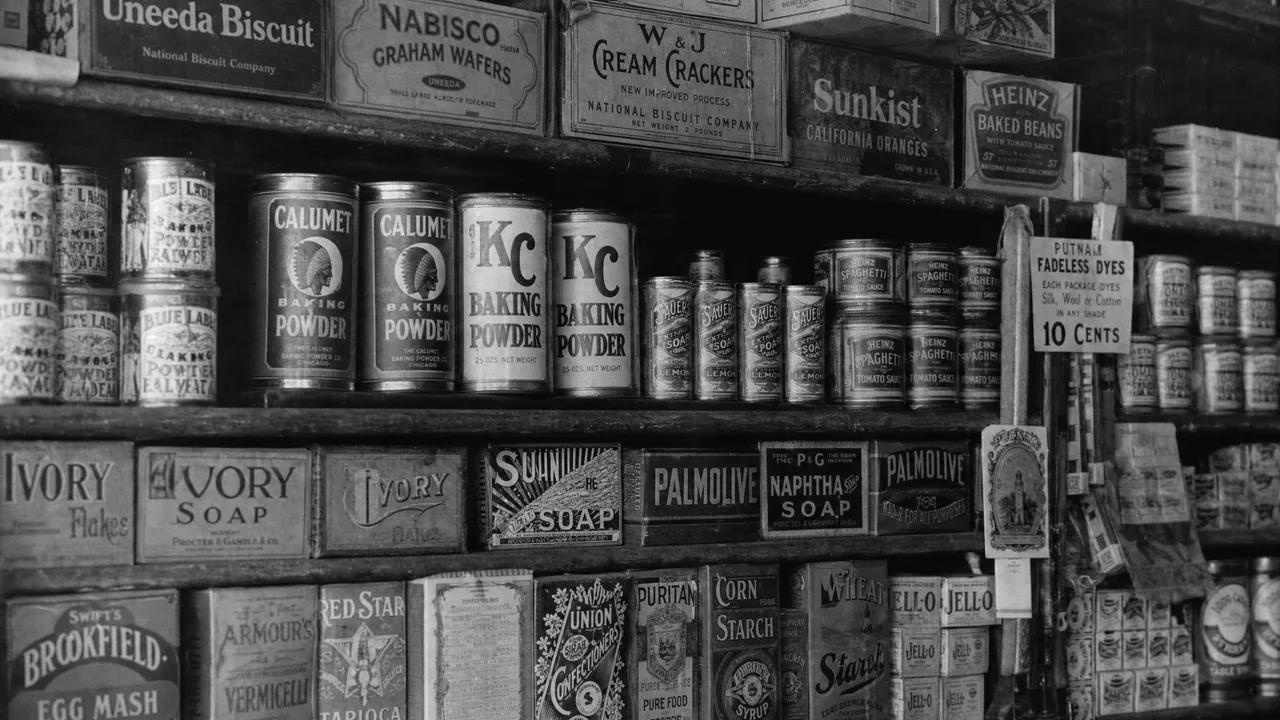
In this era packaging matured from a mere container into a deliberate and powerful marketing medium — the “silent salesman” that works on the consumer at the shelf, in the home, and in every moment of use. As branded, packaged goods displaced bulk commodities and as self-service retailing began to reduce the influence of the shopkeeper, the package increasingly had to do the selling itself, and marketers invested it with all the persuasive, informational, and brand-building functions we recognize today.
The package performed several marketing jobs simultaneously. It protected the product and guaranteed its cleanliness, freshness, and consistent quantity — no small matter in an age of growing concern about food safety and adulteration. It carried the brand name, logo, and identity, turning every unit sold into a traveling advertisement that entered and remained in the consumer’s home. And it communicated the product’s benefits, instructions, and personality through its design, color, imagery, and copy. The distinctive package became inseparable from the brand itself — the Ivory bar, the Quaker Oats cylinder, the Coca-Cola bottle.
Marketers grew increasingly sophisticated about the psychology of package design. They understood that color, shape, imagery, and typography all shaped the consumer’s perception of the product’s quality, value, and character before a single word was read, and they designed packages to convey premium quality, wholesomeness, modernity, or value as the positioning required. The package’s job was to stand out on a crowded shelf, to be recognized instantly, to communicate the brand’s promise at a glance, and to be desirable enough to lift off the shelf and into the basket.
The famous contour Coca-Cola bottle, designed in 1915 to be recognizable in the dark or when shattered on the ground, epitomizes the era’s recognition that a package could itself be a brand asset of enormous value — a shape so distinctive that it functioned as a three-dimensional trademark and an instantly recognizable symbol of the brand. Such iconic packages demonstrated that the container was not a cost to be minimized but a marketing investment capable of building recognition, differentiation, and desire.
Packaging remains one of the most important and intimate marketing media, precisely because it reaches the consumer at the decisive moments of selection and use, when receptivity is highest and no other advertising is present. The discipline of package design, the strategic use of color and form to convey positioning, the unboxing experience engineered for delight and social sharing, and the package as a canvas for brand storytelling are all mature expressions of the insight, established in this era, that the package is a silent salesman working around the clock in the store and the home.
The Dawn of Broadcast
Voices in the Air and Names in Lights
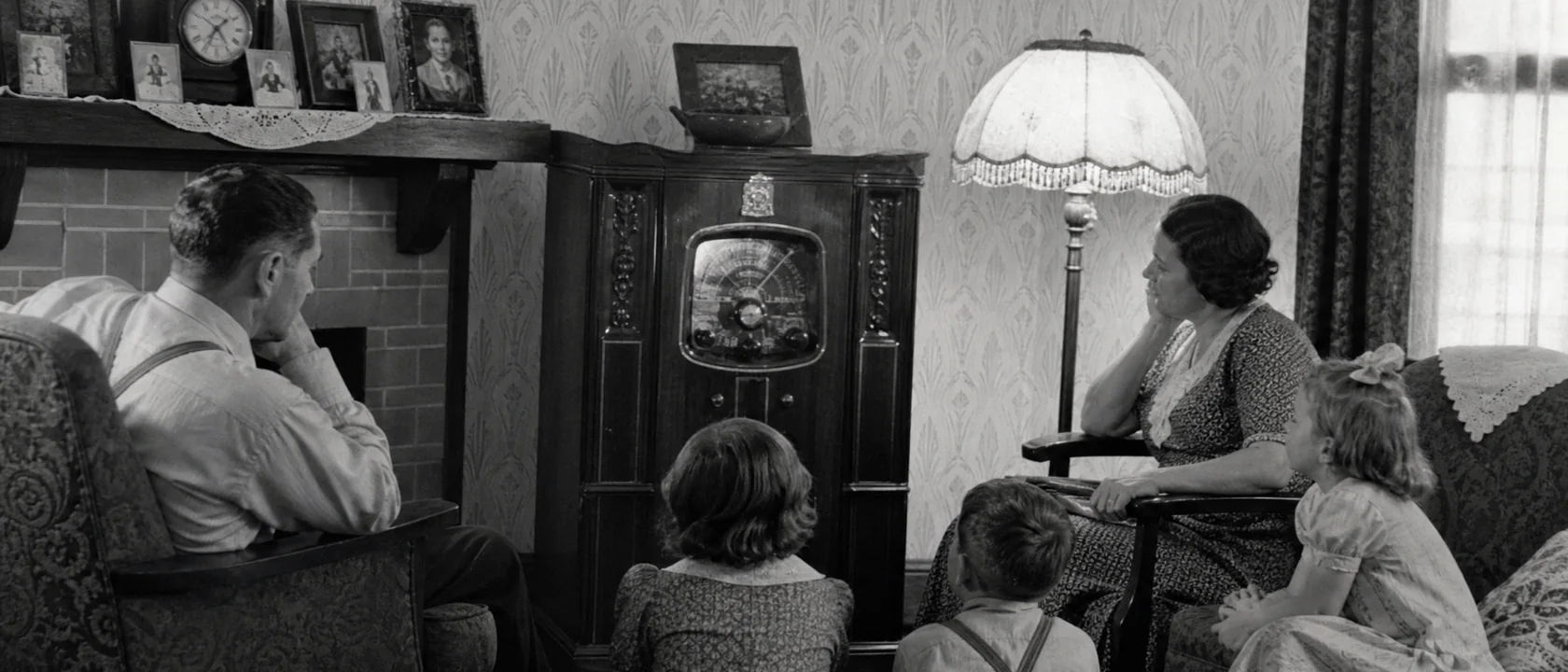
The interwar decades brought the first electronic mass medium into the American home and, with it, a marketing revolution. Radio placed a live, national, intimate voice directly into the family living room for the first time in history, and marketers rushed to master a medium unlike any before it — one that reached millions simultaneously, engaged the ear and the imagination rather than the eye, and blurred the line between advertising and entertainment. At the same time, the electrification of the nighttime city and the rise of Hollywood created dazzling new marketing canvases in light and on screen.
This era introduced techniques built on sound, entertainment, and spectacle: radio advertising and the sponsored program, the jingle and sonic branding, product placement in the movies, patriotic and cause-related marketing mobilized by two world wars and a depression, and the electric spectaculars that turned city skylines into advertising. Marketing learned to entertain, to sing, and to weave itself into the culture rather than merely interrupt it — lessons that would define the broadcast century.
Radio Advertising & Sponsored Programming
A live, national voice in every living room.
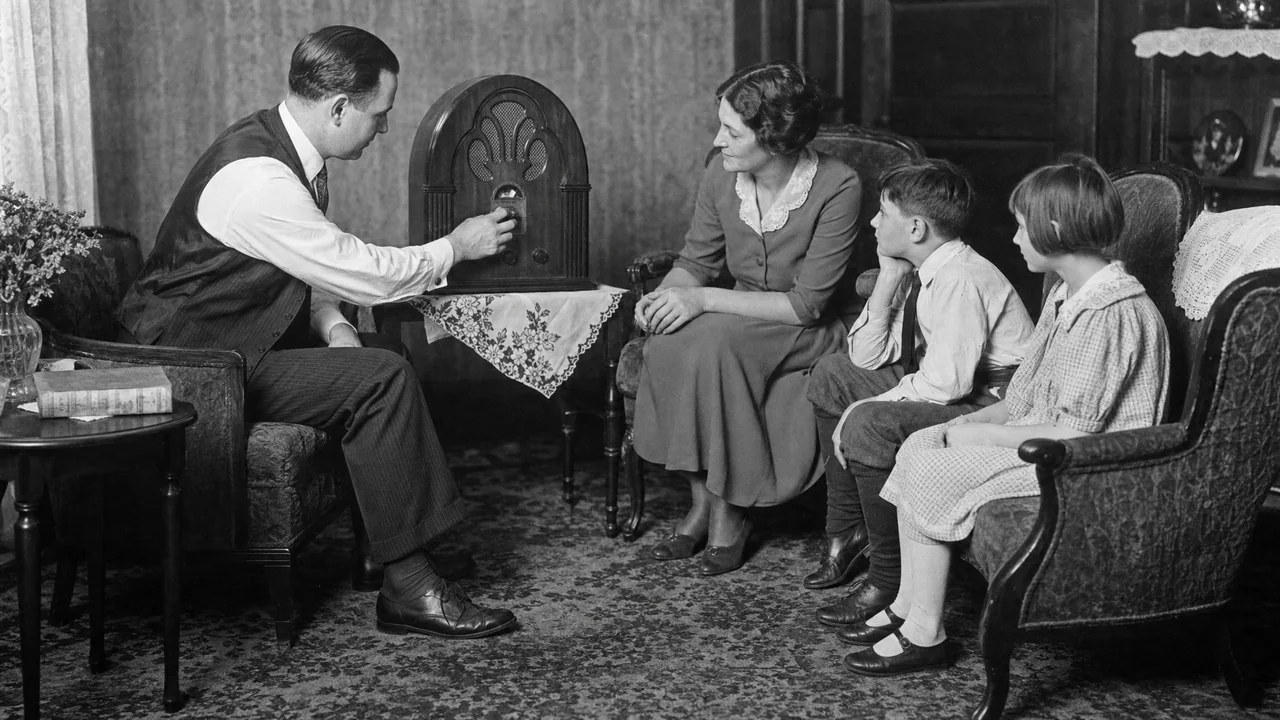
Radio advertising was the marketing breakthrough of the age, delivering something no previous medium could: a live human voice, and later music, drama, and comedy, broadcast simultaneously into millions of homes across the nation. The medium’s birth is conventionally dated to station KDKA in Pittsburgh, whose broadcast of the Harding–Cox presidential election returns on November 2, 1920, demonstrated radio’s power to reach a mass audience with immediacy that no newspaper could match.[7] Within a few short years radio would transform American marketing.
The commercial model of radio was established in 1922, when station WEAF in New York aired what is generally regarded as the first true radio advertisement — a ten-minute sponsored talk promoting apartments for the Queensboro Corporation.[8] This “toll broadcasting” concept, selling airtime to commercial sponsors, solved the fundamental question of how to pay for broadcasting and gave rise to the advertising-supported media model that would dominate the twentieth century. The advertiser funded the programming in exchange for access to the audience it gathered — the same bargain the newspaper had struck, now applied to the air.
Radio’s dominant advertising form became the sponsored program itself. Rather than merely buying spot announcements, major advertisers sponsored and often produced entire shows — the soap operas (so named because soap manufacturers sponsored them), variety hours, dramas, and comedies that filled the airwaves. The sponsor’s name was woven into the program’s very identity, and the beloved entertainment carried the brand into the audience’s affections. This deep integration of brand and content, in which the advertiser delivered the entertainment the audience craved, created powerful associations and loyalty that a mere interruption could not.
The medium demanded and rewarded entirely new creative techniques. Because radio engaged only the ear, marketers had to paint pictures with sound, voice, music, and imagination, developing the arts of the announcer’s persuasive delivery, the dramatized product story, the memorable slogan spoken aloud, and above all the musical jingle. Radio also brought an unprecedented intimacy: the voice speaking from the living-room set felt personal and trustworthy in a way print never had, and skilled advertisers exploited this intimacy to build warm, personal-seeming relationships between brands and listeners.
Radio advertising established the template for all broadcast marketing that followed and pioneered principles that endure across television, podcasting, and streaming audio today. The advertising-supported content model, the sponsored program, the integration of brand and entertainment, the power of the intimate voice, and the reach of simultaneous national broadcast were all proven in radio’s golden age. When a modern brand sponsors a podcast, integrates itself into streaming content, or crafts an audio advertisement designed to engage the imagination, it draws on techniques first mastered in the decades when radio ruled the American home.
Jingles & Sonic Branding
Music that lodges the brand in memory and will not leave.
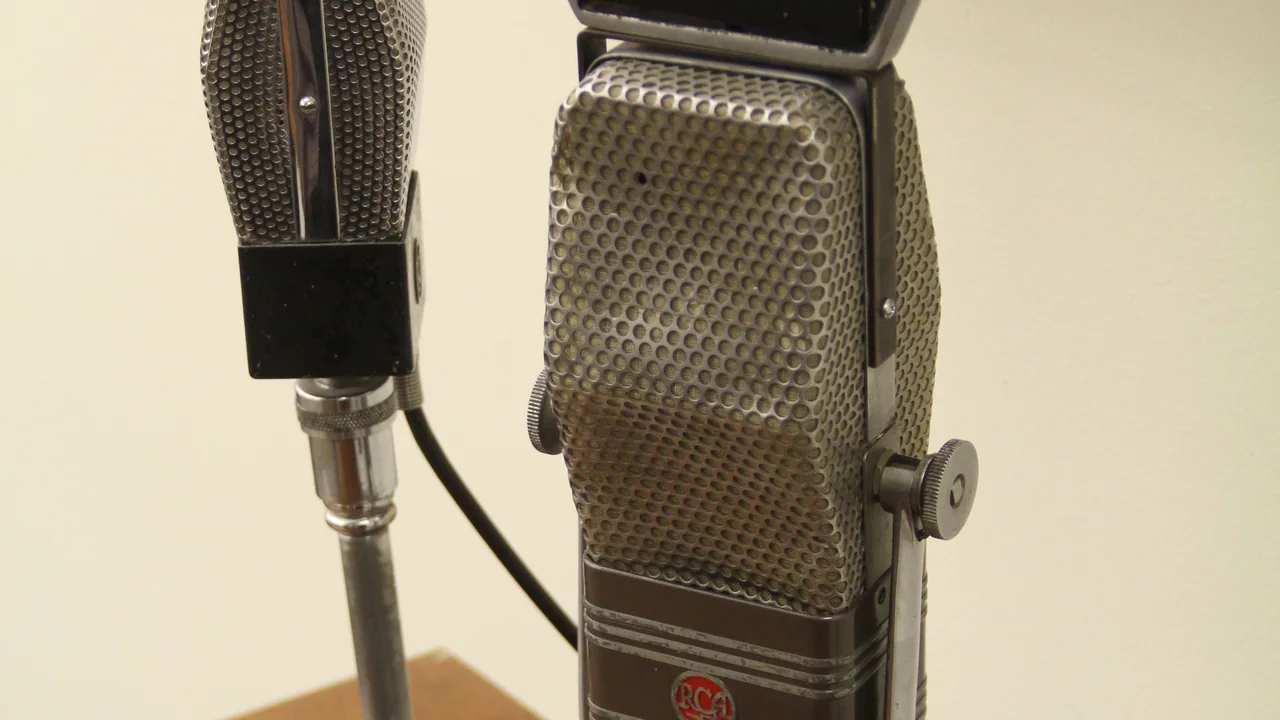
The advertising jingle — a short, catchy, original song promoting a product or brand — was one of radio’s signature marketing inventions, and it introduced the extraordinary mnemonic power of music into the marketer’s toolkit. A jingle exploits a deep feature of human cognition: melody and rhyme are vastly more memorable than spoken prose, and a well-crafted musical phrase can lodge itself in the listener’s memory and replay itself unbidden for hours, days, or a lifetime, carrying the brand message with it.
The commercial jingle is often traced to 1926, when a struggling cereal brand aired a sung radio commercial — the “Have You Tried Wheaties?” jingle — that is credited with rescuing the product from cancellation and demonstrating the selling power of the sung advertisement. Its success established the jingle as a staple of radio advertising, and through the 1930s and 1940s brands across every category commissioned catchy songs that consumers found themselves humming and singing. The jingle turned the audience into an unpaid chorus, spreading and reinforcing the brand message through their own involuntary repetition.
The jingle worked through several reinforcing psychological mechanisms. Its melody made the brand name and message easy to remember and hard to forget; its repetition, both within the commercial and across many airings, drove deep familiarity; its rhyme and rhythm created pleasure and earworm-like persistence; and its emotional and often joyful character built positive feeling toward the brand. A great jingle achieved what marketers most desire — top-of-mind awareness — automatically, because the consumer carried the brand’s song in their own head and rehearsed it without prompting.
The jingle was the leading edge of the broader discipline of sonic branding — the strategic use of sound and music to create brand identity and recognition. Beyond full jingles, marketers developed short musical signatures, brand-associated melodies, and distinctive sounds that identified a brand in an instant. This recognition that sound itself, like a logo or a color, can be owned by a brand and can trigger instant recognition and emotion, established audio as a fundamental dimension of brand identity alongside the visual.
Sonic branding has become more important than ever in an audio-saturated, screen-fatigued age of voice assistants, podcasts, streaming, and short-form video. The three-note sound that identifies a tech brand when a device powers on, the audio logo at the end of a video advertisement, the distinctive sound of an app notification, and the streaming-era jingle are all direct descendants of the Wheaties song. The insight that music is the most memorable and emotionally potent form of persuasion — that a brand you can sing is a brand you cannot forget — was proven in the first decades of radio.
Movie Product Placement & Tie-Ins
Weaving brands into the glamour of the silver screen.
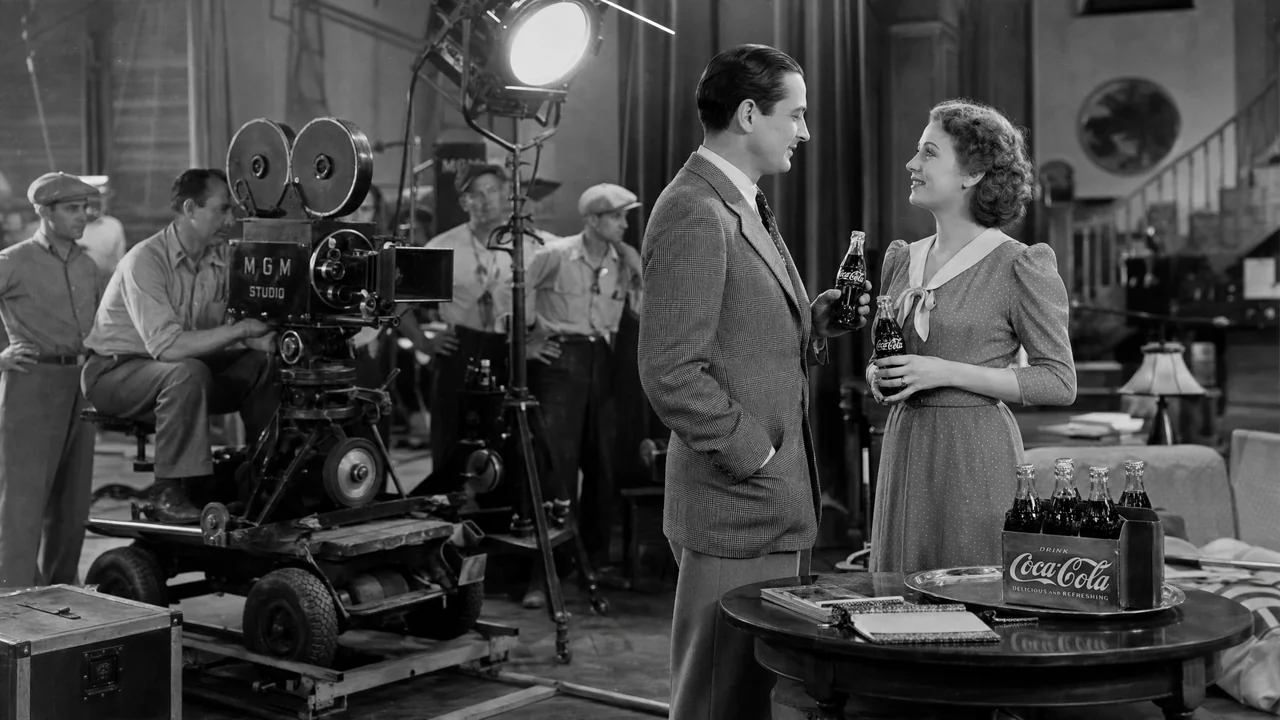
As Hollywood rose to cultural dominance in the interwar years, marketers discovered that the motion picture offered a uniquely powerful and non-interruptive way to reach and influence audiences: by placing their products directly into films, and by tying their brands to the glamour, stars, and stories of the movies. Product placement and the movie tie-in allowed a brand to be seen, used, and implicitly endorsed within the world of a beloved film, borrowing the picture’s prestige and the star’s allure without the audience perceiving a conventional advertisement at all.
The appeal of product placement rested on several advantages over conventional advertising. A product shown being used by a glamorous star in a compelling story was not resisted as advertising is resisted; instead it was absorbed as a natural, aspirational element of a world the audience admired and wished to inhabit. The brand acquired the associations of the film and its stars — sophistication, romance, adventure, modernity — and the powerful human impulse to emulate admired figures drove audiences to want the products those figures used on screen. This was celebrity endorsement and aspirational marketing fused into the entertainment itself.
Marketers also developed the broader movie tie-in, coordinating advertising, promotions, and merchandise around films and their stars. Products were advertised with images of stars and references to their films; retailers mounted displays linking products to popular pictures; and licensed merchandise extended beloved films and characters into consumer goods. The studios and stars, for their part, benefited from the additional promotion and income, creating a mutually reinforcing alliance between Hollywood and consumer marketing that would only deepen over the following century.
Product placement raised, from the beginning, the questions of authenticity and disclosure that continue to attend all forms of embedded and native marketing. Because the persuasive power of placement depends precisely on the audience not perceiving it as advertising, it occupies an ethically ambiguous zone between entertainment and salesmanship. The tension between the effectiveness of hidden persuasion and the audience’s right to know when they are being marketed to — a tension that would eventually produce disclosure regulations — was present at the technique’s birth.
Product placement and entertainment tie-ins have grown into a vast global industry and have proven remarkably adaptable to every new entertainment medium. The branded integration in a film or television show, the product featured in a music video, the placement within a video game, the brand woven into a streaming series, and the product showcased by a social-media creator are all continuations of the strategy Hollywood pioneered. The enduring insight — that a brand embedded in admired entertainment is absorbed more readily and more favorably than one that interrupts it — has only grown more valuable as audiences have grown more resistant to conventional advertising.
The Television Age
The Screen, the Suburb, and the Science of Persuasion
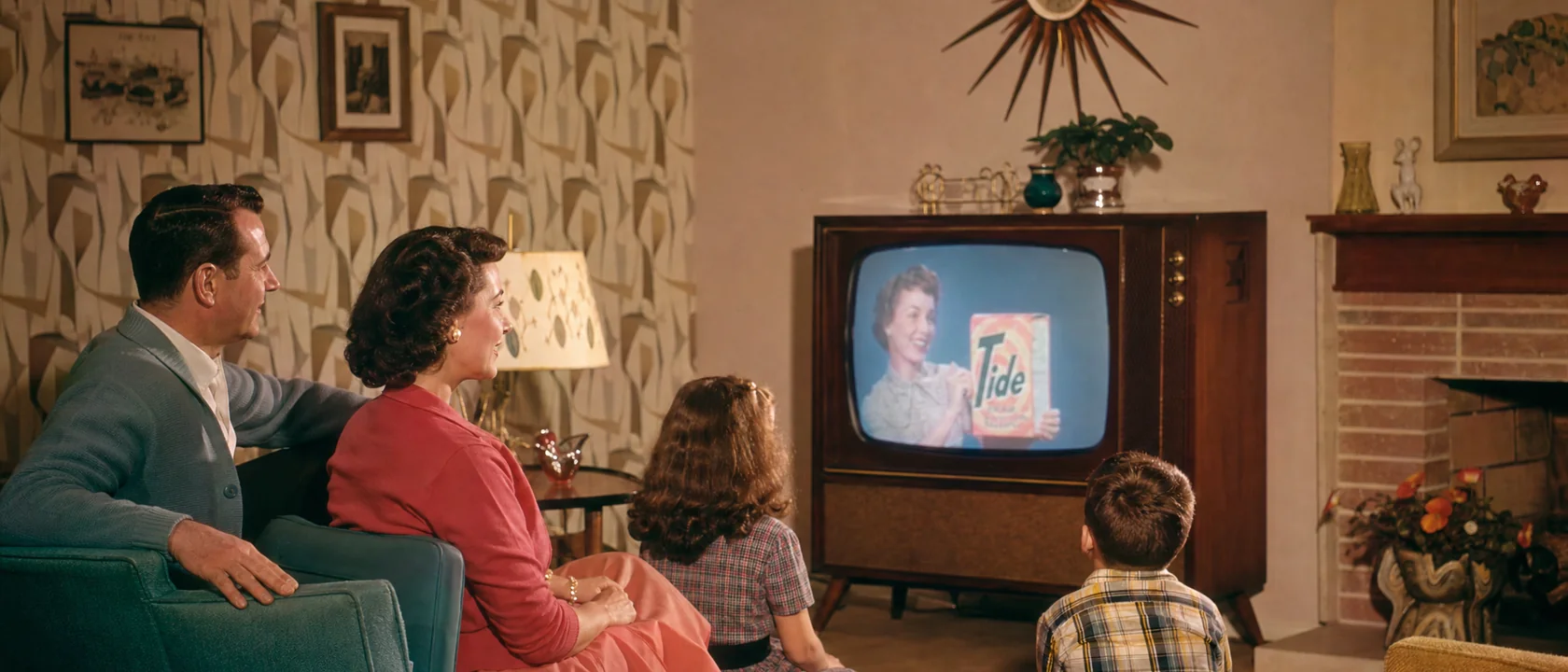
The quarter-century after the Second World War was the golden age of mass marketing. A booming economy, a surging population, the growth of the suburbs, and the arrival of television in nearly every home created the largest and most homogeneous consumer market the world had ever seen — and the marketing techniques to command it. This was the era of the great national brand, the blockbuster advertising campaign, and the advertising agency at the height of its cultural power and creative confidence.
Above all it was the era of television, which fused the reach of radio with the persuasive power of the moving image and became the most powerful marketing medium in history. Alongside television came a new rigor in the testing and rollout of products, the maturing of experiential marketing, and the systematic pursuit of customer loyalty. Marketing in these years also grew self-conscious and controversial, as critics warned of the hidden psychological persuasion that the new science of advertising made possible.[11]
Television Advertising
Sight, sound, and motion in every living room.
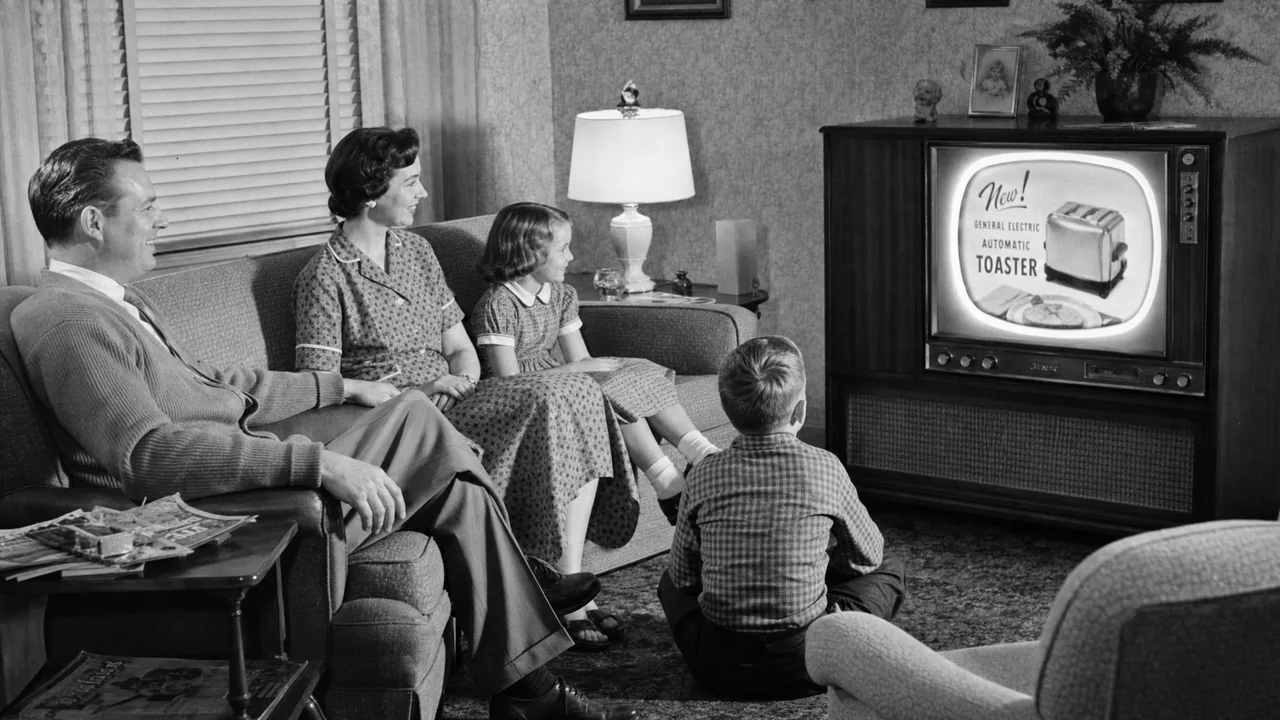
Television advertising became, in the postwar decades, the most powerful marketing medium ever created, combining the mass reach and intimacy of radio with the persuasive force of the moving image, sound, and, increasingly, color. Its commercial birth is dated precisely to July 1, 1941, when station WNBT in New York aired a ten-second spot for the Bulova Watch Company — a clock face over a map of the United States with the slogan “America runs on Bulova time” — the first legal television commercial, for which Bulova paid a total of nine dollars.[10] From that modest beginning, television advertising would grow to dominate the marketing world.
Television’s power lay in its unique combination of capabilities. It could demonstrate a product in action, show it being used and enjoyed, and dramatize its benefits with sight, sound, and motion together — a persuasive completeness no earlier medium possessed. It reached enormous audiences simultaneously, and in the era of only a few national networks, a single well-placed campaign could reach the overwhelming majority of American households within days. And it entered the home as an intimate, trusted presence during the family’s leisure hours, when audiences were relaxed, attentive, and receptive.
The medium gave rise to the modern television commercial as a distinct and highly developed art form. Advertisers and agencies developed the thirty- and sixty-second spot into a sophisticated vehicle for storytelling, demonstration, emotion, and persuasion, deploying jingles, memorable characters, dramatic demonstrations, celebrity endorsers, and increasingly cinematic production values. The demonstration commercial, the slice-of-life vignette, the testimonial spot, and the emotional brand film all flourished, and the best commercials became cultural touchstones as famous as the programs they interrupted.
Television also concentrated marketing power and cultural influence to an unprecedented degree, ushering in an age of mass-market conformity and blockbuster branding. Because a handful of networks commanded the attention of the entire nation, marketers could build truly national brands and shared consumer culture with a speed and completeness never possible before, and the biggest advertisers achieved a dominance of mind and market that defined the postwar consumer economy. This concentration also provoked concern, as critics such as Vance Packard warned that the medium’s power, married to the new science of motivational research, enabled forms of psychological persuasion the public could neither perceive nor resist.[11]
Television advertising remained the dominant marketing medium for over half a century, and though its audience has fragmented in the streaming age, its techniques endure and have migrated intact to every screen. The video advertisement, whether on television, a streaming service, a social platform, or a phone, remains the most persuasively complete form of marketing, and the storytelling, demonstration, emotional, and branding techniques perfected in television’s golden age are the direct ancestors of the video marketing that dominates the digital era. The moving image, proven supreme in the living rooms of postwar America, remains marketing’s most powerful tool.
Test Marketing
Proving a product in a small market before betting on the nation.
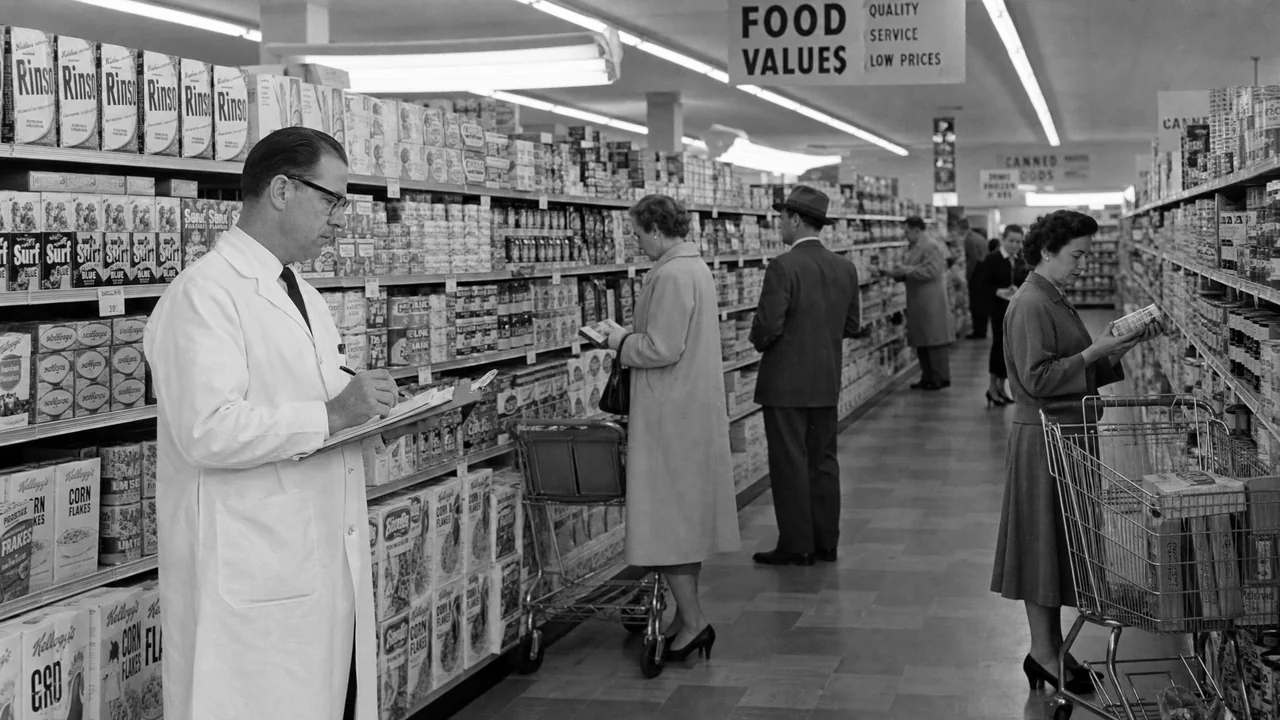
Test marketing — the practice of introducing a new product, campaign, or strategy in one or a few limited, representative markets before committing to a full national launch — became a standard and highly refined discipline in the postwar era, driven by the enormous financial stakes of national marketing. When launching a product nationally could cost millions and failure could be catastrophic, marketers wanted to prove that the product, price, packaging, and advertising would actually work in the real marketplace before betting the company on it.
The logic of the test market was to create a small-scale, controlled preview of a national launch. A company would select one or a few cities chosen to be representative of the national market in demographics, media, and retail, and would launch the full marketing program — the product on real store shelves, the advertising on local media, the pricing and promotion — in those markets alone. By measuring actual sales, repeat purchase, market share, and consumer response in these live but contained conditions, the marketer could forecast national performance and identify problems while they were still cheap to fix.
Test marketing yielded invaluable and otherwise unobtainable information. It revealed whether consumers would actually buy the product repeatedly, not merely try it once; whether the advertising drove sales; whether the price was right; whether the packaging and positioning worked at the shelf; and how the product performed against real competitors in real conditions. Crucially, it did all this with real purchases and real money on the line, providing a far more reliable prediction of national success than any survey, focus group, or laboratory test could offer, because it measured behavior rather than stated intention.
The test market also served as a laboratory for optimization before the national rollout. A company could test different prices, advertising approaches, package designs, and promotional strategies in different test markets, learn which performed best, and refine the marketing program accordingly before scaling it nationally. This ability to experiment, learn, and improve in live but limited conditions, and to carry only the proven, optimized program to the expensive national stage, dramatically improved the odds of success and the efficiency of marketing investment.
Test marketing’s core logic — prove it small before you scale it big — has become one of the governing principles of the digital marketing age, executed now with vastly greater speed, precision, and scale. The A/B test, the phased rollout, the pilot program, the soft launch, the minimum viable product, and the geographic or audience-segmented digital experiment are all direct descendants of the postwar test market. The discipline of validating a strategy against real behavior in a controlled subset before committing full resources, systematized in these decades, is now woven into the fabric of data-driven marketing and product development.
Experiential & Event Marketing
Creating branded experiences consumers step inside.
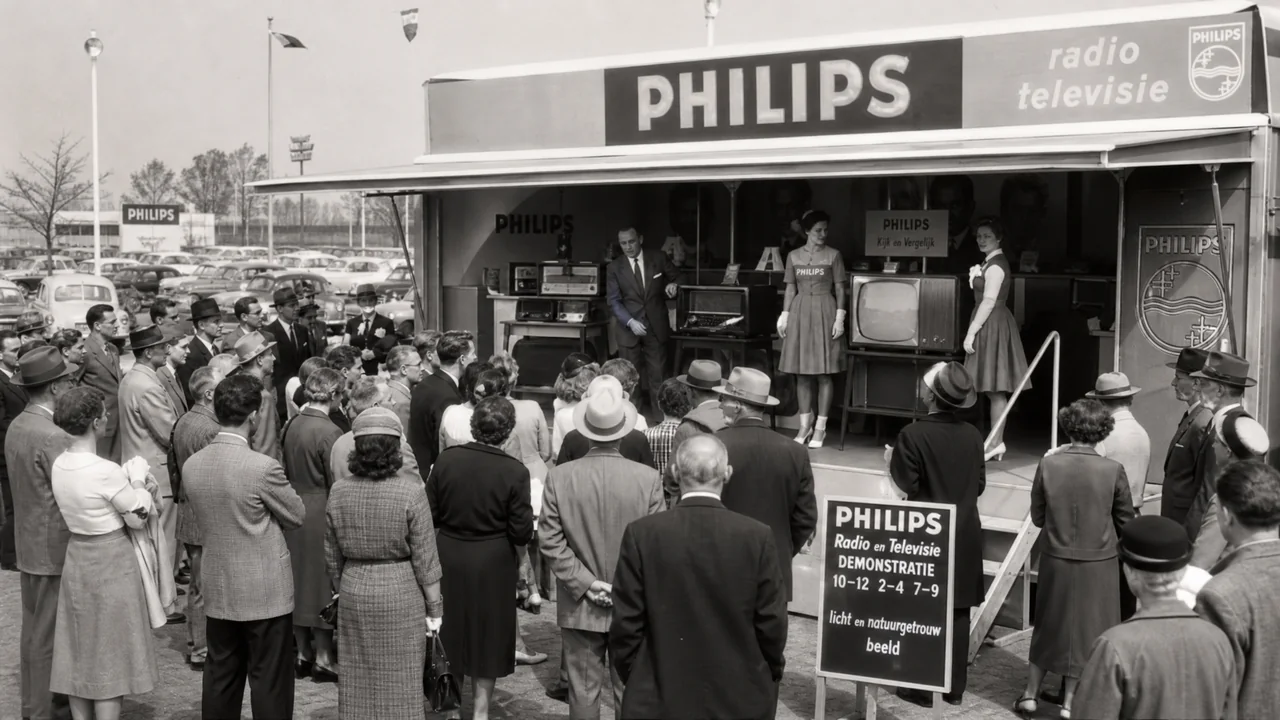
Experiential and event marketing — the creation of immersive, participatory experiences and events through which consumers engage a brand directly and memorably — matured into a sophisticated postwar discipline, building on the spectacle tradition of the nineteenth-century showmen and expositions but applying it with new resources, ambition, and strategic intent in an age of prosperity and mobility. Marketers increasingly understood that a lived, participatory experience creates deeper engagement and more durable memory than any broadcast message.
The postwar boom created both the means and the venues for experiential marketing on a grand scale. Corporate exhibits at world’s fairs and expositions grew ever more ambitious, immersing visitors in branded environments and visions of the future. Manufacturers created visitor centers, factory tours, and branded attractions where the public could experience the company and its products firsthand. The opening of Disneyland in 1955, with its sponsored attractions and immersive themed environments, demonstrated the ultimate fusion of entertainment, experience, and branding, and pointed toward the branded experiential destinations of the future.
Event marketing also expanded through sponsorship and the creation of brand-associated occasions. Brands sponsored and staged events — sporting contests, entertainment spectacles, community celebrations, promotional tours, and demonstrations — that gathered audiences and associated the brand with excitement, enjoyment, and shared experience. The traveling product demonstration, the branded roadshow, the sponsored contest, and the promotional spectacle brought the brand into direct, memorable contact with consumers in ways that complemented and deepened the reach of mass advertising.
The strategic power of experiential marketing lay in its engagement of the whole person and the creation of lasting emotional memory. A consumer who physically experiences a brand — who tastes, touches, plays, explores, and participates — forms a richer, more emotional, and more durable impression than one who merely sees an advertisement, and carries that memory and the associated feelings long afterward. The experience also generated word-of-mouth, as participants shared and recounted their experiences to others, extending the reach of the event far beyond those who attended.
Experiential marketing has become one of the most valued strategies of the contemporary era, precisely because immersive, participatory experience cuts through the clutter and skepticism that afflict conventional advertising. The brand activation, the pop-up experience, the immersive installation, the branded festival, the sponsored event, and the shareable experiential spectacle engineered for social media all descend from the postwar maturing of experiential marketing. The enduring insight — that an experience the consumer steps inside and participates in creates engagement, emotion, and memory that no message delivered from a distance can match — has only grown in value as audiences have grown more resistant to being told and more eager to be shown and included.
The Direct & Relationship Era
Data, Dialogue, and the Targeted Message
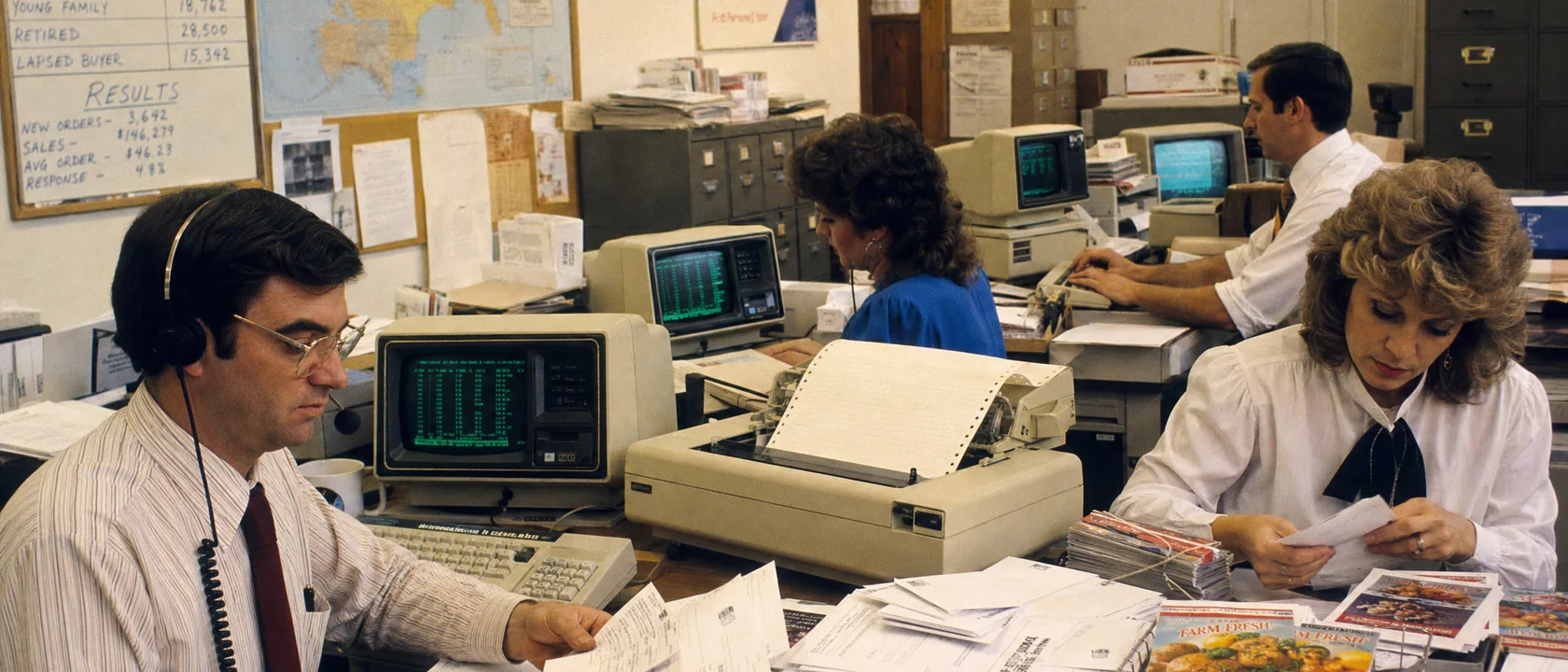
The decades before the internet saw marketing pivot from the mass broadcast toward the targeted, measurable, and personal. As mass markets fragmented, media proliferated, and the computer made it possible to store and analyze information about individual customers, marketers increasingly sought to identify, reach, and cultivate specific consumers rather than broadcasting undifferentiated messages to everyone. The one-way mass monologue of the television age began to give way to the two-way dialogue of direct and relationship marketing.
This era developed the techniques of precision and response: telemarketing’s direct telephone contact, database marketing and the first customer-relationship systems, the infomercial’s long-form direct-response television, guerrilla and ambient marketing’s creative unconventionality, and the maturing of sports sponsorship, athlete endorsement, and business-to-business trade-show marketing. Above all, this era established the computer database as the engine of marketing — the foundation on which the entire data-driven digital revolution would soon be built.
Telemarketing
The telephone as a direct, interactive selling channel.
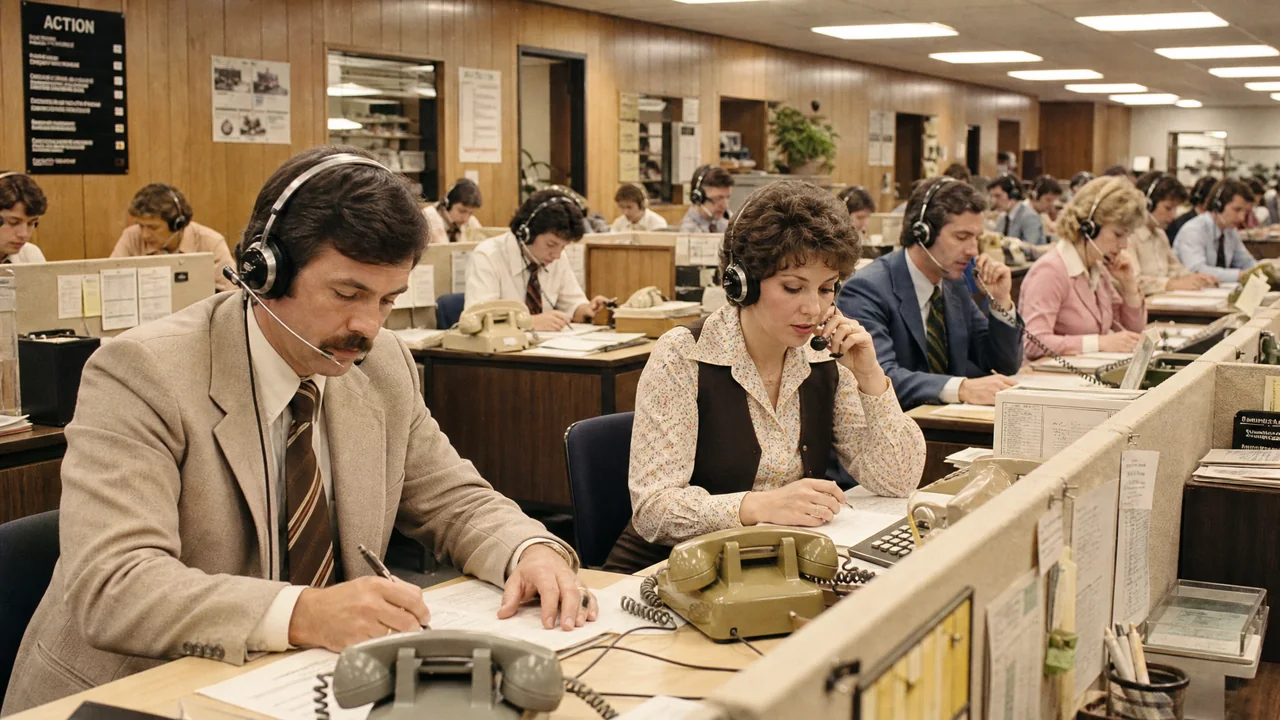
Telemarketing — the use of the telephone to contact prospects and customers directly for selling, lead generation, and service — grew into a major marketing channel in these decades, as the telephone reached near-universal penetration in American homes and businesses and as toll-free numbers and falling long-distance costs made large-scale calling economically feasible. The telephone offered marketers something print and broadcast could not: a direct, immediate, interactive, one-to-one conversation with an individual prospect, in which the marketer could tailor the pitch in real time and drive directly to a close.
Telemarketing developed in two complementary directions. Outbound telemarketing, in which the company initiated calls to prospects and customers, was used to generate leads, make sales, follow up on inquiries, renew subscriptions, and conduct research. Inbound telemarketing, in which customers called the company — often via a toll-free number promoted in advertising — handled orders, inquiries, and service, and became the essential response mechanism for direct-response advertising across print and broadcast. The toll-free number transformed passive advertising into an immediate call to action, letting a consumer moved by an advertisement act on that impulse instantly.
The interactive, conversational nature of the telephone gave telemarketing distinctive persuasive power. A skilled telemarketer could engage the prospect in dialogue, identify their needs and objections, respond and adapt in real time, build rapport, and guide the conversation toward a sale in a way no static advertisement could. The medium also allowed precise targeting, since calls could be directed to specific, pre-selected lists of prospects chosen for their likelihood to buy, and it produced immediate, measurable results, since the outcome of every call — sale, lead, or rejection — was known at once.
Telemarketing was tightly integrated with the database marketing that matured alongside it. The lists that telemarketers called were drawn from and enriched by customer databases, calls were guided by the information those databases held, and the results of calls fed back into the databases to refine future targeting. This marriage of the telephone channel with the customer database prefigured the data-driven, targeted, response-measured logic that would define digital marketing, and telemarketing became one of the earliest large-scale demonstrations of database-driven direct marketing in action.
Though intrusive telemarketing eventually provoked consumer backlash and regulation — the do-not-call registries and restrictions that constrain the practice today — its core techniques endure and have migrated across channels. The outbound sales call, the inbound response line, the interactive one-to-one sales conversation, and the integration of contact with customer data all persist in the modern call center, the sales-development function, and the conversational commerce of chat, messaging, and voice. The insight that direct, interactive, personalized dialogue is uniquely persuasive, and that it can be delivered at scale and measured precisely, was proven in the telemarketing decades.
Database Marketing & CRM
The computer as the memory and brain of marketing.
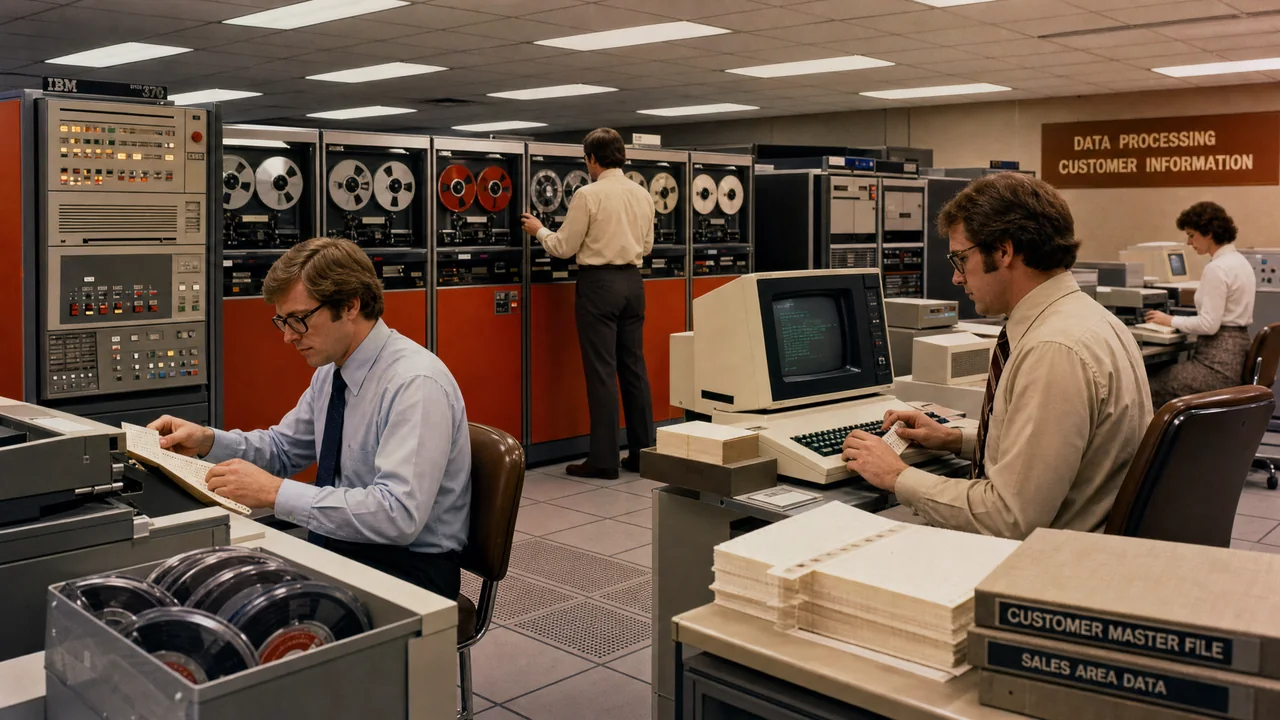
Database marketing — the practice of collecting, storing, and analyzing detailed information about individual customers and prospects in computer databases, and using that information to target and personalize marketing — emerged in these decades as perhaps the most consequential marketing development of the pre-internet era, because it established the data-driven, individually-targeted paradigm that would define all marketing to come. The computer gave marketing a memory and a brain, allowing companies for the first time to know, remember, and act upon the specific characteristics and behavior of millions of individual customers.
The technique built upon the customer records that direct-mail and catalog marketers had always kept, but the computer transformed those records from static lists into dynamic, analyzable, actionable databases. Marketers could now store not just names and addresses but purchase histories, preferences, responses, demographics, and behavior, and could sort, segment, and analyze this information to identify patterns, predict behavior, and target communications with unprecedented precision. The database made it possible to treat different customers differently — to send the right message to the right person at the right time — at a scale that manual methods could never achieve.
Database marketing enabled powerful new capabilities that are now taken for granted. Marketers could segment their customers into meaningful groups and target each with tailored offers and messages; they could identify their most valuable customers and focus resources on retaining and growing them; they could predict which customers were likely to buy, to churn, or to respond to a given offer, and act accordingly; and they could measure the results of their efforts precisely, tying specific communications to specific responses and refining their targeting continuously. Marketing became, for the first time, systematically individualized and analytically optimized.
This period also gave rise to customer relationship management, or CRM — the strategic discipline and the software systems for managing all of a company’s interactions and relationships with its customers over time. CRM extended database marketing from targeting and communication into the holistic management of the entire customer relationship, integrating sales, service, and marketing around a unified view of each customer. The goal was to build durable, profitable, individually-managed relationships by knowing each customer thoroughly and treating them accordingly across every interaction and over their entire lifetime.
Database marketing and CRM are the direct foundation of the entire modern data-driven marketing enterprise, and everything that followed — web analytics, marketing automation, personalization engines, customer data platforms, predictive modeling, and AI-driven targeting — is an elaboration of the paradigm they established. The core ideas — that marketing should be grounded in detailed data about individual customers, that different customers should be treated differently, that behavior can be analyzed and predicted, and that the long-term customer relationship should be managed as a strategic asset — were all established in these decades and remain the governing logic of marketing in the age of big data and artificial intelligence.
Infomercials & Long-Form DRTV
Extended television that sells directly and completely.
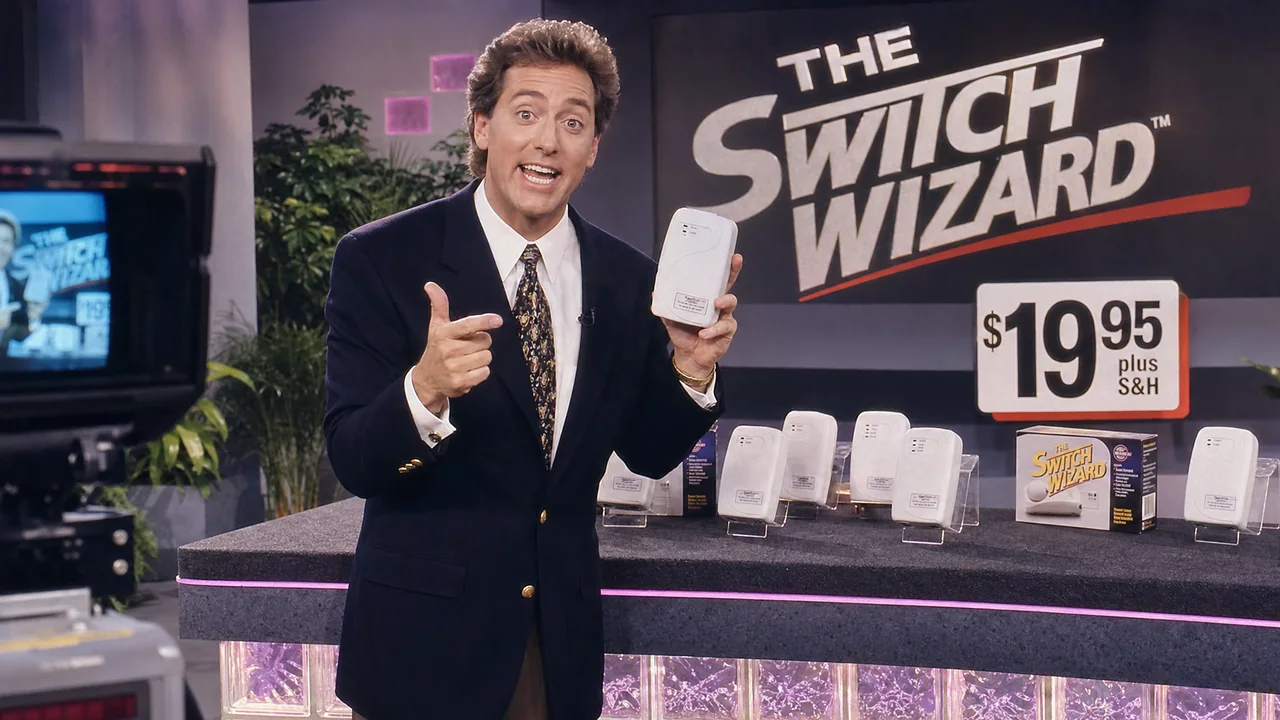
The infomercial — the long-form direct-response television program, typically running a full thirty minutes and combining entertainment, demonstration, and an insistent sales pitch — emerged as a distinctive marketing form after the deregulation of television advertising time in the United States in 1984 removed prior limits on commercial length. Freed to buy extended blocks of airtime, direct marketers created programs that could do what a thirty-second spot never could: make a complete, unhurried, deeply persuasive sales case and close the sale directly, all within a single broadcast.
The infomercial married the reach and persuasive power of television to the direct-response mechanism of the toll-free order line. Where conventional television advertising built awareness and brand image and left the purchase to happen later in a store, the infomercial sought to drive an immediate purchase, prompting viewers to call a number on screen and order the product then and there. This fusion of brand demonstration and immediate direct response, measured precisely by the orders each airing produced, made the infomercial a highly accountable and optimizable marketing vehicle in the direct-response tradition.
The long format allowed a fully developed persuasive architecture. The infomercial could demonstrate the product exhaustively, showing it solving problems and delivering results in vivid detail; it could stack testimonial upon testimonial to build overwhelming social proof; it could anticipate and answer every objection; it could build excitement and urgency through limited-time offers, bonuses, and price incentives; and it could repeat the offer and the call to action many times over its length. This complete, unhurried, repetition-rich structure made the infomercial extraordinarily effective at selling products that benefited from demonstration and explanation.
Infomercials proved especially powerful for particular categories and launched countless products and brands to enormous success. Fitness equipment, kitchen gadgets, cleaning products, beauty and health products, self-improvement programs, and other products whose benefits could be dramatically demonstrated and that inspired impulse purchase thrived in the format. The infomercial also created a distinctive style and a roster of famous pitchmen whose energetic demonstrations and catchphrases became part of popular culture, and it built businesses and fortunes on the strength of the format’s direct-selling power.
The infomercial’s techniques have migrated wholesale to the digital age and arguably dominate it. The long-form video sales letter, the product demonstration video, the extended sales webinar, the testimonial-stacked landing page, the live shopping broadcast, and the influencer’s in-depth product demonstration all employ the infomercial’s essential architecture: demonstrate thoroughly, prove with testimonials, answer objections, create urgency, and drive an immediate, measurable direct response. The insight that extended, complete, demonstration-and-proof-rich persuasion can sell directly and powerfully — that sometimes the audience will give you thirty minutes if you use them well — was proven in the infomercial boom.
The Internet & Search Revolution
The World Wide Web Rewrites Every Rule
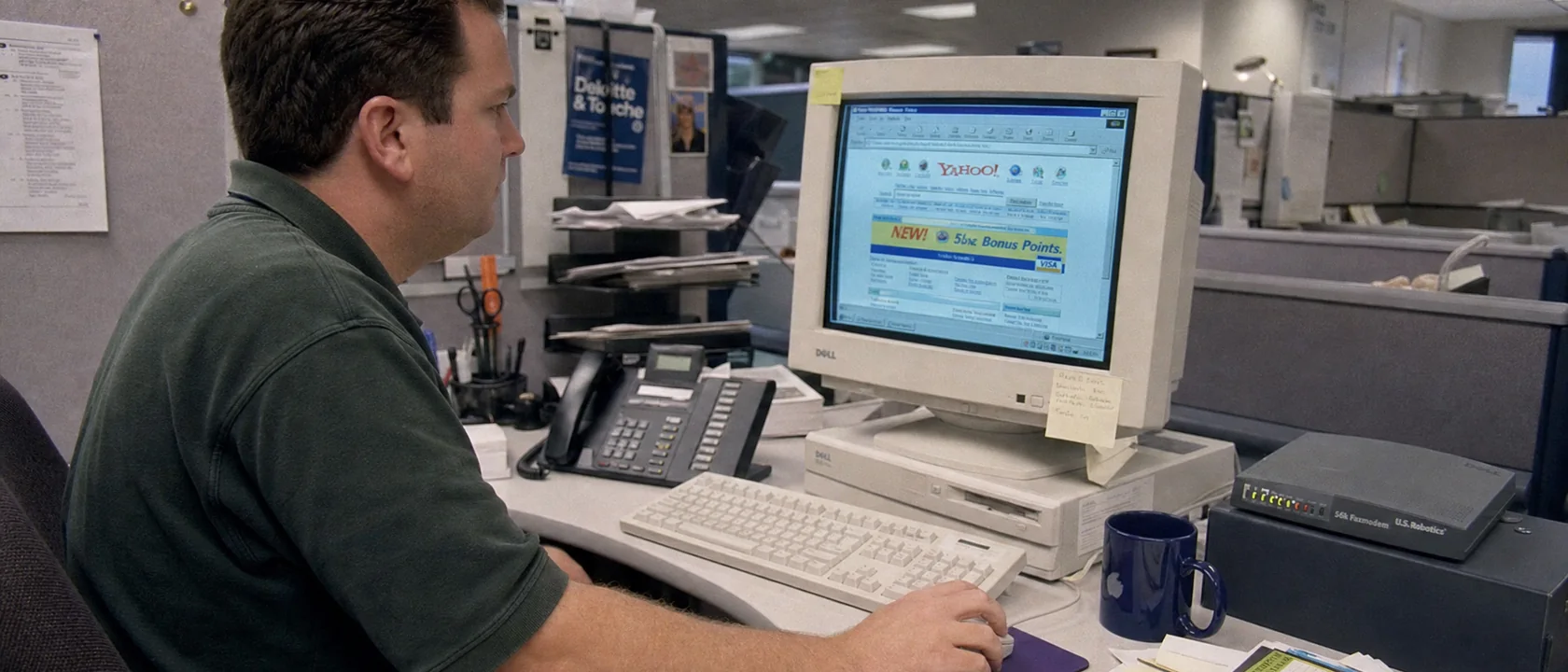
No development since the printing press transformed marketing as profoundly as the commercial internet. In the span of fifteen years, the World Wide Web moved marketing from a one-way broadcast delivered on the marketer’s schedule to an interactive, measurable, on-demand medium controlled increasingly by the consumer. The web collapsed the distance between advertisement and purchase to a single click, made every impression and action trackable, and created entirely new channels — search, email, banners, affiliates, and blogs — that had no precedent in the analog world. For the first time, a marketer could know not merely how many people might have seen an advertisement, but exactly who clicked it, what they did next, and whether they bought.
This era invented the machinery of digital marketing that still runs the industry: search engine optimization and paid search, which organized demand around the query; email marketing, which turned the inbox into a direct channel; banner and display advertising, which put the commercial message on the page; affiliate marketing, which paid for performance; e-commerce and conversion optimization, which turned websites into stores; and corporate blogging, which let brands publish and converse directly. Every one of these techniques is new to the American marketing story — none existed before the web — and together they established the measurable, targeted, interactive, consumer-controlled paradigm that all subsequent marketing has inherited.
Search Engine Optimization (SEO)
Earning visibility at the exact moment of intent.

Search engine optimization — the practice of structuring a website and its content so that it ranks prominently in the unpaid, “organic” results of search engines — emerged in the late 1990s as the web grew too vast to browse and the search engine became the primary way people found information, products, and companies online. As directories gave way to crawler-based engines and, after 1998, to Google’s link-analysis ranking, being found came to depend on being ranked, and an entire discipline arose to earn that ranking. SEO was revolutionary because it aligned marketing with intent: rather than interrupting a consumer engaged in some other activity, it placed the brand in front of a person actively searching for exactly what the brand offered, at the precise moment of demand.
The technique rested on understanding how search engines discover, interpret, and rank pages, and then shaping a site accordingly. Early SEO combined on-page factors — the keywords in titles, headings, body copy, and meta tags; the structure and crawlability of the site; the descriptiveness of its URLs — with off-page factors, chiefly the quantity and quality of inbound links, which Google’s PageRank algorithm treated as votes of confidence from the rest of the web. Marketers learned to research the terms their customers actually typed, to create content that answered those queries, and to earn links and citations that signaled authority, all in pursuit of the coveted top positions that captured the overwhelming majority of clicks.
SEO introduced a fundamentally new marketing logic: instead of pushing a message outward to an audience, the marketer positioned the brand to be pulled in by a searcher’s own initiative. This inbound, intent-driven model proved extraordinarily efficient, because it reached people already predisposed to act, and extraordinarily durable, because a well-earned organic ranking delivered traffic continuously without per-click payment. It also proved fiercely competitive, since only a handful of positions existed for any valuable query, and it demanded constant adaptation as search engines refined their algorithms to reward genuine relevance and quality and to penalize manipulation.
The discipline matured through a running contest between marketers seeking rankings and engines seeking to serve users. Early tactics that gamed the system — keyword stuffing, hidden text, link farms, and duplicate content — provoked successive algorithm updates that rewarded useful, authoritative, well-structured content and punished manipulation. Out of this contest emerged the enduring principle that the most reliable path to search visibility is to genuinely be the best, most relevant answer to the searcher’s question — a principle that pushed marketers toward substantive content, sound site architecture, and authentic authority rather than tricks.
Search engine optimization remains one of the most valuable channels in all of marketing, and its founding insight — that meeting demand at the moment of intent is more efficient than interrupting to create it — has only grown in importance. The specific tactics have evolved continuously, from keywords toward topics and user intent, from desktop toward mobile, and most recently toward optimizing for AI-generated answers and conversational search, but the fundamental discipline established in this era endures: understand what your audience is seeking, and structure your presence so that you are what they find.
Paid Search & Pay-Per-Click Advertising
Auctioning attention against the query, one click at a time.

Paid search advertising — the placement of paid text advertisements alongside organic search results, keyed to the user’s query and typically billed only when the ad is clicked — was arguably the single most important marketing innovation of the internet era, and it transformed a search engine into one of the most powerful advertising machines ever built. Pioneered commercially by Overture (formerly GoTo.com) and then perfected by Google, whose AdWords program launched in October 2000 with roughly 350 advertisers, paid search married the intent-driven precision of search to a self-serve, auction-based, performance-priced advertising model that any business, however small, could use.[14]
The mechanics were elegant and consequential. Advertisers bid on the specific keywords for which they wished their ads to appear; when a user searched one of those terms, an instantaneous auction determined which ads showed and in what order; and the advertiser paid only when a user actually clicked — the pay-per-click model. Google’s decisive refinement was to rank ads not by bid alone but by a combination of bid and quality, chiefly the ad’s click-through rate and relevance, so that more useful, more relevant ads earned better positions at lower cost. This aligned the interests of searchers, advertisers, and the engine, keeping ads relevant while maximizing revenue.
Paid search delivered a combination of advantages no previous advertising medium could match. It was perfectly targeted to expressed intent, reaching consumers at the exact moment they searched for a product or solution. It was measurable to an unprecedented degree, tying every click — and, with conversion tracking, every resulting sale or lead — to a specific keyword, ad, and cost, so that return on investment could be calculated precisely and campaigns optimized continuously. It was economically accessible, since the auction and self-serve platform let a business start with any budget and pay only for results. And it was fast, allowing a campaign to be launched, measured, and refined within hours rather than the weeks or months traditional media required.
These properties made paid search the archetype of performance marketing — advertising bought and optimized against measurable outcomes rather than estimated exposure. Marketers built elaborate account structures of campaigns, ad groups, keywords, and ads; wrote and tested countless ad variations; managed bids to hit target costs per acquisition; and mined the resulting data for insight into what customers wanted and which words moved them. An entire profession and industry of search marketing arose, and paid search became the financial engine that funded the free web, generating the overwhelming majority of the revenues of the world’s largest search company.
The paradigm paid search established — auction-based, self-serve, performance-priced, precisely measured advertising keyed to data about the individual and the moment — became the template for essentially all subsequent digital advertising, from social media ads to programmatic display to retail media networks. The channel itself remains foundational to modern marketing, and though its surfaces now extend to shopping, maps, video, and AI-generated answers, the core logic invented in this era — pay for the click, rank by relevance, measure everything, optimize relentlessly — continues to govern how demand is captured online.
Email Marketing
The direct channel that turned the inbox into a relationship.

Email marketing — the use of electronic mail to deliver commercial messages, offers, newsletters, and relationship communications directly to a recipient’s inbox — became one of the most effective and enduring digital marketing channels as email adoption spread through the late 1990s and 2000s. It was, in essence, the digital heir to direct mail, but faster, vastly cheaper, instantly measurable, and capable of a personalization and immediacy that paper could never achieve. For the cost of near-nothing per message, a marketer could reach a subscriber directly, repeatedly, and personally, in a space the recipient checked every day.
The channel’s power flowed from permission and ownership. Unlike advertising space rented from a publisher or a search engine, an email list was an asset the marketer built and owned, composed of people who had chosen to hear from the brand. This permission-based relationship, in which the consumer opted in and could opt out, made email uniquely respectful and effective when done well, because it reached an audience that had signaled genuine interest. The best practitioners treated the subscriber relationship as a long-term asset to be nurtured with valuable, welcome, relevant communication rather than exhausted with relentless selling.
Email marketing developed a rich repertoire of forms and techniques. Newsletters delivered ongoing content that kept a brand present and built authority; promotional emails drove specific offers and sales; transactional emails confirmed orders and shipments while carrying marketing messages; and, most powerfully, automated lifecycle and behavioral emails — welcome series, abandoned-cart reminders, re-engagement campaigns, and post-purchase follow-ups — delivered the right message triggered by the individual’s own behavior. Segmentation divided lists by interest, behavior, and value so that different subscribers received different, more relevant messages, and personalization inserted the individual’s name, history, and preferences into the message itself.
Crucially, email was measurable in ways direct mail never was. Marketers could track precisely how many recipients opened a message, which links they clicked, what they did on the resulting page, and whether they ultimately bought — and could use that data to test subject lines, content, timing, and offers, refining continuously. This measurability, combined with email’s extraordinarily low cost, gave it consistently among the highest returns on investment of any marketing channel, a distinction it retains to this day. The rise of email service providers put sophisticated sending, segmentation, automation, and analytics within reach of any business.
Email marketing remains a cornerstone of digital marketing precisely because it rests on an owned, permission-based, direct relationship with the individual — an asset immune to the shifting algorithms and rising costs of rented advertising channels. Its founding principles, established in this era, endure and have deepened: earn permission, deliver genuine value, segment and personalize by behavior and interest, automate around the customer lifecycle, measure everything, and treat the inbox relationship as a durable asset to be respected and nurtured over time. Every modern marketing-automation platform is, at its heart, an elaboration of the email marketing discipline forged in these years.

The Social & Mobile Decade
The Audience Becomes the Medium
If the internet era put the brand on the web, the social and mobile decade put marketing in the hand and the feed of every consumer, and in doing so it handed the megaphone to the audience itself. The smartphone made the internet constant, personal, and location-aware, while social platforms turned billions of individuals into publishers, broadcasters, and word-of-mouth engines operating at planetary scale. Marketing ceased to be something done to an audience and became something done with and through it — a continuous, participatory conversation in which consumers created, shared, and amplified brand messages, and in which a single post could reach more people than a Super Bowl commercial.
This decade produced the techniques that define contemporary marketing: social media marketing, which met consumers in the feeds where they spent their attention; influencer marketing, which rented the trust of individuals the audience already followed; content marketing, which industrialized the brand-as-publisher model; programmatic advertising, which automated the buying of audiences in real time; mobile and app-based marketing, which exploited the always-present device; podcast and native advertising, which embedded the message in the content; and the science of viral and permission marketing, which studied how ideas spread and how consent could be earned. Together they made marketing more measurable, more personal, more social, and more mobile than ever before.
Influencer Marketing
Renting the trust of the people the audience already follows.

Influencer marketing — the practice of partnering with individuals who have built engaged followings on social media to promote products and brands to their audiences — emerged as one of the most powerful marketing techniques of the decade because it solved a problem that traditional advertising increasingly could not: the growing distrust of overt advertising and the corresponding trust that consumers placed in recommendations from people they knew, admired, and followed. By working through creators whose audiences already trusted them, brands could reach consumers with a message that carried the credibility of a personal endorsement rather than the skepticism-inducing stamp of an ad.
The technique rested on the transfer of trust and relatability. Social media had created a new class of public figures — creators, experts, and personalities who built followings by consistently sharing content in a niche, from beauty and fitness to gaming, cooking, travel, and finance — and whose audiences related to them as authentic, accessible peers rather than distant celebrities. When such an influencer recommended a product, the recommendation borrowed the trust, authenticity, and relatability of the relationship they had built, reaching a highly relevant, highly engaged audience in a context of credibility that paid advertising struggled to achieve.
Influencer marketing spanned a spectrum defined by audience size and character. Celebrity and mega-influencers offered vast reach; macro-influencers offered large, engaged followings within broad categories; micro-influencers, with smaller but highly engaged and tightly niche audiences, often delivered superior engagement, relevance, and cost-efficiency; and nano-influencers, with modest but intensely loyal local or specialized followings, offered the most personal and trusted recommendations of all. Marketers learned that engagement, relevance, and authenticity frequently mattered more than raw follower counts, and that the fit between influencer, audience, and brand determined success.
The discipline matured rapidly into a structured practice. Brands and agencies developed methods for identifying and vetting influencers, negotiating partnerships, briefing creators while preserving their authentic voice, tracking performance through codes and links, and measuring return. Platforms and marketplaces arose to connect brands with creators and manage campaigns at scale. And as the practice grew, regulators — notably the Federal Trade Commission — required clear disclosure of paid partnerships, establishing that sponsored recommendations must be transparent so that audiences could weigh them accordingly, a requirement that shaped the professionalization of the field.
Influencer marketing became a permanent and growing pillar of the marketing mix because it aligns with the fundamental human tendency to trust recommendations from people over messages from brands, and because it delivers targeted, credible, engaging reach in the social spaces where audiences live. It also seeded the broader creator economy, in which individuals build businesses on their audiences and brands increasingly market through a distributed ecosystem of independent voices. The technique’s founding insight — that authentic endorsement from a trusted individual outperforms advertising from a brand — continues to drive one of the largest and fastest-growing categories of marketing spend.
Content Marketing
Industrializing the brand-as-publisher into a strategic discipline.

Content marketing — the strategic creation and distribution of valuable, relevant, consistent content to attract, engage, and retain a clearly defined audience, ultimately to drive profitable customer action — matured in this decade from the corporate blogging of the internet era into a comprehensive, formalized, and central marketing discipline. Building on the proven insight that brands could earn attention by offering genuine value rather than renting it through advertising, content marketing industrialized the brand-as-publisher model across every format and channel, making the creation of useful content a core marketing function rather than an experiment.
The discipline was defined by its inversion of the advertising bargain. Instead of interrupting an audience to demand attention for a promotional message, content marketing offered something the audience genuinely wanted — education, insight, utility, entertainment, or inspiration — and thereby drew the audience in, built a relationship of trust and authority, and guided that relationship over time toward a commercial outcome. This required the marketer to think like a publisher and to serve the audience’s interests first, trusting that the attention, trust, and authority earned would ultimately translate into demand, preference, and loyalty.
Content marketing expanded across a proliferating array of formats matched to audience preferences and stages of the buying journey. Blog posts and articles built search visibility and authority; long-form guides, white papers, and e-books captured leads and demonstrated expertise; videos, webinars, and podcasts engaged audiences who preferred to watch and listen; infographics and visual content earned shares; case studies and testimonials provided social proof; and email newsletters distributed content and sustained relationships. Marketers mapped content to the buyer’s journey, offering awareness-stage content to attract, consideration-stage content to educate, and decision-stage content to convert.
The practice demanded strategic rigor beyond mere production. Effective content marketing required a documented strategy grounded in a clear understanding of the target audience and its needs, a consistent editorial cadence, deliberate optimization for search so that content could be discovered, thoughtful distribution across owned, earned, and paid channels so that content reached its audience, and measurement of the entire path from content consumption to eventual conversion. Content became an owned asset that compounded over time, as evergreen pieces continued to attract and convert audiences long after publication, giving content marketing a durability and cumulative return that paid advertising lacked.
Content marketing established itself as one of the foundational strategies of modern marketing, underpinning search visibility, thought leadership, lead generation, customer education, and brand building alike. Its central principle — that the most durable way to earn attention, trust, and business is to consistently create genuinely valuable content that serves the audience — has only grown more important as advertising has grown more expensive and more resisted, and it remains the strategic core around which social, search, email, and community efforts are organized. Every modern brand that operates a media presence is practicing the discipline formalized in this decade.

The Age of Artificial Intelligence
The Machine Learns to Market
The present era of marketing is defined by artificial intelligence, by the collapse of the tracking infrastructure that powered the previous decade, and by the fragmentation of attention across an ever-expanding universe of immersive, interactive, and creator-driven media. Machine learning moved from the back-office optimization of ad auctions to the front line of creative production, customer conversation, and strategic decision, while generative AI — capable of producing text, images, video, and voice on demand — began to transform how marketing is made and consumed. Simultaneously, the deprecation of third-party cookies and the rise of privacy regulation forced a fundamental rebuilding of how audiences are understood and reached.
This era has produced the most rapid proliferation of new marketing techniques in history: AI-powered personalization and generative content, answer- and generative-engine optimization for AI search, voice and conversational commerce, immersive metaverse and augmented-reality experiences, Web3 and blockchain-based marketing, the dominance of short-form video, the maturation of the creator economy, the pivot to privacy-first and first-party data strategies, the mainstreaming of sustainability and purpose, the explosion of retail media, and live and social commerce that fuses content with instant purchase. Regulators, too, have entered the frame, with the Federal Trade Commission scrutinizing AI claims and data practices to keep the new tools honest.[16]
AI-Powered Personalization & Generative Marketing
The machine that predicts, creates, and personalizes at scale.

Artificial intelligence has become the central force in contemporary marketing, powering both the prediction and personalization that tailor experiences to each individual and the generative creation of the content, copy, and creative that fills marketing channels. Machine-learning systems trained on vast quantities of behavioral data can now predict what each consumer is likely to want, when they are likely to buy, which message will move them, and which are at risk of leaving — and can act on those predictions automatically, delivering individualized recommendations, offers, prices, and communications at a scale and speed no human team could approach. The Federal Trade Commission has taken active interest in ensuring that claims about these AI capabilities remain truthful and that the underlying data practices respect consumers.[16]
Predictive and personalization AI transformed marketing from segment-based to genuinely individual. Recommendation engines learned each consumer’s tastes and surfaced the products, content, and offers most likely to resonate; propensity models scored the likelihood of purchase, churn, and response, directing resources toward the most promising opportunities; dynamic personalization tailored websites, emails, and ads to each visitor in real time; and marketing-mix and attribution models used machine learning to untangle which efforts actually drove results. The cumulative effect was to fulfill, at last, the long-held marketing dream of treating every customer as an individual — the right message to the right person at the right moment — now realized automatically and at planetary scale.
The arrival of powerful generative AI marked an inflection point as consequential as any in marketing history. Systems capable of producing fluent text, striking images, convincing video, and natural voice on demand suddenly put the means of content production into every marketer’s hands, collapsing the cost and time of creating marketing assets. Marketers began using generative AI to draft copy, produce and adapt creative, generate countless variations for testing, localize content across languages and markets, and even power the conversational agents that engage customers directly, dramatically increasing the volume, speed, and personalization of content production.
This generative capability reshaped marketing workflows and raised new questions. The ability to produce endless personalized creative enabled a degree of message tailoring and testing previously impossible, but it also risked flooding channels with generic content, provoked concerns about authenticity, accuracy, and originality, and raised legal and ethical questions about training data, disclosure, and the use of synthetic media. The most effective practitioners learned to pair AI’s productive power with human judgment, strategy, and brand voice, using the machine to augment and accelerate human creativity rather than to replace the taste, insight, and authenticity that distinguish marketing that resonates from marketing that merely fills space.
AI-powered personalization and generative marketing represent the current culmination of the two-century arc from mass communication toward individual conversation and from human craft toward machine augmentation. The core capabilities — predicting individual behavior, personalizing at scale, and generating content on demand — are becoming the default infrastructure of marketing, embedded in every platform and workflow, and they are reshaping the discipline as profoundly as the printing press, broadcast, and the internet did before. The strategic challenge of this era is to harness the machine’s power responsibly, truthfully, and creatively, in service of genuine value to customers.
Answer & Generative Engine Optimization (AEO / GEO)
Being the answer when AI, not a list of links, responds.

Answer engine optimization and generative engine optimization — the practice of structuring content and presence so that a brand is surfaced, cited, and recommended by AI-powered answer engines and generative assistants — emerged as a new and rapidly growing discipline as consumers increasingly turned to conversational AI and AI-generated search results rather than traditional lists of links. As search engines integrated generative answers and as standalone AI assistants became primary tools for finding information and making decisions, the fundamental question of discoverability shifted from “how do we rank in the results?” to “how do we become the answer the AI gives?” — a change as significant for marketing as the original advent of search.
The shift responded to a genuine transformation in consumer behavior. Where users once entered keywords and chose among a page of blue links, they increasingly posed natural-language questions to AI systems that synthesized a single, direct answer, often citing a handful of sources and frequently obviating any need to click through to a website at all. In this environment, the traditional prize of a top organic ranking lost value if the AI’s synthesized answer satisfied the user without a visit, and a new prize emerged: being the source the AI drew upon, cited, and recommended, so that the brand’s information, products, and authority shaped the answer the consumer received.
The emerging discipline drew on but extended traditional search optimization. It rewarded content that directly and clearly answered the questions consumers actually asked, structured so that AI systems could readily extract and cite it; it valued authoritative, accurate, well-sourced information that AI systems, tuned to avoid error, would trust and surface; it emphasized structured data and clear formatting that made content machine-readable; and it prized the breadth and consistency of a brand’s presence across the web, since AI systems synthesized their answers from many sources. Establishing genuine authority and a strong, consistent, accurate digital footprint became the surest path to AI visibility.
The discipline also confronted new uncertainties and challenges. The opacity of AI systems made it difficult to know precisely why they cited some sources and not others; their answers varied and evolved as models were updated; and the reduction in click-through traffic threatened the traffic-based business models that had funded much web content. Marketers experimented with monitoring how AI systems represented their brands and categories, with optimizing content for extraction and citation, and with ensuring accurate representation in the sources AI systems trained on and referenced, all while the practices and the underlying technology remained in rapid flux.
Answer and generative engine optimization represents the newest frontier of the intent-driven discoverability discipline that began with search engine optimization a quarter-century earlier, adapted to a world in which AI, rather than a ranked list, increasingly mediates between the consumer’s question and the brand’s answer. As AI assistants become primary interfaces to information and commerce, the ability to be understood, trusted, cited, and recommended by these systems is becoming as essential as ranking in search once was, and the discipline of shaping how AI represents a brand is rapidly moving from experiment to necessity.
Voice & Conversational Commerce
Marketing and buying through natural spoken and typed dialogue.

Voice and conversational commerce — the discovery, marketing, and purchase of products through voice assistants, chatbots, and messaging interfaces using natural language — matured in this era as smart speakers reached tens of millions of homes, as voice assistants became ubiquitous on phones and in cars, and as conversational AI grew sophisticated enough to handle genuine dialogue. This return to the spoken word as a commercial interface, now mediated by artificial intelligence rather than a human clerk, reintroduced conversation as a primary channel of marketing and selling, and it demanded that brands learn to be present, discoverable, and persuasive in a medium with no screen and often no visible list of options.
Voice commerce presented marketers with distinctive opportunities and constraints. The voice interface was fast, hands-free, and natural, well suited to reordering familiar items, answering quick questions, and simple transactions, and it embedded commerce into the ambient environment of the home and car. But it was also constrained: without a screen, the assistant typically offered only one or a few options rather than a browsable array, which meant that being the single recommended answer — the default brand, the top result, the assistant’s suggestion — carried enormous value, and that traditional visual merchandising and comparison shopping gave way to a winner-take-most dynamic reminiscent of, but more extreme than, search.
Conversational commerce through chatbots and messaging extended the same principle to text. Brands deployed increasingly capable chatbots — supercharged by generative AI — on their websites, in messaging apps, and across social platforms to answer questions, recommend products, guide purchases, and provide service through natural dialogue at any hour and at unlimited scale. These conversational agents could engage each customer individually, understand intent, handle complexity, and carry a customer from question to purchase within a single conversation, reviving the interactive, responsive, personalized selling of the human salesperson in an automated, always-available, infinitely scalable form.
Success in conversational channels required new competencies. Marketers had to optimize for voice search and natural-language queries, which differed from typed keywords in their length, phrasing, and conversational form; to structure information so that assistants could find and deliver it; to design chatbot conversations that were genuinely helpful rather than frustrating; and to ensure that the AI agents representing their brands were accurate, on-brand, and trustworthy. The rise of powerful generative AI dramatically improved the fluency and capability of these conversational agents, accelerating the shift toward dialogue as a central mode of marketing interaction.
Voice and conversational commerce reestablished natural-language dialogue as a fundamental marketing interface and positioned brands to engage customers through conversation at scale, a capability that grows more important as AI assistants become primary intermediaries between consumers and commerce. The era’s central lesson — that consumers increasingly prefer to discover, decide, and buy through natural conversation, and that brands must be present, discoverable, and persuasive within these dialogues — links the newest marketing technology directly back to the oldest form of selling: the persuasive personal conversation, now conducted with a machine.

The Coming Decades
From Today to the Tricentennial
Between the artificial intelligence of the present and the far horizon of the year 2100 lies a long and consequential middle distance — the coming decades in which the techniques merely emerging today will mature, converge, and become the ordinary furniture of commercial life. This era bridges the two: it takes the seeds visible now — generative and agentic AI, augmented reality, ambient sensing, first-party data, and the demand for sustainability and trust — and follows them forward through the 2030s, 2040s, and beyond, toward the forms they are most likely to assume as they move from novelty to infrastructure. It is the nearer future, more certain than the visionary century that follows and more transformed than the present that precedes it.
The through-line of these decades is the quiet disappearance of marketing into the fabric of everyday experience. The screen gives way to the spatial overlay and the ambient environment; the campaign gives way to the self-directing system; the segment gives way, at last, to the genuine individual; and the transaction gives way to anticipation. At the same time, a maturing framework of regulation, privacy, and sustainability moves from aspiration to expectation, disciplining these powerful capabilities and demanding that they earn trust. What follows are the techniques most likely to define this bridge between now and the nation’s tricentennial — each a plausible extension of a trend already unmistakably underway.[16]
Agentic AI & Self-Driving Marketing
Marketing systems that plan, create, launch, and optimize on their own.
The generative artificial intelligence that today drafts copy and produces creative is, over the coming decades, expected to graduate from assistant to agent — from a tool that responds to instructions into an autonomous system that sets goals, makes plans, takes actions, and pursues outcomes on its own. Agentic AI marketing envisions systems that do not merely help a marketer execute a campaign but conceive, build, launch, monitor, and continuously optimize entire campaigns end to end, coordinating research, strategy, creative production, media buying, personalization, and measurement as a single self-directing process, with human marketers supervising, guiding, and setting the objectives rather than performing the work by hand.
This shift extends the automation that already governs ad auctions and bidding into every remaining corner of the marketing function. Where today a human still decides the strategy, writes the brief, approves the creative, and adjusts the plan, an agentic system would propose the strategy from its analysis of the market, generate and test countless creative variations, allocate budget across channels in real time, personalize every message to every recipient, and rewrite its own plan continuously in response to results — operating at a speed, scale, and tirelessness no human team could match. The marketer’s role rises accordingly, from executor to director: setting goals, defining brand and values, exercising judgment and taste, and holding the machine accountable.
The promise of self-driving marketing is a dramatic multiplication of capacity and responsiveness. Campaigns could adapt hour by hour to changing conditions; personalization could reach every individual without the labor that today makes it impossible at scale; experimentation could run continuously across thousands of variations; and the small business could command capabilities once reserved for the largest, as sophisticated marketing was rendered as accessible as a conversation with a capable agent. The long arc of marketing toward automation, scale, and individualization would approach a new plateau in which the routine execution of marketing is largely delegated to machines.
The perils are equally clear and will shape the decade’s central debates. Autonomous systems acting at scale can err, mislead, or manipulate at scale; they can optimize relentlessly for the metric they are given while undermining the trust, brand, and long-term value they are not; and they raise pressing questions of accountability, transparency, and control when the marketing that reaches the public is conceived and executed by a machine. Regulators, already attentive to AI claims and practices, are expected to extend their scrutiny to autonomous marketing, and the Federal Trade Commission’s early attention to AI in advertising foreshadows the governance such systems will require.[16] The discipline of these decades will be to harness autonomous capability while keeping human judgment, values, and responsibility firmly in command.
Agentic, self-driving marketing represents the near-term maturation of the generative-AI revolution now underway — the step from AI that produces on request to AI that pursues objectives autonomously. Whether it arrives gradually or in a rush, it points toward a coming decade in which the practice of marketing is redefined around directing, supervising, and governing intelligent systems rather than performing the work directly, and in which the marketer’s distinctly human contributions — strategy, taste, ethics, and brand — become more valuable, not less, precisely because so much else can be delegated to the machine.
Spatial Computing & Everyday Augmented Reality
Marketing woven into a persistent digital layer over daily life.
The augmented reality that today reaches consumers mainly through the smartphone camera is, over the coming decades, expected to migrate to lightweight, all-day wearable glasses and to mature into spatial computing — a persistent digital layer registered to the physical world and woven seamlessly into everyday perception. As the hardware shrinks from the handset to the eyeglass and the digital and physical worlds merge into a single blended field of view, marketing would gain the ability to place information, imagery, and experience directly into the consumer’s surroundings, anchored to the products, places, and moments to which it pertains, and available at a glance rather than through a screen deliberately consulted.
This transition would extend and mainstream the practical AR commerce already proven today. Virtual try-on, in-home product visualization, and interactive packaging — now accessed through the phone — would become ambient and continuous: a shopper could see how furniture fits a room simply by looking, read reviews and information hovering beside a product on the shelf, follow wayfinding overlaid on the street, and summon a demonstration or comparison into the space before them. The friction of retrieving a device and pointing a camera would dissolve, and the digital layer would become a constant, contextual companion to physical experience, present exactly where and when it is useful.
For marketers, spatial computing would open a new medium with its own grammar and its own real estate. The relevant canvas would no longer be the rectangular screen but the three-dimensional space around the consumer, and the discipline would become one of placing useful, welcome, contextual content into that space without cluttering or contaminating it. Location, object, and moment would become the coordinates of marketing; the storefront, the product, and the street would become interactive surfaces; and the challenge would be to earn a place in the consumer’s field of view by offering genuine utility and delight rather than intrusion into the most intimate medium yet — perception itself.
The rise of an always-on digital layer over reality would also raise profound questions the coming decades must answer. Who controls the augmentation of public and private space; what protects consumers from a visual field saturated with commercial overlay; how the right to unmediated perception is preserved; and how the enormous stream of data such devices generate is governed — all would become pressing matters of regulation, norm, and design. Research on immersive media and the spatial internet already frames these long-horizon questions, and the answers will determine whether spatial marketing becomes a welcome enhancement of experience or an unwelcome invasion of it.[19]
Spatial computing and everyday augmented reality represent the coming-of-age of the immersive marketing that today remains largely tethered to the phone — the step from occasional, deliberate augmentation to a persistent, ambient blending of digital and physical life. As wearable spatial devices approach the ubiquity that smartphones reached before them, the capability pioneered in the present era — marketing that consumers enter and interact within rather than merely view — is positioned to become a routine dimension of daily experience, and the marketers who master its new spatial grammar will define the medium.
The Segment of One: Real-Time Hyper-Personalization
The long-held dream of a market of one, finally realized.

The personalization that today tailors experiences to segments and, increasingly, to individuals is, over the coming decades, expected to reach its logical destination: the segment of one, in which every message, offer, price, product, and experience is generated uniquely for each person in real time. Fusing the predictive and generative capabilities now maturing — AI that anticipates what each consumer wants and AI that creates content on demand — marketing would move beyond selecting the best option from a fixed set toward generating a bespoke option for each individual at the moment of need, dissolving the very notion of the mass market into a market of one repeated a billion times over.
This fulfills the oldest aspiration in marketing, pursued since the door-to-door salesman and the corner merchant who knew each customer by name. Where segmentation grouped people by shared traits and personalization tailored within those groups, the segment of one treats each person as the irreducible unit: a continuously updated understanding of the individual’s preferences, context, history, and intent drives the real-time generation of content and offers crafted for that person alone. The recommendation becomes a creation; the campaign becomes a conversation; and the consumer encounters not a message chosen for people like them but a message made for them.
The enabling technologies are already converging. Generative AI supplies the means to produce infinite tailored variations at negligible marginal cost; predictive models supply the understanding of what each individual will find relevant; first-party and zero-party data supply the consented raw material; and real-time systems supply the immediacy to assemble the right experience at the moment of contact. As these capabilities mature and integrate across the coming decades, the practical and economic barriers that have always made true individualization impossible at scale fall away, and the segment of one moves from theoretical ideal to operational reality.
This power will demand a corresponding maturity of restraint and trust. Personalization so complete can tip easily into intrusion, and consumers grow uneasy when marketing seems to know them too well or to exploit rather than serve their preferences; the same capability that delivers uncanny relevance can enable uncanny manipulation. The winning practitioners of these decades will treat deep personalization as a privilege extended by a trusting customer rather than a right seized through surveillance, grounding it in consent, transparency, value, and genuine service — personalizing in the customer’s interest, not merely the marketer’s, and preserving the individual’s control over their own data and experience.
The segment of one represents the near-term culmination of the two-century movement from mass communication toward individual conversation — the point at which the dream of treating every customer as a unique individual is realized not as an aspiration but as the ordinary operation of marketing. It sets the stage for the still deeper personalization that later, more powerful computation may bring, and it marks the coming decades as the period in which the mass market, the defining abstraction of twentieth-century marketing, quietly gives way to the genuine individual.

The Marketing of Tomorrow
Where the Next 250 Years Will Take Us
As the United States celebrates its 250th birthday, it is fitting to look not only backward across the remarkable two-and-a-half-century evolution of American marketing but forward, toward the techniques that will define the nation’s tricentennial and beyond. Drawing on the research of leading universities, futurists, and technologists, and on the trajectory of the innovations already emerging, this closing section offers an exhaustive and imaginative survey of the marketing methods that may flourish in the century to come — a speculative but grounded vision of where the arc of marketing history points. Each technique below extends a trend already visible today toward its plausible future maturity.
The marketing of tomorrow will be shaped by forces now gathering: the direct interface between brain and machine; the rendering of light itself into three-dimensional experience; the harnessing of quantum computation; the extension of commerce beyond the atmosphere; the delegation of purchasing to autonomous artificial agents; the integration of marketing into the body and the built environment; the fusion of artificial intelligence, advanced sensors, and biotechnology into what the futurist Amy Webb has termed “living intelligence”; and the maturation of virtual worlds into a persistent digital economy.[18][19] What follows is a vision of marketing’s next 250 years — beginning, fittingly, with an original American innovation.
Video Blimp Marketing
A conceptual innovation by Michael Aaron Loftus — the sky as a living canvas.

Video Blimp Marketing — a conceptual innovation developed by Michael Aaron Loftus — envisions the return of the airship to the American sky, not as the static, single-message advertising blimp of the twentieth century, but as a vast, high-resolution, fully programmable aerial video display capable of delivering dynamic, targeted, interactive content to entire cities and regions from above. Where the traditional blimp carried a fixed logo or slogan, the video blimp becomes a floating screen of enormous scale, its entire surface a luminous canvas on which full-motion video, real-time content, and responsive imagery play out across the heavens, transforming the sky itself into the largest and most arresting advertising medium ever conceived.
The concept unites several converging technologies into a single, spectacular platform. Advances in flexible, lightweight, high-brightness display surfaces would clothe the airship’s envelope in a seamless, wraparound screen visible for miles by day and night; autonomous navigation and station-keeping would position the craft precisely over events, districts, and gatherings; renewable power and next-generation lift would keep it aloft cleanly and indefinitely; and real-time content systems would allow the display to change moment to moment, responding to location, time, audience, and event. The result is a medium that combines the unmissable scale and spectacle of the airship with the dynamism, targeting, and interactivity of the digital screen.
Video Blimp Marketing would revive and elevate the oldest strength of outdoor advertising — sheer, inescapable presence — while endowing it with the capabilities of the digital age. A video blimp stationed above a stadium could deliver content synchronized to the event below; one drifting over a festival or celebration could weave live, responsive imagery into the shared experience of the crowd; and a fleet coordinated across a metropolis could mount campaigns of unprecedented scale and coordination, painting messages across the skyline that millions would see at once. The medium’s combination of spectacle, scale, and shared public experience would make it uniquely powerful for the great communal moments — the celebrations, the sporting events, the civic gatherings — where a nation’s attention converges.
The technique would also raise the distinctive considerations that come with commanding the shared sky. Questions of light pollution, of the visual commons, of airspace regulation, and of the public’s right to an unmarked horizon would attend any such medium, and its responsible development would depend on thoughtful limits, on concentration around events and occasions rather than perpetual saturation, and on a balance between commercial spectacle and public amenity. Handled with restraint and creativity, however, Video Blimp Marketing could become a celebrated feature of great occasions — a source of wonder and shared spectacle rather than intrusion — much as fireworks and illuminated displays have long been.
As a distinctly American conceptual innovation — conceived by Michael Aaron Loftus in the spirit of the nation’s long tradition of marketing spectacle, from the circus parade to the electric sign to the skywriting airplane — Video Blimp Marketing points toward a future in which the sky itself becomes a canvas for dynamic, shared, spectacular communication. It represents the marriage of the grandest scale of outdoor advertising with the full dynamism of digital media, and it stands as a fitting emblem of marketing’s next frontier: the extension of the commercial imagination into new dimensions of space, spectacle, and shared human experience.
Brain-Computer & Neural Marketing
The direct interface between mind and message.

Brain-computer interface marketing envisions a future in which the interface between mind and machine becomes direct, allowing marketing to be delivered to, and understanding to be drawn from, the human brain without the mediation of screens, keyboards, or spoken words. Researchers at institutions such as the MIT Media Lab, whose work on neural interfaces and fluid human-machine interaction points toward a future in which brain-computer interfaces may become as ubiquitous as mobile phones are today, are laying the scientific foundations for a form of communication and commerce conducted at the speed and intimacy of thought itself.[17]
The trajectory builds directly on the neuromarketing of the present, which already uses electroencephalography, functional magnetic resonance imaging, eye-tracking, and biometric sensors to study the largely subconscious neural and emotional responses that drive the overwhelming majority of purchasing decisions. As neural sensing grows more precise, portable, and eventually noninvasive and continuous, marketers may gain unprecedented insight into consumers’ genuine, unfiltered responses — measuring attention, emotion, memory, and preference directly at their neural source rather than inferring them from behavior or self-report, and thereby understanding what truly moves people with a fidelity no survey or click-stream could ever provide.
In its more advanced forms, brain-computer interface marketing imagines communication flowing in both directions. Just as neural interfaces might read consumers’ responses, they might one day deliver information, experiences, and sensations directly, allowing brands to convey not merely messages but experiences — the sensation of a product, the feeling of a place, the emotional texture of a brand — to the mind directly. Commerce conducted at the speed of thought, in which a consumer might summon information, compare options, and complete a purchase through intention alone, would collapse entirely the distance between desire and fulfillment that marketing has spent centuries trying to shorten.
Such capabilities would raise the most profound ethical, legal, and philosophical questions marketing has ever confronted. The prospect of accessing, influencing, or even shaping thought and emotion directly touches the innermost sanctum of human autonomy and privacy, and it would demand robust protections — of mental privacy, of cognitive liberty, of the fundamental right to an unmanipulated mind — far exceeding any privacy framework yet devised. The responsible development of neural marketing would require that consumers retain absolute sovereignty over their own minds, with consent, transparency, and control elevated to inviolable principles, lest the technology cross from communication into manipulation of the most intimate and dangerous kind.
Whether or not the fullest visions of neural marketing are realized or permitted, the direction is clear: marketing will continue to move toward ever more direct, intimate, and immediate understanding of and communication with the human mind. The neural frontier represents the ultimate extension of the two-century arc from mass communication toward individual understanding, and toward the collapse of the distance between message and mind — an arc that will demand, at its furthest reach, the most careful stewardship of human dignity and autonomy that marketers, technologists, and society have ever been called upon to provide.
Holographic & Volumetric Marketing
Three-dimensional light that shares our physical space.

Holographic and volumetric marketing envisions a future in which light itself is sculpted into convincing three-dimensional forms that share physical space with the viewer, freeing marketing from the flat screen and allowing products, characters, environments, and experiences to appear as tangible presences in the room, on the street, and in the public square. As display technology advances beyond the two-dimensional panel toward true volumetric imagery — projected, floating, walk-around three-dimensional content requiring no headset or glasses — marketing would gain the ability to render its subjects as apparently solid objects occupying real space, viewable from every angle and interacting with their surroundings and their audiences.
The appeal of volumetric marketing lies in its unprecedented presence and impact. A product rendered as a life-size, three-dimensional presence that a consumer can walk around, examine from every angle, and perhaps reach into and manipulate would convey form, scale, and detail with a vividness no image or video could match, dramatically reducing the uncertainty that attends purchasing goods one cannot physically inspect. A brand character or spokesperson rendered as an apparently physical presence could engage consumers with a novel immediacy, and a volumetric environment could transport an audience into a branded world materialized in their own space, delivering the immersive engagement that flat media can only approximate.
In public and retail settings, holographic marketing would transform the environment itself. Storefronts and public spaces could host floating, three-dimensional displays and characters that captured attention and created spectacle; retail environments could render products, demonstrations, and experiences volumetrically, letting shoppers examine goods that need not be physically present; and events and gatherings could feature volumetric performances, presentations, and experiences of a scale and wonder previously impossible. The technology would revive the age-old power of spectacle and display — the tradition of the department-store window, the world’s-fair exhibit, and the electric sign — in a wholly new dimension.
Volumetric marketing would also integrate naturally with the other frontier technologies of its era. Combined with artificial intelligence, holographic brand characters and assistants could perceive, respond to, and converse with the people around them, becoming interactive presences rather than mere displays; combined with spatial and augmented computing, volumetric content could be woven into a persistent digital layer overlaid on the physical world; and combined with real-time personalization, holographic experiences could adapt to each viewer. The result would be a marketing medium of extraordinary richness — present, dimensional, interactive, and responsive.
Holographic and volumetric marketing represents the fulfillment of the long effort to make marketing not merely something consumers observe but something they experience as present in their world. By sculpting light into shared three-dimensional space, it would collapse the barrier between the virtual and the physical that has separated digital marketing from lived experience, and it would extend the marketer’s canvas from the flat surface into the full dimensionality of space itself — a frontier as significant, in its way, as the leap from the printed page to the moving image.
Bibliography
Sources cited in chronological order (MLA format). Each number corresponds to the superscript citations in the text.
- 1Government
Continental Congress. “The Declaration of Independence” (Dunlap Broadside). Printed by John Dunlap, 4 July 1776. Rare Book and Special Collections Division, Library of Congress, Washington, DC.
The nation’s founding broadside — the archetypal single-sheet mass communication that anchors the flyer / handbill tradition in 1776.
Library of Congress — Dunlap Broadside - 2Government
Chronicling America: Historic American Newspapers. Library of Congress and the National Endowment for the Humanities, 1777–present.
The definitive digitized archive of early American newspapers documenting the rise of paid newspaper and magazine advertising.
Chronicling America — LOC - 3Archive
Barnum, P. T. The Life of P. T. Barnum, Written by Himself. Redfield, 1855.
Barnum’s self-authored autobiography is the foundational primary source for 19th-century press agentry, publicity, and the spectacle.
Project Gutenberg — full text - 4Academic
“John Wanamaker.” They Made America, WGBH Educational Foundation / PBS, 2004.
Documents Wanamaker’s invention of the fixed price tag, the money-back guarantee, and the first copyrighted store advertisement (1874).
PBS — They Made America - 5Government
Sears, Roebuck and Co. Consumers Guide, No. 104. Sears, Roebuck and Co., 1897. Smithsonian Institution, National Museum of American History.
The mail-order “wish book” that scaled catalog and direct-mail marketing across a continent of rural consumers.
Smithsonian — Sears catalog - 6Archive
Hopkins, Claude C. Scientific Advertising. Lord & Thomas, 1923.
The first systematic articulation of reason-why copy, coupon tracking, and testable, measurable advertising — the birth of data-driven marketing.
Project Gutenberg — full text - 7Academic
“KDKA Begins to Broadcast, 1920.” A Science Odyssey: People and Discoveries, WGBH / PBS.
Chronicles KDKA Pittsburgh’s 2 November 1920 broadcast of the Harding–Cox election returns — the dawn of radio as a mass medium.
PBS — A Science Odyssey - 8Academic
“Commercial Radio Broadcasting Begins.” EBSCO Research Starters. Documents WEAF’s 28 August 1922 Queensboro Corporation “toll” broadcast.
Establishes WEAF’s 1922 ten-minute Queensboro Realty spot as the first true paid radio advertisement and the origin of the ad-supported model.
EBSCO Research Starters - 9Archive
Presbrey, Frank. The History and Development of Advertising. Doubleday, Doran & Co., 1929.
A foundational early history of American advertising covering signage, posters, trade cards, and the agency system through the 1920s.
HathiTrust — full text - 10Academic
“The First Legal TV Commercial Aired on July 1, 1941, for Bulova.” Slate / Television Academy Foundation.
Records the 10-second Bulova spot on WNBT — “America runs on Bulova time” — the first legal television commercial.
Television Academy - 11Archive
Packard, Vance. The Hidden Persuaders. David McKay Co., 1957.
The landmark exposé of motivational research and psychological persuasion that defined the postwar television-advertising era.
Internet Archive - 12Industry
“The First Banner Ad.” Wired, Condé Nast, 27 Oct. 2010; and Thierer, D. “The First-Ever Banner Ad on the Web.” The Atlantic, 2017.
Documents the 27 October 1994 launch of the first web banner ads on HotWired, including AT&T’s “You Will” creative with a ~44% click-through rate.
Wired — HotWired banner ads - 13Industry
Amazon.com. “Amazon Associates Program.” Launched July 1996; U.S. Patent for affiliate program components granted Feb. 2000 (filed June 1997).
The 1996 program that scaled affiliate marketing worldwide, letting any website earn 5–15% commissions and pioneering banner-based affiliate links.
Amazon Associates - 14Industry
Google Inc. “Google Launches Self-Service Advertising Program” (AdWords). Press release, 23 Oct. 2000; PPC auction model introduced 2002.
The October 2000 launch of AdWords with ~350 advertisers; the 2002 shift to a pay-per-click auction reshaped the entire digital-advertising economy.
Google — AdWords launch - 15Government
U.S. Census Bureau. Quarterly Retail E-Commerce Sales. U.S. Department of Commerce, 1999–present.
The official federal dataset tracking the growth of U.S. e-commerce that underpins conversion-rate optimization and online retail marketing.
U.S. Census Bureau — e-commerce data - 16Government
Federal Trade Commission. “Generative AI and Consumer Protection” and related staff reports and guidance. FTC, 2023–2025.
Federal guidance on AI-powered advertising, dark patterns, endorsements, and privacy governing the generative-AI marketing era.
FTC — business guidance - 17Academic
MIT Media Lab. “NeuraFutures” and “Fluid Interfaces.” Massachusetts Institute of Technology, 2020–present.
Ongoing research into brain–computer interfaces and their ethics, forecasting a future in which BCIs approach the ubiquity of mobile phones.
MIT Media Lab — NeuraFutures - 18Institution
Webb, Amy, and Future Today Strategy Group. Tech Trends Report. Future Today Institute, 2016–present.
The quantitative-futurist framework of “Living Intelligence” (AI + sensors + biotech) and synthetic-media forecasts informing 2100-horizon marketing.
Future Today Strategy Group - 19Institution
World Economic Forum. Global Future Councils and Future of Media, Entertainment and Sport reports. WEF, 2020–present.
Scenario research on immersive media, the metaverse economy, and human-machine convergence used to frame long-horizon marketing predictions.
World Economic Forum
About the Author
Michael Aaron Loftus
Founder & President — Digital Marketing Company and Web Development, Inc.
Michael Aaron Loftus is a marketing strategist and independent researcher trained in financial economics (B.S., Cum Laude, UMBC). He writes on the history, theory, and future of marketing, uniting scholarly rigor with practical commercial vision.
Full Biography
Let's Build Something Extraordinary
Our expert team of developers is ready to transform your vision into reality. From SEO to custom web applications — we do it all.
Social Media Marketing
Meeting the audience in the feed, and letting it carry the message.
Social media marketing — the use of platforms such as Facebook, Twitter, Instagram, LinkedIn, YouTube, Pinterest, and Snapchat to build audiences, publish content, engage consumers, and deliver advertising — became the defining marketing discipline of the 2010s as these platforms grew to encompass billions of users and to command an enormous share of the world’s daily attention. For the first time, marketers could reach vast audiences not by renting space adjacent to content but by participating directly in the social spaces where people spent hours each day connecting, sharing, and consuming, and by harnessing those people to distribute the brand’s message to their own networks.
The revolutionary quality of social media was its two-way, networked, participatory nature. Traditional media broadcast a message from one source to a passive many; social media enabled conversation, sharing, and co-creation among a networked many, so that a brand’s message could be commented upon, reshaped, and — most powerfully — shared onward by consumers to their friends and followers, carrying the implicit endorsement of a trusted personal connection. This turned every satisfied customer into a potential broadcaster and every piece of content into a potential contagion, giving marketing an organic reach and word-of-mouth amplification that no paid medium could replicate.
Social media marketing developed along two intertwined tracks. Organic social — building a following and publishing content to engage it — let brands cultivate communities, express personality, provide service, and earn reach through shareable content, all without direct media cost. Paid social — the advertising businesses the platforms built — offered targeting of extraordinary precision, because the platforms knew their users’ demographics, interests, connections, and behaviors in intimate detail, and could deliver ads to narrowly defined audiences and measure the results down to the individual action. The combination let marketers both nurture owned communities and buy precisely targeted reach on the same platforms.
The discipline demanded new competencies and rhythms. Brands had to publish continuously and natively in the idiom of each platform, to respond and engage in real time, to manage reputation in a public and unforgiving arena, to create content designed to be shared rather than merely seen, and to navigate constantly shifting algorithms that governed what content reached whom. Social listening — monitoring what people said about a brand, a category, and competitors across the social web — became a vital source of insight, and social customer service turned public feeds into support channels where responsiveness was visible to all.
Social media marketing permanently reshaped the relationship between brands and consumers, dissolving the old one-way broadcast into a continuous, public, participatory conversation in which consumers hold real power to praise, criticize, amplify, and shape brands. Its founding realities — that audiences gather and give their attention on social platforms, that consumers trust and amplify one another, that reach can be both earned and bought with precision, and that brands must genuinely participate rather than merely advertise — remain the governing conditions of marketing, even as the specific platforms rise, fall, and transform.