







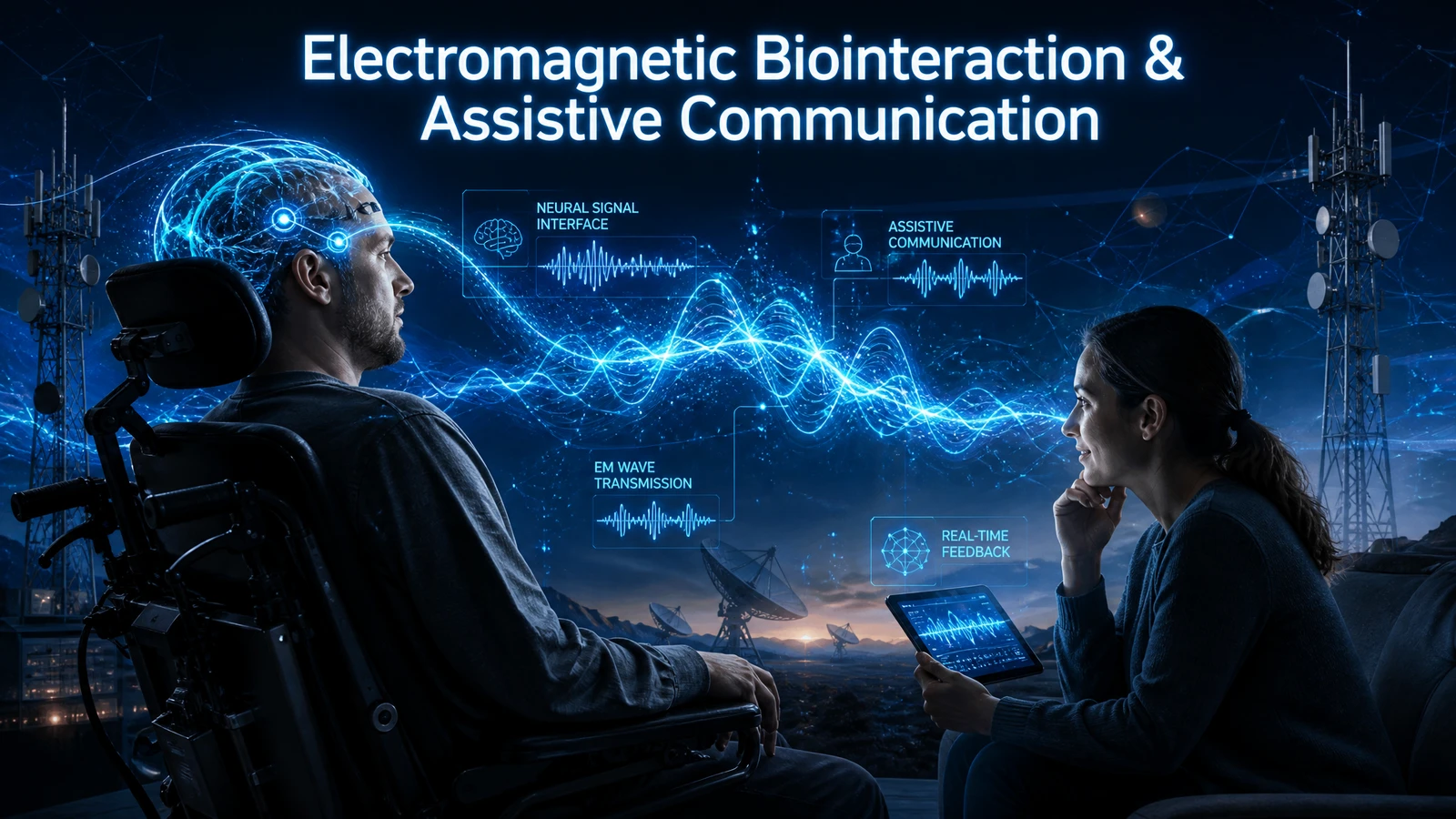
Electromagnetic Biointeraction & Assistive Communication
Demonstrated mechanisms, system architectures, and evidentiary limits — how paralyzed people communicate with loved ones, and what the physics actually permits.
Abstract
Restoring communication for people living with paralysis, anarthria, severe speech impairment, and deafness is among the most consequential goals of contemporary clinical neuroengineering. This white paper synthesizes peer-reviewed literature, governmental and institutional publications, and IEEE sources to establish a rigorous, evidence-hierarchy-first account of how demonstrated assistive communication actually works, and to draw a firm boundary between what the physics and clinical record support and what they do not.
We treat the human body accurately as a bounded electromagnetic source, receiver, and coupled dielectric medium governed by quasi-static electrodynamics at neural frequencies — never as a general-purpose radio transceiver. We assess claims of satellite-origin or tower/Wi-Fi remote reading or writing of complex thoughts and find no credible mechanistic or empirical support.
Executive Findings
§3 — Technical Foundations: The Body as a Bounded Electromagnetic System
3.1 Endogenous Bioelectricity and the Quasi-Static Regime
Neurons move ions through membrane channels; those ionic currents in the extracellular space constitute the primary current density that instruments detect. Aligned apical dendrites of cortical pyramidal cells make the cortical sheet behave, at a distance, like a layer of current dipoles — the geometry that makes EEG and ECoG possible.
At EEG and spike-band frequencies the displacement current is negligible, induction is negligible, and the full Ampère–Maxwell relation collapses to a Poisson problem. This is the quasi-static approximation:
Table 1 — Variables of the Ampère–Maxwell Law
Why this equation collapses at neural frequencies — and why that collapse means the brain cannot radiate
The curl operator measures how much a field swirls or circulates around a point. Imagine dropping a tiny paddle wheel into the field — the curl tells you how fast that wheel spins. Here it captures the circulating nature of the magnetic field.
B is the magnetic field strength measured in tesla. Inside your head, the magnetic field from your neurons is absurdly tiny — about 100 femtotesla, or one hundred millionth of a millionth of a tesla. That smallness is the core reason nobody can read your thoughts from across a room, let alone from orbit.
Mu-zero is a constant of nature that describes how well empty space allows magnetic fields to form. Its value is about 1.26 × 10⁻⁶ henrys per meter — a fixed number that appears in every equation connecting electricity and magnetism.
Greek letters: μ (mu)
J is how much electrical current flows through each square meter of tissue. In the brain, these are tiny ionic currents from neurons firing. They are the biological signals that brain-computer interfaces try to detect — but they only travel a few centimeters through tissue before becoming unreadable.
Epsilon-zero is a constant that describes how well empty space stores electrical energy. Together with mu-zero it determines the speed of light. In this equation the term containing ε₀ represents the "displacement current" — the changing electric field that acts like a current even in empty space.
Greek letters: ε (epsilon)
This is how fast the electric field is changing at any instant. When the electric field changes rapidly, it generates a magnetic field even without any physical wires carrying current. But at the slow frequencies our brains operate at, this term is so tiny it effectively vanishes.
The total current decomposes into an ohmic return term and an impressed neural source:
Table 2 — Volume Current Decomposition
The signal (Jp) versus the noise (σE) — separating neural intent from passive tissue conduction
The total current at any point in the head is a combination of two things: the passive return currents driven by voltage differences through tissue, and the active neural currents that neurons generate themselves. Separating these two is the entire challenge of brain-computer interfaces.
Sigma is how easily electricity flows through each type of tissue. Brain tissue conducts reasonably well (~0.3 S/m), but skull bone is a terrible conductor (~0.01 S/m) — about 30 times worse. This mismatch is exactly why the skull smears brain signals before they reach the scalp.
Greek letters: σ (sigma)
E is the electric push at each point — the force a charged particle would feel there. In the quasi-static brain, E equals minus the gradient of the voltage: it points from high voltage to low, pushing current along.
Jp is the signal — the tiny electrical current that a neuron generates when it fires. This is what we actually want to measure and decode. Everything else in the equation (the tissue conductivity, the return currents) is the noise and distortion that makes decoding hard.
Substituting yields the forward operator in Poisson form:
Table 3 — The Forward Poisson Operator
The complete forward model of EEG — from neural source to scalp voltage
The divergence measures whether a field is "spreading out" or "converging in" at a point — like whether water is pouring out of a source or draining into a sink. Here it tells us where current is being generated (by neurons) and where it simply flows through tissue.
Phi is the voltage at each point in the head. This is literally what EEG measures: voltage differences between pairs of scalp electrodes. But the voltage at the scalp is a heavily blurred version of what happens in the brain — the skull acts like a spatial low-pass filter, smearing fine details into blobs.
Greek letters: φ (phi)
3.2 Skull Attenuation and the Limits of Scalp Sensing
The skull is the dominant attenuator and spatial blender of scalp EEG. The skull-to-brain conductivity ratio is:
Table 4 — Skull-to-Brain Conductivity Ratio
The single number that explains why scalp EEG cannot rival implanted arrays
K is a single number that captures how much worse the skull conducts electricity compared to the brain. It ranges from about 1/15 to 1/80 depending on the measurement method. This one number explains most of the signal degradation that makes non-invasive brain reading so much harder than invasive implants.
The skull's electrical conductivity — roughly 0.01 siemens per meter. Bone is a poor conductor, and this is the physical barrier that protects your brain signals from being read at a distance. It also protects your brain from external electromagnetic interference.
Greek letters: σ (sigma)
The brain's electrical conductivity — about 0.3 siemens per meter. Brain tissue is a reasonable conductor because it is full of ions dissolved in water. Electrical signals travel relatively easily within the brain, but hit a wall when they reach the skull.
Greek letters: σ (sigma)
The information-theoretic consequence is decisive. The recoverable message is bounded by mutual information:
Table 5 — Mutual Information Bound
The mathematical ceiling on how much any BCI can decode — and why distance destroys it
Mutual information is a precise mathematical way of asking: "How much does observing the neural signal N actually tell me about the intended message S?" If observing your brain activity tells me nothing about what you're thinking, mutual information is zero. If it tells me everything, mutual information equals the full complexity of the message.
H(S) is the complexity or unpredictability of what you want to say. A 50-word command menu has low entropy — there are only 50 possibilities. Unconstrained English conversation has very high entropy — there are millions of possible sentences. The higher the entropy, the harder it is to decode.
H(S|N) is how much uncertainty about the message remains AFTER you've looked at the brain signals. If this is high, the brain signals aren't very informative. If it's low, you can decode most of the message. The gap between H(S) and H(S|N) is exactly how much useful information the neural recording provides.
§4 — Evidence Synthesis: Demonstrated Assistive Communication
4.1 From Primary Current to Decoded Speech
ECoG avoids the skull, and high-gamma power on ECoG tracks local firing — it is the workhorse feature of speech decoding. High-gamma bandpower is computed as:
Table 6 — High-Gamma Bandpower
The neural feature that modern speech decoders actually read
This is the total electrical power in the "high-gamma" frequency band (70–150 Hz) at a given moment. It tracks how actively the local neurons under an electrode are firing. When you try to say a word, specific spots on the brain surface light up in high-gamma — and that pattern is what modern speech decoders read.
Greek letters: γ (gamma)
X(f, t) is the neural signal broken down simultaneously by frequency and time. Think of it as a musical score showing which frequencies are active at each instant. The squared magnitude |X|² tells us the energy at each frequency.
4.2 The Decoding Stack
Modern systems estimate a distribution over phonemes every few tens of milliseconds, then let a language model repair the sequence. Closed-loop implementations write the problem as a latent state with a linear observation:
Table 7 — State-Space Decoding Model (Kalman)
How the decoder estimates what your articulators would be doing if your muscles still worked
z is the hidden state — the brain's internal representation of what your tongue, lips, jaw, and larynx are trying to do at time t. We can't see it directly; we have to infer it from the neural signals. This is the key idea: the decoder estimates what your articulators would be doing if your muscles still worked.
A describes how the hidden state naturally evolves from one moment to the next — the physics of articulation. Your tongue doesn't teleport; it follows smooth trajectories. Matrix A captures these natural dynamics.
y is what the electrodes actually measure — the high-gamma power, spike rates, or other features extracted from the raw brain signals. The decoder's job is to work backwards from y to figure out z (what you're trying to say).
C is the mapping from the hidden articulatory state to what the electrodes see. It encodes the fact that each electrode "sees" a mixture of signals from nearby neural populations, like listening to a crowd through different microphones.
w and v represent uncertainty — the unpredictable parts. wt is the randomness in how the brain state changes (process noise), and vt is the randomness in the measurement itself (sensor noise). The decoder has to work through both layers of uncertainty to extract the intended message.
A recurrent backbone summarizes neural history, and a softmax yields phoneme posteriors:
Table 8 — Phoneme Softmax Posterior
How neural signals become probabilities over the ~40 English phonemes
This is the decoder's confidence that the brain is trying to produce phoneme k at time t. For example, it might say "70% chance the patient is making a /b/ sound, 15% chance it's a /p/, 10% /m/..." — probabilities that sum to 100% across all ~40 English phonemes plus silence.
h is the decoder's memory — a summary of everything the neural network has seen up to time t. It captures temporal context: the fact that after "th-" you're more likely saying "the" than "thq." This memory is what makes modern decoders so much better than moment-by-moment classifiers.
wk and bk are the learned parameters that determine how the hidden state maps to the probability of each specific phoneme. They are learned during calibration — the period when the patient practices known words so the decoder can tune itself to their particular brain.
Finally a language model rescores:
Table 9 — Language-Model Rescoring
Combining neural evidence with linguistic plausibility to produce the final decoded sentence
This is the final output — the sequence of words the decoder thinks the patient is trying to say. It's the result of combining two sources of information: what the brain signals suggest (neural evidence) and what makes sense in English (language model). The word with the hat (ŵ) means "best estimate."
Pnn is the brain-signal side of the equation — what the neural network decoder says about each phoneme at each time step, based purely on what the electrodes measured. Without the language model, this would have a much higher error rate.
PLM is the language-model side — the probability that a given word sequence makes sense in English. "I want water" has high PLM; "water want I" has low PLM. This is what repairs the decoder's mistakes: even if the brain signal is ambiguous between "pat" and "bat," the language model knows which fits the sentence.
Alpha is a dial that controls how much the system trusts the brain signals versus how much it trusts English grammar. Turn it too far toward grammar and the system puts words in the patient's mouth. Turn it too far toward brain signals and you get gibberish. Finding the sweet spot is critical.
Greek letters: α (alpha)
4.3 Published Performance
| System | Interface | Result |
|---|---|---|
| Willett et al., Nature 2023 | Intracortical; ALS, attempted speech | 62 wpm; 9.1% WER (50 words) |
| Metzger et al., Nature 2023 | 253-ch ECoG; brainstem stroke | 78 wpm; 25% WER; audio + avatar |
| Card et al., NEJM 2024 | 256-site intracortical; ALS dysarthria | 99.6% (50 words); 90.2% (125k words) |
| Littlejohn/Chang 2025 | ECoG + vocoder; paralysis | Near-synchronous brain-to-voice streaming |
| Kunz/Willett, Cell 2025 | Intracortical; 4 speech-impaired people | Inner speech weaker; command-gated decoding |
§5 — Validated Modalities: Recording, Stimulation, and Photobiomodulation
A fully implanted wireless speech BCI still has electrodes on cortex; its radio carries digitized samples a few centimeters to a wearable receiver. That is telemetry, not remote mind reading. The NIH BRAIN Initiative supported the first human use of the Brown Wireless Device, delivering single-neuron-resolution data at 48 megabits per second with fidelity comparable to wired systems.
Transcranial magnetic stimulation (TMS) is externally induced, not endogenous. A stimulator discharges current into a coil, creating a rapidly changing magnetic field that penetrates the skull and induces a secondary electric current in tissue. The FDA regulates repetitive TMS systems as Class II devices, cleared for major depressive disorder, OCD, smoking cessation, and migraine.
Photobiomodulation (PBM) uses red to near-infrared light (600–1100 nm) whose photons are absorbed by mitochondrial cytochrome c oxidase, dissociating inhibitory nitric oxide, restoring electron transport, and increasing ATP synthesis. This is photon energy deposition into a chromophore — not an electrical current. Photons do not constitute an electrical current absent a defined charge-separation mechanism.
§6 — The Frey Effect: The One Real Remote RF-to-Percept Pathway
Pulsed radiofrequency energy can be heard as clicks — the Frey effect. When short, high-peak-power microwave pulses are absorbed in head soft tissue, they induce a rapid, minuscule temperature rise of order 10⁻⁵ K per pulse; thermoelastic expansion launches an acoustic pressure wave that travels by bone conduction to the cochlea. The specific absorption rate is:
Table 10 — Specific Absorption Rate (SAR)
The dosimetric quantity behind every RF exposure limit — and what it cannot measure
SAR measures how many watts of radio energy each kilogram of your tissue absorbs — it's the number behind every phone safety label. Crucially, SAR is a heating measure. It tells you how much energy is being deposited; it says nothing about whether that energy carries meaning, a message, or a thought.
Same sigma as before, but now at radio frequencies rather than neural frequencies. At GHz frequencies tissue conductivity is much higher because water molecules rotate with the field, converting radio energy into heat. This is exactly how a microwave oven works — and it's the same physics that limits what radio signals can do inside the body.
Greek letters: σ (sigma)
This is the strength of the electric field inside the body after the radio wave has penetrated. It's NOT the same as the field in the air — tissue absorbs and scatters the wave, so the internal field is typically much weaker and differently distributed than the external one.
Rho is the density of the tissue — how heavy each cubic meter is. Bone is denser than brain, fat is less dense. The division by density converts the absorbed power from "watts per cubic meter" to "watts per kilogram," which is more meaningful for assessing biological effects.
Greek letters: ρ (rho)
And the thermoelastic wave equation:
Table 11 — Thermoelastic Wave Equation (Frey Effect)
The physics of microwave hearing — cochlear acoustics, not cortical language injection
p is the sound pressure — the pressure wave that travels through tissue to the cochlea. In the Frey effect, a microwave pulse heats tissue by a tiny amount (10⁻⁵ °C), and that heating makes the tissue expand slightly, launching a sound wave. It's the same physics as thunder: rapid heating creates a pressure wave.
c is how fast sound travels through soft tissue — about 1500 meters per second, similar to water. This speed determines how the thermoelastic pressure wave propagates from the heated region to the cochlea.
Beta is how much tissue expands when you heat it. Even a tiny temperature rise causes a tiny expansion, and that expansion is what creates the sound wave. Beta is small for tissue — about 0.0003 per degree — which is why the Frey effect requires high-power pulsed microwaves, not ordinary phone signals.
Greek letters: β (beta)
T is the temperature increase caused by the absorbed microwave energy. The Frey-effect threshold is absurdly small — about 10 millionths of a degree per pulse. This makes the effect detectable by the exquisitely sensitive cochlea but far too weak to carry meaningful information or control thoughts.
Kappa is a thermal property of tissue that describes how much heat it can absorb before its temperature rises. Tissue with high kappa needs more energy to heat up. It appears in the denominator, meaning higher thermal capacity makes the acoustic pressure weaker for the same energy input.
Greek letters: κ (kappa)
Critically, destroying the cochlea eliminates the response in animal models, confirming a peripheral, not central, mechanism. The effect requires pulsed or modulated energy; continuous-wave radiation does not produce it. ICNIRP removed the microwave-hearing restriction from its 2020 guidelines precisely because it is a sensory phenomenon rather than an adverse health effect. It does not support transmission of complex thoughts or behavioral control.
§7 — Assessment of Satellite-Origin Claims
Any claim that a satellite could remotely read or write complex thought must survive three independent physical constraints, each of which the reviewed evidence renders fatal:
1. The read direction fails on signal magnitude
Endogenous neural fields are microvolts at the pial surface, tens of microvolts at the scalp, and ~100 fT magnetically a few centimeters away; there is no ohmic conductor in air to carry them. Not even a coil across a room can reconstruct inner speech, let alone a platform in orbit.
2. The write direction via RF fails on the heating constraint
To deposit enough energy for any nonthermal "writing," one would first exceed SAR-based thermal limits. The only established RF-to-percept path, the Frey effect, is peripheral cochlear clicking.
3. The optical/"photonic current" direction fails on penetration and mechanism
Even clinical transcranial PBM struggles to penetrate scalp and skull. Photons deposited in tissue are not an electrical current absent charge separation. There is no peer-reviewed evidence that satellite technology can communicate with or control the brain via photonic currents.
DARPA's completed N3 program, which pursued nonsurgical read/write interfaces, defined its own goal as interacting with a 16 mm³ volume through 16 channels using wearable or minutely invasive hardware placed on or in the head — explicitly acknowledging that signals through skin, skull, and brain scatter and attenuate severely. Even this well-funded program presumed local hardware, not remote satellite coupling.
§8 — EM Exposure Standards: Framework and Disagreements
ICNIRP's 2020 guidelines cover 100 kHz to 300 GHz and are anchored to the single substantiated adverse effect: tissue heating. Basic restrictions are internal quantities — SAR below 6 GHz, absorbed power density above. Conservative reduction factors account for biological variability. The FCC uses SAR (1.6 W/kg over 1 g) for portable devices.
The dominant institutional position holds that no consistent, reproducible adverse health effect has been demonstrated below the thermal threshold. The dissenting position, advanced by ICBE-EMF, argues the thermal-only threshold rests on 1980s behavioral studies and ignores non-thermal effects. On balance, the better-supported conclusion for present environmental exposures is the institutional one; the dissent is best read as a call for improved chronic-exposure research.
§9 — Risk, Ethics, Governance, and Cybersecurity
Inner speech is not public speech; an always-on decoder would convert private rehearsal into an audible sentence, so command-gating, on-device processing, and a physical mute are required ethics, not accessories. Neurodata reveals identity, neurological health, and cognitive states, warranting granular controls, hard on/off switches, encryption at rest and in transit, and privacy-preserving computation.
Wireless telemetry is a primary attack vector: eavesdropping, injection and replay of therapy commands, denial-of-service battery depletion. The FDA now treats cybersecurity as integral to safety, requiring a Secure Product Development Framework, Software Bill of Materials, vulnerability-management and incident-response plans. Published US speech neuroprostheses proceed under FDA investigational device exemptions and IRB oversight.
Bounded Conclusions
The electrodynamics of cortex and the clinical record jointly support a narrow, powerful conclusion. Demonstrated assistive communication for paralysis, anarthria, severe speech impairment, and deafness is achieved by placing sensors on or in the body, decoding local signals statistically, delivering output through loudspeakers or the peripheral auditory system, and moving data across ordinary communications networks under regulatory oversight.
The body is a bounded electromagnetic source and a coupled dielectric medium, well described by quasi-static physics at neural frequencies. The single genuine remote RF-to-percept pathway, the Frey effect, produces cochlear clicks by thermoelastic transduction and cannot inject vocabulary into cortex. "Photonic current" is not a real neural-writing mechanism absent charge separation, and there is no peer-reviewed evidence for satellite-to-person neural messaging.
Research Agenda
- Close the validation gap: prioritize larger controlled trials validating decoders in paralyzed populations.
- Characterize indication heterogeneity: design trials measuring MS and other heterogeneous cohorts directly.
- Develop consensus clinical outcome assessments for pivotal-trial design and reimbursement.
- Advance day-to-day stability, fully implanted packages, and premorbid-voice vocoders.
- Improve exposure science through rigorous chronic-exposure and dose-response methods.
- Standardize security and privacy engineering under frameworks such as FDA SPDF and IEEE/UL 2933 TIPPSS.
- Formalize caregiver and post-trial support so family-facing devices remain available.
This document is an educational and scientific analysis. It is not medical, surgical, or regulatory advice. Clinical decisions belong to a qualified clinician, a trial team, and the person who would use the device.
Selected Bibliography
Primary sources only — authoritative government institutions and peer-reviewed academic outlets. Click any entry to reveal its annotation and source link.
Landmark study demonstrating real-time speech decoding from motor cortex at 62 words/min with 23.8% WER, later improved to 97.5% accuracy.
doi.orgComprehensive review of speech-BCI architectures, decoding approaches, and the information-theoretic limits of invasive vs non-invasive neural recording.
doi.orgDemonstrated 78 words/min speech decoding with 25.5% WER from a single participant with ALS, controlling a digital avatar in real time.
doi.orgCurrent international RF exposure guidelines establishing SAR and power density limits based on adverse thermal effects.
doi.orgWHO position statement noting environmental RF exposures are typically thousands of times below international limits.
who.intU.S. regulatory guidance establishing the 1.6 W/kg SAR limit averaged over 1 g tissue for mobile device compliance.
fcc.govUpdated safety consensus for transcranial magnetic stimulation, establishing parameters, contraindications, and monitoring standards.
doi.orgReview of photobiomodulation via cytochrome c oxidase — photon energy deposition triggering biochemical cascades, distinct from electrical current.
doi.orgDissenting consortium review arguing existing RF exposure limits inadequately account for non-thermal biological effects — part of the documented scientific debate.
doi.orgDefinitive review of the Frey/microwave auditory effect — thermoelastic mechanism producing cochlear acoustics, not cortical language injection.
doi.orgSystematic review concluding Wi-Fi exposures at environmental levels are far below thresholds for established biological effects.
doi.orgMilestone in wireless neural telemetry achieving comparable bandwidth to wired systems — still requires an implanted device on/in the skull.
braininitiative.nih.govDARPA program explicitly requiring local wearable hardware on/in the head, acknowledging severe signal attenuation through skin, skull, and brain precludes remote reading.
darpa.milReview of endogenous bioelectric signaling in developmental biology — distinct from exogenous RF exposure and not evidence for the body as a radio transceiver.
doi.orgRegulatory framework for cochlear implant systems — the established return-channel technology enabling hearing for deaf individuals.
fda.gov
Frequently Asked Questions
Yes — demonstrated implanted speech neuroprostheses decode attempted speech from motor cortex at 62–78 words per minute with 3–25% word error rates, and return-channel interfaces (cochlear implants, hearing aids) restore hearing. The technology works with local electrodes and statistical decoders, not remote reading.
Not in the conventional sense. At neural frequencies fields are quasi-static — there is no antenna-like radiation. Endogenous brain fields (~100 femtotesla magnetically) are undetectable beyond centimeters. The body is a bounded electromagnetic source and coupled dielectric medium, not a general-purpose radio transceiver.
No credible peer-reviewed evidence supports this. Endogenous neural fields are too weak to detect from orbit. The only remote RF-to-percept pathway (Frey effect) produces cochlear clicks, not cortical language injection. "Photonic current" is not a neural writing mechanism absent charge separation.
High-peak-power microwave pulses heat head soft tissue by ~10⁻⁵ K, causing thermoelastic expansion that produces acoustic pressure waves reaching the cochlea via bone conduction. Destroying the cochlea eliminates the effect. It is peripheral cochlear acoustics, not cortical injection.
ICNIRP/FCC guidelines protect against substantiated thermal effects. Environmental exposure is typically thousands of times below limits. There is a documented scientific debate over non-thermal effects that motivates further research, but the dominant institutional position has not substantiated reproducible harm below the thermal threshold.
Photobiomodulation uses red/NIR light absorbed by mitochondrial cytochrome c oxidase, triggering biochemical cascades (ATP synthesis). This is photon energy deposition, not electrical current. Photons do not constitute current without a charge-separation mechanism. No validated pathway links optical energy deposition to remote neural messaging.
Published by Michael Aaron Loftus · DigitalMarketingCo.org
All equations are presented with variable and operator tables for both general readers and specialists.
Ready to Elevate Your Digital Presence?
Text us anytime — we'll get back to you as soon as possible. We're text-only.

Let's Build Something Extraordinary
Our expert team of developers is ready to transform your vision into reality. From SEO to custom web applications — we do it all.