








Electromagnetic Fields, Consciousness, and Synthetic Telepathy
A source-critical interdisciplinary review spanning electromagnetic field theory, bioelectromagnetics, transcranial stimulation, microwave auditory phenomena, brain–computer interfaces, speech and inner-speech decoding, historical intelligence programs, ethics, and human rights.
Keywords: electromagnetic fields, consciousness, synthetic telepathy, bioelectromagnetics, transcranial magnetic stimulation, TMS, Frey effect, microwave auditory effect, specific absorption rate, SAR, dielectric dispersion, Cole-Cole, magnetogenetics, brain-computer interface, speech decoding, inner speech, MKULTRA, DARPA N3, neurorights, cognitive liberty, mental privacy, UNESCO, ICNIRP, IEEE C95.1, Maxwell-Faraday law, Larmor frequency, neuromodulation, Michael Aaron Loftus
Executive Abstract
The organizing question of this report is not whether electromagnetic fields can interact with nervous tissue — they can — but what kinds of neural effects have been demonstrated, with what spatial and informational precision, under what exposure conditions, and how far those findings support stronger claims of "mind control" or "synthetic telepathy."
The central conclusion is graduated rather than binary. At the level of physics, induced electric fields, radiofrequency energy deposition, dielectric dispersion, magnetic resonance, and thermoelastic microwave hearing are established. At the level of clinical and laboratory neuromodulation, magnetic and electrical stimulation can alter cortical excitability and, in carefully controlled contexts, influence perception, movement, mood-related circuitry, or behavior. At the level of neural decoding, invasive speech brain–computer interfaces now support fast, large-vocabulary communication in selected people with paralysis, while non-invasive systems can recover constrained semantic or linguistic information under demanding experimental conditions.
Yet no credible public evidence demonstrates unrestricted, covert, long-range reading and writing of arbitrary human thought in uninstrumented individuals. The technological gap between "a field affects neurons" and "a remote system extracts or imposes specific private thoughts" remains large, and is treated here as a chain of separate engineering requirements rather than a single capability.
"Equations constrain physical possibilities; they do not establish biological selectivity, network-level effects, or semantic decoding."

1. Introduction: Definitions, Scope, and Epistemic Method
1.1 Four concepts that must not be conflated
The phrase "mind control" collapses several scientifically distinct phenomena. For analytical clarity, this report separates four categories: state modulation, such as changing arousal or cortical excitability; percept induction, such as eliciting a click-like auditory sensation or a phosphene; action biasing, such as altering the probability of a motor response in a constrained task; and content-specific cognitive manipulation, meaning the reliable selection, decoding, or implantation of complex semantic content.
The first three have varying degrees of experimental support depending on modality and setting. The fourth demands orders of magnitude greater information throughput, targeting precision, individual calibration, and closed-loop verification. Treating all four as one thing is the foundational error from which nearly every other error in this field descends.
"Synthetic telepathy" is used here as a neutral systems term for technological brain-mediated communication without ordinary speech or typing. This definition encompasses legitimate assistive brain–computer interfaces and does not presuppose paranormal processes. A complete system would require neural acquisition, decoding, a communication channel, encoding for a recipient, delivery of sensory or neural stimulation, and successful perceptual and cognitive integration. Demonstration of one link cannot logically substitute for validation of the chain.

1.2 Evidence classes used throughout this report
To prevent rhetorical drift, every claim in this report is explicitly graded. Each higher tier requires the lower layers plus additional demonstrated information capacity, targeting, calibration, and reproducibility.
- Tier A — Established: measured, reproduced physics or physiology with broad consensus.
- Tier B — Strong experimental support: multiple peer-reviewed demonstrations under specified conditions.
- Tier C — Emerging: genuine results, but limited in participants, scope, or replication.
- Tier D — Plausible but unproven: mechanistically conceivable, without validated demonstration.
- Tier E — Unsupported or speculative: no credible public evidence satisfying the necessary constraints.
1.3 Common category errors
Three category errors recur with remarkable regularity. The first is treating a correct equation as proof of a cognitive conclusion. The second is treating the existence of a government program as proof of a working capability. The third is treating a demonstration under cooperative, calibrated laboratory conditions as proof of covert, non-cooperative feasibility. Each substitutes evidence of one kind for evidence of another.

2. Historical Development and Institutional Context
2.1 MKULTRA and the declassified record
MKULTRA was a Cold War–era Central Intelligence Agency program, documented primarily in the record of the United States Senate joint hearing of 3 August 1977. That record conclusively establishes that unethical human behavioral experimentation was conducted, frequently without informed consent, and that institutional interest in behavioral manipulation was real and funded.
What the record does not establish is a working electromagnetic capability to read or write thoughts. This distinction is the most important in the entire historical section: the documentation proves intent, budget, and abuse. It does not prove mechanism. Mistaking evidence that an institution wanted a capability for evidence that it obtained one is an inferential error, not a cautious reading.

2.2 The microwave auditory phenomenon
In 1962, Allan H. Frey reported that modulated electromagnetic energy could produce auditory sensations in human subjects. The phenomenon is real and well documented, and the thermoelastic mechanism — a rapid, minute expansion of head tissue generating an acoustic pressure wave detected by the cochlea — is strongly supported by theory and measurement.
What the effect produces, however, is clicks, buzzes, and hisses: brief, broadband acoustic events. The distance between evoking an auditory sensation and transmitting intelligible speech is enormous. It requires control over spectral content, temporal envelope, and perceptual fidelity at levels no public demonstration has achieved — all while remaining within thermally safe exposure limits.
2.3 Soviet and Russian bioelectromagnetics
Soviet and later Russian bioelectromagnetics research traditions frequently adopted more conservative exposure thresholds and paid greater attention to so-called non-thermal effects than their Western counterparts. That divergence produced a substantial literature of uneven methodological quality whose translation and replication have been incomplete, making it fertile ground for selective citation.
2.4 From rhetoric to interface science
The most significant historical arc is not from secrecy to revelation but from rhetoric to engineering. The field has shifted from broad, unfalsifiable claims about influence toward a measurable discipline of neural interfaces with published benchmarks, regulatory oversight, and reported error rates. That shift is precisely what makes a rigorous evidence audit possible today.

3. Electromagnetic and Biophysical Foundations
3.1 Maxwell–Faraday induction in conductive tissue
The starting point for every electromagnetic interaction with the nervous system is the Maxwell–Faraday law of induction. It states that a magnetic field changing in time generates a circulating electric field. This is not a hypothesis: it is established physics, and it is the exact mechanism by which transcranial magnetic stimulation works.
The negative sign encodes Lenz’s law: induced currents oppose the flux change that produced them. The practical consequence is that the induced field depends on the rate of change of the magnetic field, not on its static magnitude. A powerful but motionless magnet induces nothing at all. It is the speed of the change that does the work, which is why clinical stimulators discharge capacitor banks in tens of microseconds.
Table 3.1 — Variables of the Maxwell–Faraday Induction Law
What each symbol means for a general reader and for a specialist in bioelectromagnetics
The curl operator asks a simple question at every point in space: "is the field swirling here, and how hard?" If you imagine dropping a tiny paddle wheel into the electric field, the curl tells you how fast that paddle wheel would spin. In this equation it is the mathematical way of saying that a changing magnetic field does not just push charges in a straight line — it winds them into loops.
E is the electric field: the invisible push that a charged particle would feel at a given point, measured in volts per meter. Inside the head, this is the quantity that actually matters for neurons, because a neuron responds to being pushed, not to the magnetic field itself. Every claim about "beaming a signal into the brain" ultimately has to explain what E looks like at the target and whether it is strong enough and precise enough to do anything.
B is the magnetic field, measured in tesla. Unlike the electric field, a magnetic field passes through skull and skin almost untouched — bone and tissue barely notice it. That transparency is exactly why magnetic stimulation works at all: the magnet outside the head can hand its energy to the brain without the skull getting in the way. But transparency cuts both ways. A field that ignores the skull also ignores the boundary between one brain region and the next.
This is the rate at which the magnetic field is changing, and it is the real engine of the whole equation. A steady magnet — even a very powerful one — induces nothing. What induces an electric field is change: the faster the magnetic field rises and falls, the stronger the electric push it creates. This is why magnetic stimulators discharge in microseconds rather than simply holding a strong field.
3.2 Conductive and dispersive tissue
An electric field inside tissue drives current. In its simplest form the relationship is linear, and is known as the Ohmic approximation. It is the most direct connection between physics and biology, and also one of the places where simplification becomes dangerous.
This relationship presupposes an isotropic, linear, memoryless, homogeneous medium. The human head is none of those four things. White matter conducts with strong anisotropy along fiber bundles; skull bone and cerebrospinal fluid differ in conductivity by more than an order of magnitude; and conductivity itself varies with frequency. Consequently, current does not flow where the source is aimed: it flows where the tissue permits.
Table 3.2 — Variables of the Ohmic Current-Density Relation
Why the simplest constitutive law in the paper is also its most frequently abused
J is how much electrical current is flowing through each square meter of tissue. It is the difference between a field that merely exists and a field that is actually doing something. Neurons are moved by current, not by abstraction, so J is where physics finally touches biology.
Sigma is how easily electricity moves through a material. Cerebrospinal fluid conducts well; skull bone conducts poorly; white matter conducts differently along a nerve bundle than across it. Because the head is a stack of materials with very different sigmas, current does not travel where you point it — it travels where the tissue lets it.
Greek letters: σ (sigma)
The same electric field from the induction law now reappears as the driver of current. The equation says the two are simply proportional: double the field, double the current. That proportionality is a convenient approximation, and it is one of the places where popular accounts quietly overreach, because real tissue is not so obliging.
3.3 Specific absorption rate and thermal transport
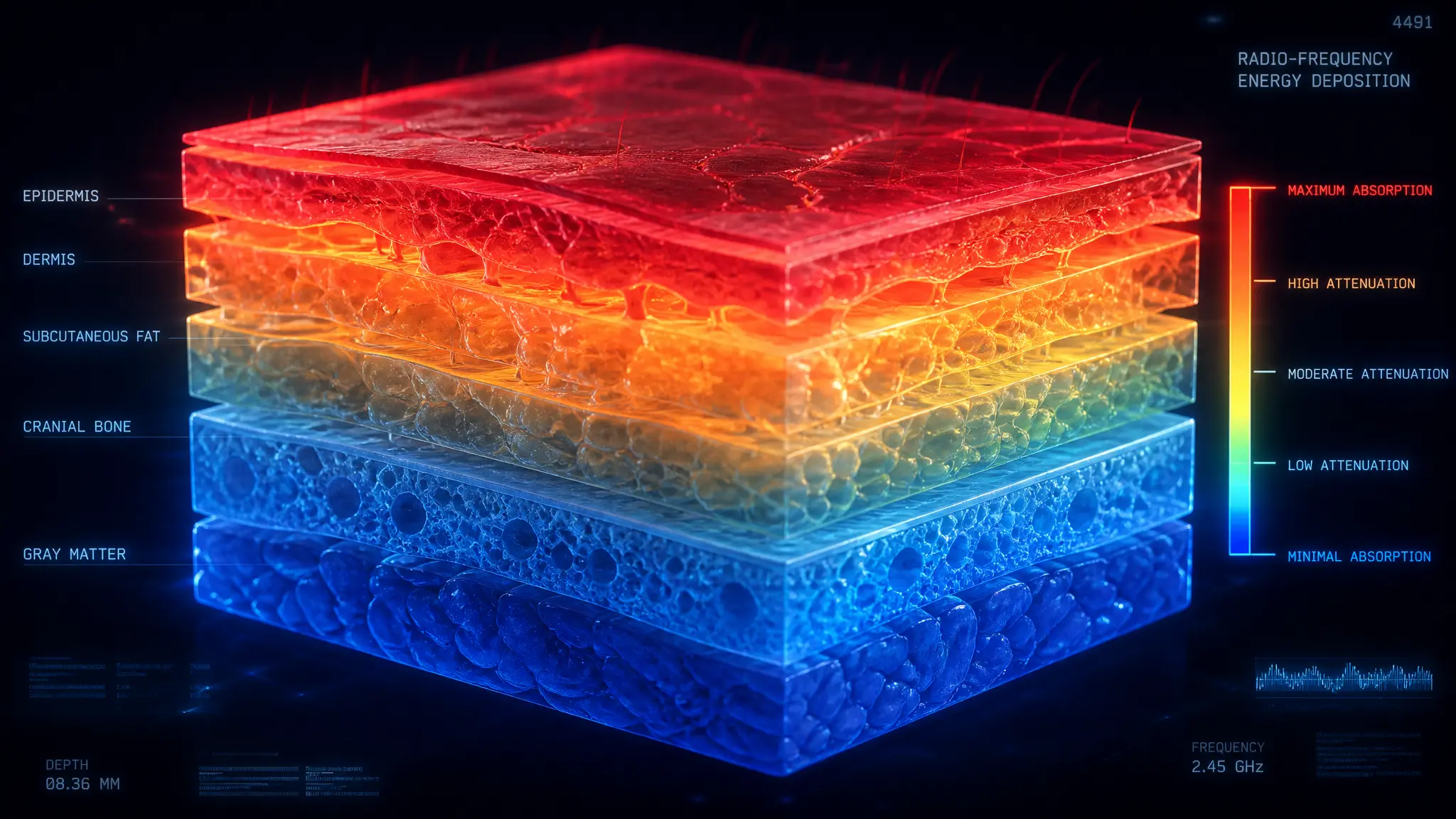
At radio frequencies, the dominant regulatory quantity is the specific absorption rate: power deposited per unit mass of tissue. It is the figure underpinning mobile-phone safety labels and the basic restrictions of both ICNIRP and IEEE.
SAR is an energy-deposition metric. It is dimensionally and conceptually incapable of expressing information content. Conflating a permissible SAR with a communication channel capacity is not a quantitative disagreement but a category error. Moreover, the quadratic dependence on field means deposited power falls as the square of amplitude, imposing a compounding and decisive energetic penalty on any long-range scenario.
Table 3.3 — Variables of the Specific Absorption Rate
The dosimetric quantity behind every radiofrequency exposure limit — and what it cannot measure
SAR measures how many watts of radio energy each kilogram of tissue is soaking up. It is the number behind phone safety labels and exposure limits. Crucially, SAR is a heating measure. It tells you how much energy is being deposited — it says nothing whatsoever about whether that energy carries meaning, a message, or a thought.
Radio fields oscillate millions of times per second, so their instantaneous strength is constantly flipping. The root-mean-square value is the honest average: the steady field that would deposit the same energy. Because SAR depends on this value squared, halving the field cuts the heating to a quarter — a steep penalty that works strongly against any long-range scheme.
Rho is simply how heavy the tissue is per unit of volume, close to that of water for most soft tissue. Dividing by it converts energy deposited in a volume into energy deposited per kilogram, which is what safety limits are written against. It is the least glamorous term in the equation and the one that makes the number comparable across bodies of different size.
Greek letters: ρ (rho)
Tissue response to a field is not a constant but a function of frequency. The Cole–Cole style dispersion model captures that behavior by summing multiple relaxation processes plus an ionic-conduction term.
The parameters of this model are fitted to laboratory measurements and depend on tissue, temperature, frequency, and measurement method. That uncertainty is not a footnote: it propagates directly into every computational dosimetry estimate built upon it, and is one reason regulatory frameworks incorporate substantial reduction factors.
Table 3.4 — Variables of the Cole–Cole Dielectric Dispersion Model
Why tissue behaves like a different material at every frequency you choose
This term describes how tissue responds to an electric field at a given frequency — how much it stores and how much it wastes as heat. The single most important consequence is that tissue is not one material with one number. It behaves like a completely different substance at 1 kHz than it does at 1 GHz, which is why no single exposure rule can span the whole spectrum.
Greek letters: ε (epsilon), ω (omega)
Omega is frequency expressed in radians per second rather than cycles per second. It is the dial that decides everything else: how deeply a field penetrates, how much heat it deposits, and whether it interacts with tissue at all. Choosing a frequency is not a detail — it is the primary design decision in any electromagnetic system aimed at the body.
Greek letters: ω (omega)
These three parameters describe each individual "response event" in the tissue: how large it is, how long it takes to happen, and how smeared out it is across frequencies. They are fitted to laboratory measurements, not derived from first principles, which means they carry real uncertainty — and that uncertainty travels into every safety calculation built on top of them.
Greek letters: Δ (Delta), ε (epsilon), τ (tau), α (alpha)
Epsilon-zero is a fixed constant of nature describing empty space. Epsilon-infinity is what the tissue looks like when the field is oscillating so fast that none of its slower internal machinery can keep up. Together they bracket the response: one is the floor set by the universe, the other the floor set by the tissue itself.
Greek letters: ε (epsilon)
3.4 The spatial selectivity bottleneck
This is the decisive physical obstacle, and it deserves stating bluntly. Penetration depth and focality oppose one another. Low frequencies penetrate but cannot be focused; high frequencies can in principle be focused but are absorbed superficially. Tissue does not focus magnetic fields, so all selectivity must be imposed by source geometry — and the focality of a finite coil collapses roughly as the inverse cube of distance.
None of these constraints forbids interaction. What they do is set the price. And the price, expressed in power, hardware mass, and infrastructure, is what makes covert long-range scenarios inconsistent with any published system.
4. Neuromodulation Modalities
4.1 Transcranial magnetic stimulation
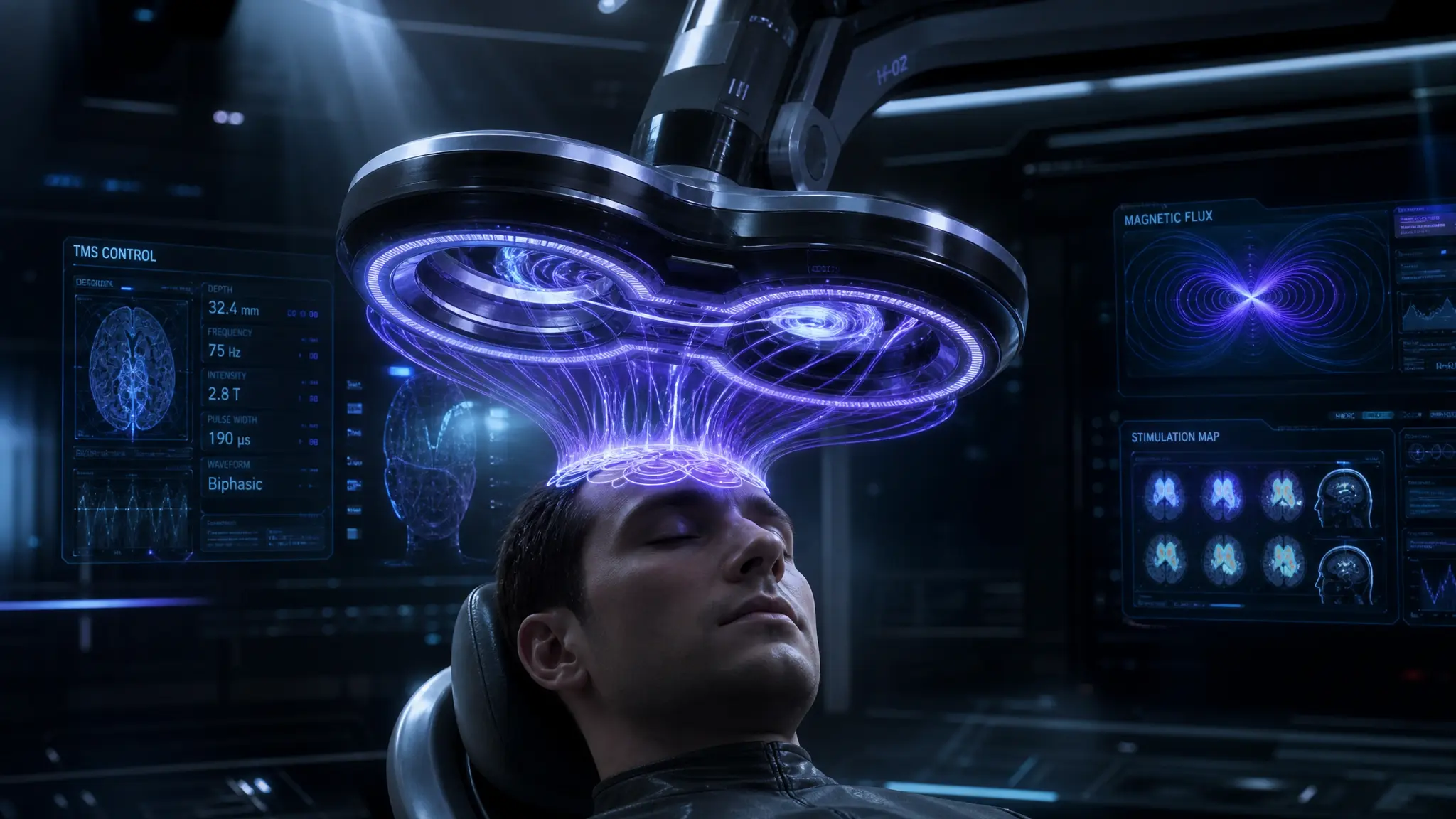
Transcranial magnetic stimulation is the most mature and best-regulated demonstration that electromagnetic fields can modulate neural activity non-invasively. A low-inductance coil placed centimetres from the scalp discharges a capacitor bank, producing a magnetic pulse on the order of one to two tesla at the coil face, with rates of change on the order of ten thousand tesla per second.
A first-order estimate of the induced tangential field in a circular tissue loop clarifies which parameters actually matter in design.
This expression is deliberately simple and valid only as order-of-magnitude scoping: it presupposes spatial uniformity, neglects conductivity boundaries, and ignores anisotropy. Its value lies in showing at a glance that loop radius enters linearly — which formalizes the scale problem dominating any argument about neuron-level selectivity.
Table 4.1 — Variables of the Induced Loop-Field Estimate
The order-of-magnitude formula behind coil design — and the scale problem it exposes
This is a back-of-the-envelope estimate of the electric field induced around the edge of a circular loop of tissue by a changing magnetic field. It is deliberately simple, and it is useful precisely because it shows at a glance which knobs actually matter — and how quickly they run out of room.
Frequency appears here as a straight multiplier: double the frequency and you double the induced field. That looks like an easy win until you remember that higher frequencies are absorbed more strongly and penetrate less deeply. Every gain on one side of the ledger is paid for on the other.
The radius of the conducting loop enters directly, which produces an uncomfortable result: bigger loops pick up more induced field than smaller ones. Since a single neuron is microscopically small, the field it experiences from a broad, unfocused external source is correspondingly tiny. Selectivity does not come for free.
Peak field strength is the term engineers usually try to increase, and it is also the term that fights back hardest. Producing large fields at a distance demands enormous power, enormous hardware, or both — and the requirement grows far faster than the distance does.
4.2 Electrical stimulation and implants
Direct electrical stimulation, whether transcranial or via implanted electrodes, offers spatial control far superior to any stand-off method, precisely because the electrode is placed where it must act. Deep brain stimulation for movement disorders is the most established clinical example. The price of that precision is surgery, and that price is exactly what covert-influence claims seek to avoid.
4.3 Magnetogenetics and remote actuation
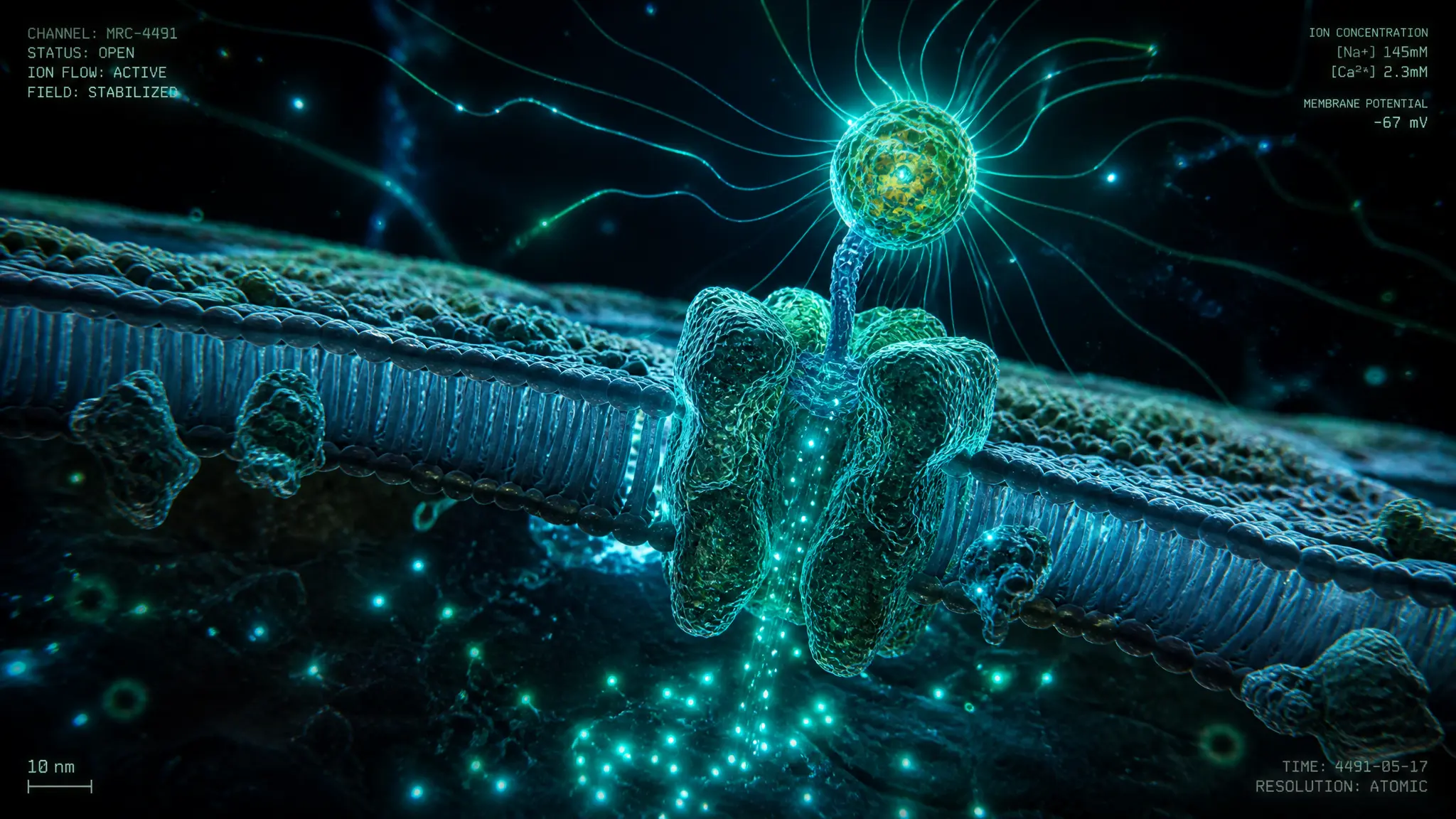
Magnetogenetics solves the selectivity problem in a revealing way: instead of trying to focus the field, it introduces a molecular transducer into the target cells. It has been demonstrated in animal models that remote magnetic fields can actuate neural systems carrying engineered molecular components introduced in advance.
The conceptual lesson matters more than the technical result. Selectivity was achieved by modifying the target, not by perfecting the source. Any claim of covert stand-off influence over an unmodified person must, by definition, dispense with precisely the step that made this demonstration possible.
The Larmor relation is frequently invoked in speculative literature to suggest that a tuned radio frequency could "resonate" with neural tissue. The equation is correct and underpins magnetic resonance imaging, but spin precession is a single-particle phenomenon with no established pathway to macroscopic cognitive control — and reaching the resonance condition requires a static field demanding a multi-ton superconducting magnet.
Table 4.2 — Variables of the Larmor Precession Relation
Correct physics, routinely misapplied — what resonance does and does not permit
Place a magnetic particle in a steady magnetic field and it will wobble like a spinning top, at a rate set entirely by the field strength. That wobble rate is the Larmor frequency. It is the physics that makes MRI possible — and it is also the physics most often misappropriated to suggest that a specific radio frequency could "resonate" with a thought.
Greek letters: ω (omega)
Gamma is a fixed property of a given particle: it says how strongly that particle responds to a magnetic field. A hydrogen nucleus has one value, an electron a very different one. Because gamma is fixed by nature, you cannot tune it — which sharply constrains what any external field can be made to do.
Greek letters: γ (gamma)
B-zero is the strong, steady background magnet — the kind that fills an MRI bore at one and a half to seven tesla. Note the scale: that is tens of thousands of times the Earth’s field, generated by a superconducting magnet weighing several tons. It is not something that can be quietly produced at a distance.
4.4 Sensory substitution
It is worth noting that many of the most convincing experiences of "information delivered directly to the brain" are not neuromodulation at all but sensory substitution: information encoded into an existing sensory channel that the brain learns to reinterpret. It is effective, well documented, and requires no exotic physics.
5. Neural Decoding: What Has Actually Been Demonstrated
5.1 Invasive speech interfaces
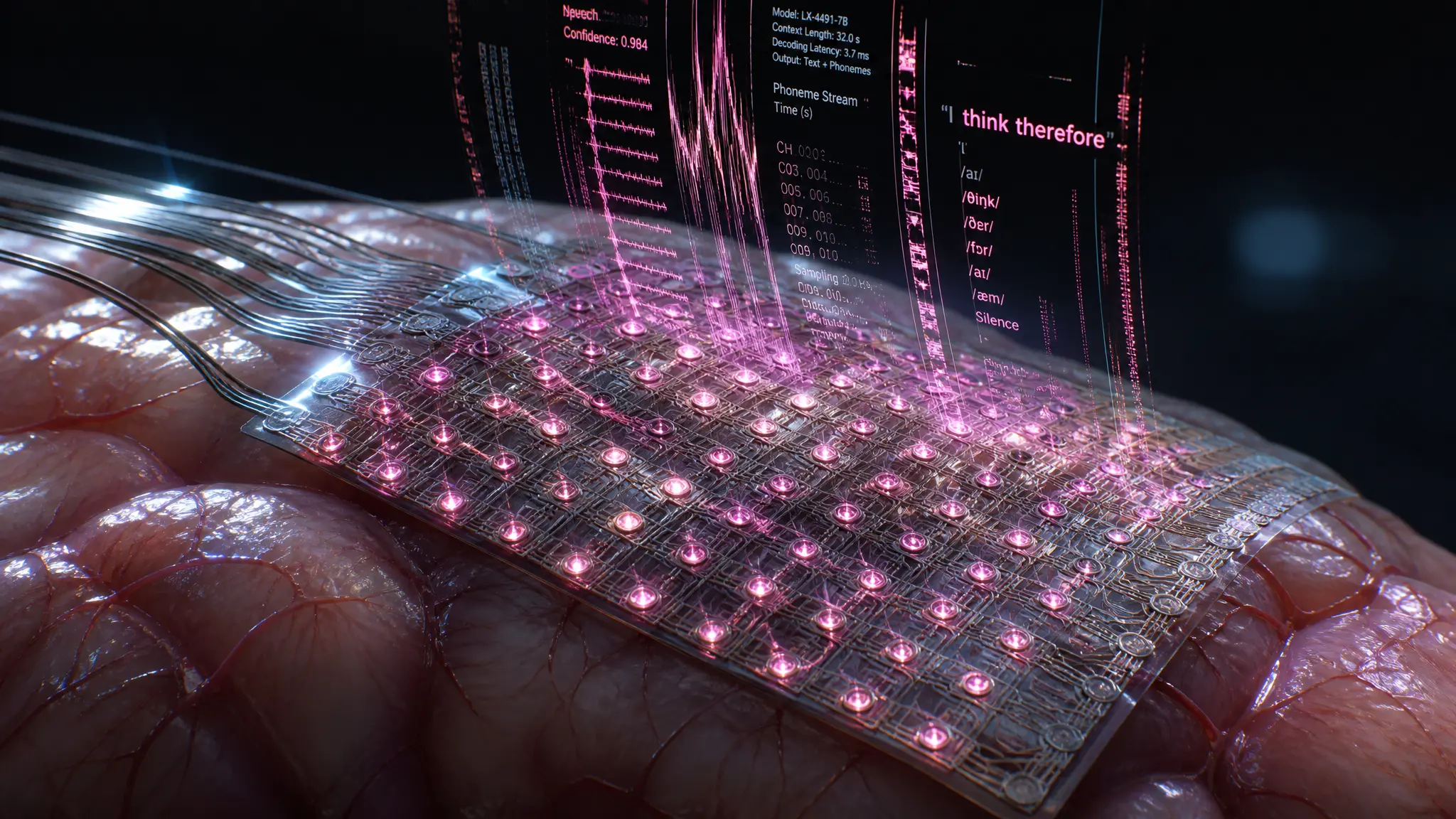
Implanted brain–computer interfaces represent the strongest result in the entire decoding field. Multiple peer-reviewed demonstrations have decoded intended speech at genuinely useful communication rates in participants with paralysis, and long-term intracortical systems have moved toward independent home use.
The enabling conditions must be stated as clearly as the result: surgically placed electrodes, cooperative participants, extensive individualized calibration, and per-subject trained models. None of those conditions survives translation to a covert scenario.
5.2 Inner speech
Recent demonstrations have decoded inner speech — imagined rather than attempted words — in some implanted-interface contexts. These results are genuine and significant, and they are also strictly limited: few participants, constrained vocabularies, invasive access. Generalization has not been established, and their Tier C grading reflects exactly that combination of authenticity and limitation.
5.3 Non-invasive semantic decoding
Functional MRI, magnetoencephalography, and electroencephalography systems can recover constrained semantic or linguistic information without surgery. This has progressed beyond simple classification and constitutes a real scientific achievement. But it requires trained, cooperative subjects, hours of per-person calibration data, and laboratory equipment that is neither portable nor concealable. Performance degrades sharply outside those conditions — and degrades further still if the subject simply declines to cooperate.
5.4 The inverse problem
Beneath all non-invasive decoding lies the electromagnetic inverse problem: reconstructing internal sources from external measurements has no unique solution. Regularizing assumptions are required, and those assumptions substantially determine the result. This is not a limitation of current instrumentation that engineering will overcome; it is a mathematical property of the problem.
6. Synthetic Telepathy as a Systems-Engineering Problem
6.1 The six-link chain
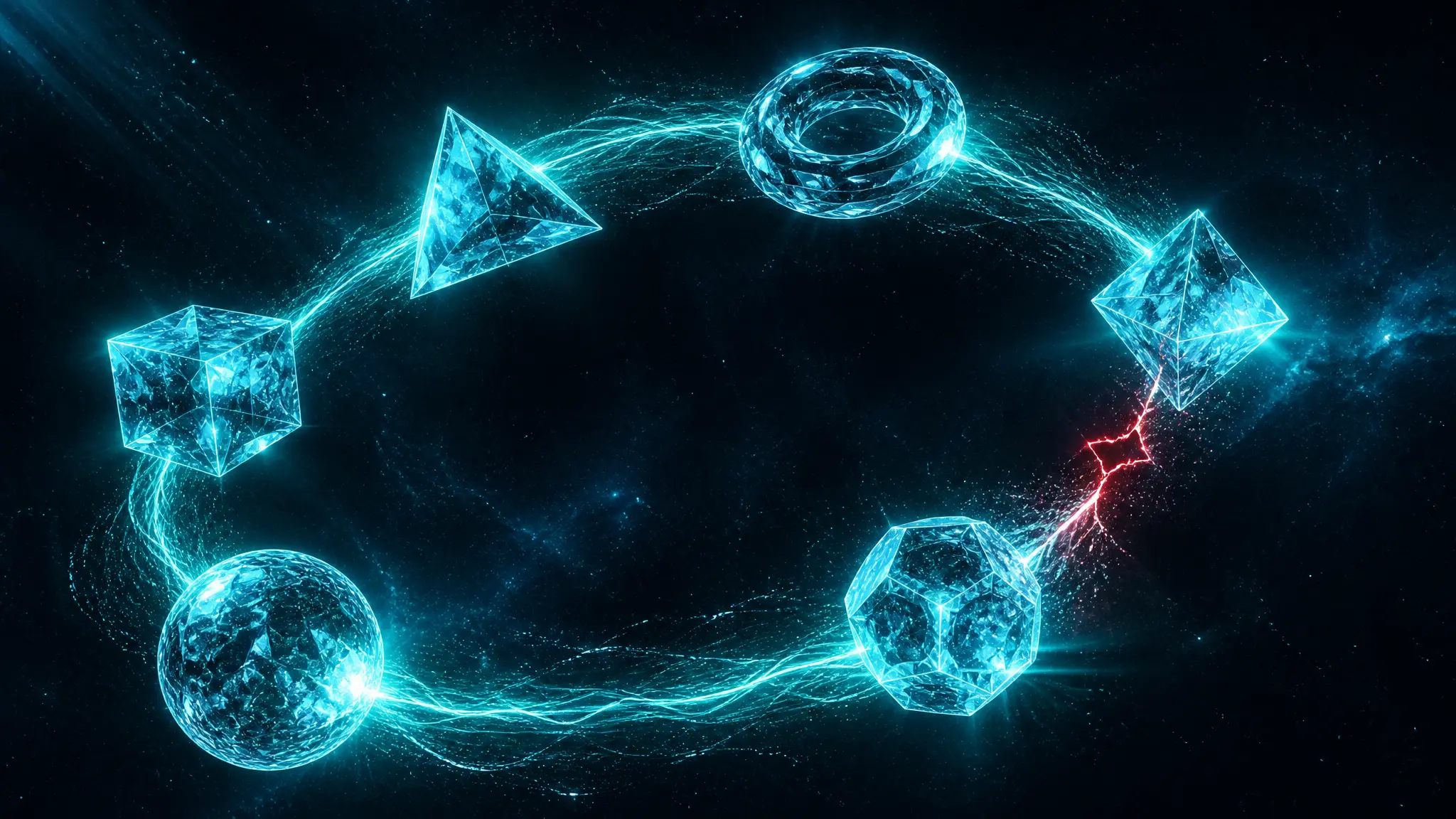
Analyzed as a system rather than as a capability, complete synthetic telepathy requires six successive links, each of which must work for the system to work: neural acquisition with sufficient signal-to-noise and spatial resolution; decoding into semantic representation; a communication channel; encoding for the recipient; delivery of sensory or neural stimulation; and successful perceptual and cognitive integration in the recipient.
6.2 Radio is not the hard part
Link three — moving bits from one place to another — has been a solved problem for a century. That the radiofrequency portion is trivial is exactly what makes speculative claims so persuasive and so misleading at once. The difficulty concentrates overwhelmingly in links one and five: acquiring usable neural signal without sensors, and delivering stimulation with semantic precision.
6.3 The covert stand-off scenario
The scenario that most concerns the public — covert stand-off reading or writing on an uninstrumented person — fails at the first link, before any decoding question arises. Neural signals outside the skull are femtotesla and microvolt in scale, drowned by ambient noise, and magnetoencephalography requires shielding and cryogenics to detect them at all.
6.4 What evidence would be decisive
An honest report must specify what would refute it. Decisive evidence would be a preregistered, placebo-controlled, independently verified demonstration in which an uninstrumented, non-cooperative subject at a specified range reported operator-determined semantic content well above chance, with published dosimetry. That standard is not unattainable in principle. It simply has not been met.

7. Military and National-Security Context
State interest in neurotechnology is not a theory: it is publicly documented. DARPA’s Next-Generation Nonsurgical Neurotechnology program explicitly pursued bidirectional nonsurgical interfaces. That documentation is the most direct evidence both of state investment in the capability and of the technical difficulty that motivated the program in the first place.
The correct reading of a program’s existence is subtle but fundamental. A funded research program demonstrates that a capability was considered desirable and non-trivial. It does not demonstrate that it was achieved. In many cases the very existence of an ambitious program is evidence that the problem remained unsolved at the time of funding.
Separately, anomalous health incidents reported by diplomatic and intelligence personnel have generated considerable official investigation. Responsible treatment of these cases requires holding two things at once: that reported symptoms are real and deserve serious medical attention, and that causal attribution to a directed electromagnetic mechanism remains a contested hypothesis rather than an established fact.
8. Safety, Exposure, and Adverse Effects
Modern exposure frameworks are built on basic restrictions — internal quantities such as induced electric field and specific absorption rate — from which more easily measured external reference levels are derived. ICNIRP and IEEE have substantially converged, and both incorporate considerable reduction factors below established effect thresholds.
It is important to be precise about what these limits protect against. They are designed to prevent established thermal effects and unintended stimulation of excitable tissue. They are not designed to prevent cognitive manipulation, because no established mechanism of cognitive manipulation exists to legislate against. Citing an exposure limit as though it credentialed a capability inverts the purpose of the document.
On the clinical side, repetitive transcranial magnetic stimulation operates within an explicit regulatory envelope, with dosing and adverse-event controls defined in United States Food and Drug Administration guidance. The best-characterized adverse risk is seizure induction, which is rare and managed through parameter limits and patient screening.

9. Ethics, Neurorights, and Cognitive Liberty
The conclusion that covert stand-off thought reading is unsupported does not reduce the urgency of governance: it increases it. Legitimate neurotechnology is advancing rapidly, and protection must be established before capability makes it necessary. UNESCO adopted a global recommendation on the ethics of neurotechnology in 2025 that foregrounds mental privacy and autonomy.
This report proposes eight safeguards that should apply to any system acquiring, storing, or acting upon neural data, regardless of its present capability level.
- Specific informed consent: consent to neural data acquisition must be explicit, revocable, and separate from any other consent.
- Data minimization: collect only the signals necessary for the stated function, for the minimum time necessary.
- Secondary-inference prohibition: neural data collected for one purpose must not be repurposed to infer unrelated states.
- Auditability: decoding and stimulation systems must produce logs inspectable by independent third parties.
- Coercion protection: no employer, insurer, or authority should condition a benefit on the surrender of neural data.
- Identity continuity: closed-loop systems must include user override controls and protections against non-consented personality change.
- Performance transparency: error rates, calibration conditions, and generalization limits must be published alongside any capability claim.
- Legal recourse: individuals must have enforceable legal remedies for neural-data misuse, not merely voluntary guidelines.
A closing note on respect: people who report distressing experiences that they attribute to electromagnetic influence deserve serious medical attention and dignified treatment. Rejecting a causal explanation is not rejecting a person’s suffering, and the scientific community should be far more careful in distinguishing the two.
10. Evidence Audit of Common Claims
The table below applies the evidence ladder from Section 1.2 to the nine claims that dominate public discourse on electromagnetic fields and cognition. Tap any row to reveal the full reasoning behind its grading.
Evidence Audit of Common Claims
Reason: Direct consequence of Maxwell–Faraday induction and the physical basis of transcranial magnetic stimulation. Measurable, reproducible, and quantitatively modeled in standard dosimetry.
Reason: The microwave auditory effect is well documented, and the thermoelastic expansion mechanism is strongly supported by theory and measurement. It produces clicks or buzzes, not speech-grade content.
Reason: Transcranial magnetic stimulation is a mature, regulated clinical technology. Effects depend critically on coil geometry, intensity, timing, and cortical target, and do not generalize to arbitrary remote configurations.
Reason: Demonstrated in animal models that carry engineered molecular components introduced in advance. The capability is contingent on prior biological modification of the subject, which is precisely what covert-influence claims cannot assume.
Reason: Demonstrated with fMRI, MEG, and EEG under trained, cooperative, per-subject experimental conditions with substantial calibration data. Performance degrades sharply outside those conditions.
Reason: Multiple peer-reviewed demonstrations exist in participants with paralysis. Performance requires surgically placed electrodes and extensive individualized calibration.
Reason: Recent demonstrations are genuine but involve limited participants, constrained vocabularies, and invasive access modalities. Generalization has not been established.
Reason: No credible public demonstration satisfies the required sensing sensitivity, spatial resolution, signal-to-noise, and independent validation constraints. The claim fails at the acquisition link before any decoding question arises.
Reason: No credible public end-to-end demonstration exists, and known stimulation modalities lack the semantic precision, spatial selectivity, and closed-loop verification such a capability would require.
10.1 How to read this table
The structure of the table is itself the argument. Claims degrade monotonically as requirements are added: covertness, range, absence of instrumentation, arbitrariness of content, and subject non-cooperation. Each additional requirement subtracts a tier or more. The two Tier E claims are Tier E not out of hostility to the idea, but because they accumulate all of those requirements simultaneously.

11. Research Agenda 2026–2035
A critique without an agenda is incomplete. The four priorities below follow directly from the bottlenecks identified in this report, ordered by the ratio of clarity gained to difficulty of achievement.
- Open individualized dosimetry: subject-specific head models with published dielectric parameters and uncertainty intervals, so that field-at-target claims can be independently verified.
- Preregistered decoding protocols: blinded, placebo-controlled studies with pre-specified endpoints that report error rates and generalization conditions alongside successes.
- Standardized selectivity metrics: a common definition of focality and effective depth allowing neuromodulation modalities to be compared honestly.
- Anticipatory governance: enforceable legal instruments for neural data that take effect before capability makes them urgent, following the UNESCO framework.
12. Conclusion
Electromagnetic fields interact with nervous tissue. That statement is true, established, and the foundation of valuable medical technology. It is also, on its own, nearly contentless with respect to the questions people care most about. The distance between "a field affects neurons" and "a remote system extracts or imposes specific private thoughts" is not a gap closed by more power. It is a chain of separate engineering requirements, and most of them remain unmet.
The intellectually honest posture is neither dismissal nor credulity but grading. Every claim deserves a tier, every tier deserves a criterion, and every criterion deserves to be published. That is the method this report attempts to model as much as to apply.
12.1 What should change
Three things would immediately improve public discourse. First, that every capability claim be published together with its calibration conditions and error rates. Second, that the existence of a program stop being cited as evidence of a capability. And third, that neural-data protection be established now, while the window to do so calmly remains open.
Appendix A — Core Equations and Interpretation
The six equations developed in Sections 3 and 4 are collected here alongside their meaning and, critically, their interpretive limit — what each one does not license you to conclude.
Appendix A — Core Equations & Interpretation
| Equation | Meaning | Interpretive Limit |
|---|---|---|
| ∇ × E = −∂B/∂t | Faraday induction: a changing magnetic flux generates circulating electric fields. | Does not specify which neurons are activated or what cognition results. |
| J = σE | Ohmic approximation relating current density to the local electric field. | Tissue is heterogeneous, anisotropic, dispersive, and nonlinear in some regimes. |
| SAR = σ|Erms|² / ρ | Radiofrequency power absorbed per unit tissue mass in a conductive approximation. | Not a measure of information transfer or of influence over thought. |
| ε*(ω) = ε∞ + Σ Δε / (1 + (jωτ)1−α) + σ/(jωε0) | Cole–Cole style dispersion model of frequency-dependent tissue permittivity. | Parameters depend on tissue, temperature, frequency, and measurement method. |
| ωL = |γ|B0 | Larmor angular frequency for a magnetic moment in a static field. | Microscopic spin physics does not by itself provide a macroscopic cognitive-control mechanism. |
| E ≈ πfrB | Idealized induced tangential field in a circular loop under a sinusoidal magnetic field. | Human anatomy requires numerical field modeling; this is an order-of-magnitude estimate only. |
A recurring error in speculative literature is to present a correct equation and then jump directly to a cognitive conclusion. Equations constrain physical possibilities; they do not establish biological selectivity, network-level effects, or semantic decoding.
Frequently Asked Questions
Yes, and this is not in dispute. Time-varying magnetic fields induce electric fields in conductive tissue, and transcranial magnetic stimulation exploits that fact as a regulated clinical therapy. The relevant scientific question was never whether interaction exists, but what kinds of neural effects have been demonstrated, with what spatial and informational precision, and under what exposure conditions.
Yes. Pulsed radiofrequency energy can evoke auditory sensations through thermoelastic expansion in head tissue, and the phenomenon is well documented. What it produces, however, is clicks, buzzes, or hisses — not intelligible speech. The distance between an auditory sensation and the transmission of semantic content is enormous and has not been bridged in any credible public demonstration.
As a neutral systems-engineering term for brain-mediated communication, genuine components exist: implanted brain–computer interfaces decode intended speech at useful rates in people with paralysis. But a complete system requires six independent links, and no public system has demonstrated the full chain in an uninstrumented subject.
MKULTRA was a Cold War–era CIA program documented in the 1977 United States Senate hearing record. It conclusively demonstrates that unethical human behavioral experimentation occurred and that institutional interest in behavioral manipulation was real. What it does not demonstrate is a working electromagnetic capability to read or write thoughts: the record documents intent and abuse, not a validated mechanism.
Because the requirements scale punishingly. Deposited power falls as the square of field amplitude, far-field amplitude falls with range, and the focality of a finite coil collapses roughly as the inverse cube of distance. Added to thermal exposure limits, this means the necessary infrastructure and power budget is neither concealable nor consistent with any published system.
Neurorights are emerging legal protections for mental privacy, cognitive liberty, psychological integrity, and identity continuity. They matter now precisely because legitimate neurotechnology is advancing: UNESCO adopted a global recommendation on the ethics of neurotechnology in 2025 that foregrounds mental privacy and autonomy. Governance must precede capability rather than chase it.
No. It makes a more precise and more useful claim: that assertions must be graded by evidence class. Field induction, microwave hearing, and clinical neuromodulation are established or strongly supported. Non-invasive semantic decoding is emerging and heavily constrained. Covert, long-range reading or writing of arbitrary thought in uninstrumented people is, on the available public evidence, Tier E: unsupported.
Presenting a correct equation and then jumping directly to a cognitive conclusion. Equations constrain what is physically possible; they do not establish biological selectivity, network-level effects, or semantic decoding. Demonstrating one link of the chain cannot logically substitute for validating the whole chain.
Bibliography
Primary sources only — authoritative government institutions and peer-reviewed academic outlets. Click any entry to reveal its annotation and source link.
The principal international basic-restriction framework for radiofrequency exposure, defining SAR and absorbed power density limits used throughout this report.
icnirp.org — RF Guidelines 2020The parallel IEEE exposure and dosimetry standard, whose harmonization with ICNIRP is discussed in the safety section.
standards.ieee.org — C95.1-2019WHO monographs on radiofrequency, static and extremely low frequency fields provide the institutional health-evidence baseline referenced in the safety discussion.
who.int — Electromagnetic fieldsA national regulatory instrument with an accompanying technical guide, useful for comparing how basic restrictions are operationalized across jurisdictions.
canada.ca — Safety Code 6The primary declassified hearing record establishing that unethical behavioral experimentation occurred — and equally establishing the absence of a validated electromagnetic thought-control mechanism.
intelligence.senate.gov — 1977 Joint HearingThe originating report of the microwave auditory effect, still the reference point for every subsequent discussion of radiofrequency-evoked auditory sensation.
journals.physiology.org — Frey 1962The reference parameterization underlying Cole–Cole dispersion modeling and virtually all computational dosimetry of the human head.
pubmed.ncbi.nlm.nih.gov — Gabriel et al. 1996Public program documentation for bidirectional nonsurgical neural interfaces — the most direct evidence of state investment in the capability, and of the technical difficulty that motivated the program.
darpa.mil — N3 ProgramRegulatory guidance defining the clinical envelope within which transcranial magnetic stimulation is authorized, including dosing and adverse-event controls.
fda.gov — rTMS Special ControlsThe first global normative instrument on neurotechnology ethics, foregrounding mental privacy, cognitive liberty, and autonomy — the governance backbone of Section 9.
unesco.org — Ethics of NeurotechnologyA consensus review of the low-frequency health-effects literature, included because it models the evidentiary discipline this report attempts to apply.
nap.nationalacademies.org — NRC 1997
Research Integrity Statement
This report is an independent, source-critical interdisciplinary review prepared by Digital Marketing Company It synthesizes public peer-reviewed literature, institutional standards, and declassified government records. It describes no classified system, claims no access to non-public information, and constitutes neither medical, legal, nor security advice. All evidence gradings are the author’s judgments based on the public literature available as of August 2026 and are subject to revision as new evidence emerges. Where evidence is contested, it is identified as contested rather than resolved in favor of any conclusion.
Ready to Elevate Your Digital Presence?
Text us anytime — we'll get back to you as soon as possible. We're text-only.

Let's Build Something Extraordinary
Our expert team of developers is ready to transform your vision into reality. From SEO to custom web applications — we do it all.