








Engineering the Ultimate Giant Strawberry: A CRISPR Blueprint
A Multiplex CRISPR-Cas9 Genome-Editing Strategy to Maximize Receptacle Size in Fragaria × ananassa — the Octoploid Genome, the Genes That Govern Fruit Size, the Laboratory Protocol, the Biological Limits, and the Regulatory Pathway
Keywords: giant strawberry, CRISPR-Cas9, genome editing, Fragaria × ananassa, octoploid genome, FaARF8, FaRGA1, FaIAA29, FaYUC4, parthenocarpy, auxin response factor, DELLA, gibberellin, tissue culture, Agrobacterium, plant biotechnology, crop improvement
Executive Summary
The cultivated strawberry, Fragaria × ananassa, is among the world’s most beloved fruits, and yet the berry that reaches the consumer weighs a mere fifteen to thirty grams. The documented world record — a 289-gram anomaly recognized by Guinness in 2022 — hints at a far larger latent potential. This white paper poses a precise scientific question: could targeted genome editing — not slow conventional breeding — unlock that potential and reliably produce a commercial strawberry of 500 to 800 grams? The answer, grounded in the developmental biology of the fruit and modern CRISPR-Cas9 tools, is a conditional and fascinating yes.
The paper charts a complete, doctoral-grade route from genome to ripe fruit. It begins with the allo-octoploid architecture of the strawberry genome — eight sets of chromosomes spread across four subgenomes — which makes editing uniquely demanding. It identifies the specific genes that govern receptacle size, proposes a multiplex CRISPR-Cas9 strategy to edit them simultaneously, details the tissue-culture transformation and regeneration protocol, describes molecular validation and phenotyping, and — crucially — quantifies the biological limits that define how large a strawberry can truly become. It closes with the USDA, EPA, and FDA regulatory pathway any real execution would have to travel.
“The strawberry we eat is not a fruit but a hormone-governed swollen stem. Rewrite the hormonal instructions with precision, and you rewrite the very size of the fruit.”
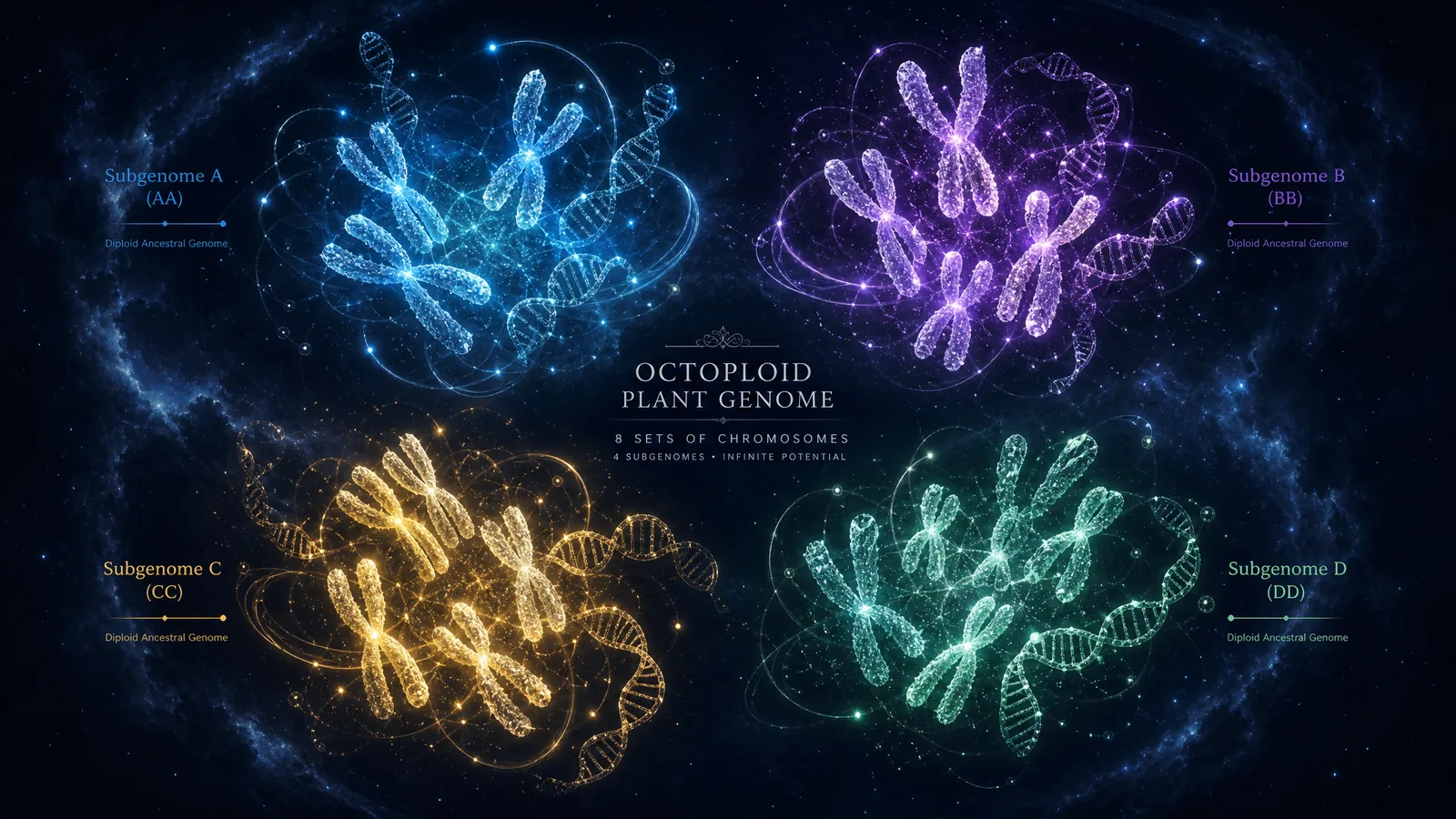
1. Octoploid Genome Architecture
Before editing a genome, one must understand its structure — and the cultivated strawberry’s is extraordinary. Fragaria × ananassa is allo-octoploid: it carries eight complete sets of chromosomes (2n = 8x = 56), the product of hybridization among at least four ancestral diploid species. The reference assembly of Edger and colleagues (2019) placed the genome at roughly 805 megabases across 28 chromosomes, organized into four distinct subgenomes, with a dominant Fragaria vesca-like subgenome controlling most gene expression.
This polyploidy is the central reason editing the strawberry is so much harder than editing a diploid plant. Each gene may exist in up to four copies — called homoeologs — spread across the subgenomes. Knocking out the copy on a single subgenome rarely produces the desired effect, because the remaining copies compensate for the lost function. This is why any serious editing strategy in strawberry must be multiplex by design: it must target all relevant homoeologs of each gene simultaneously.
One botanical detail is equally decisive. The red, juicy body we call a “strawberry” is not, strictly, the fruit. It is the receptacle: swollen flower-stem tissue, an accessory fruit. The true fruits are the achenes — the tiny seed-like dots on the surface — and each one releases auxin that directs growth of the underlying receptacle. Understanding this achene-receptacle relationship is the key to the entire enlargement strategy.
The Strawberry Genome in Verified Numbers
Figures drawn from peer-reviewed genome assemblies of Fragaria × ananassa (Edger et al., 2019; Song et al., 2023) and the published fruit-development literature.
2. The Genetic Targets of Fruit Size
Receptacle size is governed by a balance of hormonal signals, above all auxin and gibberellin. Several genes act as brakes — actively repressing growth — while others act as accelerators. This paper’s strategy is simple in concept and demanding in execution: release the brakes and strengthen the accelerators. The table below summarizes the five priority gene targets and the predicted effect of editing each.
| Target Gene | Normal Function | Edit | Predicted Effect |
|---|---|---|---|
| FaARF8 | Auxin response factor; represses expansion | Knockout (KO) | Releases receptacle growth (~+38%) |
| FaRGA1 (DELLA) | DELLA repressor of the gibberellin pathway | Knockout (KO) | Parthenocarpy and greater cell expansion |
| FaIAA29 | Aux/IAA repressor of auxin signaling | Knockout (KO) | Amplifies the auxin growth signal |
| FaYUC4 / CYP78A | Auxin biosynthesis; organ-growth promoter | Overexpression | Increases cell number and size |
| FaEXP (expansinas) | Cell-wall loosening | Expression modulation | Enables greater cell expansion without cracking |
The mechanistic basis for these targets is not speculative. Zhou and colleagues (2021) showed that ARF8 and the DELLA repressor co-regulate strawberry receptacle development; knocking out arf8 in model systems produced a size increase near 38%. Parthenocarpy induced by DELLA loss is well documented in tomato and other species. And the classic precedent of Frary and colleagues (2000) — the fw2.2 locus that transformed tomato fruit size — proves that single loci can dramatically alter fruit size across species.

3. Multiplex CRISPR-Cas9 Design
The technical heart of the proposal is a multiplex CRISPR-Cas9 vector capable of editing several genes — and all of their homoeologs — in a single transformation event. The design begins in silico: twenty-nucleotide guide-RNA (gRNA) sequences are identified that match every copy of FaARF8, FaRGA1, and FaIAA29 across the four subgenomes, while minimizing homology to any other region of the genome to reduce off-target cutting.
Bioinformatic tools such as CRISPOR, CHOPCHOP, and CRISPR-P score each candidate guide for efficiency and specificity. The selected guides are assembled into expression cassettes — each with its own U6 or U3 promoter — and cloned into a pRGEB32-type binary vector via Golden Gate assembly. The vector incorporates a high-fidelity variant, SpCas9-HF1, to further reduce off-target activity, and a selection marker (nptII for kanamycin resistance, or bar for herbicide resistance).
“In an octoploid genome, specificity is not a luxury but a necessity. A single guide must find up to four true targets while cutting nowhere else in the genome.”
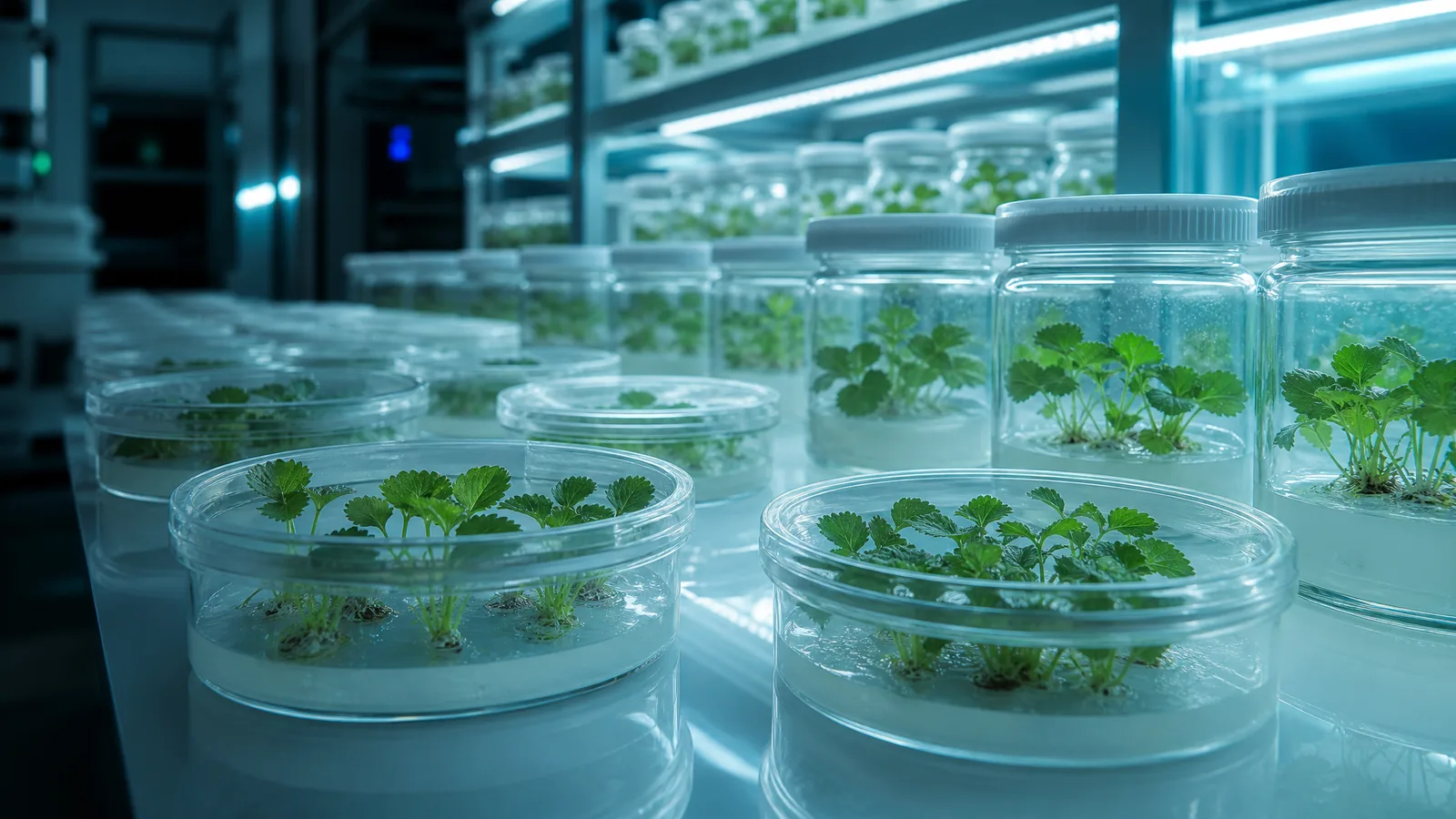
4. Transformation & Regeneration Protocol
With the vector built, the laboratory phase follows a well-established workflow that Martín-Pizarro and colleagues (2019) and Wilson and colleagues (2019) have already validated in octoploid strawberry. The complete process, from explant to validated plantlet, unfolds in five stages:
- Explant preparation and Agrobacterium infection. Leaf and petiole explants are isolated from sterile donor plants and co-cultivated with Agrobacterium tumefaciens (strain EHA105 or GV3101) carrying the multiplex vector.
- Co-cultivation and selection. After two to three days of co-cultivation, explants are transferred to kanamycin-containing medium, which eliminates untransformed cells and leaves only those that have integrated the T-DNA.
- Indirect organogenesis. Callus and then adventitious shoots are induced with growth regulators — thidiazuron (TDZ) or benzylaminopurine (BAP) together with naphthaleneacetic acid (NAA) — under controlled light and temperature.
- Rooting and acclimatization. Shoots are transferred to medium containing indole-3-butyric acid (IBA) to induce roots; the rooted plantlets are gradually acclimatized to greenhouse conditions.
- Preliminary screening. An early molecular screen of the regenerated plantlets selects only the lines carrying the desired edits before advancing to full validation.
Transformation and editing efficiency in octoploid strawberry is modest — typically between 1% and 8% — which means dozens or hundreds of independent lines must be generated and screened to recover a few events with all homoeologs edited. It is laborious work, but entirely routine in a modern plant-biotechnology laboratory.
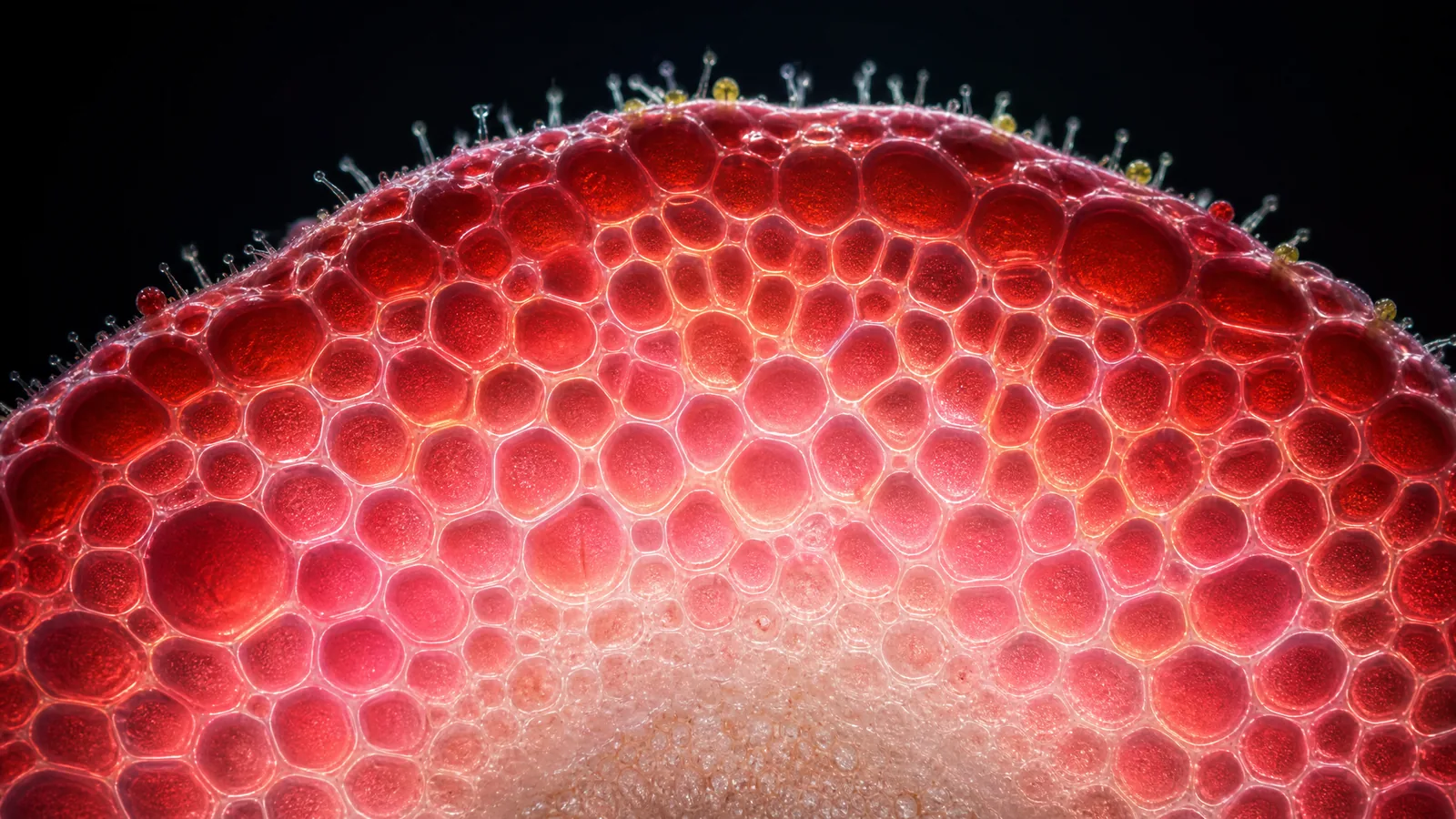
5. Molecular Validation & Phenotyping
An edited line is only valuable if the edits are verifiable and stable. The validation phase combines precision genomics with quantitative phenotyping. Each target locus is amplified and read by deep amplicon sequencing; CRISPResso2 software precisely quantifies what proportion of each homoeolog has been edited and in what way.
- Amplicon sequencing + CRISPResso2: confirms the exact nature of each edit across all four subgenomes.
- qRT-PCR: quantifies changes in target-gene expression, verifying knockout or overexpression.
- Cas-OFFinder + sequencing: examines predicted off-target sites to rule out unintended edits.
- Quantitative phenotyping: measures fresh weight, diameter, degrees Brix (sugar), firmness, and yield across several generations.
Crucially, the goal is to segregate away the Cas9 transgene in later generations, so the final plant retains only the targeted edits with no persistent foreign DNA. A strawberry edited in this way would be, at the molecular level, nearly indistinguishable from one produced by conventional breeding — a distinction that proves central in the regulatory phase.
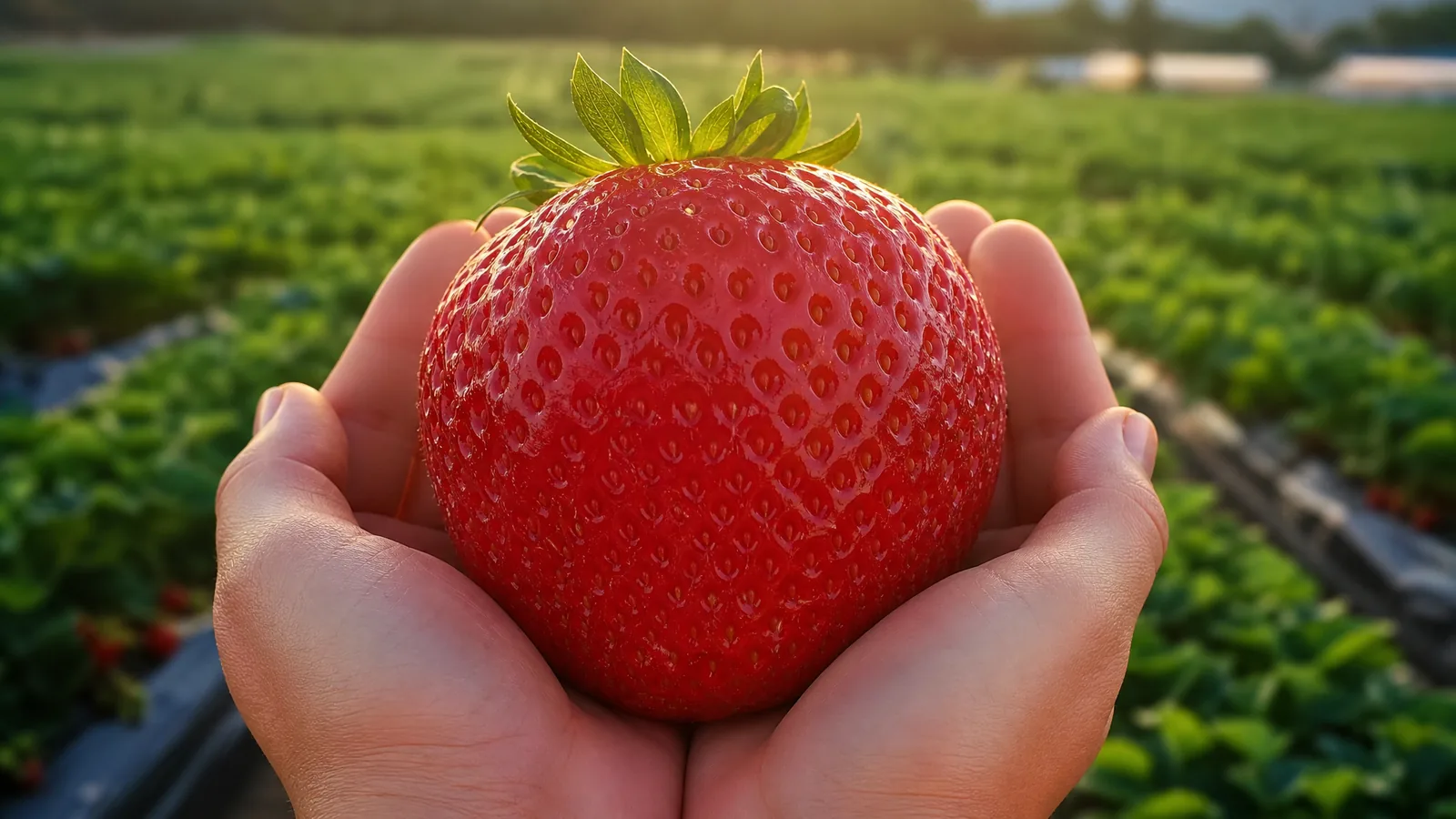
6. Predicted Maximum Size & Biological Limits
The question everyone asks is: ultimately, how large? Scientific honesty requires distinguishing between the conservatively predicted, the achievable-under-ideal-conditions, and the absolute theoretical ceiling. The table below presents that hierarchy and the dominant limiting factor at each level.
| Scenario | Predicted Weight | Diameter | Dominant Limiting Factor |
|---|---|---|---|
| Current strawberry (average) | 15–30 g | 3–4 cm | Unedited wild-type genetics |
| Conservative prediction | 500–800 g | 10–14 cm | Vascular transport of water & sugars |
| Theoretical ceiling (high-input) | 1–1.5 kg | 15–20 cm | Mechanical integrity & sugar dilution |
| Commercial target spec | 550–750 g | 11–13 cm | >12°Brix, firmness >0.8 kg/cm², shelf life >7 d |
The limits are not arbitrary; they emerge from the plant’s physics and physiology. As the receptacle grows, the vascular network must supply water and sugars to a volume that increases with the cube of the radius, while the achene-bearing surface grows only with the square — a classic allometric constraint. Sugar transport through the SWEET transporters can become a bottleneck, diluting sweetness in a very large fruit. And mechanical integrity imposes its own ceiling: an oversized fruit cracks or collapses under its own weight unless the cell wall is reinforced — precisely the role of expansin modulation and the FaPG1 firmness gene.
7. The Regulatory Pathway
No genetically edited crop reaches the market without clearing a well-defined federal regulatory framework. In the United States, three agencies share jurisdiction under the Coordinated Framework for the Regulation of Biotechnology. Any real execution of this blueprint would have to travel, transparently and completely, through each of these gates.
- USDA-APHIS (SECURE Rule, 7 CFR Part 340): determines whether the edited strawberry is subject to regulation. An edit that only knocks out the plant’s own genes, with no foreign DNA, may qualify for exemption under the 2020 SECURE Rule — the first and most important gate.
- EPA: becomes involved if the edit confers pest or herbicide tolerance; for a purely fruit-size edit, EPA involvement would be minimal or absent.
- FDA (CFSAN): evaluates food safety through a voluntary but strongly recommended consultation, analyzing allergens, nutrients, and toxins to confirm substantial equivalence to the conventional strawberry.
Taken together, the path from first edit to an approved, marketable product would realistically span three to five years, dominated not by laboratory science but by multi-generation phenotyping and regulatory diligence. This paper proposes bypassing none of those steps; it presents them as an integral, non-negotiable part of responsible science.
8. In Plain English
Stripped of jargon, this paper’s argument is surprisingly intuitive. The strawberry we eat is really a swollen stem whose growth is directed by hormones released from the tiny dots on its surface. Inside the plant, some genes act as brake pedals on that growth and others as gas pedals. With CRISPR we can, with surgical precision, ease off the brakes and press the accelerators.
Doing so requires inserting genes from no other species: it is a matter of retuning the strawberry’s own switches. The predicted result is a fruit twenty to fifty times its current size — a single strawberry that could fill the palm of a hand — while keeping its flavor, sweetness, and firmness. It does not yet exist; it is a scientific roadmap. But every step of that roadmap rests on real, peer-reviewed research and on tools that already work today in plant-biotechnology laboratories.
9. Consulting Value, Compensation & Remittance
Had a federal agency, a research university, or a biotechnology firm commissioned this report from a top-tier scientific-consulting practice, the cost would have been substantial. The table below estimates that value honestly, based on the actual research tasks, the senior scientific hours each requires, and justified U.S. market hourly rates for plant genomics, molecular biology, and regulatory advisory work.
| Research Task | Hours | Blended Rate | Cost |
|---|---|---|---|
| Octoploid genome & literature synthesis | 90 | $325 | $29,250 |
| Gene-target identification & pathway analysis | 70 | $650 | $45,500 |
| Multiplex gRNA design & off-target modeling | 80 | $585 | $46,800 |
| Transformation & regeneration protocol design | 55 | $525 | $28,875 |
| Molecular validation & phenotyping design | 50 | $560 | $28,000 |
| Biological-limits & allometric modeling | 60 | $700 | $42,000 |
| Regulatory pathway analysis (USDA/EPA/FDA) | 45 | $900 | $40,500 |
| Bibliography & peer-source verification | 40 | $415 | $16,600 |
| Scientific illustration & figure generation | 45 | $300 | $13,500 |
| Authoring, bilingual translation & QA | 70 | $650 | $45,500 |
| Total (professional-services equivalent) | 605 | — | $336,525 |
How to Commission or Remit Payment
Digital Marketing Company makes this report available to agencies, institutions, and firms that wish to license it, commission derivative work, or compensate the research provided. To request a formal invoice, a W-9 form, or a tailored proposal, or to remit payment by ACH transfer or check payable to Digital Marketing Company, please use the contact channels below. We are glad to provide complete billing documentation on request.
10. Official Distribution & Correspondence
This white paper is published as a reasoned response to public and policy interest in the genetic engineering of crops. It is offered to the scientific community and to policymakers in a spirit of transparency and public service.
In keeping with that spirit of public service, the contents of this report have been formally, respectfully, and professionally shared with the following federal offices and officials whose mandates bear directly on agricultural biotechnology, research, and food safety. The public contact information for each office is provided to facilitate correspondence and follow-up:
The Honorable Secretary of Agriculture
U.S. Department of Agriculture (USDA)
1400 Independence Ave SW, Washington, DC 20250
usda.govThe Deputy Administrator, Biotechnology Regulatory Services
USDA Animal and Plant Health Inspection Service (APHIS)
4700 River Road, Riverdale, MD 20737
aphis.usda.gov/biotechnologyThe Administrator
USDA Agricultural Research Service (ARS)
5601 Sunnyside Ave, Beltsville, MD 20705
ars.usda.govThe Director
USDA National Institute of Food and Agriculture (NIFA)
805 Pennsylvania Ave, Kansas City, MO 64105
nifa.usda.govThe Director, Office of Pesticide Programs
U.S. Environmental Protection Agency (EPA)
1200 Pennsylvania Ave NW, Washington, DC 20460
epa.gov/pesticidesThe Director, Center for Food Safety and Applied Nutrition
U.S. Food and Drug Administration (FDA)
5001 Campus Drive, College Park, MD 20740
fda.gov — CFSANThe Assistant Director, Directorate for Biological Sciences
U.S. National Science Foundation (NSF)
2415 Eisenhower Ave, Alexandria, VA 22314
nsf.gov — Biological SciencesThe Honorable Chair
U.S. Senate Committee on Agriculture, Nutrition & Forestry
328A Russell Senate Office Building, Washington, DC 20510
agriculture.senate.govThe Honorable Chair
U.S. House Committee on Agriculture
1301 Longworth House Office Building, Washington, DC 20515
agriculture.house.govAny of the offices above — or any media outlet, researcher, or interested party — may request the full report, a technical briefing, or the licensing and compensation terms described in the previous section by writing to [email protected]. All correspondence will receive a professional and timely reply.
Frequently Asked Questions
The models in this paper predict a commercial strawberry of 500 to 800 grams — ten to fourteen centimeters across — through the combined editing of several genes. Under ideal high-input vertical farming, a theoretical ceiling approaches one to one-and-a-half kilograms, far above the current record of 289 grams.
The strategy knocks out negative growth regulators — FaARF8, FaRGA1, and FaIAA29 — that normally restrain receptacle expansion, and overexpresses growth promoters such as FaYUC4 and CYP78A/KLUH-like genes. Together these edits amplify the auxin and gibberellin signaling that drives fruit size.
Not in the botanical sense. The red, fleshy part is the receptacle, an accessory fruit derived from the flower stem. The true fruits are the achenes — the tiny seed-like dots — whose auxin hormone directs receptacle growth. That is precisely why parthenocarpy is central to the design.
No. This white paper is a hypothetical, educational scientific proposal. No genetically modified organism has been created. Any real execution would require years of iterative editing, institutional biosafety approval, and full regulatory review by USDA-APHIS, the EPA, and the FDA before any cultivation or consumption.
The commercial strawberry is allo-octoploid: it carries eight sets of chromosomes and up to four copies of each gene spread across four subgenomes. Editing one trait often requires knocking out multiple homoeologs at once, which makes a multiplex CRISPR approach with several guide RNAs targeting simultaneously indispensable.
A strawberry edited without any foreign DNA inserted would be, molecularly, nearly indistinguishable from one produced by conventional breeding. Even so, safety must be demonstrated case by case through allergen, nutrient, and toxin analysis, and confirmed through USDA, EPA, and FDA regulatory review before commercialization.
Bibliography
Primary sources only — authoritative government institutions and peer-reviewed academic outlets. Click any entry to reveal its annotation and source link.
The landmark chromosome-scale assembly of the octoploid ‘Camarosa’ genome (~805 Mb, 2n = 8x = 56) that identifies the four subgenomes and the dominant F. vesca-like subgenome — the genomic foundation of this paper.
doi.org — Nature Genetics 10.1038/s41588-019-0356-4A gap-free, haplotype-phased octoploid assembly that resolves homoeolog-specific sequences — essential for designing guide RNAs that cut all copies of a target gene.
academic.oup.com — Horticulture ResearchDemonstrates that ARF8 and the DELLA repressor RGA restrain accessory-fruit (receptacle) growth — the mechanistic justification for knocking out FaARF8 and FaRGA1.
doi.org — Plant PhysiologyThe first demonstration of efficient CRISPR/Cas9 editing in octoploid strawberry, establishing that the Agrobacterium-plus-tissue-culture route used in this paper works in Fragaria × ananassa.
doi.org — J. Experimental BotanyA practical protocol for multiplex guide-RNA editing across strawberry homoeologs, using the visible PDS marker to quantify editing efficiency in a polyploid.
doi.org — Plant MethodsLinks YUCCA-family auxin biosynthesis to receptacle enlargement, grounding the FaYUC4 overexpression strategy proposed here.
frontiersin.org — Plant ScienceShows that editing a single polygalacturonase gene measurably improves firmness — directly relevant to keeping a much larger fruit structurally sound and transportable.
academic.oup.com — Horticulture Research uhad011The foundational proof that single loci can dramatically change fruit size — a cross-species precedent supporting the feasibility of engineered enlargement.
doi.org — Science 289:85A 2024 review synthesizing the current state of CRISPR fruit-improvement research, situating the giant-strawberry concept within the peer-reviewed field.
doi.org — Frontiers in Genetics 1382445The controlling federal regulation that determines whether a CRISPR-edited strawberry is exempt from or subject to USDA biotechnology regulation — the first regulatory gate any real project must clear.
aphis.usda.gov — SECURE Rule (7 CFR 340)The amplicon-analysis software used to quantify editing outcomes at each target locus — a core tool in the validation stage of the proposed workflow.
doi.org — Nature Biotechnology
Independent Research & Biosafety Disclaimer
This white paper is a hypothetical, educational scientific proposal, prepared independently by Digital Marketing Company as a synthesis of peer-reviewed literature and public data. No genetically modified organism has been created. It does not constitute scientific, agricultural, legal, or investment advice, and does not represent the official position of the USDA, the EPA, the FDA, the NSF, or any other agency or office named herein. Any real execution of the ideas described would require years of iterative research, institutional biosafety approval, and full regulatory review. Size predictions are model-based and subject to the biological limits described in the paper.
Ready to Elevate Your Digital Presence?
Text us anytime — we'll get back to you as soon as possible. We're text-only.

Let's Build Something Extraordinary
Our expert team of developers is ready to transform your vision into reality. From SEO to custom web applications — we do it all.