







Quantum Atlas
God, The Origin of Time & Matter, The Evolution of Reality & The Beauty of Nature

This work shows that the world's religions are not in fundamental conflict; they are culturally distinct expressions of the same underlying reality.
Through rigorous mathematics and quantum physics I demonstrate a coherent scientific pathway to God, beginning with the Loftus Primordial-Field Hypothesis—the identification of an unexcited primordial quantum field as the divine ground of existence.
From that single foundational excitation the 64-step Quantum Cosmology Transition Atlas derives the entire causal chain: relational time, pre-geometry, semiclassical spacetime, inflation, reheating, and the hot Big Bang plasma.
The encyclopedic continuation then carries the same disciplined narrative forward through the formation of nebulae, galaxies, and solar systems; the assembly of planets and the Earth–Moon system; prebiotic chemistry and the origin of life; the expansion of the kingdoms of life; and finally the emergence of consciousness and the measurable beauty of nature—always distinguishing established physics from metaphysical interpretation.
— Michael Aaron Loftus
Editorial and Scientific Scope
The Quantum Cosmology Transition Atlas presents, in sixty-four disciplined steps, a candidate causal chain from a proposed unexcited primordial quantum field to the hot Big Bang plasma. Every displayed equation is followed by a table of its symbols and operators, a Greek-letter key, and three layered explanations — College, Graduate, and PhD. Throughout, established physics is held separate from the author’s metaphysical interpretation. The identification of the unexcited primordial field with God is presented as Michael Aaron Loftus’s metaphysical hypothesis, not as experimentally established physics.
Status Legend
Foundational Reality and the First Excitation
Primordial Quantum Field in an Unexcited State
★Loftus foundational or metaphysical postulateFoundational existence is postulated before differentiated matter, radiation, classical spacetime, or ordinary clock time.

Symbols & Operators — Step 1
Tap any symbol to expand its meaning
Proposed foundational state. A change in this state changes the entire starting condition of the model.
Greek letters: Ψ (Psi)
Quantum-state notation. They indicate that Ψ₀ is a state vector rather than an ordinary numerical field value.
Labels the initial or reference configuration; it does not by itself mean zero energy.
Greek letter key:Ψ = Psi
Think of this as the starting condition of the theory: not particles floating in empty space, but one proposed foundational quantum reality from which later distinctions may emerge.
Primordial Hilbert Space
†Currently unresolved theoretical bridgeA complete theory requires a mathematical space containing all admissible primordial states.

Symbols & Operators — Step 2
Tap any symbol to expand its meaning
Any allowed primordial quantum state.
Greek letters: Ψ (Psi)
Set-membership operator: says the state belongs to the state space.
Hypothetical primordial Hilbert space. Enlarging it permits more possible states; restricting it removes possibilities.
Subscript identifying the space as primordial rather than a standard particle Hilbert space.
Greek letter key:Ψ = Psi
A Hilbert space is like the full catalog of all quantum configurations the model allows.
Observable Algebra
†Currently unresolved theoretical bridgeThe theory must specify operators that distinguish one primordial configuration from another.

Symbols & Operators — Step 3
Tap any symbol to expand its meaning
Expectation value of observable Ô in state Ψ.
Greek letters: Ψ (Psi)
Quantum operator representing a measurable or relational property.
Bra and ket forming the quantum expectation-value sandwich.
Greek letters: Ψ (Psi)
States equality between the compact expectation-value notation and its operator expression.
Greek letter key:Ψ = Psi
You need a quantum “measuring rule” that can tell the starting state and the excited state apart.
Foundational Dynamical Law or Constraint
†Currently unresolved theoretical bridgeThe model must choose between evolution with respect to a parameter and a timeless quantum constraint.
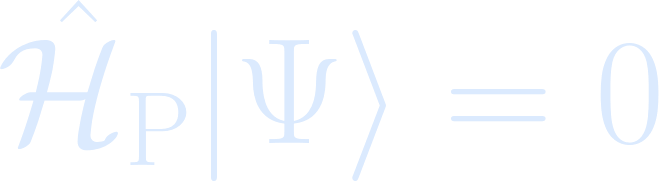
Symbols & Operators — Step 4
Tap any symbol to expand its meaning
Primordial Hamiltonian constraint or generator.
Universal primordial state.
Greek letters: Ψ (Psi)
Constraint statement; unlike a usual energy equation, it may express gauge invariance or timelessness.
Indicates that ℋ is an operator acting on quantum states.
Greek letter key:Ψ = Psi
The equation says the whole quantum state obeys a rule, even before there is an ordinary clock.
Stability Classification of the Initial State
◇Candidate mechanism under active scientific investigationThe initial state must be identified as stable, metastable, degenerate, marginal, or unstable.

Symbols & Operators — Step 5
Tap any symbol to expand its meaning
Hamiltonian operator controlling quantum evolution.
Initial state.
Greek letters: Ψ (Psi)
Energy eigenvalue. Lower values usually indicate greater stability, subject to the theory.
Eigenvalue relation: operating with Ĥ reproduces the same state multiplied by E₀.
Greek letter key:Ψ = Psi
A perfectly stable starting state stays the same unless the theory contains some additional reason for change.
Exact-Ground-State Obstruction
✓Established physics or standard mathematical frameworkOrdinary unitary evolution preserves a nondegenerate energy eigenstate up to an unobservable overall phase.

Symbols & Operators — Step 6
Tap any symbol to expand its meaning
The initial state after evolution parameter t.
Greek letters: Ψ (Psi)
Base of the exponential.
Imaginary phase rotation; it changes phase but not ordinary expectation values of a stationary state.
Energy eigenvalue; larger E₀ makes the phase rotate faster.
Evolution parameter; increasing t increases accumulated phase.
Reduced Planck constant, setting the quantum action scale.
Division operator, scaling phase by ℏ.
Greek letter key:Ψ = Psi
The state’s mathematical “clock hand” turns, but nothing measurable changes.
Nonzero Transition Amplitude
†Currently unresolved theoretical bridgeA viable pathway requires a nonzero amplitude connecting the initial and a distinguishable final configuration.

Symbols & Operators — Step 7
Tap any symbol to expand its meaning
Transition amplitude from state 0 to state i; its squared magnitude contributes to probability.
Direction of the proposed transition.
Final-state bra.
Greek letters: Ψ (Psi)
Evolution or transition operator.
Initial state.
Greek letters: Ψ (Psi)
Requirement that the pathway is not forbidden.
Greek letter key:Ψ = Psi
There must be a nonzero quantum chance for the starting condition to become something else.
Semiclassical Tunneling Candidate
◇Candidate mechanism under active scientific investigationA metastable primordial configuration could decay through a Euclidean bounce or related nonperturbative process.

Symbols & Operators — Step 8
Tap any symbol to expand its meaning
Decay rate; larger Γ means a faster transition.
Greek letters: Γ (Gamma)
Approximate proportionality rather than exact equality.
Prefactor from fluctuations and dimensional scales; increasing A increases the rate linearly.
Exponential base.
Suppression exponent. Larger B makes tunneling exponentially rarer; larger ℏ weakens suppression.
Euclidean action difference associated with the bounce.
Quantum action scale.
Greek letter key:Γ = Gamma
A larger barrier makes the jump much less likely; a smaller barrier makes it easier.
Dynamical Instability Candidate
◇Candidate mechanism under active scientific investigationAn unstable mode can amplify microscopic fluctuations into a distinguishable configuration.

Symbols & Operators — Step 9
Tap any symbol to expand its meaning
Amplitude of a small perturbation in mode k.
Greek letters: δ (delta)
Proportionality symbol.
Exponential growth base.
Magnitude of an imaginary or unstable-mode frequency; larger values produce faster growth.
Greek letters: ω (omega)
Relational or effective evolution parameter; increasing τ increases amplification.
Greek letters: τ (tau)
Ensure a positive growth rate is used.
Greek letter key:δ = delta · ω = omega · τ = tau
Like a ball balanced on top of a hill, a tiny disturbance can grow quickly.
Initial Quantum Excitation at t = 0
★Loftus foundational or metaphysical postulateThe Loftus model defines t = 0 as the boundary at which the first physically distinguishable excitation and relational change occur.

Symbols & Operators — Step 10
Tap any symbol to expand its meaning
Unexcited foundational state.
Greek letters: Ψ (Psi)
Represents the proposed transition; it is not itself a mechanism.
Excited primordial state with at least one changed observable or correlation.
Greek letters: Ψ (Psi)
Labels the state as excited.
Greek letter key:Ψ = Psi
The starting quantum reality undergoes its first real change.
Excitation, Correlation, and Relational Time
Basis Expansion of the Excited State
✓◇Established mechanism applied speculatively to primordial cosmologyThe excited state can be decomposed into amplitudes for accessible primordial configurations.

Symbols & Operators — Step 11
Tap any symbol to expand its meaning
Excited state.
Greek letters: Ψ (Psi)
Sum over all basis configurations α; adding more basis states enlarges the represented possibilities.
Greek letters: Σ (Sigma), α (alpha)
Complex amplitude; larger magnitude gives greater weight, while phase affects interference.
Greek letters: α (alpha)
Basis state labeled by α.
Greek letters: α (alpha)
Equality between the total state and its basis expansion.
Greek letter key:Ψ = Psi · Σ = Sigma · α = alpha
The excited state may contain many possibilities at once, each with its own quantum weight.
Relative Quantum Phases
✓Established physics or standard mathematical frameworkComplex amplitudes carry phases that determine constructive and destructive interference.

Symbols & Operators — Step 12
Tap any symbol to expand its meaning
Complex amplitude of configuration α.
Greek letters: α (alpha)
Magnitude; its square influences probability weight.
Greek letters: α (alpha)
Exponential base.
Imaginary unit; produces phase rotation.
Relative phase angle; changing it changes interference with other amplitudes.
Greek letters: θ (theta), α (alpha)
Polar decomposition of a complex number.
Greek letter key:α = alpha · θ = theta
Two possibilities can reinforce or cancel each other depending on their phase.
Interaction Activation
✓◇Established mechanism applied speculatively to primordial cosmologyNonlinear terms permit energy and amplitude transfer among primordial degrees of freedom.

Symbols & Operators — Step 13
Tap any symbol to expand its meaning
Full Hamiltonian.
Free or uncoupled part; controls independent mode behavior.
Addition combines free and interacting dynamics.
Interaction term; stronger coupling increases scattering, entanglement, and energy transfer.
One part describes how things behave alone; the other describes how they affect each other.
Entanglement Formation
✓Established physics or standard mathematical frameworkInteractions generically produce nonseparable correlations between subsystems.

Symbols & Operators — Step 14
Tap any symbol to expand its meaning
Joint quantum state.
Greek letters: Ψ (Psi)
States that the joint state cannot be written as a simple product.
State of subsystem A.
Greek letters: ψ (psi)
Tensor-product operator combining independent subsystem state spaces.
State of subsystem B.
Greek letters: ψ (psi)
Greek letter key:Ψ = Psi · ψ = psi
The parts become linked so that describing one fully requires information about the other.
Reduced State and Entanglement Entropy
✓Established physics or standard mathematical frameworkA subsystem acquires a mixed reduced state when unobserved degrees of freedom are traced out.

Symbols & Operators — Step 15
Tap any symbol to expand its meaning
Von Neumann entropy of subsystem A; larger values generally indicate stronger mixedness or entanglement for a pure global state.
Ensures the entropy is nonnegative because logarithms of probabilities are nonpositive.
Trace operator, summing diagonal contributions over the subsystem state space.
Reduced density operator of A.
Greek letters: ρ (rho)
Natural logarithm; weights small eigenvalues strongly.
Specify that the logarithm acts on ρA.
Greek letter key:ρ = rho
It tells us how mixed or quantum-linked one part is with everything else.
Relational Clock Decomposition
◇Candidate mechanism under active scientific investigationA subsystem may act as a clock relative to another subsystem.

Symbols & Operators — Step 16
Tap any symbol to expand its meaning
Total state space.
Approximate equivalence; exact factorization may fail in constrained systems.
Clock subsystem Hilbert space.
Tensor product combining clock and system spaces.
System Hilbert space whose evolution is described relative to the clock.
Instead of an outside clock, one quantum part measures change in another.
Conditional Relational State
◇Candidate mechanism under active scientific investigationConditioning on a clock reading produces an effective evolving state for the remaining degrees of freedom.

Symbols & Operators — Step 17
Tap any symbol to expand its meaning
Conditional system state when the clock reads τ.
Greek letters: ψ (psi), τ (tau)
Proportionality; normalization is required afterward.
Clock-state bra selecting reading τ.
Greek letters: τ (tau)
Global constrained state.
Greek letters: Ψ (Psi)
Internal clock value; changing τ labels relational evolution.
Greek letters: τ (tau)
Greek letter key:ψ = psi · τ = tau · Ψ = Psi
Choose a clock value, and the equation tells you the corresponding state of everything else.
Dynamical Entangled Primordial State
◇Candidate mechanism under active scientific investigationThe excited state now possesses interactions, correlations, internal ordering, and nontrivial mode occupation.

Symbols & Operators — Step 18
Tap any symbol to expand its meaning
Connected correlation between A and B; zero means no connected two-point correlation.
Joint expectation value.
Subtracts the product of independent averages.
What the joint average would contain if correlations were absent.
Indicate quantum observables.
It checks whether two quantum features are truly linked.
Collective Pre-Geometry and Semiclassical Spacetime
Spectral Decomposition of Primordial Modes
✓◇Established mechanism applied speculatively to primordial cosmologyThe quadratic kernel is diagonalized to identify independent or unstable collective modes.

Symbols & Operators — Step 19
Tap any symbol to expand its meaning
Quadratic kernel or linearized operator.
Eigenmode n.
Eigenvalue controlling stiffness, frequency, or stability; negative values may indicate instability.
Greek letters: λ (lambda)
Eigenvalue relation.
Greek letter key:λ = lambda
It identifies the basic patterns the quantum system can support.
Occupation-Number Growth
✓◇Established mechanism applied speculatively to primordial cosmologySelected bosonic or collective modes can become highly populated.
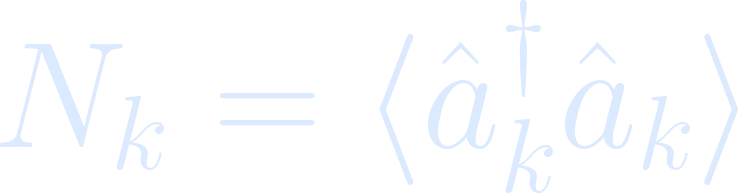
Symbols & Operators — Step 20
Tap any symbol to expand its meaning
Mean occupation number of mode k; larger values mean more quanta in that mode.
Creation operator.
Annihilation operator.
Number operator for the mode.
Expectation value in the quantum state.
It tells us how many quantum excitations occupy a particular pattern.
Bose Enhancement
✓Established physics or standard mathematical frameworkFor bosonic modes, existing occupation stimulates further population.

Symbols & Operators — Step 21
Tap any symbol to expand its meaning
Transition rate adding one boson to a mode.
Greek letters: Γ (Gamma)
Proportionality.
Current occupation number; larger N increases the rate.
Spontaneous contribution present even when N = 0.
Transition from N to N + 1 particles.
Greek letter key:Γ = Gamma
The more bosons already in one mode, the easier it is for another to join.
Condensate Order Parameter
◇Candidate mechanism under active scientific investigationA collective state may develop a nonzero macroscopic expectation value.
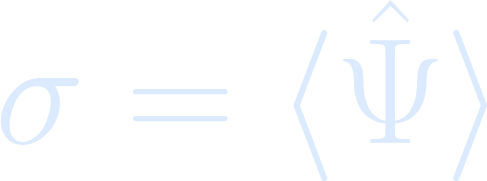
Symbols & Operators — Step 22
Tap any symbol to expand its meaning
Condensate order parameter; larger magnitude indicates stronger coherent collective occupation.
Greek letters: σ (sigma)
Definition.
Expectation value of the fundamental field operator.
Greek letters: Ψ (Psi)
Marks Ψ as an operator before averaging.
Greek letter key:σ = sigma · Ψ = Psi
Many microscopic quanta act together as one large-scale field.
Coarse-Grained Volume Observable
◇Candidate mechanism under active scientific investigationCollective quanta may define an effective volume before a smooth metric is available.
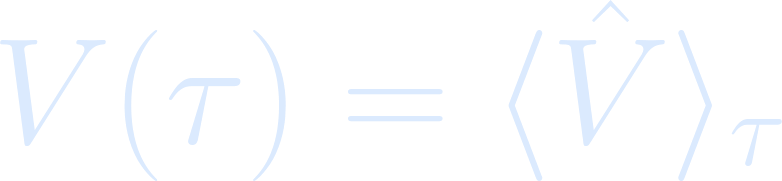
Symbols & Operators — Step 23
Tap any symbol to expand its meaning
Relational volume at clock reading τ.
Greek letters: τ (tau)
Quantum volume operator.
Conditional expectation value at relational time τ.
Greek letters: τ (tau)
Internal clock variable; changing it traces effective expansion or contraction.
Greek letters: τ (tau)
Greek letter key:τ = tau
It tracks how the universe-like volume changes using an internal quantum clock.
Semiclassical Branch Formation
◇Candidate mechanism under active scientific investigationThe universal state becomes concentrated around approximately classical field and geometric trajectories.

Symbols & Operators — Step 24
Tap any symbol to expand its meaning
Semiclassical wave function.
Greek letters: Ψ (Psi)
Approximate form.
Slowly varying amplitude.
Exponential base.
Rapidly varying phase determined by action S.
Hamilton-Jacobi action; its gradients define classical momenta.
Controls the semiclassical expansion; small ℏ relative to the action strengthens the approximation.
Greek letter key:Ψ = Psi
The wave function begins to behave like a bundle of classical histories.
Reduced Density Matrix and Decoherence
✓◇Established mechanism applied speculatively to primordial cosmologyEnvironmental correlations suppress observable interference among macroscopically different branches.

Symbols & Operators — Step 25
Tap any symbol to expand its meaning
Reduced density matrix of the retained system.
Greek letters: ρ (rho)
Partial trace over environmental degrees of freedom.
Full density matrix.
Greek letters: ρ (rho)
Definition of the reduced state.
Greek letter key:ρ = rho
The environment hides the quantum overlap between different macroscopic possibilities.
Semiclassical Spacetime Metric
✓◇Established mechanism applied speculatively to primordial cosmologyA smooth metric becomes a valid coarse-grained description of one branch.

Symbols & Operators — Step 26
Tap any symbol to expand its meaning
Squared spacetime interval.
Temporal contribution; c converts time to length units.
Scale factor; increasing a expands physical separations between comoving points.
Spatial line element with curvature label k.
Greek letters: Σ (Sigma)
Combines temporal and spatial contributions.
Spatial-curvature index; positive, zero, or negative curvature changes geometry.
Greek letter key:Σ = Sigma
It is the standard mathematical picture of expanding space.
Quantum Fields, Stress-Energy, and Backreaction
Field Decomposition into Background and Perturbations
✓◇Established mechanism applied speculatively to primordial cosmology✓◇ A macroscopic background is separated from quantum fluctuations.

Symbols & Operators — Step 27
Tap any symbol to expand its meaning
Full quantum field operator.
Greek letters: φ (phi)
Homogeneous background expectation value.
Greek letters: φ (phi)
Adds background and fluctuations.
Quantum perturbation; larger amplitude means stronger inhomogeneity.
Greek letters: δ (delta), φ (phi)
Spatial position.
Time parameter on the semiclassical branch.
Greek letter key:φ = phi · δ = delta
Think of a calm ocean level plus waves on top.
Scalar-Field Energy Density
✓Established physics or standard mathematical frameworkKinetic, gradient, and potential contributions determine the field’s gravitational energy density.

Symbols & Operators — Step 28
Tap any symbol to expand its meaning
Scalar-field energy density; larger values increase gravitational sourcing.
Greek letters: ρ (rho), φ (phi)
Normalization factor for quadratic kinetic and gradient terms.
Time-kinetic energy; faster field motion increases energy and usually raises pressure.
Greek letters: φ (phi)
Spatial-gradient energy; larger inhomogeneity raises energy and resists homogeneous inflation.
Greek letters: φ (phi)
Scale-factor suppression of physical gradients; larger a reduces gradient energy.
Potential energy; if dominant, it can produce vacuum-like pressure.
Greek letters: φ (phi)
Adds distinct positive energy contributions.
Greek letter key:ρ = rho · φ = phi
A field stores energy by moving, by being uneven, and by sitting high on its potential.
Scalar-Field Pressure
✓Established physics or standard mathematical frameworkThe same energy components combine with different signs to determine effective pressure.

Symbols & Operators — Step 29
Tap any symbol to expand its meaning
Effective scalar-field pressure.
Greek letters: φ (phi)
Kinetic contribution; larger motion raises pressure.
Greek letters: φ (phi)
Averaged gradient contribution; enters with a negative sign under isotropic averaging.
Greek letters: φ (phi)
Potential contribution; a larger potential makes pressure more negative.
Greek letters: φ (phi)
Factor from isotropic averaging of spatial gradients.
Greek letter key:φ = phi
If the field is mostly stored potential energy, it can act like negative pressure.
Renormalized Stress-Energy Source
✓Established physics or standard mathematical frameworkQuantum-field energy must be regularized and renormalized before sourcing semiclassical gravity.

Symbols & Operators — Step 30
Tap any symbol to expand its meaning
Einstein tensor describing spacetime curvature.
Greek letters: μ (mu), ν (nu)
Cosmological-constant contribution.
Greek letters: Λ (Lambda), μ (mu), ν (nu)
Equates geometry to quantum stress-energy source.
Gravitational coupling; larger G strengthens curvature response, while larger c suppresses it strongly.
Greek letters: π (pi)
Renormalized expectation value of quantum stress-energy.
Greek letters: μ (mu), ν (nu)
Spacetime tensor indices specifying components.
Greek letters: μ (mu), ν (nu)
Greek letter key:μ = mu · ν = nu · Λ = Lambda · π = pi
Quantum matter shapes gravity through its average energy and stresses.
Stress-Energy Fluctuation Criterion
✓◇Established mechanism applied speculatively to primordial cosmologySemiclassical gravity is most credible when stress-energy fluctuations are controlled.
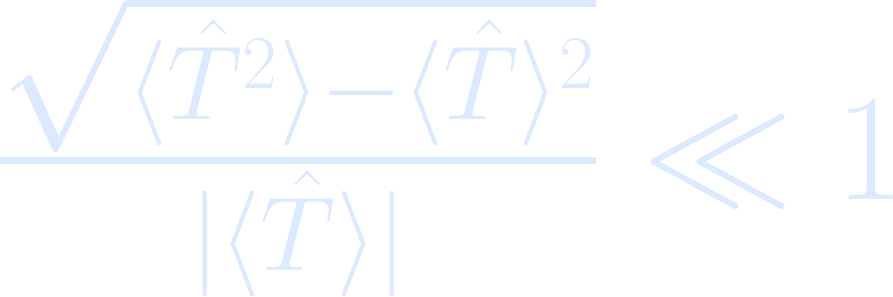
Symbols & Operators — Step 31
Tap any symbol to expand its meaning
Root-mean-square fluctuation of stress-energy.
Second moment.
Subtracts the squared mean to form the variance.
Magnitude of the mean stress-energy.
Requirement that relative fluctuations are much smaller than the mean.
Prevent sign of the mean from affecting the ratio.
A smooth spacetime approximation works best when quantum energy is not wildly fluctuating.
Self-Consistent Backreaction Loop
✓◇Established mechanism applied speculatively to primordial cosmologyThe quantum state and geometry must be solved together rather than sequentially assumed.

Symbols & Operators — Step 32
Tap any symbol to expand its meaning
Initial quantum state.
Greek letters: Ψ (Psi)
State determines its stress-energy expectation value.
Mean energy, momentum, pressure, and stress.
Greek letters: μ (mu), ν (nu)
Stress-energy determines geometry.
Spacetime metric.
Greek letters: μ (mu), ν (nu)
Geometry changes field evolution, producing a new state Ψ′.
Labels the updated state.
Greek letter key:Ψ = Psi · μ = mu · ν = nu
Matter shapes space, and reshaped space changes matter.
Energy Concentration and the Primordial Plasma-Like Domain
Gravitational Focusing of Positive Energy
✓◇Established mechanism applied speculatively to primordial cosmologyPositive-energy matter and radiation generally focus causal trajectories and can promote contraction.

Symbols & Operators — Step 33
Tap any symbol to expand its meaning
Ricci curvature tensor.
Greek letters: μ (mu), ν (nu)
Null tangent vector.
Greek letters: μ (mu)
Curvature experienced along a null direction.
Greek letters: μ (mu), ν (nu)
Null convergence condition associated with focusing under classical assumptions.
Einstein summation over spacetime components.
Greek letter key:μ = mu · ν = nu
Gravity tends to pull energy together rather than make it inflate.
Energy-Density Growth During Compression
✓◇Established mechanism applied speculatively to primordial cosmologyContraction raises density and interaction rates.
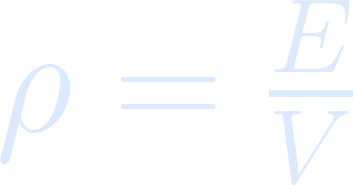
Symbols & Operators — Step 34
Tap any symbol to expand its meaning
Energy density.
Greek letters: ρ (rho)
Total energy in the region; increasing E raises density if volume is fixed.
Division.
Physical volume; decreasing V raises density if energy is conserved.
Greek letter key:ρ = rho
Compressing energy makes it more concentrated.
Relativistic Plasma Equation of State
✓Established physics or standard mathematical frameworkAn approximately thermal ultrarelativistic plasma has positive pressure.

Symbols & Operators — Step 35
Tap any symbol to expand its meaning
Radiation or ultrarelativistic pressure.
Equation-of-state factor in three spatial dimensions.
Relativistic mass-equivalent density.
Greek letters: ρ (rho)
Converts mass density to energy density units.
Defines the idealized radiation equation of state.
Greek letter key:ρ = rho
A hot plasma pushes outward, but it does not have the negative pressure needed to inflate space.
Thermalization Criterion
✓◇Established mechanism applied speculatively to primordial cosmologyInteraction rates must exceed expansion or contraction rates for local equilibrium to develop.

Symbols & Operators — Step 36
Tap any symbol to expand its meaning
Microscopic interaction rate; larger values promote equilibrium.
Greek letters: Γ (Gamma)
Much greater than.
Macroscopic expansion rate; larger H makes equilibrium harder to maintain.
Greek letter key:Γ = Gamma
Collisions must happen quickly enough for the plasma to settle into a common temperature.
Ultra-High-Energy Primordial Plasma Core
★Loftus foundational or metaphysical postulateThe Loftus model proposes a compact, self-gravitating, pre-stellar plasma-like domain.

Symbols & Operators — Step 37
Tap any symbol to expand its meaning
Proposed core energy density.
Greek letters: ρ (rho)
Much greater than.
Reference density of familiar astrophysical matter or plasma.
Greek letters: ρ (rho)
Identifies the hypothetical primordial domain.
Greek letter key:ρ = rho
It would be far more primitive and extreme than a normal star.
Critical Regime and Plasma-to-Vacuum Transition
Temperature-Dependent Effective Potential
✓◇Established mechanism applied speculatively to primordial cosmologyThermal and quantum corrections reshape the field potential at extreme energy.

Symbols & Operators — Step 38
Tap any symbol to expand its meaning
Effective potential governing the field in a thermal environment.
Order-parameter or scalar-field value.
Greek letters: φ (phi)
Temperature; changing T can move minima and barriers.
Zero-temperature potential.
Adds thermal corrections.
Temperature-dependent correction; its sign and size determine symmetry restoration or new phases.
Greek letters: Δ (Delta)
Greek letter key:φ = phi · Δ = Delta
At different temperatures, the field may prefer different states.
Symmetry Restoration and Instability
✓◇Established mechanism applied speculatively to primordial cosmologyExtreme temperature can favor a symmetric phase that later becomes unstable.

Symbols & Operators — Step 39
Tap any symbol to expand its meaning
Second derivative of the effective potential; it measures local curvature.
Field value where stability is tested.
Greek letters: φ (phi)
Temperature.
Negative curvature, indicating an unstable direction.
Second derivative with respect to φ.
Greek letter key:φ = phi
The field is balanced on a hill rather than resting in a valley.
Order-Parameter Growth
✓◇Established mechanism applied speculatively to primordial cosmologyAn unstable or nucleated phase develops a macroscopic field value.

Symbols & Operators — Step 40
Tap any symbol to expand its meaning
Quantum expectation value of the field.
Greek letters: φ (phi)
Effective macroscopic order parameter.
Greek letters: φ (phi)
Signals departure from the symmetric zero-value state.
Defines the macroscopic value as the expectation value.
Greek letter key:φ = phi
The system chooses a nonzero state instead of remaining perfectly symmetric.
Potential-Energy Domination
✓◇Established mechanism applied speculatively to primordial cosmologyThe coherent field must dominate over kinetic, gradient, and thermal components.

Symbols & Operators — Step 41
Tap any symbol to expand its meaning
Potential energy density; larger values strengthen vacuum-like behavior.
Greek letters: φ (phi)
Much greater than.
Kinetic energy density; larger values weaken negative pressure.
Greek letters: φ (phi)
Gradient energy; larger inhomogeneity obstructs smooth inflation.
Greek letters: φ (phi)
Separates two simultaneous conditions.
Scale factor; larger a suppresses physical gradient energy.
Greek letter key:φ = phi
The field must be mostly “stored energy,” not fast movement or rough spatial variation.
Vacuum-Like Equation of State
✓Established physics or standard mathematical frameworkPotential domination produces negative pressure approximately equal in magnitude to the energy density.
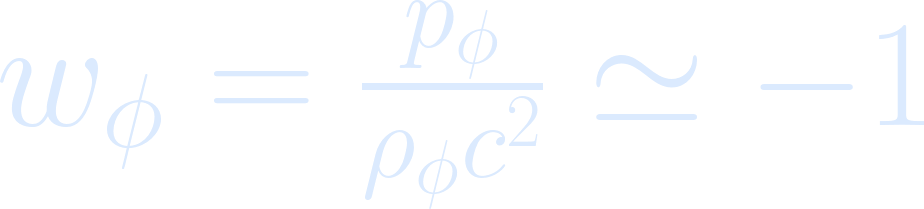
Symbols & Operators — Step 42
Tap any symbol to expand its meaning
Equation-of-state parameter.
Greek letters: φ (phi)
Field pressure.
Greek letters: φ (phi)
Field energy density in pressure units.
Greek letters: ρ (rho), φ (phi)
Forms a dimensionless ratio.
Approximately equal.
Vacuum-like value; values below -1/3 permit accelerated expansion in standard GR.
Greek letter key:φ = phi · ρ = rho
The field behaves like vacuum energy rather than ordinary matter or radiation.
Vacuum-Dominated State
✓◇Established mechanism applied speculatively to primordial cosmologyVacuum-like field energy exceeds all competing components.

Symbols & Operators — Step 43
Tap any symbol to expand its meaning
Vacuum-like energy density.
Greek letters: ρ (rho)
Must exceed the combined competing densities.
Radiation density.
Greek letters: ρ (rho)
Matter density.
Greek letters: ρ (rho)
Gradient-energy density.
Greek letters: ρ (rho)
Anisotropic shear contribution.
Greek letters: ρ (rho)
Adds competing components.
Greek letter key:ρ = rho
The negative-pressure field has to outweigh radiation, matter, and unevenness.
Vacuum Domination to Inflation
Friedmann Expansion Constraint
✓Established physics or standard mathematical frameworkThe total energy density sets the Hubble expansion rate for an FLRW universe.
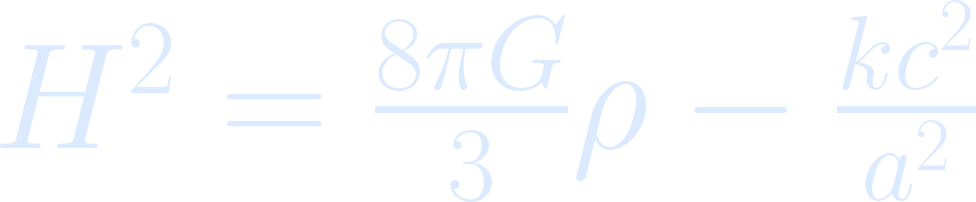
Symbols & Operators — Step 44
Tap any symbol to expand its meaning
Hubble parameter; larger H means faster fractional expansion.
Expansion-rate magnitude squared.
Gravitational coupling factor.
Greek letters: π (pi)
Total energy density; increasing ρ generally raises H².
Greek letters: ρ (rho)
Spatial-curvature contribution; sign depends on k and magnitude decreases as a grows.
Scale factor.
Curvature index.
Greek letter key:π = pi · ρ = rho
It tells how fast the universe can expand based on what energy and curvature it contains.
Acceleration Equation
✓Established physics or standard mathematical frameworkPressure as well as density determines whether expansion accelerates or decelerates.

Symbols & Operators — Step 45
Tap any symbol to expand its meaning
Fractional acceleration of the scale factor.
Negative gravitational coefficient.
Greek letters: π (pi)
Energy density.
Greek letters: ρ (rho)
Pressure; positive pressure increases deceleration, sufficiently negative pressure reverses the sign.
Relativistic pressure contribution to active gravitational mass.
Group density and pressure into the active gravitational combination.
Greek letter key:π = pi · ρ = rho
Ordinary matter slows expansion, but strong negative pressure can speed it up.
Inflationary Threshold
✓Established physics or standard mathematical frameworkAccelerated expansion begins when the Hubble slow-roll parameter falls below unity.
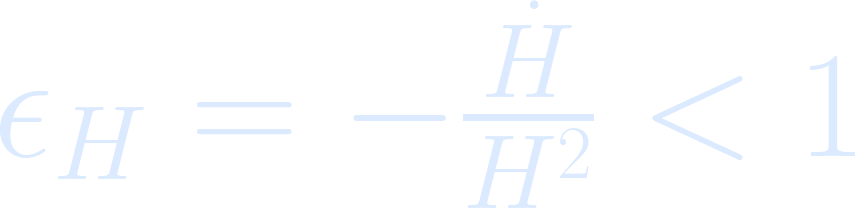
Symbols & Operators — Step 46
Tap any symbol to expand its meaning
First Hubble slow-roll parameter.
Greek letters: ε (epsilon)
Makes εH positive when H decreases slowly.
Time derivative of H; more negative Ḣ raises εH.
Normalizes the rate of change by the expansion scale.
Exact condition for ä > 0 in standard FLRW dynamics.
Greek letter key:ε = epsilon
The universe must expand faster and faster, not merely expand.
Scalar-Field Evolution with Hubble Damping
✓Established physics or standard mathematical frameworkThe expanding background damps the field’s motion.

Symbols & Operators — Step 47
Tap any symbol to expand its meaning
Field acceleration.
Greek letters: φ (phi)
Hubble damping term; larger H slows field motion more strongly.
Greek letters: φ (phi)
Derivative of the potential; steeper slope drives faster rolling.
Greek letters: φ (phi)
Combines acceleration, damping, and force terms.
Equation of motion balance.
Greek letter key:φ = phi
Expansion acts like friction on the field’s motion.
Slow-Roll Approximation
✓◇Established mechanism applied speculatively to primordial cosmologyA slowly varying field keeps the vacuum-like energy density nearly constant.

Symbols & Operators — Step 48
Tap any symbol to expand its meaning
Hubble friction acting on field velocity.
Greek letters: φ (phi)
Approximate equality.
Downhill force from the potential.
Greek letters: φ (phi)
Larger H reduces |φ̇| for a fixed slope.
Steeper potential increases field speed.
Greek letters: φ (phi)
Greek letter key:φ = phi
The field rolls slowly because cosmic expansion resists its motion.
Quasi-Exponential Expansion
✓Established physics or standard mathematical frameworkNearly constant H integrates to exponential scale-factor growth.

Symbols & Operators — Step 49
Tap any symbol to expand its meaning
Scale factor at time t.
Initial scale factor.
Exponential function.
Integral accumulating the expansion rate over time.
Time-dependent Hubble rate.
Infinitesimal integration element.
Specify the interval of accumulated expansion.
A nearly constant H makes the universe’s size grow extremely rapidly.
Number of E-Folds
✓Established physics or standard mathematical frameworkInflationary duration is measured logarithmically by the growth of the scale factor.

Symbols & Operators — Step 50
Tap any symbol to expand its meaning
Number of e-folds; larger N means exponentially more expansion.
Natural logarithm.
Final-to-initial scale-factor ratio.
Equates logarithmic growth with integrated Hubble expansion.
Accumulates H over the inflationary interval.
Beginning and end times of inflation.
It is a convenient way to count enormous expansion.
Shrinking Comoving Hubble Radius
✓Established physics or standard mathematical frameworkInflation makes the comoving Hubble scale decrease.
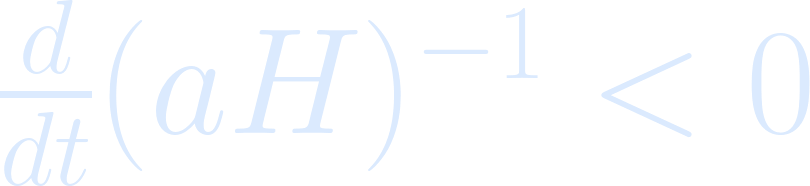
Symbols & Operators — Step 51
Tap any symbol to expand its meaning
Time-derivative operator.
Comoving Hubble radius.
Scale factor; rapid growth drives the quantity downward.
Hubble rate.
States that the comoving Hubble radius decreases.
Quantum wavelengths can be stretched outside the region that communicates within one Hubble time.
Inflation
✓◇Established mechanism applied speculatively to primordial cosmologySustained accelerated metric expansion is established.

Symbols & Operators — Step 52
Tap any symbol to expand its meaning
Second time derivative of the scale factor; positive means acceleration.
Expansion acceleration condition.
Both conditions must hold.
Hubble rate.
Selects an expanding rather than contracting branch.
Space itself grows faster and faster.
Quantum Perturbations and the Seeds of Structure
Mode Decomposition of Perturbations
✓Established physics or standard mathematical frameworkField fluctuations are resolved into comoving Fourier modes.

Symbols & Operators — Step 53
Tap any symbol to expand its meaning
Field perturbation in position space.
Greek letters: δ (delta), φ (phi)
Integral over all wavevectors.
Three-dimensional momentum-space volume element.
Fourier normalization.
Greek letters: π (pi)
Amplitude of mode k.
Greek letters: δ (delta), φ (phi)
Plane-wave basis function.
Dot product setting spatial phase.
Greek letter key:δ = delta · φ = phi · π = pi
Any complicated ripple can be built from simpler waves.
Horizon Crossing
✓Established physics or standard mathematical frameworkA mode crosses the Hubble scale when its physical wavelength matches the Hubble radius.

Symbols & Operators — Step 54
Tap any symbol to expand its meaning
Comoving wavenumber; larger k means shorter comoving wavelength.
Scale factor.
Hubble parameter.
Comoving Hubble wavenumber.
Defines horizon-crossing condition.
The expanding universe stretches the wave beyond the Hubble distance.
Curvature-Perturbation Power Spectrum
✓◇Established mechanism applied speculatively to primordial cosmologyInflation predicts statistical amplitudes for primordial curvature fluctuations.

Symbols & Operators — Step 55
Tap any symbol to expand its meaning
Dimensionless power spectrum at wavenumber k.
Phase-space scaling; emphasizes shorter wavelengths before normalization.
Fourier normalization factor.
Greek letters: π (pi)
Squared magnitude of the curvature-perturbation mode.
Remove complex phase from the power.
Greek letter key:π = pi
It tells us how much “seed structure” exists for different wavelengths.
Conservation of Super-Hubble Curvature Perturbation
✓◇Established mechanism applied speculatively to primordial cosmologyFor adiabatic perturbations, the curvature perturbation is approximately conserved outside the Hubble radius.

Symbols & Operators — Step 56
Tap any symbol to expand its meaning
Comoving curvature perturbation.
Time derivative.
Approximately constant in time.
Requires adiabaticity and negligible nonadiabatic pressure on super-Hubble scales.
The early-universe pattern can survive until much later cosmic times.
End of Inflation, Preheating, and Reheating
End-of-Inflation Condition
✓Established physics or standard mathematical frameworkInflation terminates when accelerated expansion ceases.

Symbols & Operators — Step 57
Tap any symbol to expand its meaning
Hubble slow-roll parameter.
Greek letters: ε (epsilon)
Approaches. Boundary between accelerated and decelerated expansion.
Greek letter key:ε = epsilon
The universe no longer expands with increasing acceleration.
Coherent Inflaton Oscillation
✓◇Established mechanism applied speculatively to primordial cosmologyThe field may oscillate around a lower-energy minimum after inflation.

Symbols & Operators — Step 58
Tap any symbol to expand its meaning
Field acceleration.
Greek letters: φ (phi)
Expansion damping.
Greek letters: φ (phi)
Restoring force near a quadratic minimum.
Greek letters: φ (phi)
Effective inflaton mass; larger mass increases oscillation frequency.
Greek letters: φ (phi)
Dynamical balance.
Greek letter key:φ = phi
Like a spring losing energy, the field oscillates and gradually transfers energy elsewhere.
Parametric Resonance
✓◇Established mechanism applied speculatively to primordial cosmologyOscillations can nonperturbatively amplify coupled particle modes.

Symbols & Operators — Step 59
Tap any symbol to expand its meaning
Mode amplitude of a field coupled to the inflaton.
Greek letters: χ (chi)
Second time derivative.
Greek letters: χ (chi)
Time-dependent effective frequency; periodic variation can create resonance bands.
Greek letters: ω (omega)
Mode equation.
Momentum-mode label.
Greek letter key:χ = chi · ω = omega
The oscillating field can amplify other fields like pushing a swing at the right rhythm.
Perturbative Decay Rate
✓◇Established mechanism applied speculatively to primordial cosmologyResidual coherent field energy can decay into particles through ordinary interaction vertices.

Symbols & Operators — Step 60
Tap any symbol to expand its meaning
Inflaton decay rate.
Greek letters: Γ (Gamma), φ (phi)
Greater than or comparable to.
Expansion rate.
When decay becomes at least as fast as expansion, energy transfer becomes efficient.
Greek letter key:Γ = Gamma · φ = phi
Particle production wins once decay happens faster than cosmic dilution.
Radiation-Energy Evolution
✓Established physics or standard mathematical frameworkProduced radiation gains energy from decay while losing energy to expansion.

Symbols & Operators — Step 61
Tap any symbol to expand its meaning
Rate of change of radiation density.
Greek letters: ρ (rho)
Dilution and redshift of radiation in an expanding universe.
Greek letters: ρ (rho)
Source term from field decay.
Greek letters: Γ (Gamma), φ (phi), ρ (rho)
Remaining coherent-field energy density.
Greek letters: ρ (rho), φ (phi)
Balances loss and production.
Greek letter key:ρ = rho · Γ = Gamma · φ = phi
The universe stretches radiation out, but decays add new radiation.
Kinetic Equilibration
✓◇Established mechanism applied speculatively to primordial cosmologyElastic scattering redistributes momentum toward a thermal form.

Symbols & Operators — Step 62
Tap any symbol to expand its meaning
Elastic-scattering rate.
Greek letters: Γ (Gamma)
Much greater than.
Expansion rate.
Frequent momentum exchange establishes kinetic equilibrium.
Greek letter key:Γ = Gamma
Collisions smooth out how fast particles are moving.
Chemical Equilibration
✓◇Established mechanism applied speculatively to primordial cosmologyNumber-changing reactions establish equilibrium abundances.

Symbols & Operators — Step 63
Tap any symbol to expand its meaning
Inelastic or number-changing reaction rate.
Greek letters: Γ (Gamma)
Much greater than.
Expansion rate.
Reaction network reaches chemical equilibrium before expansion freezes it out.
Greek letter key:Γ = Gamma
The plasma adjusts not only particle speeds but also how many particles of each kind exist.
Radiation Domination and Hot Big Bang Plasma
✓Established physics or standard mathematical frameworkAfter reheating and thermalization, relativistic particles dominate the cosmic energy density.

Symbols & Operators — Step 64
Tap any symbol to expand its meaning
Radiation density.
Greek letters: ρ (rho)
Radiation exceeds remaining coherent-field density.
Residual inflaton or vacuum-like field density.
Greek letters: ρ (rho), φ (phi)
Total pressure.
Radiation-like equation of state.
Greek letters: ρ (rho)
Both domination and equation-of-state conditions are required.
Greek letter key:ρ = rho · φ = phi
This is the familiar hot early universe from which later matter and cosmic structures develop.
Bibliography
Compiled in Chicago style (Notes & Bibliography). Endnotes are given in citation order; the bibliography follows alphabetically with hanging indents.
Notes
- N. D. Birrell and P. C. W. Davies, Quantum Fields in Curved Space (Cambridge: Cambridge University Press, 1982).
- Robert M. Wald, Quantum Field Theory in Curved Spacetime and Black Hole Thermodynamics (Chicago: University of Chicago Press, 1994).
- Viatcheslav Mukhanov, Physical Foundations of Cosmology (Cambridge: Cambridge University Press, 2005).
- Steven Weinberg, Cosmology (Oxford: Oxford University Press, 2008).
- Daniel Baumann, Cosmology (Cambridge: Cambridge University Press, 2022).
- Claus Kiefer, Quantum Gravity, 3rd ed. (Oxford: Oxford University Press, 2012).
- Esteban A. Calzetta and Bei-Lok B. Hu, Nonequilibrium Quantum Field Theory (Cambridge: Cambridge University Press, 2008).
- Leonard Parker and David Toms, Quantum Field Theory in Curved Spacetime: Quantized Fields and Gravity (Cambridge: Cambridge University Press, 2009).
- Edward W. Kolb and Michael S. Turner, The Early Universe (Redwood City, CA: Addison-Wesley, 1990).
- Andrei Linde, Particle Physics and Inflationary Cosmology (Chur, Switzerland: Harwood Academic, 1990).
- Sidney Coleman, “Fate of the False Vacuum: Semiclassical Theory,” Physical Review D 15 (1977): 2929–2936.
- Sidney Coleman and Frank De Luccia, “Gravitational Effects on and of Vacuum Decay,” Physical Review D 21 (1980): 3305–3315.
- Lev Kofman, Andrei Linde, and Alexei A. Starobinsky, “Towards the Theory of Reheating after Inflation,” Physical Review D 56 (1997): 3258–3295.
- Jonathan J. Halliwell, “Introductory Lectures on Quantum Cosmology,” in Quantum Cosmology and Baby Universes, ed. Sidney Coleman et al. (Singapore: World Scientific, 1991).
- Daniele Oriti, “Group Field Theory and Loop Quantum Gravity,” in Loop Quantum Gravity: The First 30 Years, ed. Abhay Ashtekar and Jorge Pullin (Singapore: World Scientific, 2014).
Bibliography
Baumann, Daniel. Cosmology. Cambridge: Cambridge University Press, 2022.
Birrell, N. D., and P. C. W. Davies. Quantum Fields in Curved Space. Cambridge: Cambridge University Press, 1982.
Calzetta, Esteban A., and Bei-Lok B. Hu. Nonequilibrium Quantum Field Theory. Cambridge: Cambridge University Press, 2008.
Coleman, Sidney. “Fate of the False Vacuum: Semiclassical Theory.” Physical Review D 15 (1977): 2929–2936.
Coleman, Sidney, and Frank De Luccia. “Gravitational Effects on and of Vacuum Decay.” Physical Review D 21 (1980): 3305–3315.
Halliwell, Jonathan J. “Introductory Lectures on Quantum Cosmology.” In Quantum Cosmology and Baby Universes, edited by Sidney Coleman, Jonathan B. Hartle, Tsvi Piran, and Steven Weinberg. Singapore: World Scientific, 1991.
Kiefer, Claus. Quantum Gravity. 3rd ed. Oxford: Oxford University Press, 2012.
Kofman, Lev, Andrei Linde, and Alexei A. Starobinsky. “Towards the Theory of Reheating after Inflation.” Physical Review D 56 (1997): 3258–3295.
Kolb, Edward W., and Michael S. Turner. The Early Universe. Redwood City, CA: Addison-Wesley, 1990.
Linde, Andrei. Particle Physics and Inflationary Cosmology. Chur, Switzerland: Harwood Academic, 1990.
Mukhanov, Viatcheslav. Physical Foundations of Cosmology. Cambridge: Cambridge University Press, 2005.
Oriti, Daniele. “Group Field Theory and Loop Quantum Gravity.” In Loop Quantum Gravity: The First 30 Years, edited by Abhay Ashtekar and Jorge Pullin. Singapore: World Scientific, 2014.
Parker, Leonard, and David Toms. Quantum Field Theory in Curved Spacetime: Quantized Fields and Gravity. Cambridge: Cambridge University Press, 2009.
Wald, Robert M. Quantum Field Theory in Curved Spacetime and Black Hole Thermodynamics. Chicago: University of Chicago Press, 1994.
Weinberg, Steven. Cosmology. Oxford: Oxford University Press, 2008.
Authorial Attribution
“God Initiated the First Quantum Excitation” and the identification of the proposed Primordial Quantum Field with God are attributed to Michael Aaron Loftus and are presented as metaphysical hypotheses rather than experimentally established physics.