








What Is SEO and Why Does It Matter in 2026?
Search Engine Optimization (SEO) is the discipline of improving a website's visibility in organic search engine results pages (SERPs). In 2026, SEO has evolved far beyond simple keyword placement — it now encompasses technical performance, user experience, content authority, and alignment with AI-powered search interfaces like Google AI Overviews, ChatGPT, and Perplexity.
According to research from the Harvard Business Review, organic search drives over 53% of all website traffic, making it the single largest channel for digital customer acquisition. Businesses that invest strategically in SEO consistently outperform competitors who rely solely on paid advertising.
The modern SEO landscape demands a holistic approach. Google processes over 8.5 billion searches daily, and the introduction of AI Overviews, zero-click answers, and multimodal search results has fundamentally changed how users interact with search engines. Understanding these shifts is essential for any business aiming to maintain or grow its organic presence.
The Three Pillars of SEO
1. Technical SEO
Technical SEO forms the foundation upon which all other optimization efforts rest. It ensures that search engine crawlers can efficiently discover, crawl, render, and index your website content. Key technical SEO elements include:
- Core Web Vitals (CWV): Google's page experience metrics — Largest Contentful Paint (LCP), Interaction to Next Paint (INP), and Cumulative Layout Shift (CLS) — directly impact rankings. Research from Google's Web.dev shows that sites meeting CWV thresholds see significantly higher engagement rates.
- Site Architecture & Crawlability: A logical URL hierarchy, XML sitemaps, proper internal linking, and efficient robots.txt configuration ensure search engines can access all important pages. Flat site architectures with clear navigation paths reduce crawl depth and improve indexation.
- Mobile-First Indexing: Google predominantly uses the mobile version of content for indexing and ranking. Responsive design, fast mobile load times, and touch-friendly interfaces are now non-negotiable requirements.
- Structured Data & Schema Markup: Implementing Schema.org structured data helps search engines understand content context, enabling rich results like FAQ snippets, review stars, and knowledge panels. Studies from Search Engine Land indicate that pages with structured data receive 20-30% higher click-through rates.
- HTTPS & Security: SSL/TLS encryption is a confirmed ranking signal. Beyond SEO, it builds user trust and is required for modern browser features like geolocation and service workers.
2. On-Page SEO
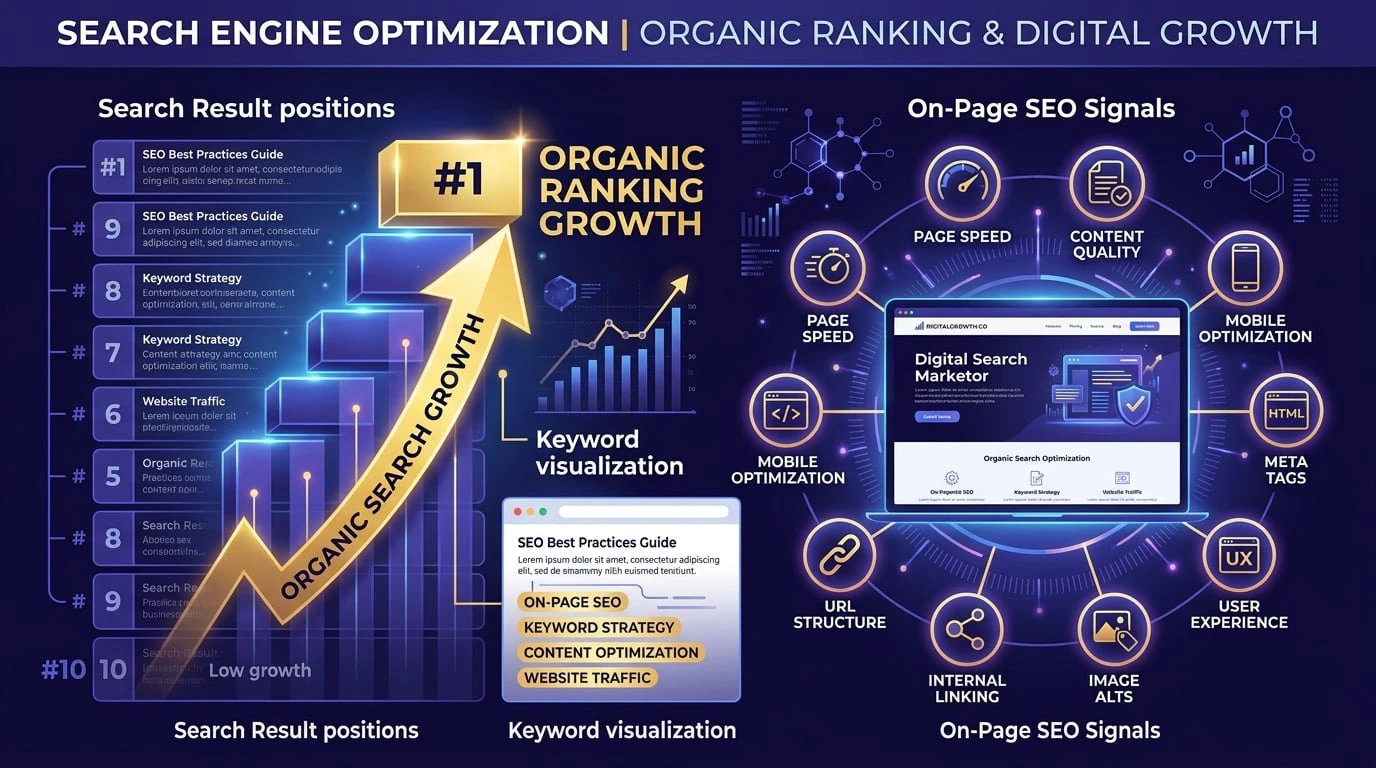
On-page SEO refers to the optimization of individual web pages to rank higher and earn more relevant traffic. It involves both the content itself and the HTML source code. Critical on-page elements include:
- Title Tags & Meta Descriptions: These remain the most impactful on-page elements. Titles should be under 60 characters, include primary keywords naturally, and compel clicks. Meta descriptions should be under 160 characters and serve as compelling ad copy for organic listings.
- Header Hierarchy (H1-H6): A well-structured heading hierarchy helps both users and search engines understand content organization. The H1 should capture the primary topic, while H2s and H3s break content into scannable sections.
- Content Quality & E-E-A-T: Google's Experience, Expertise, Authoritativeness, and Trustworthiness framework is central to content evaluation. Research from Moz demonstrates that content demonstrating firsthand experience and citing authoritative sources consistently outranks thin or generic alternatives.
- Keyword Strategy: Modern keyword strategy goes beyond exact-match placement. Semantic SEO focuses on topic clusters, related entities, and search intent alignment. Tools and methodologies from Ahrefs show that comprehensive content covering a topic's full semantic field ranks for significantly more keywords.
- Internal Linking: Strategic internal links distribute page authority, help search engines discover content, and guide users through conversion funnels. Hub-and-spoke content architectures are particularly effective.
- Image Optimization: Descriptive file names, meaningful alt text, modern formats (WebP/AVIF), lazy loading, and responsive sizing all contribute to both SEO and page performance.
3. Off-Page SEO
Off-page SEO encompasses all optimization activities that occur outside your own website, primarily focused on building authority and trust signals:
- Link Building: High-quality backlinks from authoritative, relevant domains remain one of Google's strongest ranking signals. Research from Backlinko analyzing 11.8 million search results found that the #1 result in Google has an average of 3.8x more backlinks than positions #2-#10.
- Brand Mentions & Digital PR: Even unlinked brand mentions signal authority to search engines. Digital PR campaigns that earn coverage from reputable publications build both brand awareness and domain authority simultaneously.
- Local SEO & Citations: For businesses with physical locations, consistent NAP (Name, Address, Phone) citations across directories, Google Business Profile optimization, and local reviews are essential ranking factors.
- Social Signals: While not direct ranking factors, social media engagement drives traffic, amplifies content reach, and creates opportunities for natural link acquisition.
SEO in the Age of AI Search
The emergence of AI-powered search has introduced new challenges and opportunities for SEO professionals. Google AI Overviews, ChatGPT search, Perplexity, and other AI interfaces now synthesize information from multiple sources to provide direct answers, often reducing click-through rates for traditional organic results.
To succeed in this environment, businesses must optimize for both traditional search and AI citation. This means creating content that is factually accurate, well-structured, and authoritative enough to be referenced by AI systems. Research from the Harvard Business School's Digital Initiative highlights that brands maintaining strong E-E-A-T signals are significantly more likely to be cited in AI-generated answers.
Key strategies for AI search optimization include implementing comprehensive structured data, creating definitive "best answer" content for key queries, ensuring content is machine-readable and well-organized, and building topical authority through content clusters that demonstrate deep expertise.
Measuring SEO Success
Effective SEO requires ongoing measurement and analysis. Key performance indicators include:
- Organic Traffic Growth: Month-over-month and year-over-year increases in sessions from organic search
- Keyword Rankings: Position tracking for target keywords across desktop and mobile
- Conversion Rate: The percentage of organic visitors who complete desired actions
- Domain Authority / Domain Rating: Third-party metrics that estimate a site's overall ranking potential
- Core Web Vitals Scores: Real-user experience data from Chrome UX Report (CrUX)
- Crawl Health: Index coverage, crawl errors, and sitemap status in Google Search Console
- AI Citation Rate: How frequently your brand is referenced in AI-generated search results
Tools like Google Search Console, Google Analytics 4, Ahrefs, Semrush, and Screaming Frog provide the data foundation for comprehensive SEO analysis. Regular audits — ideally quarterly — ensure that technical issues are caught early and strategic adjustments are made based on performance trends.
Common SEO Mistakes to Avoid
Even experienced marketers make SEO errors that can significantly impact performance. The most common mistakes include:
- Ignoring search intent: Creating content that targets keywords without understanding what users actually want leads to high bounce rates and poor rankings. Always analyze the current top-ranking pages to understand the expected content format and depth.
- Neglecting technical foundations: Beautiful content means nothing if search engines cannot efficiently crawl and index it. JavaScript rendering issues, slow page speeds, and broken internal links silently undermine even the best content strategies.
- Chasing algorithm updates reactively: Sites built on solid fundamentals — great content, clean architecture, genuine authority — weather algorithm updates far better than those employing short-term tactics.
- Underinvesting in content maintenance: SEO is not a one-time effort. Content decay, competitive changes, and evolving search intent require ongoing content refreshes and updates to maintain rankings.
- Building low-quality links: Manipulative link schemes violate Google's guidelines and can result in penalties. Focus on earning links through valuable content, genuine relationships, and digital PR.
The Future of SEO: 2026 and Beyond
SEO continues to evolve rapidly. The integration of AI into search, the rise of multimodal queries (combining text, images, and voice), and increasingly sophisticated user experience signals are reshaping the discipline. Businesses that view SEO as a long-term investment in digital presence — rather than a set of technical tricks — will be best positioned for sustainable organic growth.
The convergence of SEO with Answer Engine Optimization (AEO), Generative Engine Optimization (GEO), and AI Optimization (AIO) means that modern search strategy must be holistic, addressing traditional rankings, AI citations, voice search, and visual search simultaneously. Organizations that build genuine expertise, create truly valuable content, and maintain technically excellent websites will thrive regardless of how search technology evolves.