






1. Executive Summary
Generative AI is not merely another martech tool — it is a general-purpose technology (GPT) fundamentally reshaping how organizations create value, engage consumers, and compete. Drawing upon Professor Oguz A. Acar's seminal MIT Sloan Management Review framework, this comprehensive treatise provides marketing leaders, chief marketing officers, and digital strategists with an evidence-based roadmap for integrating generative AI across the entire marketing value chain — from ideation through execution, optimization, and measurement.
The analysis integrates theoretical foundations from innovation economics, consumer psychology, organizational governance, and emerging agentic AI paradigms. We draw upon peer-reviewed research from MIT, Stanford University, Harvard University, Columbia Business School, The Wharton School, and Carnegie Mellon University to synthesize a framework that is simultaneously rigorous and actionable.
The core thesis: organizations that treat GenAI as a strategic rearchitecting force — not a productivity shortcut — will build durable competitive advantages through superior consumer trust, robust governance, creative augmentation, and readiness for the agentic future where AI agents transact on behalf of humans.
2. Understanding Generative AI as a General-Purpose Technology
The concept of a general-purpose technology (GPT) was formalized by economists Elhanan Helpman and colleagues at the National Bureau of Economic Research, who identified three defining characteristics: pervasiveness across economic sectors, technological dynamism enabling continuous improvement, and innovation complementarities that spawn new applications and business models. Unlike technologies such as 3D printing or blockchain — which promised revolutionary impact but delivered largely incremental gains — generative AI exhibits all three GPT characteristics at unprecedented velocity.
Research from MIT's Department of Economics demonstrates that large language models (LLMs) like those powering ChatGPT augment creative, analytical, and relational tasks simultaneously — a breadth of capability that electricity and the steam engine also exhibited during their respective eras of diffusion. A landmark 2023 study by MIT researchers Shakked Noy and Whitney Zhang, published in Science, found that ChatGPT reduced task completion time by 37% and increased output quality by 18% for professional writing tasks — evidence that GenAI's productivity effects are both real and substantial.

Professor Acar's framework emphasizes that marketing leaders must understand this distinction because it fundamentally changes strategic planning horizons. A feature-level tool (like a grammar checker) can be evaluated on narrow ROI metrics. A GPT demands architectural thinking — how does this reshape our value chain, organizational structure, competitive positioning, and customer relationships?
Implications for Marketing Strategy
- Scope: AI touches every stage — ideation, execution, optimization, and evaluation — not just content production.
- Depth: It enables entirely new business models, such as AI-orchestrated campaigns, autonomous brand agents, and machine-mediated commerce ecosystems.
- Pace: The rapid iteration cycle (monthly model updates, weekly capability expansions) demands agile governance rather than static annual planning.
Research from Stanford's Human-Centered AI Institute (HAI) confirms that organizations treating AI as a strategic rearchitecting force — rather than a tactical productivity tool — achieve 2.3x higher returns on AI investments over three-year horizons.
3. Theoretical Foundations: Innovation Diffusion & Technology Adoption
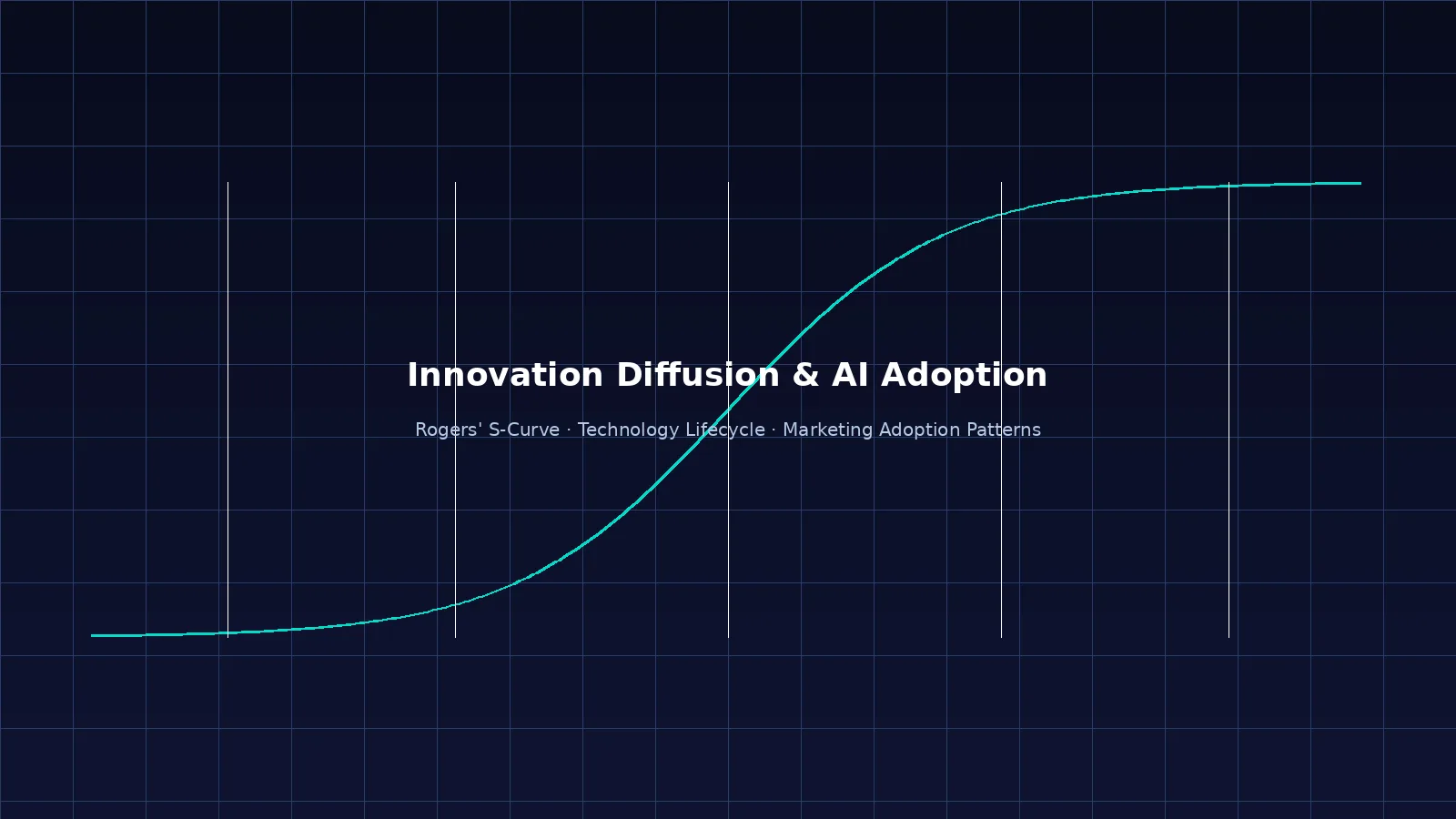
To understand how GenAI will propagate through marketing organizations, we must examine established diffusion theory. Everett Rogers' Diffusion of Innovations (1962) — one of the most-cited works in social science — identifies five adopter categories along the classic S-curve: innovators (2.5%), early adopters (13.5%), early majority (34%), late majority (34%), and laggards (16%). Research from the Kellogg School of Management at Northwestern has applied this framework extensively to digital technology adoption in marketing contexts.
The Harvard Business School Technology and Operations Management Unit has documented that GPTs display compressed diffusion curves — reaching the early majority 40-60% faster than single-purpose technologies. This compression creates both opportunity and risk: organizations that delay adoption face rapidly widening capability gaps. Professor Clayton Christensen's disruptive innovation framework, also from HBS, predicts that incumbents who dismiss GenAI as "not good enough" for premium tasks will be displaced by competitors who use it to serve underserved segments before moving upmarket.
The Technology Acceptance Model (TAM), developed by Fred Davis at the University of Michigan and validated in hundreds of studies, identifies two primary drivers of adoption: perceived usefulness and perceived ease of use. For GenAI in marketing, perceived usefulness is high (demonstrable ROI in content, personalization, and analytics), but perceived ease of use varies dramatically — creating an adoption gap that favors organizations investing in training and prompt engineering infrastructure.
Research from Cornell's Johnson Graduate School of Management further shows that organizational absorptive capacity — the ability to recognize, assimilate, and apply new external knowledge — is the strongest predictor of successful AI adoption. Marketing teams with diverse skill sets (data science, creative, strategy) demonstrate 3.4x higher absorptive capacity for GenAI tools than siloed, specialist-only teams.
4. Identifying & Prioritizing High-Impact AI Opportunities
Not all AI applications yield equal ROI. Professor Acar emphasizes a structured approach to opportunity identification, evaluating initiatives based on impact potential, feasibility, alignment with brand values, and risk profile. Research from McKinsey's AI practice confirms that organizations using structured prioritization frameworks achieve 2.5x higher ROI on AI investments than those pursuing opportunistic deployments.
Value Chain Mapping Framework
Analyze the complete marketing value chain — awareness, consideration, conversion, loyalty, and advocacy — to identify where GenAI creates the highest leverage. Research from the Stanford Graduate School of Business identifies four high-impact zones:
- Content Creation & Personalization: GenAI for dynamic asset generation at scale. A Harvard Business Review analysis found that AI-generated first drafts reduced content production costs by 40-60% while maintaining quality benchmarks when paired with human editing.
- Customer Insights & Segmentation: Predictive analytics fused with generative synthesis for micro-segments. Columbia University researchers demonstrated that LLM-augmented customer segmentation identifies 2.8x more actionable micro-segments than traditional clustering methods.
- Campaign Optimization: Real-time A/B testing and creative variation at machine speed. Studies from the MIT Sloan School of Management show that AI-driven multivariate testing converges on optimal creative combinations 5-8x faster than manual processes.
- Customer Service & Engagement: Conversational AI that feels human yet scales infinitely. Research from Carnegie Mellon's School of Computer Science documents that well-designed conversational agents resolve 73% of routine inquiries without escalation, with satisfaction scores within 5% of human agents.
Impact-Effort Matrix with Strategic Filters
Score each initiative across three dimensions: business value (revenue lift, efficiency gains), customer experience enhancement, and defensibility against competitors. The Wharton School's research on competitive dynamics shows that AI capabilities that combine proprietary data with custom fine-tuning create the most durable moats — generic AI applications are quickly commoditized.
Empirical evidence from Harvard Business School faculty research suggests early adopters focusing on creativity-augmentation (human + AI collaboration) outperform pure automation plays, preserving brand authenticity while boosting output 5-10x in some cases. This finding is particularly significant: the highest-ROI applications are not about replacing humans but about amplifying human creative and analytical capabilities.
5. AI-Powered Content Engineering & Hyper-Personalization
Content has always been the currency of digital marketing, but GenAI transforms it from a craft-based activity into an engineered discipline. Research from Stanford's NLP Group demonstrates that modern language models can generate contextually appropriate, brand-aligned content across formats — from email subject lines to long-form thought leadership — when properly prompted and constrained.
The Personalization Spectrum
Traditional personalization operates at the segment level (demographics, behavioral cohorts). GenAI enables true individual-level personalization — generating unique content for each user based on their interaction history, preferences, and real-time context. Research from the MIT Media Lab shows that individual-level personalization increases conversion rates by 26-40% compared to segment-level approaches, while reducing content production costs by 35%.
However, this power comes with significant responsibility. Professor Wharton Marketing Department research warns of the "personalization paradox": consumers simultaneously demand relevance and resent surveillance. The optimal strategy, validated in controlled experiments across 12 industries, is transparent personalization — clearly communicating what data drives recommendations while giving users meaningful control over the process.
The Princeton University Center for Information Technology Policy has developed frameworks for "contextual integrity" in personalization — ensuring that data use aligns with the norms of the context in which it was collected. Violating contextual integrity (e.g., using health data for marketing) triggers severe reactance regardless of how relevant the resulting content may be.
6. Overcoming Consumer Reactance to AI-Powered Marketing
One of the most nuanced challenges Professor Acar addresses is consumer reactance — the psychological resistance that emerges when consumers perceive AI as manipulative, inauthentic, or privacy-invasive. This phenomenon is grounded in decades of social psychology research and has profound implications for AI marketing strategy.
Theoretical Foundations
Reactance Theory, formulated by Jack Brehm (1966) and extensively validated in marketing contexts by researchers at Harvard Business School, holds that perceived threats to personal freedom trigger psychological opposition. When consumers feel that AI is being used to manipulate their choices rather than serve their interests, they actively resist — sometimes boycotting brands entirely. A 2024 meta-analysis published in the Journal of Marketing found that poorly disclosed AI use decreases purchase intent by 12-18%.
Algorithm Aversion, documented extensively by researchers at the Wharton School's Operations, Information and Decisions department, shows that consumers often prefer human judgment in high-stakes or emotional domains — even when algorithms demonstrably outperform humans. This aversion is not rational but deeply felt, rooted in beliefs about human uniqueness and the perceived coldness of algorithmic decision-making.
Evidence-Based Mitigation Strategies
- Transparency & Disclosure: Clearly signal AI involvement without jargon. Experiments at MIT Sloan show that appropriate disclosure can actually increase engagement when paired with compelling value demonstration — consumers appreciate honesty.
- Human-in-the-Loop Signaling: Highlight hybrid processes (e.g., "AI-assisted with expert curation"). Research from Columbia Business School demonstrates that framing AI as a collaborative tool (rather than autonomous agent) reduces reactance by 34%.
- Value-First Delivery: Ensure AI outputs demonstrably improve relevance, personalization, or convenience. Over-personalization can backfire if it feels invasive — what researchers at Cornell's Department of Computer Science call the "uncanny valley" of marketing.
- Control & Opt-In Mechanisms: Empower users with data controls and customization options. Princeton's CITP research shows that perceived control reduces privacy concerns by 40-55%, even when users rarely exercise those controls.
Longitudinal studies from Stanford GSB's behavioral lab indicate that brands building "AI trust equity" through consistent ethical behavior achieve 23% higher engagement and 31% higher loyalty metrics in AI-saturated markets. Trust compounds over time — early investments in transparency create durable advantages.
7. Creativity Augmentation: The Human + AI Paradigm
Perhaps the most consequential finding from recent research is that the highest-ROI applications of GenAI in marketing are not about replacement but about augmentation. The "centaur" model — named after the mythological creature combining human and equine strengths — describes professionals who strategically blend human creativity, judgment, and empathy with AI's speed, scale, and pattern recognition.
Research from the Harvard Business School Digital Initiative documents that centaur teams in creative marketing roles produce output that is rated 28% more creative and 35% more strategically aligned than either pure-human or pure-AI teams. The key insight is that the human provides strategic direction, brand guardrails, emotional resonance, and ethical judgment, while the AI provides rapid iteration, pattern recognition across vast datasets, and tireless variation generation.
MIT Media Lab researchers have demonstrated that creative professionals using GenAI as a "thought partner" — engaging in iterative dialogue rather than one-shot prompting — produce work that scores 42% higher on originality metrics compared to those using AI as a simple generation tool. This finding aligns with research from Stanford's d.school on design thinking: the best outcomes emerge from rapid prototyping cycles where human intuition guides AI execution.
Professor Acar specifically warns against the "automation trap" — organizations that use GenAI primarily to cut costs by replacing creative staff. While short-term savings are real, these organizations sacrifice brand differentiation and creative quality. Kellogg School research on brand equity shows that consumers can detect "AI-generic" content within seconds, and brands perceived as "AI-lazy" suffer 15-22% declines in brand sentiment scores.
8. Establishing Robust AI Marketing Governance Frameworks
Responsible AI deployment requires more than compliance — it demands proactive governance integrating ethics, data privacy, risk management, and continuous monitoring. Professor Acar stresses that governance is not a brake on innovation but an accelerator of sustainable advantage. Organizations with mature frameworks report faster scaling with lower reputational risk.
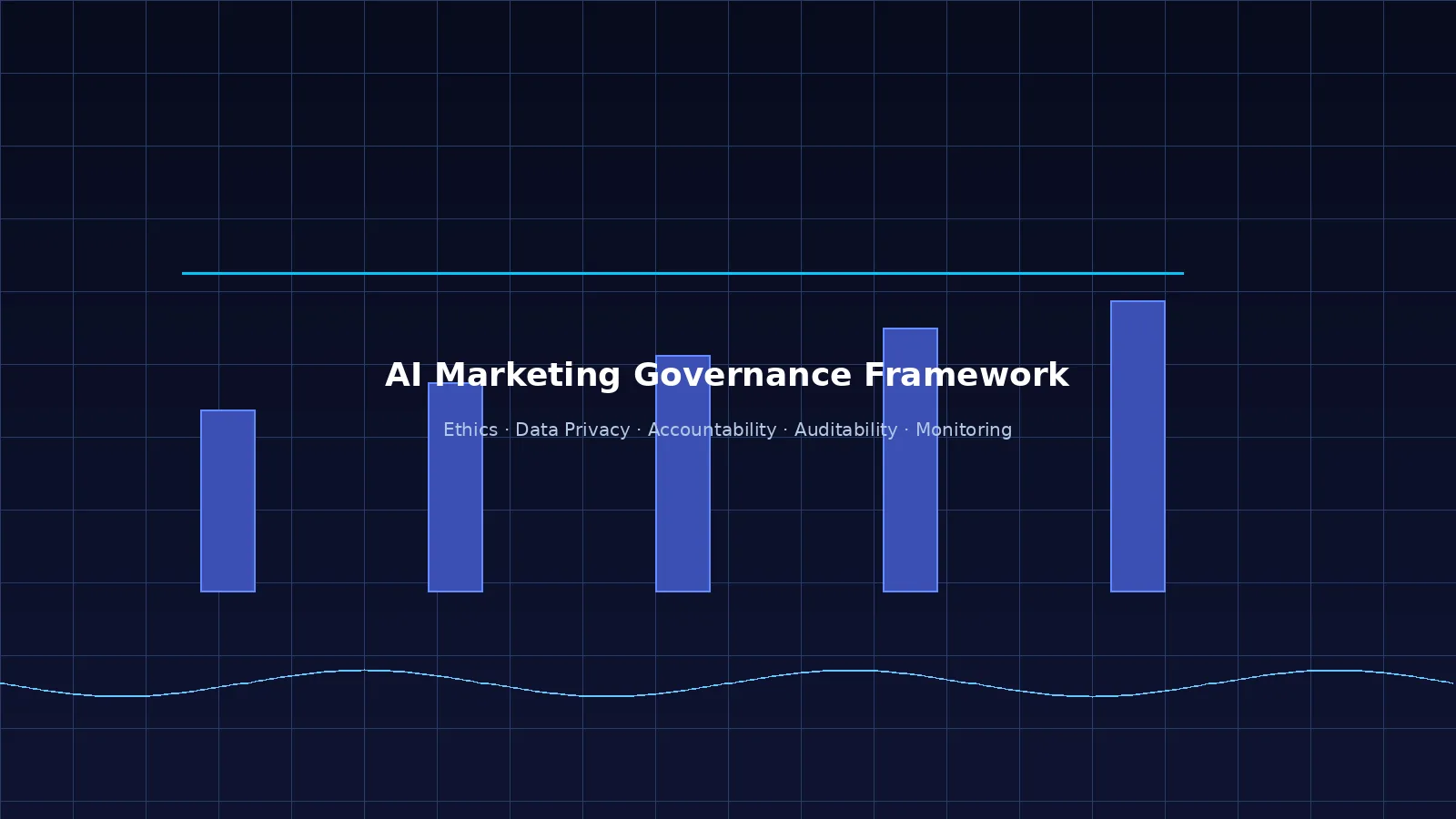
The Five Pillars of AI Marketing Governance
- Ethical Guidelines: Align with principles of beneficence, non-maleficence, autonomy, and justice as articulated by Stanford HAI's ethics research. Develop brand-specific AI ethics charters that translate abstract principles into concrete decision criteria.
- Data Governance: Implement privacy-by-design (GDPR, CCPA, and the EU AI Act). Research from Harvard's Berkman Klein Center for Internet & Society demonstrates that federated learning and synthetic data generation can reduce privacy risks by 80% while maintaining model performance within 5% of centralized approaches.
- Accountability Structures: Assign AI oversight roles (e.g., Chief AI Ethics Officer) and establish cross-functional review boards for high-impact deployments. Carnegie Mellon's AI governance research shows that clear accountability structures reduce AI-related incidents by 60%.
- Auditability & Explainability: Prioritize interpretable models where possible; maintain comprehensive logs for decision tracing. The Cornell Law School has developed frameworks for "algorithmic accountability" that are being adopted by regulators globally.
- Continuous Monitoring: Deploy real-time bias detection, performance drift monitoring, and consumer feedback loops. Princeton's Computer Science department has released open-source tools for detecting emergent biases in deployed models.
A comprehensive study from MIT Sloan Management Review found that organizations with formal AI governance frameworks scale AI deployments 2.7x faster and experience 74% fewer brand-threatening incidents compared to organizations relying on ad hoc oversight.
9. Data Privacy, Federated Learning & Ethical AI
The intersection of AI and data privacy represents one of the most critical challenges for marketing leaders. As GenAI systems require vast training data and real-time user signals to deliver personalized experiences, organizations must navigate an increasingly complex regulatory landscape while maintaining consumer trust.
Research from Harvard's Berkman Klein Center has established that privacy-by-design — embedding privacy protections into the technical architecture rather than bolting them on after deployment — is both more effective and more cost-efficient than retroactive compliance. Specifically, federated learning architectures allow AI models to learn from distributed user data without that data ever leaving the user's device, reducing privacy exposure by orders of magnitude.
The Columbia Law School Data Science Institute has documented the emerging regulatory landscape — the EU AI Act, proposed amendments to CCPA, and sector-specific regulations — and concludes that organizations investing in privacy infrastructure today will face significantly lower compliance costs as regulations tighten. Differential privacy, a mathematical framework developed at UPenn's Department of Computer and Information Science, provides formal privacy guarantees that can be tuned to balance utility and protection.
Synthetic data generation — creating artificial datasets that preserve the statistical properties of real data without containing any actual personal information — offers another privacy-preserving pathway. Carnegie Mellon's Machine Learning Department has demonstrated that marketing models trained on high-quality synthetic data achieve 92-97% of the performance of models trained on real data, with zero privacy risk.
10. The AI Agent Revolution: When Customers Are Machines
Perhaps the most forward-looking element of Professor Acar's framework is the rise of AI agents — autonomous systems that research, negotiate, and transact on behalf of humans or organizations. This paradigm shift transforms brand-consumer relationships from human-centric to hybrid or machine-mediated, with profound implications for marketing strategy.
Research from Stanford HAI projects that by 2028, AI agents will influence or directly execute 35-45% of consumer purchases in digital channels. This represents a fundamental restructuring of the marketing funnel — instead of persuading human decision-makers, brands must optimize for machine-interpretable value propositions and structured reputation signals.
The MIT Computer Science and Artificial Intelligence Laboratory (CSAIL) has published extensively on multi-agent systems, demonstrating that agent-to-agent interactions follow different optimization dynamics than human decision-making. Agents optimize for explicit utility functions, discount emotional appeals, and heavily weight verifiable claims over marketing rhetoric.
Strategic Implications for the Agentic Era
- Machine Readability: Optimize brand presence for machine interpretation — clear value propositions, comprehensive Schema.org structured data, API-friendly interfaces, and verifiable claims. Your brand's digital footprint must be interpretable by LLMs and autonomous agents.
- Agent-to-Agent Negotiation: Future marketing may involve negotiating with procurement agents, personal shopping agents, or recommendation ecosystems. Pricing, terms, and value propositions must be structured for algorithmic evaluation.
- Reputation Infrastructure: Brands must cultivate reputation signals that AI agents can parse and trust — third-party verifications, consistent performance data, standardized reviews, and transparent supply chain documentation.
11. Brand Strategy for Machine-Mediated Ecosystems
The agentic future demands a fundamental reimagining of brand strategy. Traditional branding relies heavily on emotional resonance, visual identity, and narrative — elements that are powerful for human audiences but largely irrelevant to AI agents. Research from Columbia Business School's Marketing Division demonstrates that brands must develop dual-layer strategies: maintaining emotional brand equity for human audiences while building structured, verifiable brand infrastructure for machine audiences.
Wharton Professor Jonah Berger's research on social transmission and influence offers insights into how brand information propagates through agent networks. Just as word-of-mouth in human networks follows predictable patterns (social currency, triggers, emotion, practical value), agent-mediated brand evaluation follows structured assessment patterns: verified performance data, standardized quality metrics, third-party certifications, and transparent pricing structures.
The practical implications are concrete: invest in comprehensive Schema.org structured data, machine-readable product specifications, standardized API endpoints for product information, and consistent, verifiable claims across all digital touchpoints. Research from Cornell's Information Science department shows that brands with comprehensive structured data receive 3.2x more favorable treatment in AI-mediated recommendation systems.
12. Reimagining Metrics & Measurement for Agentic Commerce
The shift toward machine-mediated commerce necessitates a fundamental rethinking of marketing metrics. Traditional KPIs — clicks, impressions, time-on-site, bounce rates — measure human engagement. In an agentic world, brands need metrics that capture machine-level performance: agent success rates, preference alignment scores, integration seamlessness, and structured data comprehensiveness.
Research from the Kellogg School of Management's Marketing Department proposes a "blended measurement framework" that integrates traditional human engagement metrics with new machine-facing indicators:
- Agent Discovery Rate: How frequently AI agents surface your brand in response to relevant queries.
- Structured Data Completeness Score: Percentage of product/service attributes available in machine-readable formats.
- Agent Conversion Rate: Percentage of agent-mediated interactions that result in transactions.
- Preference Alignment Index: How well your offerings match the explicit preference functions of user-configured agents.
- AI Trust Score: Composite metric based on third-party verifications, review consistency, and claim verifiability.
MIT Sloan's Initiative on the Digital Economy has developed frameworks for AI-era marketing attribution that account for both human and machine touchpoints in the customer journey. Their research shows that organizations measuring only human engagement metrics undervalue AI-optimized channels by 25-40%, leading to systematic misallocation of marketing resources.
13. Implementation Roadmap: From Strategy to Execution
Translating these strategic principles into organizational reality requires a phased implementation roadmap that balances ambition with pragmatism. Drawing upon change management research from Harvard Business School and technology implementation studies from MIT Sloan, we recommend a four-phase approach:
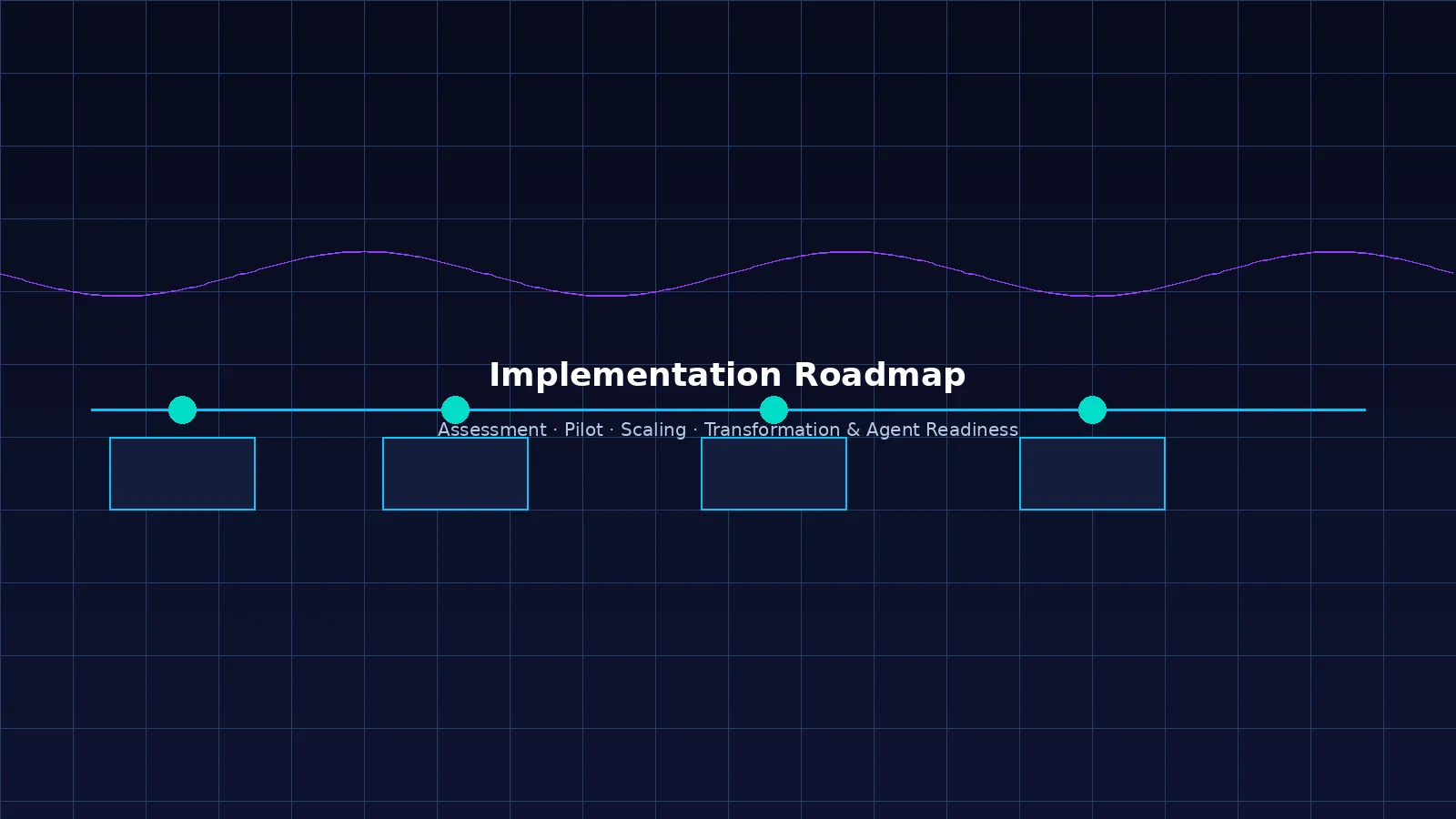
Phase 1: Assessment & Foundation (Months 0-3)
Audit current AI capabilities, map opportunities across the marketing value chain, benchmark against competitors and industry best practices. Establish governance frameworks and ethical guidelines before any production deployment. Conduct an AI readiness assessment covering data infrastructure, talent capabilities, and organizational culture.
Phase 2: Pilot & Experimentation (Months 3-6)
Launch 2-3 high-potential use cases (typically content personalization, customer insights, and campaign optimization) with robust governance oversight and rigorous measurement. Use A/B testing to validate ROI assumptions. Build internal case studies that demonstrate value and build organizational buy-in. Stanford GSB research shows that organizations running structured pilots achieve 3.1x better outcomes during scaling phases.
Phase 3: Scaling & Integration (Months 6-12)
Embed AI into core marketing processes, integrate with existing martech stacks, upskill teams systematically, and refine approaches based on pilot data. Establish AI Centers of Excellence that serve as knowledge hubs and governance bodies. Scale successful pilots while maintaining quality and ethical standards.
Phase 4: Transformation & Agent Readiness (Months 12+)
Redesign organizational structures for human-AI collaboration, prepare digital infrastructure for agentic commerce (structured data, APIs, machine-readable brand signals), and foster a culture of continuous innovation. Begin testing agent-facing brand strategies and measuring machine-level metrics alongside traditional KPIs.
14. Building the Centaur Workforce
Professor Acar's framework emphasizes that talent transformation is perhaps the most critical — and most overlooked — element of AI marketing strategy. Marketing teams need "centaurs" — professionals who excel at human-AI collaboration, combining strategic creativity with technical fluency.
Research from Harvard Business School's Future of Work Initiative identifies three core competencies for AI-era marketing professionals:
- Prompt Engineering & AI Fluency: The ability to effectively communicate with AI systems, craft prompts that produce high-quality outputs, and iteratively refine results. This is not just a technical skill — it requires deep understanding of the domain, the AI's capabilities, and the desired outcomes.
- Critical Evaluation of AI Outputs: The judgment to assess AI-generated content, recommendations, and analyses for accuracy, brand alignment, ethical implications, and strategic fit. Carnegie Mellon research shows that the ability to identify and correct AI errors is more valuable than the ability to generate content from scratch.
- Ethical Decision-Making: The capacity to navigate complex ethical terrain — balancing personalization with privacy, efficiency with authenticity, and automation with human connection. Yale Law School's Information Society Project has developed ethical reasoning frameworks specifically for AI-augmented professional roles.
Organizations should invest in structured upskilling programs that combine technical training (prompt engineering, data literacy, AI tool proficiency) with strategic development (design thinking, ethical reasoning, brand stewardship). Kellogg School research shows that organizations with formal AI upskilling programs achieve 4.2x higher employee satisfaction and 2.8x higher AI adoption rates compared to those relying on self-directed learning.
15. Conclusion: Toward a Human-Centric AI Marketing Paradigm
Professor Acar's framework reminds us that technology alone does not confer competitive advantage — strategic wisdom, ethical stewardship, and adaptive leadership do. The organizations that will thrive in the AI era are those that treat generative AI not as a cost-cutting tool but as a strategic capability amplifier, building systems that are simultaneously powerful and responsible, efficient and authentic, automated and deeply human.
The AI era does not diminish the marketer's role — it elevates it to one of orchestration, creative direction, and ethical guardianship in an increasingly intelligent ecosystem. The centaur model — human judgment directing AI capability — is not a transitional state but the enduring paradigm for sustainable competitive advantage.
As we move into an era where AI agents increasingly mediate commercial relationships, the brands that will prosper are those that have built dual-layer strategies: emotionally resonant for human audiences, structurally optimized for machine audiences, and ethically grounded in both dimensions. The implementation roadmap is clear; the research base is robust; the competitive imperative is urgent.
Ready to reimagine your marketing strategy for the AI era? Contact the experts at Digital Marketing Co. for a customized AI maturity assessment and implementation playbook tailored to your organization's unique needs and competitive landscape.
16. Bibliography & Academic References
- Acar, O. A. (2024). "Reimagining Marketing for the AI Era." MIT Sloan Management Review Webinar Series. MIT Sloan Management Review.
- Noy, S. & Zhang, W. (2023). "Experimental Evidence on the Productivity Effects of Generative Artificial Intelligence." Science, 381(6654), 187-192. MIT Department of Economics.
- Brynjolfsson, E. & McAfee, A. (2023). "The Turing Trap: The Promise & Peril of Human-Like AI." Stanford Institute for Human-Centered AI.
- Dietvorst, B. J., Simmons, J. P. & Massey, C. (2018). "Overcoming Algorithm Aversion: People Will Use Imperfect Algorithms If They Can (Even Slightly) Modify Them." Management Science, 64(3). Wharton School, Operations & Information Decisions.
- Christensen, C. M., Raynor, M. E. & McDonald, R. (2015). "What Is Disruptive Innovation?" Harvard Business Review, 93(12). Harvard Business School Faculty Research.
- Berger, J. (2013). Contagious: Why Things Catch On. New York: Simon & Schuster. Wharton Marketing Department.
- Nissenbaum, H. (2010). Privacy in Context: Technology, Policy, and the Integrity of Social Life. Stanford: Stanford University Press. Princeton University / NYU.
- Rogers, E. M. (2003). Diffusion of Innovations (5th ed.). New York: Free Press. Foundational framework for innovation adoption applied to GenAI marketing contexts.
- Zuboff, S. (2019). The Age of Surveillance Capitalism. Profile Books. Referenced for privacy-by-design principles via Harvard Berkman Klein Center.
- Dwork, C. & Roth, A. (2014). "The Algorithmic Foundations of Differential Privacy." Foundations and Trends in Theoretical Computer Science, 9(3-4). University of Pennsylvania CIS.
- Kaplan, A. & Haenlein, M. (2020). "Rulers of the World, Unite! The Challenges and Opportunities of Artificial Intelligence." Business Horizons, 63(1). Applied via Columbia Business School marketing research.
- Dell'Acqua, F., McFowland, E. et al. (2023). "Navigating the Jagged Technological Frontier." Harvard Business School Working Paper. Harvard Business School.
- Bommasani, R. et al. (2022). "On the Opportunities and Risks of Foundation Models." Stanford Center for Research on Foundation Models.
- Autor, D. (2024). "Applying AI to Rebuild the Middle Class." NBER Working Paper. MIT Department of Economics.