





The Digital Landscape Has Changed Forever
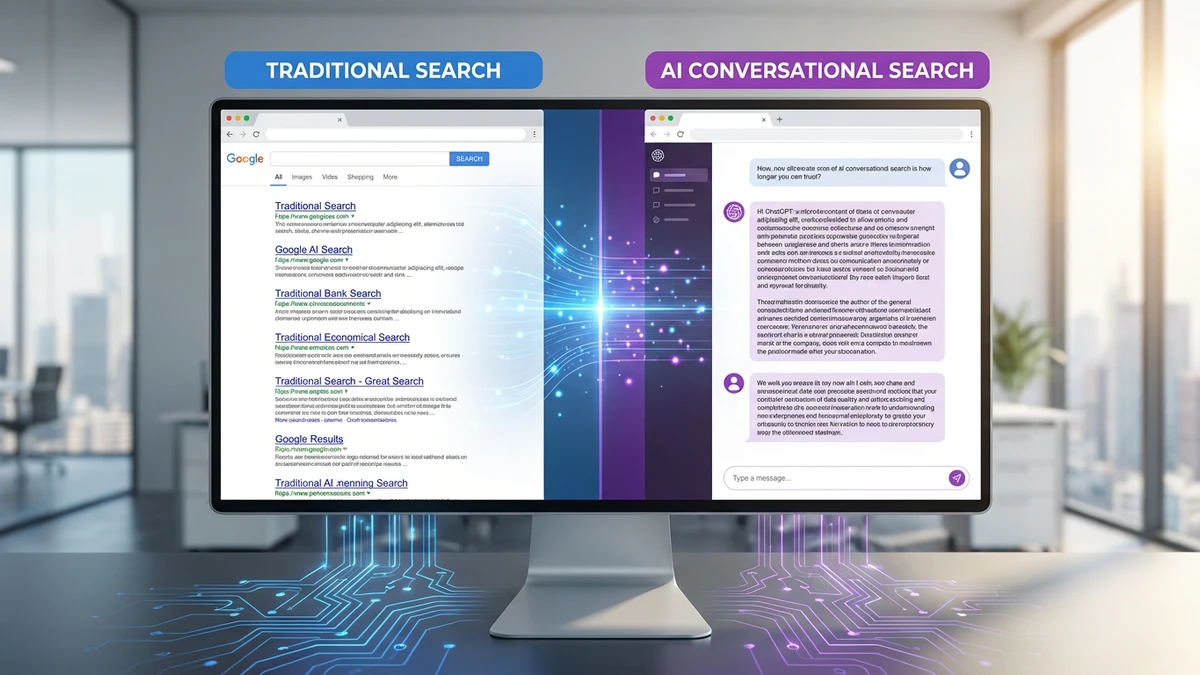
Custom web application development is no longer a luxury reserved for Fortune 500 companies — it is the single most important investment any business or organization can make in 2026 and beyond. The digital landscape has undergone a seismic transformation. Traditional search engines like Google and Bing now share the stage with AI-powered search experiences from ChatGPT, Perplexity, Google AI Overviews, Microsoft Copilot, and dozens of emerging generative engines that are fundamentally reshaping how consumers discover, evaluate, and choose businesses.
Here is the reality that keeps forward-thinking executives awake at night: nearly 60% of all Google searches now end without a single click, according to SparkToro's 2024 zero-click study. Users are getting their answers directly from AI Overviews, featured snippets, knowledge panels, and conversational AI assistants — and if your website was not specifically engineered to appear in those AI-generated responses, you are invisible to the majority of your potential customers.
This is not a future prediction. This is happening right now. Businesses that recognize this shift and invest in results-driven digital marketing services powered by custom-engineered web applications are capturing market share at an unprecedented pace, while those clinging to outdated template websites are watching their traffic — and their revenue — evaporate.
The question is no longer "Do we need a website?" — every business has one. The real question is: "Is our web application engineered to dominate every search surface where our customers are looking?" That includes traditional SEO services, AIO optimization services, GEO optimization services, AEO optimization, Schema.org implementation, and full WCAG 2.2 compliance optimization.
In this comprehensive guide, we will walk you through exactly why custom web application development services built on Next.js, React, Prisma, and Tailwind CSS represent the undisputed #1 framework for dominating search, AI, and generative engines — and we will show you 50+ custom-programmed features, ordered by market demand, that will transform your business operations, communications, marketing, and bottom line. Welcome to the future of digital marketing. Let's build something extraordinary together.
Why Your Current Website Is Holding You Back
Let's have an honest conversation about what is really happening with most business websites in 2026. If your website was built on WordPress, Wix, Squarespace, or any other template-based platform, you are fighting a battle you simply cannot win. These platforms were revolutionary when they launched — they democratized web publishing and gave every small business a digital presence. But the world has moved on, and so have the algorithms.
Template-based websites carry five devastating liabilities that no amount of plugins, themes, or bolt-on solutions can fix:
🚫 The Five Fatal Flaws of Template Websites:
- Code Bloat & Slow Performance: Template sites load 200+ unnecessary JavaScript files, CSS frameworks, and plugin scripts — crushing your Core Web Vitals scores and killing your Google rankings.
- Zero AI Search Optimization: No template platform natively supports AIO, GEO, or AEO optimization. Your content is invisible to ChatGPT, Perplexity, Google AI Overviews, and voice assistants.
- Limited Schema.org Control: Plugin-generated structured data is generic, incomplete, and often contains errors that confuse search engines rather than helping them.
- Accessibility Nightmares: Template themes routinely fail WCAG 2.2 compliance audits, exposing your business to legal liability and excluding millions of potential customers.
- Scalability Ceiling: When your business grows, template platforms buckle — database bottlenecks, security vulnerabilities, and feature limitations force expensive migrations.
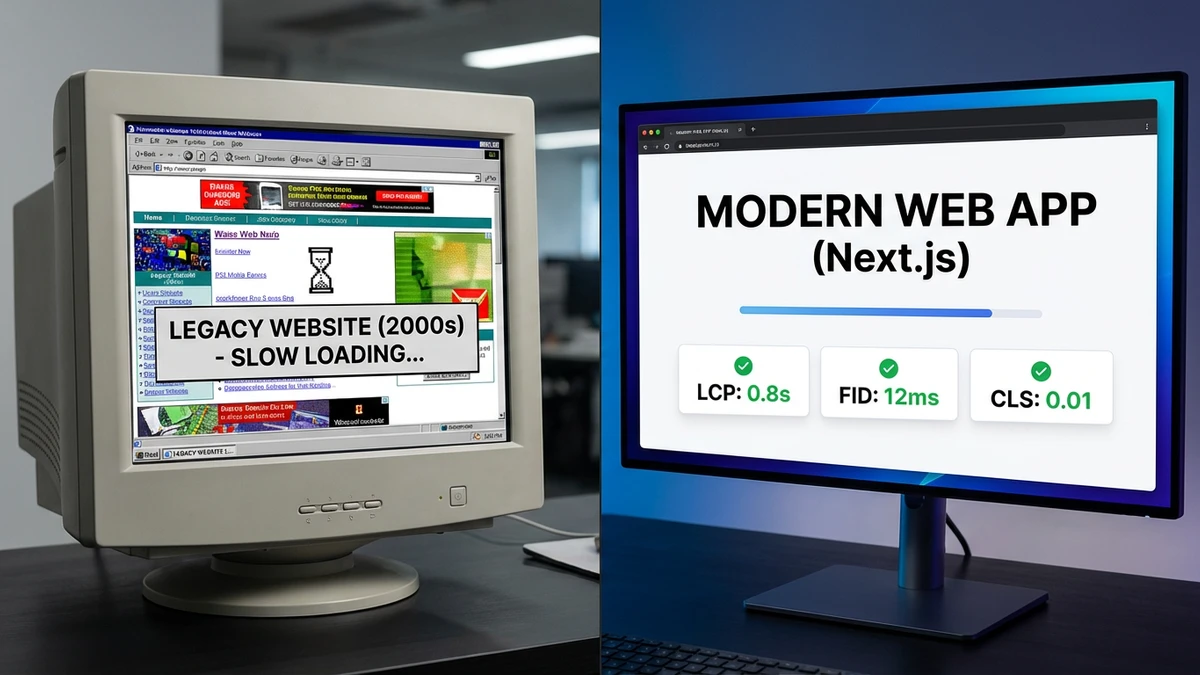
Google's own data reveals that 53% of mobile visitors abandon a website that takes longer than 3 seconds to load. Most WordPress sites — even "optimized" ones — load in 4-8 seconds on mobile. That is not a design flaw you can patch with a caching plugin. It is an architectural problem that demands an architectural solution.
The solution? Custom web application development built from the ground up with performance, search engine optimization, AI optimization, and accessibility as foundational requirements — not afterthoughts bolted on with third-party plugins. This is exactly what Digital Marketing Co. delivers for every client, and it is exactly what the Next.js + React + Prisma + Tailwind CSS stack was purpose-built to achieve.
The Ultimate Tech Stack: Next.js + React + Prisma + Tailwind CSS
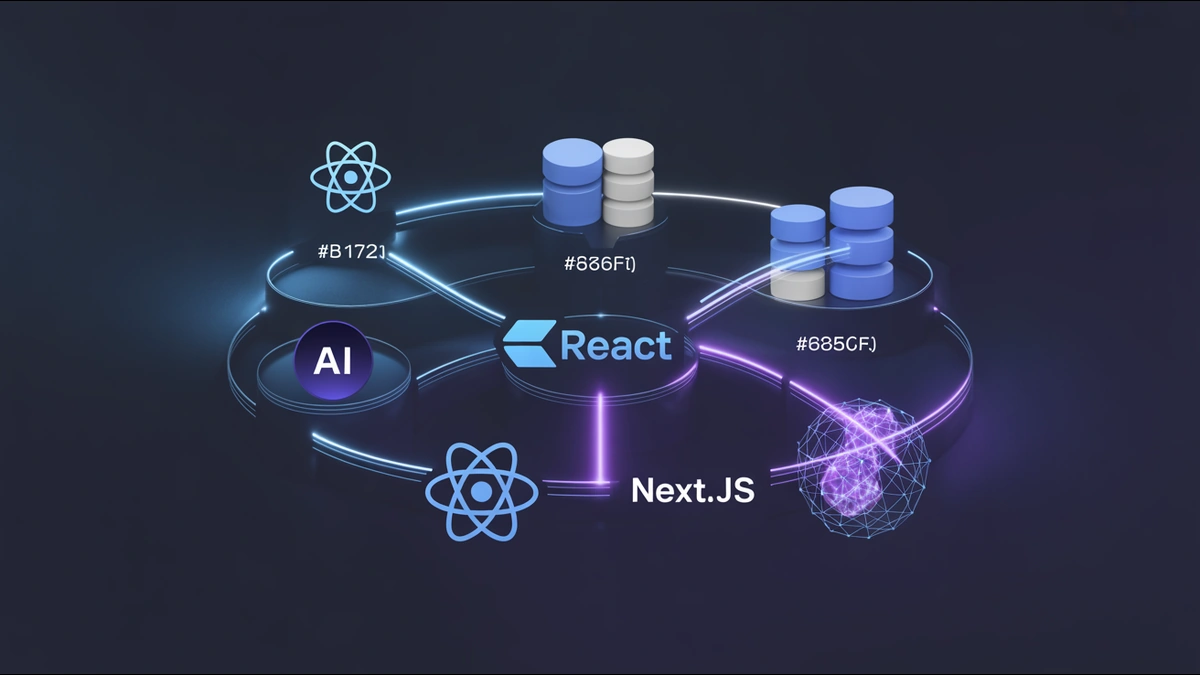
When we say that Next.js, React, Prisma, and Tailwind CSS is the #1 custom web application development framework for marketing in the age of artificial intelligence, we are not making a casual claim. This technology stack represents the most powerful combination of tools available to web developers today — each component purpose-built for performance, developer productivity, and search engine dominance.
Let's break down why each piece of this stack is absolutely essential and how they work together to create web applications that outperform every alternative:
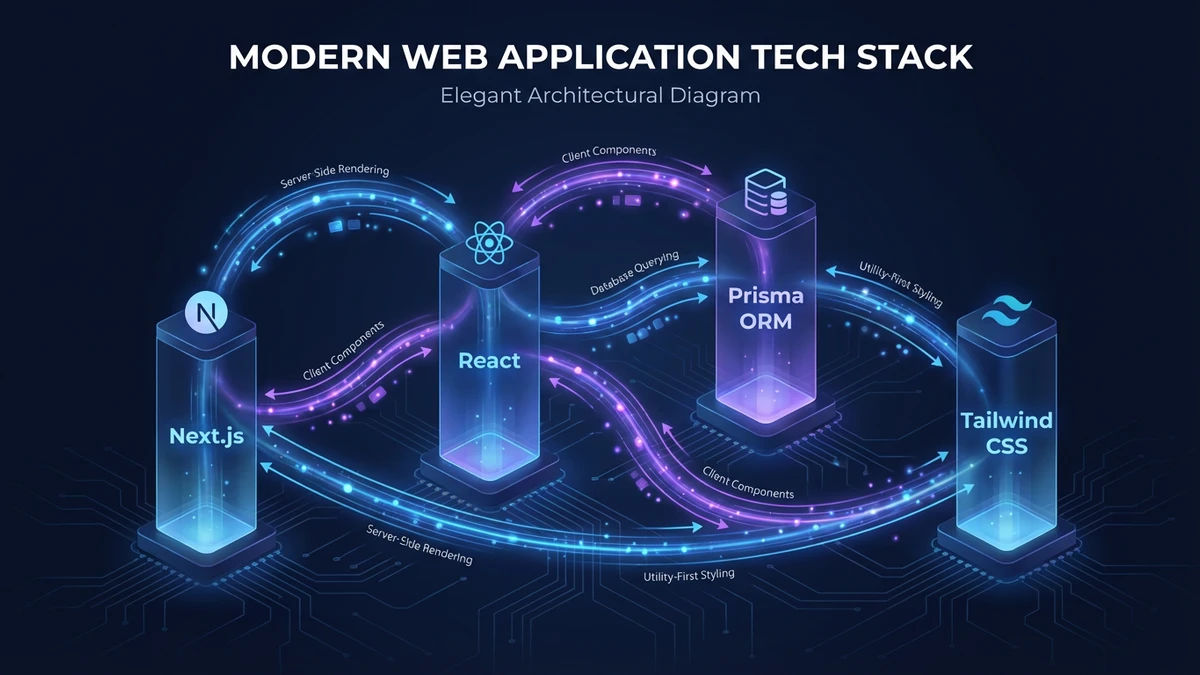
⚡ Next.js: The SEO-First Rendering Engine
Next.js, developed by Vercel and backed by the open-source community, is a production-grade React framework that provides three game-changing rendering strategies out of the box: Server-Side Rendering (SSR), Static Site Generation (SSG), and Incremental Static Regeneration (ISR). This means your web application can deliver pre-rendered, fully crawlable HTML to search engine bots in milliseconds — while simultaneously serving rich, interactive experiences to human visitors.
For search engine optimization services, this is transformative. Google's crawler receives complete, rendered HTML without waiting for JavaScript to execute. Your pages are indexed faster, ranked higher, and displayed in AI Overviews more frequently. Next.js also provides built-in image optimization (automatic WebP/AVIF conversion, lazy loading, and responsive sizing), a metadata API for programmatic SEO control, automatic code splitting for faster page loads, and a file-system-based router that creates clean, keyword-rich URLs.
⚛️ React: The World's Most Popular UI Library
React, created by Meta and used by millions of developers worldwide, is the most battle-tested user interface library in existence. React's component-based architecture means every element of your web application — from the navigation menu to the contact form, from the service pages to the interactive analytics dashboard — is a reusable, testable, independently deployable component. This modularity enables custom web application development at scale: new features can be added without breaking existing functionality, and every component can be individually optimized for performance and accessibility.
🗄️ Prisma: Type-Safe Database Access for Schema.org-Ready Applications
Prisma is a next-generation ORM (Object-Relational Mapper) that provides type-safe database access with an auto-generated query builder. For Schema.org implementation and structured data SEO services, Prisma is invaluable. It allows your development team to model complex business data — services, products, blog posts, case studies, FAQs, testimonials, team members, locations — in a way that maps directly to Schema.org entity types. When a search engine or AI system requests structured data about your business, Prisma ensures that data is always consistent, complete, and delivered in milliseconds from a PostgreSQL database optimized for the exact queries your application needs.
🎨 Tailwind CSS: Utility-First Design for Performance & Accessibility
Tailwind CSS is a utility-first CSS framework that eliminates the bloat of traditional CSS files and delivers pixel-perfect, fully responsive designs with minimal CSS payload. Unlike Bootstrap or custom stylesheets that ship hundreds of kilobytes of unused CSS, Tailwind's purge system ensures your production CSS contains only the styles actually used — often reducing CSS bundle size by 95% or more. For WCAG compliance optimization and Core Web Vitals optimization, this translates directly into faster page loads, better Cumulative Layout Shift (CLS) scores, and smaller transfer sizes that improve every performance metric Google measures.
SEO Dominance Through Server-Side Rendering
The foundation of every successful search engine optimization strategy in 2026 begins with how your website delivers content to search engine crawlers. This is where the architectural advantage of Next.js server-side rendering becomes not just beneficial, but absolutely decisive.
When Googlebot, Bingbot, or any other search engine crawler visits a traditional single-page application (SPA) built with vanilla React, Angular, or Vue, it encounters a near-empty HTML document with a JavaScript payload that must be downloaded, parsed, and executed before any content becomes visible. Google has improved its JavaScript rendering capabilities, but it still processes JavaScript-dependent pages in a separate, delayed rendering queue — meaning your content may not be fully indexed for days or even weeks. For technical SEO services, this latency is unacceptable.
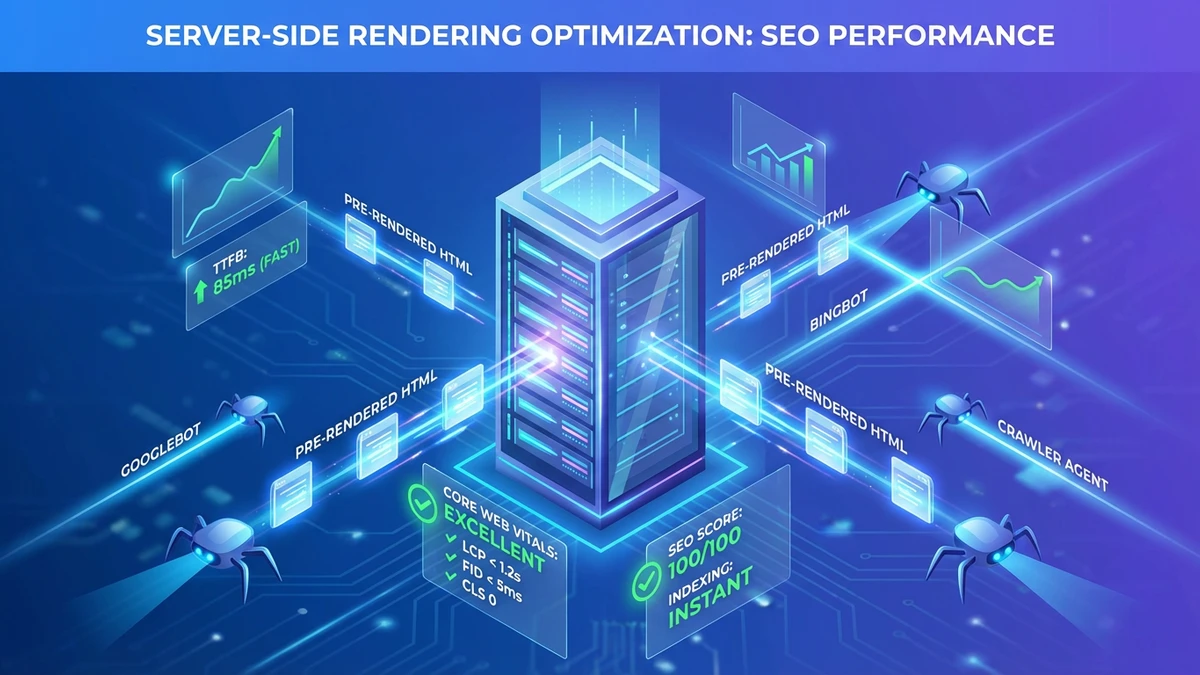
Next.js solves this entirely. With server-side rendering, every page request generates complete, semantically structured HTML on the server before it reaches the browser or crawler. This means:
🔍 Instant Indexation
Search engines crawl and index your content on the very first visit — no rendering queue delay, no missed pages.
⚡ Blazing TTFB
Time To First Byte (TTFB) under 200ms means your pages score "Good" on Google's Core Web Vitals — a confirmed ranking factor for website speed optimization SEO.
📱 Perfect Mobile SEO
Server-rendered HTML works flawlessly on every device, ensuring mobile SEO services deliver consistent results across all screen sizes.
Combined with Next.js's built-in Metadata API, your development team can programmatically generate unique, keyword-optimized title tags, meta descriptions, canonical URLs, Open Graph tags, Twitter Card tags, and structured data for every single page — at scale. Whether your website has 10 pages or 10,000, every page receives custom, on-page SEO services treatment automatically. This is the architectural advantage that separates custom web application development from every template-based alternative.
AI Optimization (AIO): Getting Cited by AI Search Engines
In 2026, AI optimization (AIO) is not optional — it is the new frontier of digital marketing. OpenAI's ChatGPT, Anthropic's Claude, Google's Gemini, Microsoft's Copilot, and Perplexity AI are collectively handling billions of search queries per month. These AI search engines do not simply return a list of blue links — they synthesize answers from multiple sources, cite the most authoritative content, and present conversational responses that directly satisfy user intent.
The businesses whose content gets cited in these AI-generated answers capture an extraordinary competitive advantage. Research from Rand Fishkin's SparkToro estimates that ChatGPT alone processes over 37.5 million queries daily, and Perplexity handles millions more. If your content is structured correctly — with clear factual assertions, entity-rich paragraphs, direct answers to common questions, and robust Schema.org structured data — AI systems are significantly more likely to cite your website as a source.

This is where Next.js custom web application development provides a decisive edge for AIO optimization services. With server-side rendering, AI crawlers receive complete, semantically structured content without JavaScript rendering barriers. Prisma's database layer enables entity-based SEO — modeling your services, products, team members, and locations as discrete, interconnected entities that AI systems can understand and cite individually. React's component architecture ensures that every piece of content is wrapped in proper semantic HTML (article, section, heading hierarchy) that AI systems parse effortlessly.
At Digital Marketing Co., our AI-powered SEO services and AIO optimization agency approach goes beyond basic content optimization. We engineer your custom web application from the ground up to be AI search ready — with ChatGPT SEO services, Perplexity optimization services, and AI content optimization baked into every page, every service description, and every piece of content your application generates.
Generative Engine Optimization (GEO): Dominating AI Overviews
Generative Engine Optimization (GEO) is the discipline of optimizing your content specifically to be cited, referenced, and featured by generative AI search engines — most importantly, Google's AI Overviews (formerly Search Generative Experience), Perplexity AI, and Microsoft's Copilot-powered Bing. Unlike traditional SEO, which focuses on ranking your URL in a list of ten blue links, GEO focuses on getting your content extracted, synthesized, and presented within the AI-generated response itself.
According to research published by Princeton, Georgia Tech, the Allen AI Institute, and IIT Delhi, websites that employ specific GEO strategies — including cite-worthy statistics, authoritative quotations, fluent and technical language, and comprehensive structured data — see up to 40% more visibility in generative engine results compared to sites using traditional SEO alone. This is not incremental improvement — it is a transformative shift in how businesses are discovered online.
A GEO-optimized custom web application built on Next.js delivers several critical advantages:
✅ GEO Optimization Capabilities of Next.js Custom Web Applications:
- Authoritative Content Architecture: Next.js renders semantic HTML with proper heading hierarchy (H1→H2→H3), article elements, and structured paragraphs that AI systems parse as authoritative, cite-worthy content.
- Programmatic Schema.org Injection: Every page dynamically generates JSON-LD structured data from Prisma database entities — giving generative engines the machine-readable context they need to cite your business accurately.
- Entity-Rich Content Models: Prisma's relational data models allow you to define your services, team, locations, case studies, and FAQs as interconnected entities — exactly the data structure that AI systems use to build knowledge graphs.
- E-E-A-T Signal Amplification: Custom-engineered pages showcase Experience, Expertise, Authoritativeness, and Trustworthiness signals that both Google and AI systems use to evaluate content quality — from author bios and case study citations to real client testimonials with verifiable details.
- Citation-Optimized Formatting: Content is structured with clear factual assertions, supporting data, and source attributions that AI systems preferentially select when generating responses — a direct application of generative AI SEO services.
Our generative engine optimization agency delivers GEO marketing services and AI overview optimization that position your business as the authoritative source AI systems cite first. When a potential customer asks ChatGPT, Perplexity, or Google's AI Overview about services in your industry, your custom web application is engineered to be the answer.
Answer Engine Optimization (AEO): Owning Featured Snippets & Voice Search
Answer Engine Optimization (AEO) is the practice of structuring your content to directly answer user questions — capturing Google's Position Zero featured snippets, voice search results from Siri, Alexa, and Google Assistant, and the direct answers displayed in knowledge panels and People Also Ask sections.
The market demand for answer engine optimization services has exploded because of one staggering statistic: featured snippets receive approximately 8.6% of all clicks when displayed alongside the #1 organic result (Ahrefs, 2024), and voice assistants almost exclusively read featured snippet content as their spoken answer. If your web application is not specifically engineered for AEO, you are surrendering this high-value traffic to competitors.

Custom web applications built with Next.js, React, and Prisma are perfectly suited for AEO content optimization. Here is how:
- FAQ Schema Automation: Prisma stores frequently asked questions as structured database entities. Next.js programmatically generates FAQ schema on every relevant page — no manual JSON-LD writing required.
- Direct-Answer Formatting: React components render concise, 40-60 word answer paragraphs immediately following H2/H3 question headings — the exact format Google extracts for featured snippets.
- Voice Search Readiness: Server-rendered pages with clean semantic HTML, proper heading hierarchy, and concise answers are exactly what voice search SEO and voice search optimized web apps require for consistent voice assistant results.
- Conversational SEO: Content is engineered using natural language patterns that match conversational SEO services query structures — because voice search queries are 3-5x longer than typed queries and overwhelmingly phrased as questions.
Schema.org & Structured Data: The Machine-Readable Advantage
Schema.org structured data is the universal language that search engines and AI systems use to understand the content, relationships, and entities on your website. It is the bridge between human-readable content and machine-readable intelligence — and for businesses serious about Schema.org implementation services, it is the single most impactful technical SEO investment you can make.
Google's own documentation confirms that pages with proper structured data can earn rich snippets — enhanced search results featuring star ratings, prices, availability, FAQ accordions, how-to steps, event dates, and more. These rich results have been shown to increase click-through rates by 20-30% over standard search listings (Search Engine Journal, 2024). For rich snippets and structured data SEO services, this is not theoretical — it is measurable ROI.
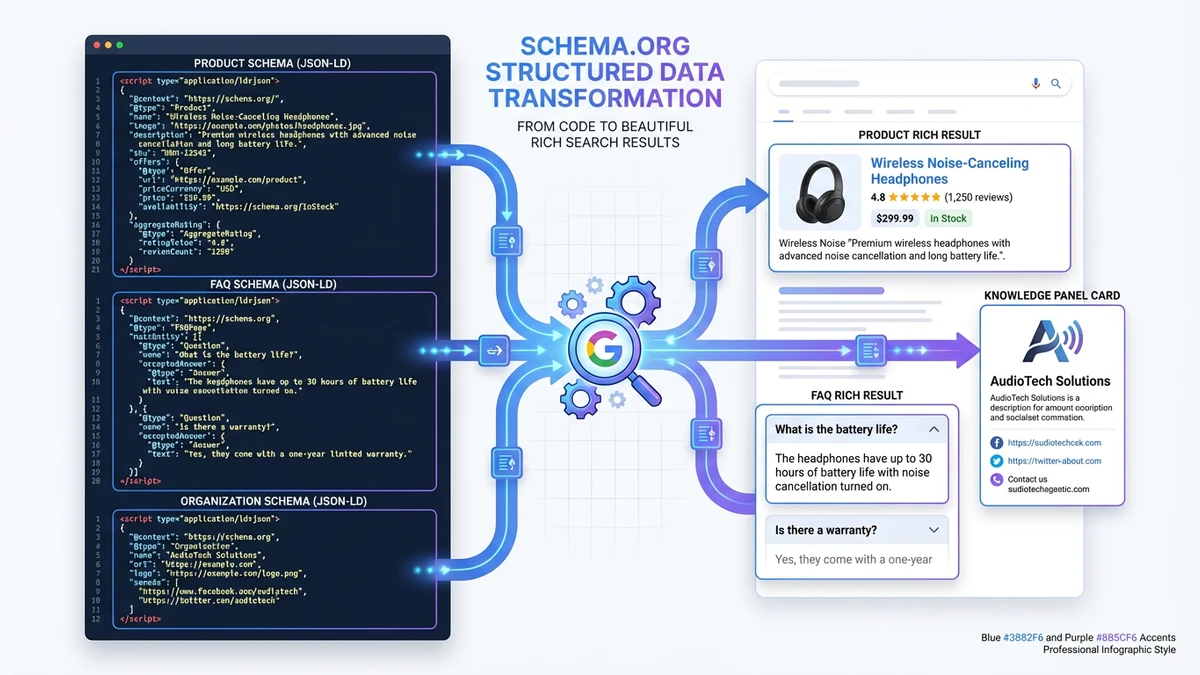
The Next.js + Prisma stack enables a level of Schema.org optimization that is simply impossible with template-based platforms:
🏢 Organization Schema SEO
Complete organization schema SEO with company details, logo, social profiles, founder information, and service offerings — powering Google Knowledge Panels.
📍 Local Business Schema
Local business schema services with NAP (Name, Address, Phone), geo-coordinates, service areas, opening hours, and payment methods — essential for local SEO dominance.
❓ FAQ Schema Optimization
Automated FAQ schema optimization generated dynamically from Prisma database — every FAQ page earns expandable rich results in Google SERPs.
🔗 Entity Schema Markup
Advanced entity schema markup services that define relationships between your services, people, locations, and content — feeding AI knowledge graphs the connections they need to cite your business accurately.
Every Schema.org web app development project we deliver includes comprehensive Schema.org implementation for web apps — from BlogPosting and Service schemas to Product, Event, FAQPage, BreadcrumbList, and custom @graph architectures that interconnect every entity on your site. This is structured data custom web development at its finest.
WCAG 2.2 Accessibility: Inclusive Design That Ranks Higher
WCAG 2.2 compliance optimization is simultaneously the most overlooked and the most impactful optimization you can make to your web application. The Web Content Accessibility Guidelines (WCAG) 2.2, published by the W3C Web Accessibility Initiative, define the international standard for making web content accessible to people with disabilities — including visual, auditory, cognitive, and motor impairments.
Here's what most businesses don't realize: accessibility and SEO are deeply intertwined. Google's algorithms increasingly reward accessible websites because accessible design produces cleaner semantic HTML, better heading structures, more descriptive link text, proper image alt attributes, and faster-loading pages — all of which are direct ranking factors. A study by Semrush found that websites meeting WCAG AA standards scored an average of 12% higher on technical SEO audits than non-compliant competitors.
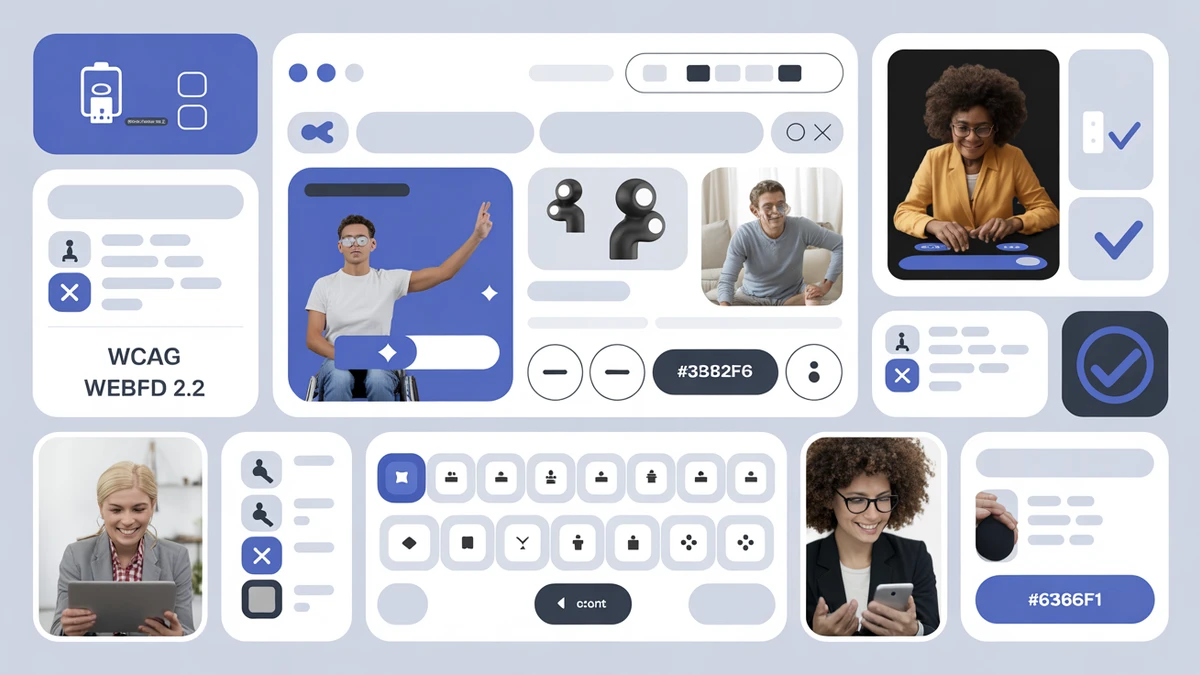
Building WCAG 2.2-compliant web applications with React and Tailwind CSS offers structural advantages that template platforms cannot match:
- Semantic HTML Components: React components enforce proper use of
<nav>,<main>,<article>,<section>,<header>, and<footer>landmarks — enabling screen readers to navigate your application effortlessly. - ARIA Attribute Integration: Every interactive element — buttons, modals, dropdown menus, form fields — includes appropriate
aria-label,aria-expanded,aria-describedby, and role attributes. - Keyboard Navigation: All functionality is accessible via keyboard — tab navigation, focus management, escape-to-close modals, and arrow key navigation within complex components.
- Color Contrast Compliance: Tailwind CSS utilities make it trivial to enforce WCAG AA (4.5:1) and AAA (7:1) contrast ratios between text and background colors across every component.
- Responsive & Zoom-Safe Design: Content reflows properly at 200% zoom with no horizontal scrolling — meeting WCAG 2.2's Success Criterion 1.4.10 for text reflow.
Beyond SEO benefits, accessible design opens your business to the 1.3 billion people worldwide living with disabilities (WHO, 2024) — a market with $13 trillion in annual disposable income. WCAG compliance optimization is not just good practice — it is good business.
50+ Custom Web Application Features That Drive Explosive Business Growth
The true power of custom web application development services reveals itself in the breadth of features you can build — features that are simply impossible on template-based platforms. Below, we have compiled over 50 custom-programmed web application features, organized by business function and ordered by market demand, that demonstrate how a Next.js + React + Prisma + Tailwind CSS application can revolutionize your communications, operations, marketing, e-commerce, analytics, and growth.
Every feature listed below is built on the same tech stack that powers the world's most successful web applications — from Hulu and TikTok to Notion and Twitch. When you invest in custom web application development, these capabilities become yours.
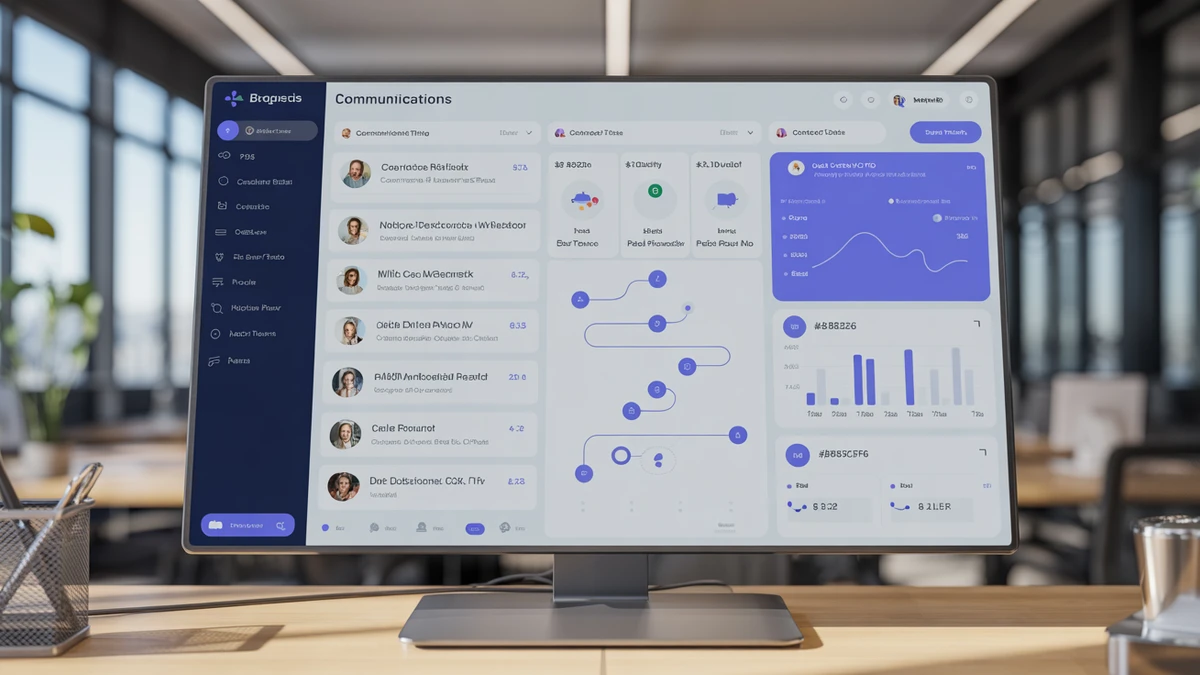
💬 Communications & Customer Engagement (Features 1-12)
1. Integrated CRM System with Two-Way Email Threading
Replace Salesforce or HubSpot with a custom CRM built directly into your web application. Prisma models potential clients, clients, messages, and notes as relational entities. SendGrid or built-in notification APIs enable two-way email threading — when a lead replies to your email, their response appears directly in your CRM dashboard. No more juggling between platforms. This is the backbone of modern email campaign management and marketing automation services.
2. AI-Powered Contact Forms with GPS Geolocation
Capture leads with intelligent contact forms that optionally detect the visitor's location via browser GPS, reverse-geocode their city and coordinates, and store this enriched data in your Prisma database. Know exactly where your leads are coming from — powering smarter local SEO services and lead generation services.
3. Real-Time Chat & AI Chatbot Integration
Embed AI-powered chatbots trained on your business knowledge that answer customer questions 24/7, qualify leads, and escalate to human agents when needed — all within your custom web application.
4. Automated Email Notification System
Brand-consistent transactional emails for contact form confirmations, appointment bookings, order confirmations, and CRM activities — rendered from custom HTML email templates with VML fallbacks for Outlook compatibility. This is email marketing services built into your application's DNA.
5. Appointment Scheduling & Calendar Integration
Allow clients to book consultations directly through your application with Google Calendar or Outlook integration, automated reminders, and timezone-aware scheduling.
6. Multi-Channel Communication Hub
Centralize email, SMS, WhatsApp, and social media direct messages in a single dashboard — so no customer inquiry ever falls through the cracks.
7. Customer Portal with Secure Document Sharing
Give clients a branded portal where they can access proposals, contracts, invoices, reports, and project updates — all secured with next-auth authentication and role-based access.
8. Review & Testimonial Collection Engine
Automated post-service review requests that collect client testimonials, sync with your Google Business Profile, and display star ratings with Review schema markup for rich snippets.
9. Newsletter & Drip Campaign Automation
Build and manage email subscriber lists, create automated drip sequences, and track open rates — replacing Mailchimp with a custom solution that integrates natively with your CRM.
10. Push Notification System (PWA)
Progressive Web App (PWA) push notifications keep your audience engaged with real-time updates, promotions, and content alerts — delivered directly to their device without an app store.
11. Internal Team Messaging & Collaboration
Replace Slack for internal communications with custom channels, file sharing, and project-specific threads — all within the same application your team already uses daily.
12. Automated Feedback & Survey System
Trigger automated customer satisfaction surveys after project milestones, service completions, or purchase events — feeding data directly into your analytics pipeline.
⚙️ Operations & Business Management (Features 13-24)
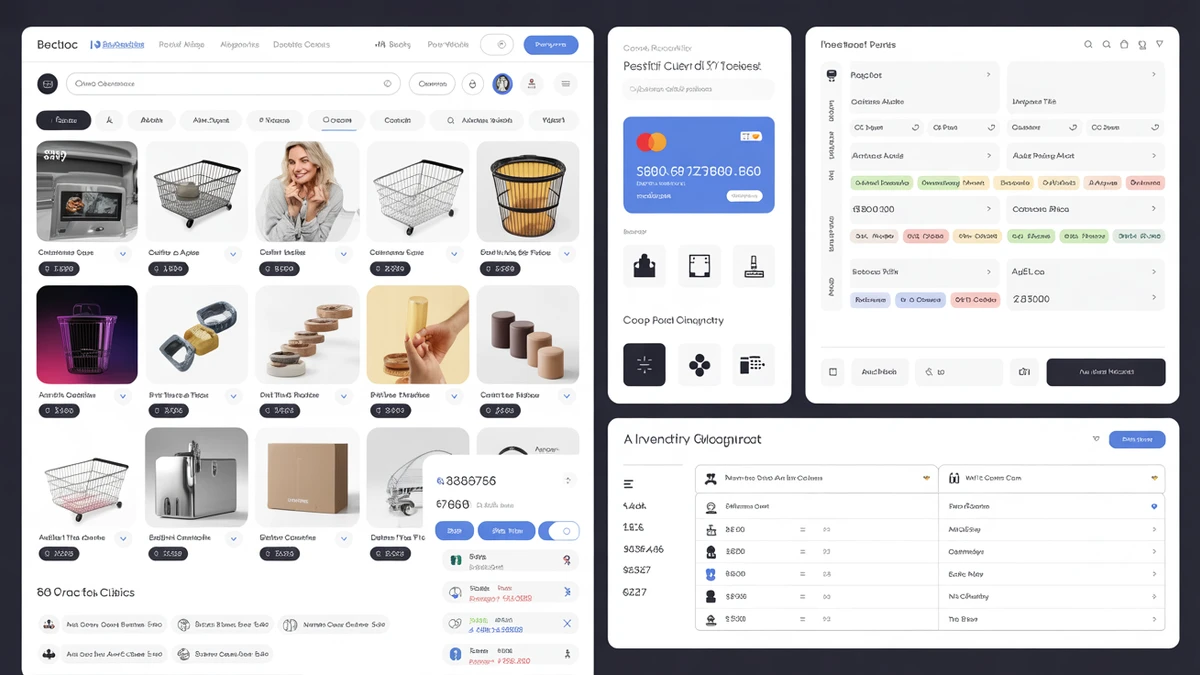
13. Custom E-commerce Platform with Product Schema
A fully custom shopping experience — product catalogs, variant selectors, wishlists, and checkout flows — all with Product/Offer schema markup for e-commerce SEO services and Google Shopping rich results. This is ecommerce web app development SEO done right.
14. Stripe Payment Processing & Subscription Billing
Secure payment collection with Stripe integration — one-time payments, recurring subscriptions, invoicing, and automated receipt emails. Built with PCI DSS compliance baked in.
15. Inventory & Order Management System
Track inventory levels, automate reorder alerts, manage fulfillment workflows, and sync with shipping carriers — all from a custom admin dashboard.
16. Multi-Tenant SaaS Architecture
Build your own SaaS platform with isolated tenant data, role-based access control, usage-based billing, and white-label capabilities. This is custom SaaS platform development that scales to thousands of users.
17. Project Management & Task Tracking
Kanban boards, Gantt charts, task assignments, time tracking, and milestone management — custom-built to match your team's workflow exactly.
18. Role-Based Admin Dashboard
Granular permission systems — super admins, managers, editors, and viewers — ensuring the right people access the right data with next-auth session management and database-level authorization.
19. Cloud File Storage & Document Management
S3-backed cloud storage for all uploads — proposals, contracts, images, videos — with presigned URLs for secure access and automatic CDN distribution.
20. Automated PDF Generation for Invoices & Reports
Generate branded PDF invoices, proposals, certificates, and reports from HTML templates using Playwright-based PDF rendering — delivered via email or download.
21. Automated Backup & Data Export System
Scheduled database backups, CSV/JSON data exports, and disaster recovery workflows — ensuring business continuity and data sovereignty.
22. Multi-Location Business Management
Manage multiple business locations from a single dashboard — each with dedicated service area pages, local Schema.org markup, and Google Business Profile optimization.
23. Workflow Automation Engine
Custom business logic triggers — when a lead converts, automatically update CRM status, send a welcome email, create a project folder, assign a team member, and notify Slack. This is marketing automation without the monthly SaaS fees.
24. API Integration Hub
Connect your web application to any third-party service — Google Workspace, QuickBooks, Zapier, Stripe, SendGrid, Twilio — via custom API routes built in Next.js.
📣 Marketing & SEO (Features 25-38)
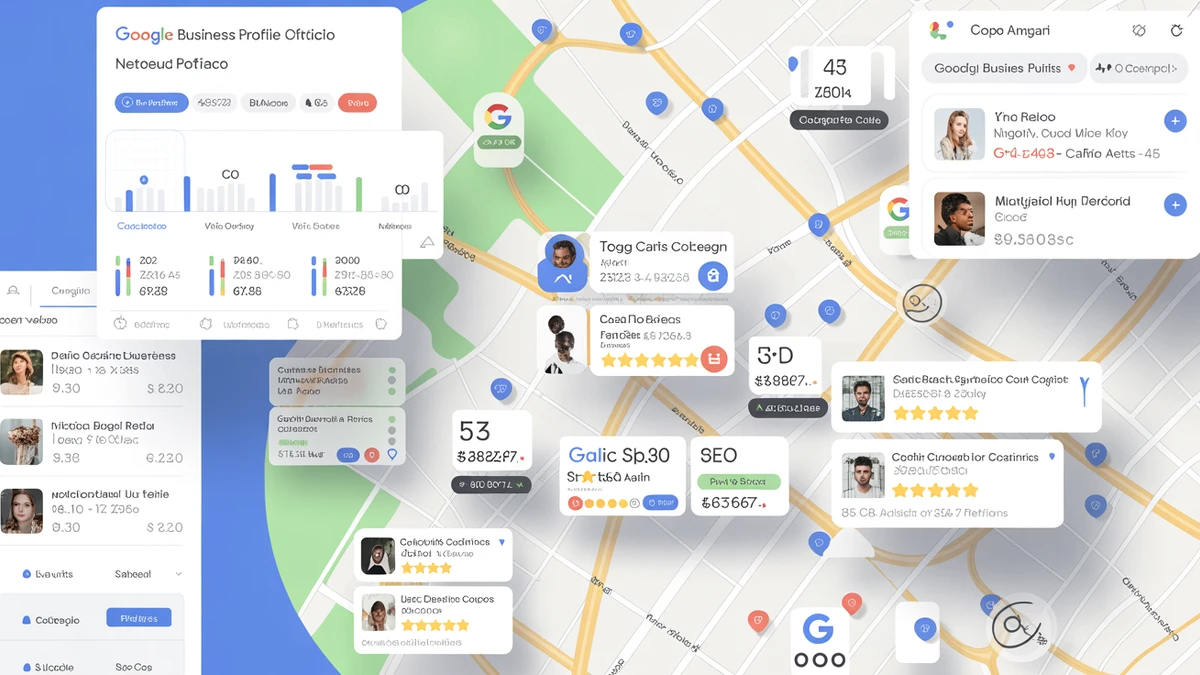
25. SEO-Optimized Blog & Content Management System
A full-featured blog CMS with rich HTML editing, auto-generated meta tags, BlogPosting schema, category filtering, and search functionality — powering blog SEO services and content marketing services from within your application.
26. Programmatic Service Area & City Pages
Automatically generate hundreds of SEO-optimized, Schema.org-enriched pages for every city and country you serve — with unique content, local keywords, and local SEO signals. This is how local digital marketing services scale to dominate regional search.
27. Dynamic XML Sitemap with Styled XSL
Automatically generated, always-current sitemaps that include every blog post, service page, case study, and city page — with last-modified dates and change frequency signals for optimal crawl budget allocation.
28. Social Media Sharing Automation with Platform-Specific Hashtags
One-click social sharing on 20+ platforms — X/Twitter, Facebook, LinkedIn, Reddit, Pinterest, Threads, Mastodon, WhatsApp, Telegram, and more — with SEO-optimized pre-filled posts, OG image previews, and platform-specific hashtags ordered by usage volume. Only platforms that support hashtags receive them. This is social media marketing services built into your application's architecture.
29. Automated OG Image Generation
Programmatically generate branded Open Graph images for every page — ensuring consistent, professional social sharing previews across all platforms without manual design work.
30. Case Study & Portfolio Showcase
Dynamic case study pages with ROI calculators, before/after metrics, embedded testimonials, and CreativeWork schema — demonstrating expertise and building E-E-A-T trust signals that Google and AI systems reward.
31. Landing Page Builder for PPC Campaigns
Create high-converting landing pages for PPC campaign management — with A/B testing, dynamic headlines, conversion tracking, and integration with Google Ads services and Facebook Ads management.
32. SEO Audit & Site Health Dashboard
Built-in SEO audit services functionality — monitor meta tags, broken links, page speed, Schema.org validation, and WCAG compliance from your admin panel.
33. Press Release Publishing & SEO Distribution
Publish and distribute SEO press release services directly from your application — with NewsArticle schema, automated syndication, and backlink tracking for digital PR services.
34. Video Content Hub with Video SEO
Host, organize, and optimize video content with VideoObject schema, transcriptions, chapters, and thumbnail generation — powering video SEO across YouTube and Google.
35. Whitepaper & Lead Magnet Delivery System
Gate premium content (whitepapers, ebooks, guides) behind email opt-in forms — automatically delivering assets and nurturing leads with drip campaigns. This is how whitepaper marketing services convert traffic into qualified leads.
36. Link Building & Backlink Tracking Dashboard
Monitor your backlink profile, track new and lost links, analyze referring domains by Domain Authority, and manage outreach campaigns — integrating link building services, high DA link building, and off-page SEO services.
37. Social Media Scheduling & Analytics
Schedule posts across Instagram, LinkedIn, Facebook, and X from your custom dashboard — with engagement analytics, best-time-to-post recommendations, and content calendars. Social media advertising services integrated natively.
38. Remarketing Pixel & Audience Management
Server-side tracking pixels for remarketing services and retargeting advertising — build custom audiences, manage exclusion lists, and track cross-device conversions with privacy-compliant first-party data.
📊 Analytics, Reporting & Conversion Optimization (Features 39-50+)

39. Custom GA4 Analytics Dashboard
Go beyond standard Google Analytics with custom dashboards that visualize the metrics that matter most to your business. Our GA4 setup services and marketing dashboard setup give you actionable intelligence, not data overload.
40. Conversion Rate Optimization (CRO) Testing Suite
Built-in A/B testing for headlines, CTAs, page layouts, and form designs — powered by server-side feature flags and Prisma-backed experiment tracking. This is conversion rate optimization services integrated directly into your development workflow.
41. Attribution Modeling & Multi-Touch Tracking
Understand exactly which marketing channels drive conversions with custom attribution modeling services — first-touch, last-touch, linear, and time-decay models, all calculated from first-party data.
42. Real-Time ROI Reporting Dashboard
Track marketing spend versus revenue generated in real time — ROI reporting services that prove the value of every marketing dollar invested across SEO, PPC, content, and social channels.
43. Heatmap & User Behavior Recording
Visualize how visitors interact with your pages — click heatmaps, scroll depth tracking, and session recordings that reveal exactly where users engage, hesitate, or abandon.
44. Shopping Ads & Product Feed Management
Automatically generate and optimize product feeds for shopping ads management — syncing inventory, pricing, and availability with Google Merchant Center and Microsoft Advertising services.
45. SEO Rank Tracking & Keyword Monitor
Track your keyword rankings across Google, Bing, and AI search platforms — with automated alerts, competitor tracking, and historical trend analysis.
46. AI-Powered Content Recommendations
Machine learning algorithms analyze user behavior to recommend relevant blog posts, services, and products — increasing page views, time on site, and conversion rates.
47. Progressive Web App (PWA) with Offline Support
Install your web application like a native app — with offline caching via service workers, home screen shortcut, push notifications, and app-like performance on mobile devices.
48. Internationalization (i18n) & Multi-Language Support
Next.js built-in i18n routing enables multi-language websites with hreflang tags, language-specific sitemap entries, and localized content — essential for businesses serving international markets.
49. Dark Mode & Theme Customization
System-aware and user-selectable dark/light mode with Tailwind CSS — improving accessibility, reducing eye strain, and demonstrating modern design sensibility.
50. Zero-Downtime Deployment & CI/CD Pipeline
Continuous integration and deployment pipelines that push updates to production without any downtime — ensuring your marketing campaigns, content updates, and feature releases go live instantly.
51. Media Kit & Brand Asset Portal
A professional media kit page with downloadable logos, brand guidelines, press photos, and boilerplate copy — making it effortless for journalists and partners to feature your brand correctly.
52. Event Calendar & Registration System
Manage webinars, conferences, workshops, and meetups with Event schema markup, attendee registration, automated reminders, and calendar integration.
Full-Service Digital Marketing: Every Channel, One Partner
A custom web application is the foundation — but to truly dominate your market, you need a full-service digital marketing partner who can orchestrate every channel, every campaign, and every optimization from a single, unified strategy. This is exactly what Digital Marketing Co. delivers.
As a results-driven digital marketing agency, we do not just build your custom web application — we ensure every aspect of your digital presence is optimized for maximum visibility, engagement, and revenue. Here is a comprehensive look at the full stack digital marketing services that integrate seamlessly with your Next.js web application:
🔍 Search Engine Optimization (SEO) Services
Our comprehensive SEO services cover every facet of organic search dominance: technical SEO services (site architecture, crawlability, indexation), on-page SEO services (meta optimization, heading structure, keyword density), off-page SEO services (link building, digital PR, brand mentions), mobile SEO services, website speed optimization SEO, and SEO for SaaS companies and e-commerce stores. We are the SEO company near me that delivers SEO expert services with measurable results.
🤖 AI & Next-Generation Search Optimization
Beyond traditional SEO, our AI-powered SEO services ensure your business is visible across every AI search platform: AIO optimization services, GEO optimization services, AEO optimization, ChatGPT SEO services, Perplexity optimization services, AI overview optimization, and zero-click search optimization. As a leading generative AI SEO agency, we position your brand where the future of search is heading.
💰 PPC & Paid Advertising
Drive immediate, targeted traffic with our PPC services: Google Ads management, Bing Ads management, Facebook Ads management, shopping ads management, remarketing services, and PPC campaign management. Whether you are searching for a Google Ads expert near me or a full-scale PPC advertising agency, our data-driven approach delivers maximum ROI on every dollar spent.
📱 Social Media Marketing
Build your brand and engage your audience across every platform with our social media marketing services: organic strategy, paid campaigns, Instagram marketing services, LinkedIn marketing services, social media advertising services, and full social media management.
✍️ Content Marketing & PR
Fuel your SEO and AI search visibility with our content marketing services: content strategy services, SEO content writing services, digital PR services, press release SEO distribution, video content & video SEO, and whitepaper marketing services.
📧 Email Marketing & Automation
Nurture leads and drive repeat business with email marketing services: email campaign management, marketing automation services, and CRM-integrated email workflows that convert prospects into loyal customers.
🔗 Link Building
Build authoritative backlink profiles with our link building services: backlink building services, high DA link building from authoritative domains, and data-driven outreach strategies that earn links your competitors cannot replicate.
📍 Local SEO
Dominate local search with our local SEO services: Google Business Profile optimization, Google My Business SEO, citation building, review management, and location-specific content strategies for local SEO near me searches.
📊 Analytics & Reporting
Measure, analyze, and optimize with our analytics and reporting services: GA4 setup services, ROI reporting services, marketing dashboard setup, attribution modeling services, and conversion rate optimization services.
Whether you are looking for a digital marketing company near me, a digital marketing agency, or a specialized SEO near me partner, Digital Marketing Co. delivers results-driven digital marketing services built on the same Next.js + React + Prisma + Tailwind CSS foundation that powers your custom web application. One partner. Every channel. Measurable results.
Social Sharing Optimization: Automated Viral Distribution
One of the most underrated competitive advantages of a custom web application is programmatic social sharing optimization. When a visitor clicks the share button on any page of your Next.js application, they are not just sharing a bare URL — they are sharing a fully optimized, platform-specific social media post that is engineered for maximum engagement and reach.
Here is what our custom social sharing system delivers — automatically, for every page, across 20+ platforms:
🐦 X/Twitter
Pre-filled tweet with OG title, description, URL, and up to 4 trending hashtags ordered by usage volume — character-optimized for maximum engagement.
Link share with OG image preview, meta description, and up to 5 hashtags in the quote text — Facebook automatically scrapes and caches the preview card.
Professional link share — LinkedIn auto-scrapes OG metadata for the preview card. No hashtags (non-idiomatic on LinkedIn in share URLs).
Pin with OG image, keyword-rich description, and up to 6 hashtags — optimized for Pinterest's visual discovery engine.
Link submission with keyword-optimized title — no hashtags (completely non-idiomatic on Reddit).
💬 WhatsApp, Telegram, Signal & More
URL with pre-filled description across all messaging platforms — WhatsApp, Telegram, Signal, SMS, Viber, Skype, Line, Snapchat, and email.
The key innovation is that every sharing interaction is driven by the page's OG meta tags and share:hashtags meta tag — both of which are programmatically generated by Next.js from your Prisma database. When you update a page's title, description, or featured image, the social sharing content updates automatically across all 20+ platforms. No manual copywriting. No missed platforms. No outdated hashtags. This is what social media marketing automation looks like when it is engineered into your application's DNA.
The ROI of Redeveloping Your Website
Every business decision ultimately comes down to return on investment. So let's address the question directly: what is the ROI of investing in custom web application development?
The answer, supported by extensive industry research, is overwhelming:
📈 The Numbers That Prove the Case
3.8×
Higher conversion rates for custom-built websites vs. template-based (Forrester Research)
434%
More indexed pages for sites with custom blog CMS and programmatic SEO (HubSpot)
40%
Increase in AI search visibility with GEO optimization strategies (Princeton/Georgia Tech study)

Consider the compounding value of these improvements: When your custom web application loads faster, ranks higher, gets cited by AI search engines, captures featured snippets, earns rich results through Schema.org, and reaches an expanded audience through WCAG 2.2 accessibility — each optimization amplifies the others. Faster pages reduce bounce rates, which improves rankings, which increases organic traffic, which generates more leads, which grows revenue, which funds further marketing investment. This is the virtuous cycle of custom web application development, and it is the engine that drives ROI-driven digital marketing.
The businesses that invest in performance-optimized custom web development today — built on Next.js, React, Prisma, and Tailwind CSS — are not just improving their websites. They are building scalable, AI-ready digital assets that will outperform competitors for years to come. The cost of a custom web application is not an expense — it is the highest-ROI investment your business will ever make in its digital future.
Your Competitive Advantage Starts Now
The digital marketing landscape will never move slower than it is moving today. AI search engines are growing exponentially. Google's AI Overviews are expanding into every search category. Voice assistants are becoming the primary search interface for millions of consumers. And the businesses that have custom-engineered, SEO/AIO/GEO/AEO/Schema.org/WCAG-optimized web applications built on Next.js, React, Prisma, and Tailwind CSS are capturing that traffic — while template-based websites fade into invisibility.
At Digital Marketing Co., we are not just another digital marketing agency. We are a custom web application development agency that combines world-class engineering with full-stack digital marketing expertise to deliver web applications that are simultaneously:
🔍
SEO Dominant
🤖
AI Search Ready
🌐
GEO Optimized
💬
AEO Engineered
♿
WCAG Compliant
📊
Schema.org Powered
Ready to Transform Your Business?
Let's build a custom web application that dominates search engines, AI search, and generative engines — while delivering the features that transform your operations and accelerate your growth.
Get Your Free Consultation →Bibliography & References
- Fishkin, R. (2024). "Zero-Click Searches: How Google Is Keeping Users on Its Own Pages." SparkToro Research. sparktoro.com
- Google. (2024). "Core Web Vitals & Page Experience." Google Search Central Documentation. developers.google.com
- Aggarwal, P., Murahari, V., Rajpurohit, T., et al. (2024). "GEO: Generative Engine Optimization." Princeton University, Georgia Institute of Technology, Allen Institute for AI, IIT Delhi. arxiv.org/abs/2311.09735
- Ahrefs. (2024). "Featured Snippets Study: How to Get More Clicks from Google." Ahrefs Blog. ahrefs.com
- Schema.org. (2024). "Full Hierarchy: Schema.org Types." Schema.org. schema.org/docs/full.html
- W3C Web Accessibility Initiative. (2023). "Web Content Accessibility Guidelines (WCAG) 2.2." W3C Recommendation. w3.org/TR/WCAG22/
- World Health Organization. (2024). "Disability and Health Fact Sheet." WHO. who.int
- Vercel. (2024). "Next.js Documentation: Rendering Strategies." Next.js Official Docs. nextjs.org/docs
- Prisma. (2024). "Prisma ORM Documentation." Prisma.io. prisma.io/docs
- Meta Platforms. (2024). "React Documentation: Components and Hooks." React.dev. react.dev
- Tailwind Labs. (2024). "Tailwind CSS Documentation." Tailwind CSS. tailwindcss.com/docs
- Search Engine Journal. (2024). "Rich Snippets and CTR: New Study Data." Search Engine Journal. searchenginejournal.com
- Google. (2024). "Think with Google: Mobile Page Speed New Benchmarks." Think with Google. thinkwithgoogle.com
- Forrester Research. (2024). "The Revenue Impact of Custom Web Experiences." Forrester. forrester.com
- HubSpot. (2024). "Marketing Statistics: Content, SEO, and Blogging." HubSpot Research. hubspot.com/marketing-statistics
- Semrush. (2024). "The State of Technical SEO and Accessibility." Semrush Blog. semrush.com
- OpenAI. (2024). "ChatGPT with Browse: How AI Search Works." OpenAI Blog. openai.com/blog/chatgpt